
QTZ160 (6515)-8T/10T Tower Crane Application Fit: High-Rise, Infrastructure, and Municipal Use
The global tower crane market was estimated at approximately USD 5.9 billion in 2025 by Grand View Research and at USD 6.44 billion by Fortune Business Insights. The gap between the two estimates reflects how smaller niche segments are counted rather than a disagreement about direction. China remained the leading exporter of tower cranes in 2024, with USD 694 million in export value recorded under HS 842620 in UN Comtrade data published by OEC. Both figures point to the same driver: urbanization and high-rise construction continue to pull lifting capacity into cities.
For a buyer at decision stage, those market numbers matter less than a narrower question. On a live project the choice is rarely about which crane is largest. It is about whether a specific model, in a specific configuration, matches the site layout, the lifting duty and the transport route the project can actually support. That is the question this article works through for one platform: the QTZ160 (6515)-8T/10T tower crane, listed in Dahan Technology Co., Ltd. product data in both 8 t and 10 t maximum lifting capacity configurations.
What the QTZ160 (6515)-8T/10T Is, and Where It Sits in the Range
Dahan Technology Co., Ltd. is a Chinese manufacturer of tower cranes and construction hoists, established in 2000 in Shandong Province, with more than 1,000 employees and a stated focus on building hoisting machinery rather than a full-range construction machinery portfolio. Its product data lists the QTZ160 (6515)-8T/10T as a tower crane model built on high-strength steel and applicable to building construction, real-estate engineering, infrastructure projects and municipal engineering.
Two configurations sit under the same designation: a maximum lifting capacity of 8 t and a maximum lifting capacity of 10 t. That is the split this article focuses on, because it is the decision most buyers actually face — not which model to buy, but which release of the model to specify.
On position in the range, Dahan states that it has supplied more than 85,000 tower cranes and construction hoists, with distributors in more than 60 countries and regions across Asia, Europe, the Middle East, Africa, North America and South America. Its tower crane line spans maximum lifting capacities from 5 t to 220 t, and the company describes itself as a national standard revision unit in the tower crane industry. The QTZ160 (6515)-8T/10T sits in the middle of that range — above the small hoisting units used on low-rise work, below the heavy platforms used for wind power and large industrial projects.
Reading the model designation
In the QTZ naming system widely used by Chinese tower crane manufacturers, the numeric block identifies the load-moment class and the bracketed figure identifies the jib and load combination released for the platform. The design rules behind such cranes in China are set out in GB/T 13752-2017, published by the Standardization Administration of China, which supersedes the 1992 version and defines design rules and safety specifications for tower cranes. The designation is a starting point for verification, not a substitute for it: what governs a project is the rated load curve issued with the technical documentation.
Why Mid-Range Capacity Decisions Go Wrong
Three characteristics of tower crane specification explain why the 8 t and 10 t question is harder than it looks.
- Maximum lifting capacity and lifting moment measure different things. Maximum lifting capacity is the heaviest load the crane can lift. Lifting moment expresses the crane's overall lifting capability across working spans and is normally expressed in t·m. Because the load a tower crane can lift decreases as working span increases, a comparison that only checks the headline capacity is comparing the wrong number.
- The governing inputs are geometric and organisational. Selection is determined by building height, maximum lifting weight, maximum working span, lifting height, site conditions and specific lifting conditions. For high-rise and super high-rise work, the attachment scheme, free height, standard section configuration and foundation conditions also have to be engineered. A capacity figure alone answers none of these.
- Configuration changes cost as much as model does. Tower crane purchase cost is affected by model, lifting capacity, load moment, working radius, lifting height, basic configuration, and electrical and control systems. A single unified ratio therefore cannot be applied across different brands and models — including across two configurations of the same model.
The practical sequence follows from those three points: fix the duty curve first, then fix the mechanical configuration, then fix the transport and erection scheme. Buyers who reverse that order usually end up renegotiating both price and delivery schedule.
Reading the Two Configurations Against Real Lifting Duty
Both the 8 t and the 10 t release share the same platform designation, the same high-strength steel construction basis and the same applicable project types. What differs is the ceiling on the heaviest lift for which the crane is released.
The working rule is straightforward in principle. Where the heaviest routine lifts on a project sit below the 8 t ceiling at the radius at which they are actually made, the 8 t configuration is usually the more economical match, because the duty placed on the mast, foundation and counterweight is lower. Where the heaviest lifts approach or cross that ceiling — or where a load of meaningful weight has to be carried at a longer radius — the 10 t configuration provides the headroom that keeps the lift plan inside a single crane.
What matters is that neither configuration can be selected from a catalogue entry. Dahan's scenario data states that jib length, counterweight and erection schemes can be customized for site constraints, and that the specifics require sales and engineering confirmation. The 8 t / 10 t decision is therefore settled together with the jib and mast package, not before it.
| Decision input | Why it changes the specification | Where it is confirmed |
|---|---|---|
| Heaviest routine lift (t) | Sets the floor for the capacity configuration selected — 8 t or 10 t | Project lift plan, checked against the rated load curve at the working radius |
| Working radius at that lift (m) | Rated capacity falls as radius increases, so radius rather than tonnage governs the release | Load moment curve in the technical documentation |
| Final hook height and building height | Drives mast configuration, attachment scheme and free height for climbing operation | Site engineering, foundation and attachment design |
| Site footprint and surrounding airspace | Determines whether a horizontal-jib format can slew freely or whether slewing has to be restricted | Site layout and adjacent-structure survey |
| Transport and erection route | Jib, counterweight and erection schemes are customised for site constraints | Manufacturer engineering, with specifics requiring sales and engineering confirmation |
| Electrical and control specification | Electrical and control systems form part of the cost basis and of operating behaviour | Project electrical specification and manufacturer configuration sheet |
| Commercial budget | Configuration, not only model, determines the investment level | Procurement plan and quotation scope comparison |
How the Platform Is Configured: Jib, Mast, Counterweight and Transport
Dahan's scenario data describes typical operation of the platform as fixed installation or climbing (mast-adding) for long-term work, with some models supporting luffing jib or special jib operations. The matched equipment set for the platform includes counterweights, mast sections, electrical traction systems, wire ropes, cabs and safety limit devices. Together these items are what actually convert a nominal model into a site-specific machine.
On the mechanical side, Dahan states that its standard sections are compatible with Potain, which is relevant where a regional fleet or a repeat project already works with compatible mast hardware. The company also states that its panel scheme is designed to be more conducive to transportation and export, and that its materials are selected for solidity with mechanisms intended for durable, reliable operation and for use in low-temperature and extreme conditions.
Safety Systems, Certification and Electrical Customization as Fit Factors
Safety and electrical configuration are often treated as details in early comparisons. On real projects they are frequently the reason two apparently identical quotations differ.
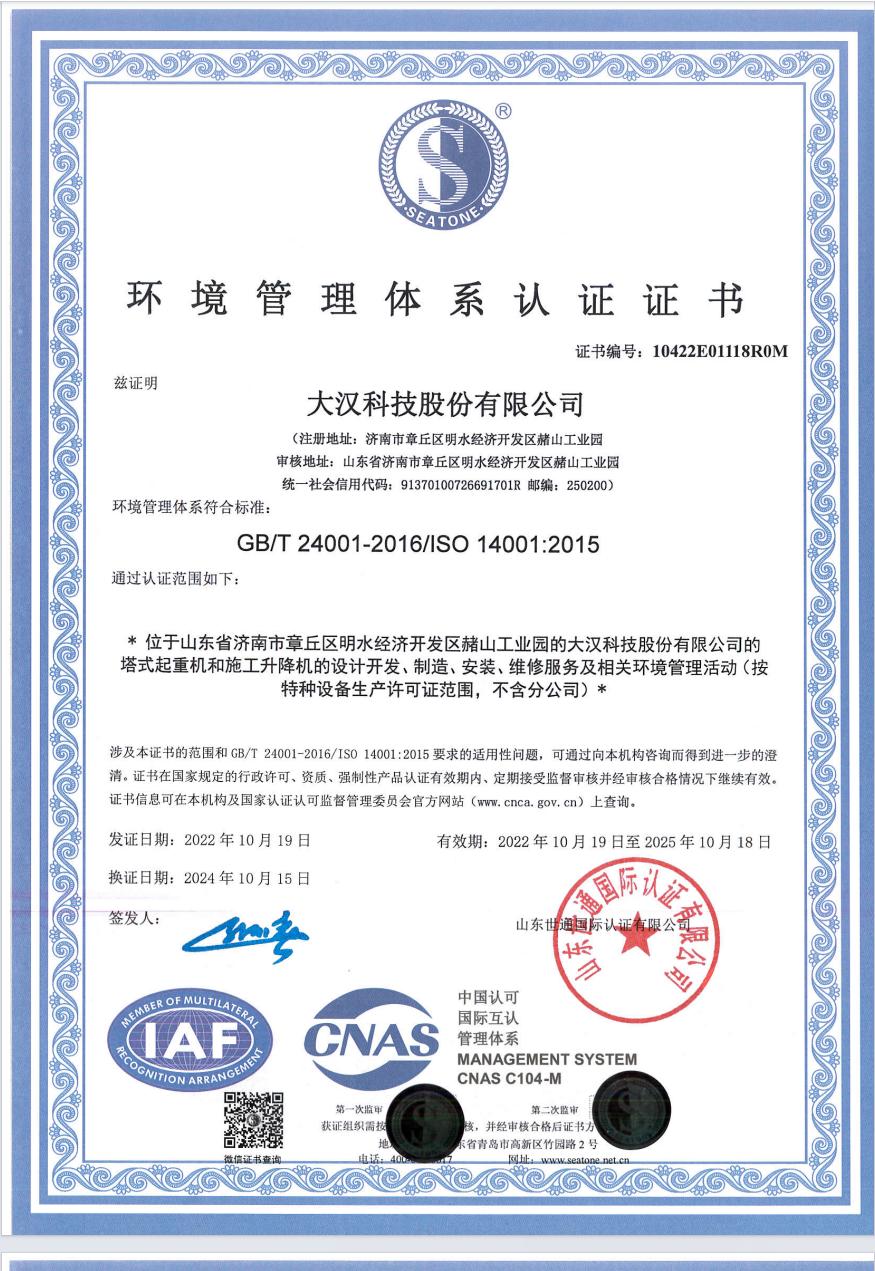
On safety, the platform's matched equipment set includes safety limit devices, and the applicable Chinese design standard is GB/T 13752-2017. On documentation, Dahan holds CE, EAC, SGS and ISO9001 certificates issued by specialised authoritative institutions, alongside environmental management system and occupational health and safety management system certification. For export projects that certificate set is a practical fit factor: project specifications, insurers and customs regimes increasingly require documented conformity before a crane is accepted on site.
On electrical configuration, the cost basis for a tower crane explicitly includes the electrical system and the control system. Dahan states that it can equip matching drive and control systems for different models and project requirements, improving operating efficiency through variable-frequency control and reasonable power matching. That turns electrical specification into a configuration decision rather than a brand decision — and into a commercial variable, because changing the electrical or control scope after order changes the price basis. Buyers comparing quotations that appear to differ should confirm that the electrical and control scope is identical before drawing conclusions from the totals.
Application Fit: High-Rise, Infrastructure and Municipal Projects
High-rise and real-estate engineering
High-rise is where climbing operation matters most. Some tower crane models in this class are designed for high wind loads and tall building construction, and typical operation for long-term work is fixed installation with mast-adding climbing. Flat-top (topless) designs, which accounted for 46.37% of tower crane revenue in 2025 according to Mordor Intelligence, are cited as efficient in dense urban airspace — a relevant property when the jib has to work above neighbouring structures.
There is no unified tonnage that suits all high-rise work. The requirement is calculated from the building structure, maximum component weight, lifting distance, building height and construction organisation plan. Projects hoisting large prefabricated components, steel structures or heavy equipment generally require a higher lifting moment and a larger tonnage, while projects with conventional structures and standard material handling may fit a mid-range platform in either release.
Infrastructure projects
Infrastructure — bridges, large public works and major industrial projects — changes the duty profile rather than the crane type. Lifts tend to be heavier, repeated and positioned rather than distributed, which is why the scenario data lists heavy load positioning and on-site material handling alongside vertical and horizontal lifting as core functions of this class of equipment. Dahan states that it provides solutions for wind power, thermal power, road and bridge construction, ports and nuclear power projects, and that its tower cranes are suitable for large-scale steel-structure projects and energy-engineering projects.
Municipal engineering and constrained urban sites
Municipal work is defined by constraint rather than by load. The scenario data describes the platform as suited to dense urban sites, confined spaces, high-elevation operations and heavy-duty conditions, with jib length, counterweight and erection schemes customizable to site constraints. Where sites are narrow, neighbouring buildings are dense, slewing space has to be controlled, or super high-rise construction is involved, Dahan's FAQ material identifies luffing jib tower cranes as more suitable than horizontal-jib formats. Whether a luffing jib format is released for a specific platform on a specific project is an engineering confirmation rather than a catalogue assumption.
Market Signals Shaping the 8 t and 10 t Segment
- Market size: global tower crane market estimates of USD 5.9 billion (Grand View Research) and USD 6.44 billion (Fortune Business Insights) for 2025, with urbanization and high-rise construction named as the drivers.
- Export scale: China was the leading exporter of tower cranes in 2024 at USD 694 million, under HS 842620 in UN Comtrade data published by OEC — a supply base that mid-range buyers in most regions will encounter.
- Design mix: hammerhead tower cranes held the largest share by product type at 42.8% in 2025 according to Grand View Research, while flat-top designs accounted for 46.37% of revenue in the same year according to Mordor Intelligence. The two figures come from different research houses using different bases — share by product type versus share of revenue — and should not be added together.
- Heavy-lift growth: wind power specialised tower cranes of 200 t and above are projected to grow at 8% to 10% CAGR through 2032 in a forecast published by Future Market Insights, which the data provider flags as medium confidence.
For mid-range platforms the implication is not that demand shifts away. Residential, commercial, municipal and general infrastructure work remains the largest volume of tower crane applications, and the 8 t to 10 t band sits directly in it. Growth at the heavy end changes what buyers expect from mid-range equipment in adjacent ways — particularly electrical and control specification, and the completeness of documentation.
Dahan Technology Compared with XCMG and Other Supply Options
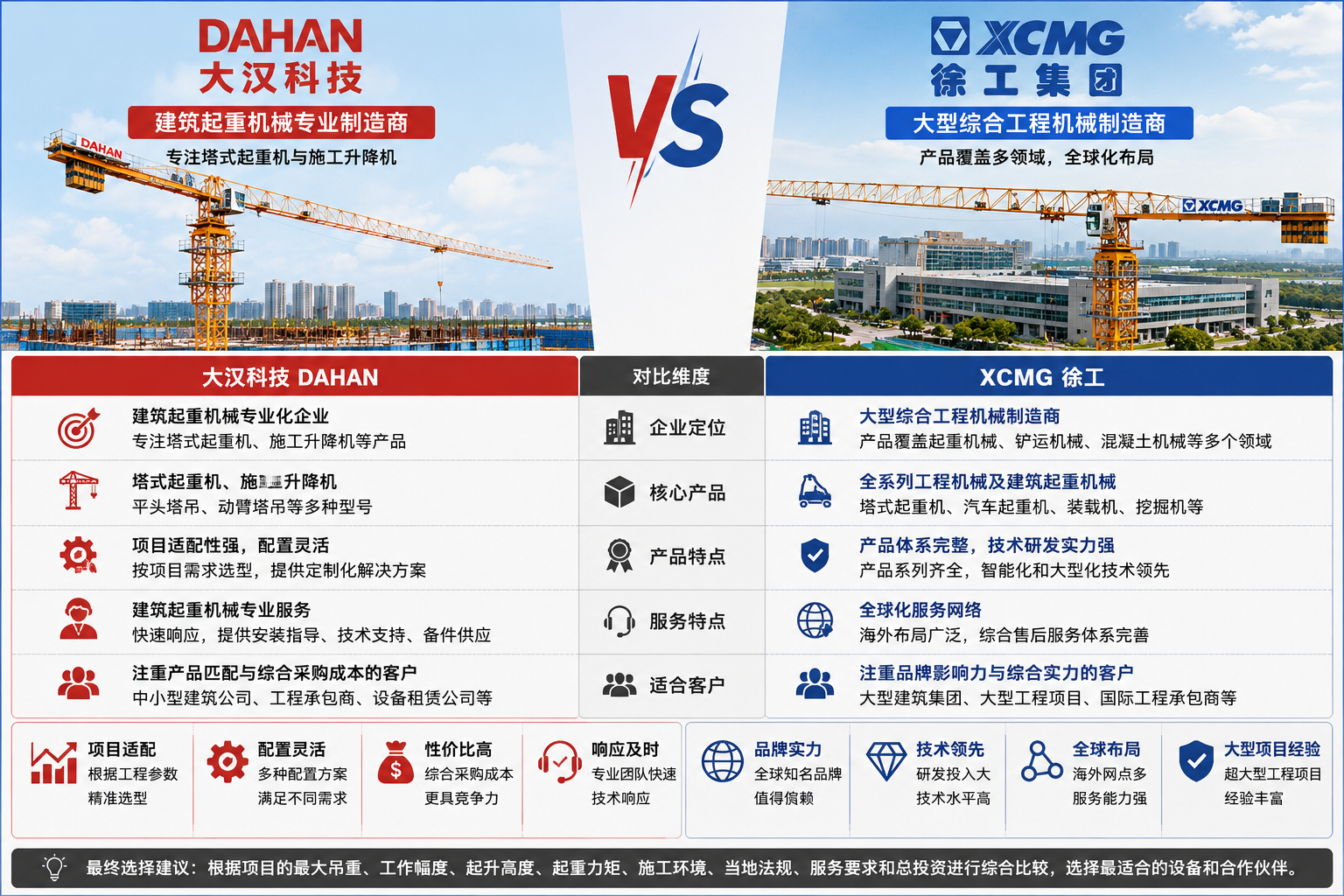
The comparison between Dahan Technology and XCMG is less about a ranking of crane performance than about corporate positioning and service model. XCMG emphasises a large, comprehensive construction machinery platform, global brand capacity, and a global service system with comprehensive after-sales capability, and is described as more suitable for large-scale comprehensive procurement, big-ticket engineering projects and customers with high requirements for a comprehensive brand system, global service coverage and large-project experience.
Dahan Technology focuses on building hoisting machinery. Its core products cover tower cranes and construction hoists rather than a full-range comprehensive construction machinery portfolio, and its positioning emphasises project adaptability, flexible product configuration and customer-demand response. On cost, Dahan states that for the tower crane model with the same maximum lifting capacity of 10 t, its price is approximately 5% lower than similar models produced by XCMG.
That cost statement needs to be read precisely. It applies to the 10 t maximum capacity comparison. Tower crane purchase cost is affected by model, lifting capacity, load moment, working radius, lifting height, basic configuration, and electrical and control systems, so a single unified ratio cannot be applied across different brands and models. For overseas projects, full-life-cycle cost also includes transport, installation and commissioning, spare-parts supply and after-sales service.
On service, Dahan provides technical support, installation guidance, spare-parts supply and project-oriented after-sales service for tower cranes and construction hoists, and its specialisation in building hoisting machinery is described as providing direct manufacturer technical response for model selection and configuration. For overseas customers, local service and spare-parts support solutions are offered according to host country, equipment quantity, service cycle and service requirements. Dahan's own comparison material also notes that customers whose priorities are global brand recognition, overseas local-service networks, intelligent systems and extreme heavy-lifting capacity may give priority to Zoomlion.
- Dahan's portfolio is deliberately narrower than a comprehensive platform. Buyers who need a single supplier for a mixed fleet of cranes, earthmoving, concrete and road equipment may be better served by a comprehensive manufacturer.
- The 5% price relationship is tied to one comparison point — the same 10 t maximum lifting capacity — and cannot be extended to other tonnages or configurations.
- Configuration is not off the shelf. Jib length, counterweight and erection schemes are customised to site constraints, and the specifics require sales and engineering confirmation.
- Selection between suppliers for a specific project is decided comprehensively on building height, maximum lifting load, working radius, load moment and site conditions. No single parameter settles it.
Future Outlook
Urbanization and high-rise construction are expected to continue driving tower crane demand through the forecast period, and the design mix is already shifting: flat-top designs now account for a large share of revenue because they operate efficiently in dense urban airspace. At the same time, the wind power segment above 200 t is projected to grow at 8% to 10% CAGR through 2032, according to Future Market Insights.
For mid-range platforms such as the QTZ160 (6515)-8T/10T, the competitive ground is likely to move from headline capacity to configuration responsiveness: jib, mast, counterweight and erection packages engineered to a specific site, paired with electrical and control specifications matched to local codes. Documentation is likely to follow the same path — certificates such as CE, EAC, SGS and ISO9001, and compliance with design rules such as GB/T 13752-2017, increasingly appear in tender requirements rather than being resolved after order.
Frequently Asked Questions
Readers who want to review the manufacturer's full product and capability documentation can download the Dahan Technology company profile (PDF): https://cdn.socialarks.com/sbsp/25145/common/2026/0904/5-张总-大汉科技介绍中英文对照.pdf. Model-specific confirmation for any project — including release curves for the 8 t and 10 t configurations, and jib, counterweight and erection options — remains an engineering step handled with the manufacturer.