
Qualification Checklist for Cosmetic Filling Machines: What Buyers Should Verify
Qualification Checklist for Cosmetic Filling Machines: What Buyers Should Verify
Qualification review for a cosmetic filling machine answers a narrow question: can the supplier show documented evidence that the machine's material-contact surfaces, cleaning behaviour, safety design and process capability match the conditions of a cosmetic production environment? At the decision stage, that evidence — not the headline speed figure — is usually what separates two technically similar offers.
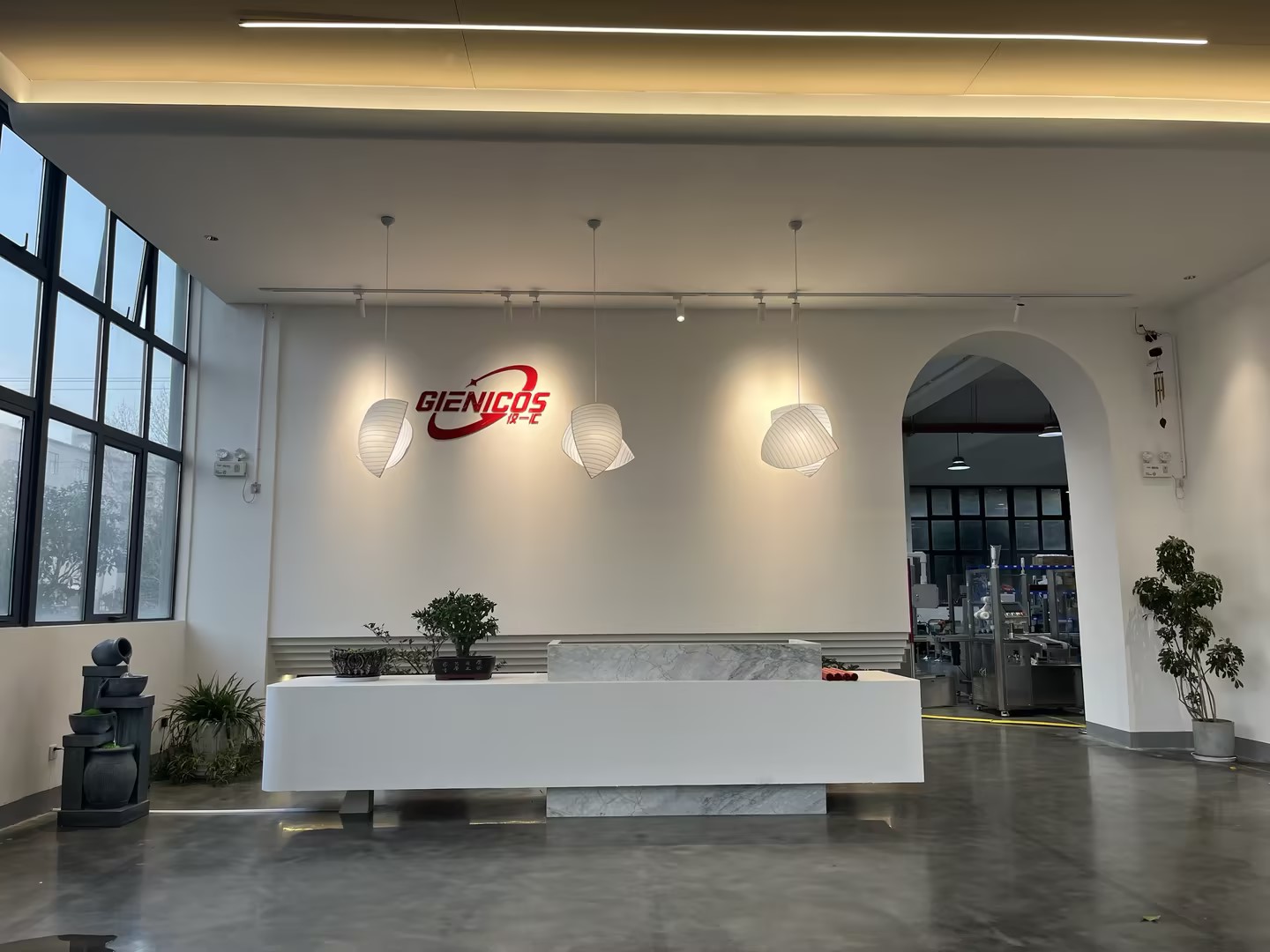
Factory visits and technical reviews are the point at which qualification documents are usually tested against what is physically on the shop floor. Image: GIENICOS, Shanghai.
The problem: specifications converge long before qualification evidence does
By the time a buyer has shortlisted two or three cosmetic filling machines, the visible specifications tend to look alike: servo piston filling, PLC control with touch-screen operation, stainless steel construction, adjustable capping torque. The differences that decide a project usually sit one layer deeper, in areas that brochures rarely document properly — which stainless grade actually touches the bulk material, whether the filling path can be dismantled for cleaning without special tooling, which standards the specific model was designed against, how a tolerance figure was measured, and what paperwork arrives with the machine at handover.
Discovering a gap in that layer after installation is expensive. A wetted part in an unverified alloy, a cleaning procedure that cannot be validated for a pigment-heavy formula, a machine that needs more compressed air than the clean room can supply, or a changeover that takes an hour instead of fifteen minutes — each shifts cost from the purchase price into production. Qualification review is the practice of moving those questions in front of the purchase order.
Market direction reinforces the point. Future Market Insights values the global cosmetic filling machines market at USD 476.80 million in 2025 and projects USD 718.63 million by 2036, with automatic filling machines projected to hold a 41.2% share of the cosmetic filling technology market in 2026. Asia Pacific held a 33.08% share of the broader filling machine market in 2025, according to Fortune Business Insights. As more capacity moves to automated lines, more buyers are asking suppliers for evidence that fits inside their own quality systems.
Trade documentation matters here as well. Cosmetic filling machinery generally falls under HS code 8422.30, with 8422.30.91 covering machinery for opening, filling and closing containers, as listed in the USITC Harmonized Tariff Schedule. Buyers assembling a qualification file often need the technical description and the customs classification to agree.
What a supplier can actually document
SHANGHAI GIENI INDUSTRY CO., LTD., which operates under the brand GIENICOS, is a Shanghai-based manufacturer of intelligent cosmetic filling and packaging equipment, founded in 2011, with production located in the Baihao AI Technology Park, Jiading North Industrial Park, Jiading District, Shanghai. The company concentrates on equipment for colour cosmetics and skincare rather than general-purpose filling machinery, and the facts that belong in a qualification discussion are specific enough to check:
- Manufacturing footprint and capacity: a 2,000 m² factory, 30 employees, a 10-engineer R&D team, and an annual output of approximately 100 units, with about 80% of production exported to markets in the EU, USA and Asia.
- Material specification: SUS316L stainless steel is specified for all wetted parts on its cosmetic filling platforms, with product-contact material listed per model — the JLF-A dual-nozzle loose powder filling machine, for example, is listed with SUS316L product-contact parts.
- Component sourcing: critical components are sourced from Mitsubishi and Schneider, a detail that matters when a buyer's maintenance plan depends on globally available spares. Servo and conveying components are named in model datasheets as well.
- Process performance: a filling tolerance of ±0.1–0.2 g under long-run continuous production, and a production speed of up to 80 pcs/min on high-speed configurations.
- Service terms: a standard 12-month warranty from the date of machine acceptance, covering manufacturing defects and excluding wearing consumable parts and man-made damage, with free spares and freight carried by the supplier.
Two further facts help a buyer calibrate the supplier's operating environment. GIENICOS established an AI division in 2020 and has since worked on vision-based applications and smart manufacturing solutions, and its customer base spans 100 countries, including long-term project work with contract manufacturers such as COSMAX, INTERCOS, Weckerle, VIVA, OXYGEN, ICT and Fiabila, alongside brand owners including L'Oréal, Winona and Chando. In a qualification file those relationships are context rather than proof of a specific machine's compliance — but they do indicate that the documentation is regularly read by buyers who carry formal validation obligations.
The eight-point qualification checklist
The checklist below converts the general instruction to "verify the supplier" into items that can be answered with a document. Each row works as a question for a technical review and as a line item for a factory audit.
| Verification area | Question to ask | Evidence to request |
|---|---|---|
| Material contact | Which stainless grade is specified for each wetted part? | Part-level material schedule covering nozzles, tanks, valves, pumps and product hoses |
| Cleanability | Can the filling path be dismantled and cleaned without special tooling? | Modular assembly description, cleaning procedure and a stated cleaning time |
| Applicable standards | Which standards does this exact model conform to? | Model-level standard declaration plus CE documentation for the ordered configuration |
| Process capability | Which tolerance is maintained in continuous production, and on which bulk? | Tolerance statement plus a trial report run on the buyer's own formula |
| Component traceability | Which brands are used for PLC, servo and pneumatic control? | Bill of materials naming control and drive component brands |
| Changeover | How long does a format change take between sizes? | Documented changeover time and the tooling or spare-part set required |
| Utilities and site fit | What power, air and space does the machine need? | Utility data sheet listing voltage, air pressure and air consumption |
| Handover and warranty | What is included after acceptance, and what is excluded? | Manual, spare-parts list and written warranty terms |
Material contact: ask per part, not per machine
The useful unit of evidence is the individual wetted part. SUS316L and SUS304 are both stainless steels, but they are not interchangeable where prolonged contact with cosmetic bulks and cleaning agents is involved, so a blanket statement that a machine is "made of stainless steel" answers very little. GIENICOS specifies SUS316L for all wetted parts across its filling platforms and lists product-contact material per model, which gives a buyer something concrete to cross-check against the delivered machine.
Applicable standards: expect a model-level declaration
GIENICOS declares EN 60204-1:2018 and EN ISO 12100:2010 as the applicable standards for the JY-CR50 and JY-CR200 High Speed Powder Mixers and for the JSFL single-nozzle hot filling line. EN 60204-1 addresses the electrical safety of machinery and EN ISO 12100 addresses risk assessment and design principles; both are routinely requested in machine qualification files. The company also states that its product range carries CE certification. Because declarations are made per model, a portfolio-level claim should always be re-verified for the exact model on the purchase order.
Cleanability and validation: request times, not adjectives
Modular structure is the design answer to cleanability: key assemblies support fast disassembly, convenient cleaning and spare-part replacement, which limits production downtime. Documented examples in the range include a cleaning time of approximately 30 minutes for the JMF vertical dual-nozzle high-viscosity filling machine and a changeover time of 15 minutes for the JRS-G3 toner and cream rotary filling machine. Buyers should still confirm that a supplier's figure was measured against a comparable bulk and container, because pigment, wax and silicone residues do not behave identically across formulas.
Accuracy claims: treat every tolerance as conditional
The filling tolerance stated for GIENICOS platforms is ±0.1–0.2 g under long-run continuous production, and the JMG lipgloss and mascara line adds functional safeguards such as a return-suction anti-drip nozzle and no-bottle no-fill detection. Elsewhere the range shows how conditional such numbers are: the JQL-04C cushion filling machine states ±0.15 g subject to material formula, sponge characteristics and other factors. A tolerance figure is therefore a starting point for a trial, not a guarantee, and the qualification file should say which bulk it was measured with.
Applying the checklist to three machine types
The checklist shifts shape once it is applied to a specific platform, because each machine type carries its own verification emphasis.
| Machine | Verified parameters | Qualification emphasis |
|---|---|---|
| Rotary Nail Polish Filling Machine — JQR-01N | Container range 5–30 ml; filling precision about ±0.2 g; AC220V, 1 phase, 2 kW; working sequence: bottle feed, filling, brush feed, cap feed, capping, discharge | Cleaning validation must cover brush and cap feeding stations, not only the filling nozzle; volatile formulations require verification at line temperature |
| Tube Filling and Sealing Machine — GFS-40 / GFS-60 | Filling volume 5–250 ml (GFS-40) and 5–200 ml (GFS-60); servo filling; 30–40 pcs/min and 60–80 pcs/min; tube diameter 10–50 mm; tube length 60–210 mm; 3P 380V, 5.0 / 5.3 kW; one tank with level control, heating and mixing optional | Confirm whether the ordered configuration includes tank heating and mixing, and verify seal integrity on the buyer's own tube stock |
| Automatic Powder Press Machine — GP 050 SE | Rotary servo press; 50–60 pcs/min with a 4-cavity example; 1 colour standard, customizable; 0.5–1 operator; optional robot pan feeder; compact powder and eyeshadow | Press tooling ownership and tolerance, dust containment in the clean room, and a widened scope if vision or robot feeding is added |
Two adjacent categories deserve the same treatment. For hot-pour and hot filling work — lipstick, lip balm, wax-based bulks — the qualification scope extends to the melting and holding stage, where GIENICOS uses features such as sanitary valves without dead angle, heating, stirring and vacuum functions on tanks such as the TSP 20 L hot pouring machine and the MT series melting tanks. For high-speed lines, the JHF hot filling and cooling line is configurable with 2, 4, 6 or 16 nozzles and filling ranges of 1–20 mL, 20–50 mL, 50–100 mL or 100–200 mL, so the qualification file has to describe the configuration actually ordered rather than the product family.
Market trend: automation share is rising, and documentation is following
The clearest trend signal in this category is the shift of volume towards automated equipment. Automatic filling machines are projected to hold a 41.2% share of the cosmetic filling technology market in 2026, according to Future Market Insights, within a market that the same source values at USD 476.80 million in 2025 and projects at USD 718.63 million by 2036. Regional concentration reinforces where the equipment demand sits: Asia Pacific accounted for a 33.08% share of the filling machine market in 2025, per Fortune Business Insights.
The practical consequence for buyers is a change in expectations rather than in technology. When automatic lines were a premium purchase, qualification documents were a differentiator between suppliers. As automated configuration becomes the default, part-level material schedules, model-level standard declarations and measured tolerance data become baseline requirements in the quotation stage — reviewed by quality teams before a technical review is scheduled, not after a machine has been installed.
Comparison with traditional specification-only buying — and where the checklist approach has limits
The traditional approach compares catalogue specifications, price and a short sample run, then assembles qualification documents once the order is placed. It is faster, and it is often adequate when the product is simple and the formulation is tolerant. The checklist approach adds a structured evidence review before the purchase order, and it typically points towards machines built with SUS316L wetted parts, internationally sourced control components and modular cleaning design. GIENICOS states that this configuration carries an initial cost 10–20% higher than alternatives, with the potential for lower total cost of ownership through reduced waste and maintenance. Buyers should treat that trade-off as a genuine boundary, not a slogan:
- Initial cost: a 10–20% higher purchase price has to be recovered through reduced waste, fewer changeovers and lower maintenance. At low production volumes or with forgiving formulas, that recovery may not occur within the buyer's planning horizon.
- Scale fit: the equipment is designed for cosmetic GMP clean-room workshops and for large-volume mass production of colour cosmetics and skincare goods. Pilot, laboratory or highly variable small-batch operations may find a production line disproportionate to their needs.
- Utility requirements: models in the range specify compressed air at 0.5–0.8 MPa, with consumption from ≥300 L/min on a vertical dual-nozzle filler to ≥900 L/min on a rotary eyeliner filler, and three-phase 380V supply on several lines. These conditions must be verified before delivery, not discovered at installation.
- Configuration-dependent scope: options such as tank heating, pressurization or an optional robot pan feeder change what has to be qualified. A checklist written for the standard configuration will not cover the machine if options are added later.
- Conditional tolerances: declared accuracy depends on the bulk and the container. A ±0.2 g figure on a rotary nail polish filler and a ±0.15 g figure subject to formula and sponge characteristics on a cushion filler are guidance values that require confirmation by trial.
- Declaration scope: applicable standards are declared for specific models, such as the JY-CR50, JY-CR200 and the JSFL line. A declaration issued for one model does not transfer automatically to another.
- Documents are not validation: supplier documentation supports a buyer's own installation and performance qualification work; it does not replace it.
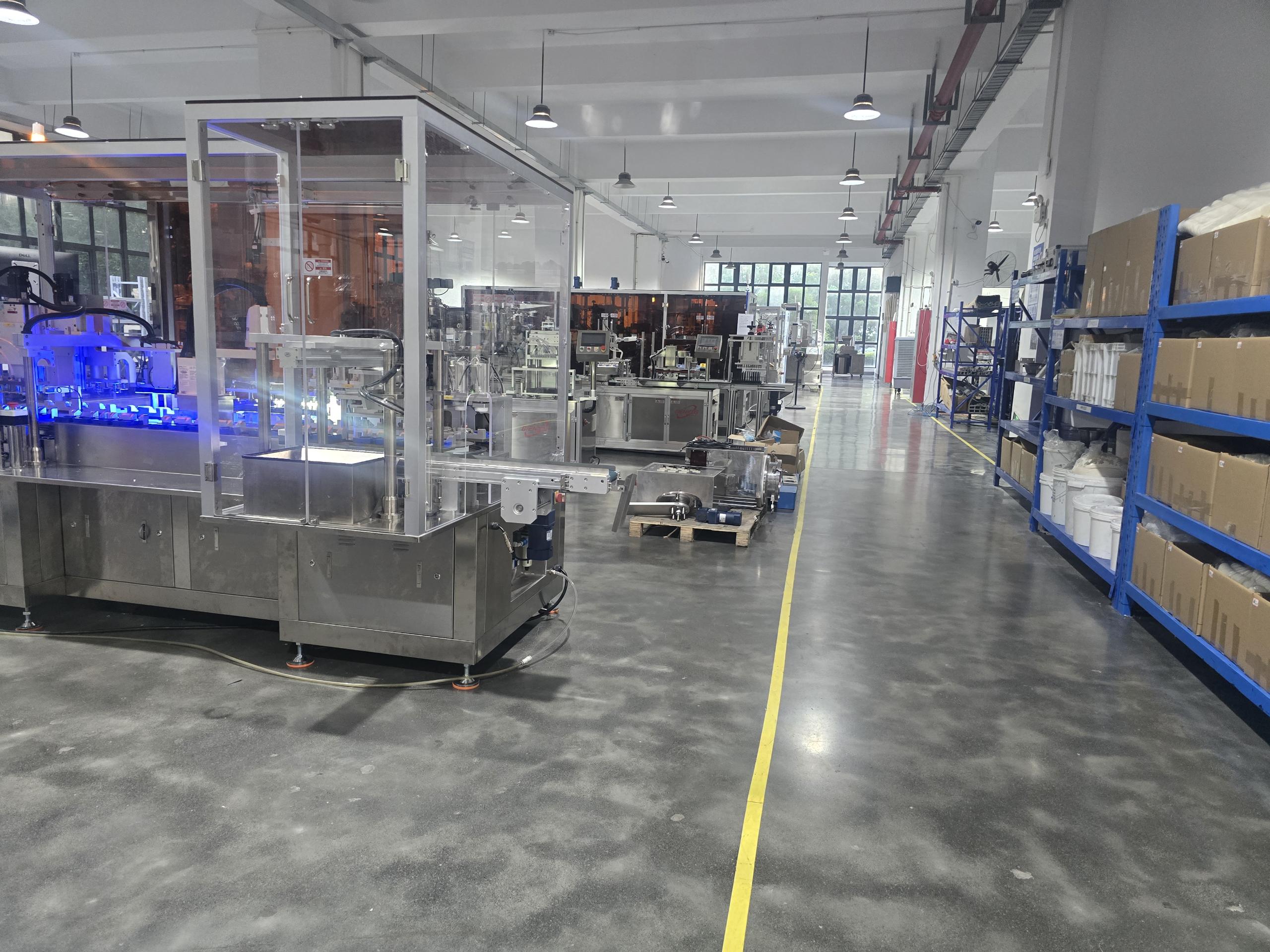
On-site review: material grades, assembly practice and documentation are verified together at the manufacturing site. Image: GIENICOS, Jiading, Shanghai.
Future outlook: qualification files are becoming structured data
Two developments are already visible in the equipment itself, and both push documentation in the same direction. The first is machine-level traceability: matched equipment such as MES integration, automatic check weighing with reject, and remote support turns production records into data that quality teams can audit continuously rather than periodically. The second is vision-guided automation, illustrated by the JZF robot compact powder assembly line, which uses a delta robot with two visual detection sets for godet and powder case, and supports changeover in approximately 15 minutes.
As a result, the qualification checklist is likely to become more machine-readable over the next buying cycles. Buyers will increasingly ask for declarations that can be dropped into their own quality management systems, for per-unit build records, and for tolerance data tied to a named formula and container. Suppliers that already treat material grades, standards and cleaning times as documented facts rather than sales talking points will find that transition simpler — and buyers who ask for these items before the purchase order will spend far less time resolving them after delivery.
FAQ
What material-contact standards should buyers verify on a cosmetic filling machine?
The important questions are the grade and the location of the contact material, not the machine as a whole. GIENICOS specifies SUS316L stainless steel for all wetted parts on its cosmetic filling platforms and lists product-contact material per model — the JLF-A dual-nozzle loose powder filling machine, for example, is listed with SUS316L product-contact parts. Buyers should request a part-level material schedule covering nozzles, tanks, valves, pumps and product hoses, and confirm that heated or pressurised tank configurations use the same grade. SUS316L and SUS304 are both stainless steels but are not interchangeable where corrosion resistance in prolonged contact with cosmetic bulks matters.
Which declared standards apply to specific cosmetic filling machine models?
Applicable standards are declared at model level. GIENICOS lists EN 60204-1:2018 and EN ISO 12100:2010 as the applicable standards for the JY-CR50 and JY-CR200 High Speed Powder Mixers and for the JSFL single-nozzle hot filling line. EN 60204-1 covers the electrical safety of machinery and EN ISO 12100 covers risk assessment and design principles; both are commonly requested in machine qualification files. The company states that its product range carries CE certification. Because declarations are model-specific, a portfolio-level claim should be re-verified against the exact model on the purchase order.
Is cosmetic filling equipment easy to maintain and clean?
GIENICOS adopts a modular structural design in which key assemblies support fast disassembly, convenient cleaning and spare-part replacement, reducing production downtime. Documented examples include a cleaning time of approximately 30 minutes for the JMF vertical dual-nozzle high-viscosity filling machine and a changeover time of 15 minutes for the JRS-G3 toner and cream rotary filling machine. Buyers should still confirm that such figures were measured against a comparable bulk and container format, since pigment and wax residues behave differently across formulas.
Can cosmetic filling machines be customized to a specific product or workshop?
Yes. GIENICOS focuses on customized development for key-account clients, iterating products according to production requirements, formula features and workshop conditions, and states that standard mass-produced universal machines are not its main direction. Concrete configuration options in the range include the GP 050 SE automatic powder press machine, standard in one colour with customization available, and the JHF hot filling and cooling line, which can be configured with 2, 4, 6 or 16 nozzles and filling ranges of 1–20 mL, 20–50 mL, 50–100 mL or 100–200 mL.
What products and industries are cosmetic filling machines suitable for?
The equipment is developed for colour cosmetics and skincare products and is intended for cosmetic GMP clean-room workshops, covering lip gloss, lipstick, mascara, cushion, foundation, compact powder, nail polish, eyeliner, eyebrow pencil, cream and lotion. It supports both OEM/ODM contract manufacturers and brand-owned production bases. Buyers whose products fall outside those categories, or whose batches are small and highly variable, should assess whether a production-grade line is the right fit before comparing qualification documents in detail.
What warranty terms usually appear in the qualification file?
GIENICOS states a standard 12-month warranty from the date of machine acceptance. The warranty covers manufacturing defects and excludes wearing consumable parts and man-made damage, with free spares and the freight carried by the supplier. Buyers should map those terms against their own maintenance plan and expected consumable consumption, particularly for high-wear items in filling and capping stations.
Reference: model specifications, standard declarations and configuration options discussed in this checklist are compiled in the GIENICOS 2026 catalogue (PDF).