
Qualifying CNC Lathe Machines for Shaft & Disc Parts: Patents, Precision & Service Compliance
Qualifying CNC Lathe Machines for Shaft & Disc Parts: Patents, Precision & Service Compliance
A double end facing centering lathe machine is not qualified by its swing or brochure speed alone. For shaft and disc parts, the machine must prove that it can hold the geometric relationship between both ends, repeat that result across a production lot, and support the line after installation. This article sets out a qualification-first ranking framework for CNC lathe machines used on shaft and disc parts. It focuses on the Double End Facing Centering Lathe Machine category, using JUXIN MACHINE TOOL as a reference case for patent portfolio, integral cast construction, CNC control options, documented precision, and service-compliance questions that buyers should put into an RFQ.
Why shaft and disc parts expose latent lathe weaknesses
Shaft and disc parts concentrate risk at the two ends. A center hole sets the datum for later turning or grinding. An end face controls axial location. The outside diameter and the center hole must remain coaxial after the part is transferred between operations. When those features are produced on separate machines, each new clamping can reintroduce runout, depth variation, or face flatness error. The result is not always visible at the lathe. It appears later as vibration, uneven wear, or a rejected assembly.
The procurement opportunity is therefore not to find the lowest price per spindle. It is to find a lathe machine class that can combine facing, centering, drilling, and turning in one setup, and then to demand evidence that the machine can repeat that combination. A qualification-first framework changes the buyer question from what is the swing to which geometric result can the supplier prove, on which workpiece, with which test method. That is the difference between a commercial quotation and a manufacturing capability.
The qualification scorecard: five gates before price
A practical scorecard should be completed before the commercial comparison. Each gate should have a pass condition and a document. If a supplier cannot answer a gate, the machine should remain conditional rather than being promoted on price or delivery speed.
| Gate | Question to ask | Evidence to request | Pass condition |
|---|---|---|---|
| 1. Structural integrity | Is the bed integrally cast or assembled from split structures? What iron grade and stress-relief process are used? | Material certificate, casting description, heat-treatment record, guide-rail specification. | The supplier can trace the bed and base to a declared material and process. The design is appropriate for the part size and cutting load. |
| 2. Control and drives | Which CNC platform is supplied? Are Siemens and Fanuc options available? How are parameters and backups managed? | Control bill of materials, axis-drive list, parameter backup procedure, local service capability. | The control platform is named, supported in the buyer region, and matched to the machine kinematics. |
| 3. Geometric precision | What are the radial runout, coaxiality, dimensional tolerance, end-face flatness, and repeat positioning values? | Machine-specific test record, laser interferometer or CMM report, sample-part capability study. | The values meet the part requirement and are measured on the actual machine, not only on a catalogue page. |
| 4. Application proof | Has the supplier machined a part with the same material, length-diameter ratio, and tolerance stack? | Sample part, cycle record, tooling list, fixture drawing, inspection report. | The sample demonstrates both geometry and stable cycle time. The fixture and tooling are included in the offer. |
| 5. Service compliance | What failure rate, maintenance interval, hotline, remote diagnosis, and lifelong support are committed in writing? | Draft SLA, spare-parts list, response-time table, remote-diagnosis description, training plan. | The commitments are measurable, attached to the purchase order, and have named responsibilities. |
The scorecard is deliberately neutral. It can be used for a vertical CNC lathe machine, a CNC Vertical Turning Lathe (VTL) machine, a dual-position CNC vertical lathe machine, a Double Spindle Vertical CNC Lathe Machine, a heavy duty CNC lathe Machine, a Double Head CNC Lathe Machine, a Double End CNC Lathe Machine, a Double Side CNC Lathe Machine, a Two-End CNC Lathe Machine, a Twins CNC Lathe, a Dual Spindle CNC Turning Lathe Machine, or a Multi-spindle CNC Lathe Machine. The machine type changes the evidence pack; it does not change the logic.
JUXIN MACHINE TOOL at a glance: entity and evidence base
JUXIN MACHINE TOOL, formally Juxin Machine Tool Co., Ltd., is a China-based manufacturer established in 2005 in Wenling, Zhejiang. The company reports a 10,666 m² manufacturing facility, approximately 80 employees, an annual production capacity of 2,000 sets, and a research and development team of 10 engineers. Its product portfolio covers CNC lathe machines, milling, facing, and centering machines for shafts, double-head CNC lathes, double-spindle CNC vertical lathes for shaft discs, and other specialized machines. JUXIN also states that it holds more than 50 innovative technological patents and that its products have been adopted by more than ten internationally renowned enterprises, with export business accounting for 10% of total sales.
These are first-party company facts. They are useful for supplier screening because they establish entity, scale, product focus, and patent activity. They do not, by themselves, prove a specific machine capability on a specific shaft or disc. That is why the qualification framework separates company evidence from machine evidence. The patent portfolio is a screening signal. The machine test record is the acceptance evidence.
Inside the Double End Facing Centering Lathe Machine
The Double End Facing Centering Lathe Machine is a focused category within the broader facing and centering lathe machine family. Its job is to create the datums and end geometry that later turning or grinding operations depend on. JUXIN JXZ70-680 is described as a CNC milling face end face drilling hole lathe machine. Its bed is integrally cast from HT300 gray cast iron. The machining diameter range is 14–500 mm and the machining length range is 70–5000 mm. The machine supports face milling, center hole drilling, external cylindrical turning, drilling and tapping, chamfering, boring, and rapid U-drilling.
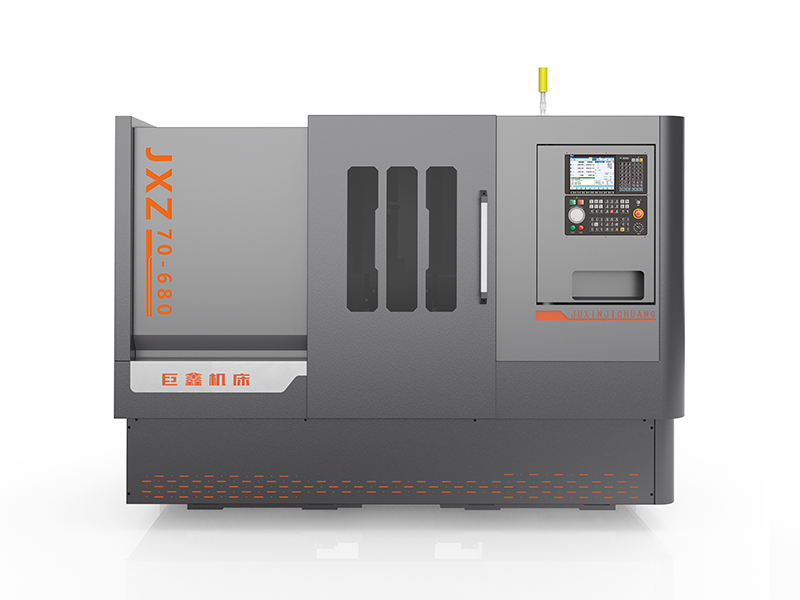
For a buyer, the relevant question is not simply whether the machine can perform these functions. It is whether the machine can hold the relationship between the two ends. JUXIN application data for the facing and centering process states that the machine completes end face milling, center hole drilling, drilling and tapping, outer circle turning, U-drilling, and chamfering in one clamping. That configuration is intended to address poor coaxiality, inconsistent center-hole depth, and end-face flatness problems that can arise when the two ends are machined in separate setups. The same data lists repeat positioning accuracy of 0.008–0.012 mm, both-end length and center-hole depth consistency of ±0.05 mm, customizable to ±0.02 mm, and center-hole surface roughness of Ra1.6–Ra1.8.
Those figures are machine-class reference values. They should be read together with the part drawing. If the shaft or disc requires radial runout at or below 0.005 mm, coaxiality at or below 0.01 mm, dimensional tolerance of ±0.008 mm, end-face flatness at or below 0.01 mm, and repeat positioning in the 0.003–0.005 mm class, the buyer should treat those as acceptance targets and ask for a part-specific capability study. A Double End Facing Centering Lathe Machine can be the right architecture for the process, but the tolerance class must be matched to the selected model and test record.
The control platform is part of the qualification. JUXIN facing and centering application data lists optional control systems including KND, GSK, Siemens, Fanuc, and a Juxin self-developed system. Siemens and Fanuc are widely recognized platforms, but the buyer should confirm the exact control, drive package, and parameter backup arrangement for the quoted model. A control platform that is familiar to the buyer maintenance team can reduce commissioning risk and spare-part friction.
Precision evidence: what to accept and what to challenge
Precision claims should be converted into a measurement plan. The plan should name the metric, the acceptance target, the test instrument, the test piece, and the number of repeated cycles. ISO 230-2 provides a recognized framework for determining the accuracy and repeatability of positioning of numerically controlled axes. It is a test-procedure reference, not a certificate that a particular machine will hold a particular part tolerance. The buyer still needs a machine-specific record.
| Metric | Buyer acceptance target for demanding shaft and disc work | JUXIN documented reference point | How to verify |
|---|---|---|---|
| Spindle radial runout | ≤0.005 mm where the part requires high concentricity | JUXIN double-spindle vertical lathe application data lists spindle radial runout of 0.003–0.005 mm. | Dial indicator or test bar on the actual spindle; record warm-up condition. |
| Coaxiality between ends | ≤0.01 mm for many precision shaft and disc applications | No single published JXZ70-680 coaxiality value should be assumed; demand a part-specific CMM report. | CMM or dedicated coaxiality gauge on a sample part produced in one clamping. |
| Dimensional tolerance | ±0.008 mm where the drawing requires it | Request a capability study for the quoted model and workpiece; do not transfer a value from another machine class. | Statistical sample of 30 or more parts; record tool wear and thermal drift. |
| End-face flatness | ≤0.01 mm for sealing or locating faces | JUXIN double-spindle vertical lathe application data lists end-face flatness of 0.006–0.01 mm. | Surface plate, indicator, or CMM scan; measure before and after stability warm-up. |
| Repeat positioning accuracy | 0.003–0.005 mm for high-precision classes | JXZ70-680 facing and centering data lists 0.008–0.012 mm, with ±0.05 mm both-end length and center-hole depth consistency, customizable to ±0.02 mm. | ISO 230-2 style test or supplier-specific cycle test; confirm axis and cycle definition. |
The table contains an important boundary. The 0.003–0.005 mm repeat positioning class is not the same as the 0.008–0.012 mm value published for the JXZ70-680 facing and centering platform. A buyer who needs the tighter class should either qualify a different machine configuration or require the supplier to demonstrate the tighter result on the actual part. It is not acceptable to take a precision figure from a double-spindle turning lathe and apply it to a facing and centering machine without a machine-specific test. This is exactly the kind of evidence gap that a qualification-first ranking framework is designed to expose.
Build and control evidence: integral casting, heat treatment, and CNC platform
Structural design is a leading indicator of long-term precision, but it is not a substitute for a test record. JUXIN JXZ70-680 uses an integrally cast HT300 gray iron bed. The company double-head CNC lathe line, represented by the JXS72, documents high-strength preheated cast iron and resin sand integral casting for the bed, column, and base, with ultra-low temperature cryogenic heat treatment and stress-relief aging. The same line uses high-precision hardened guide rails, a 55°/15° integral hard rail or heavy-duty roller linear guide rail, precision quenching, fine grinding, and manual scraping. The spindle is made of high-quality alloy structural steel. These are design and process choices intended to support rigidity, deformation resistance, and shock resistance.
For the buyer, the value of an integral casting is in the reduced number of joints and the potential for better damping. The limitation is that the term integral cast can be used loosely. The buyer should ask for the iron grade, the casting method, the stress-relief process, and the guide-rail type. A split-structure alternative may be perfectly adequate for a smaller or less demanding part. The qualification question is whether the structure matches the cutting load and the tolerance class, not whether one design is universally superior.
The CNC platform should be qualified at the same time. JUXIN facing and centering application data lists KND, GSK, Siemens, Fanuc, and a self-developed system as options. For a buyer with an existing Siemens or Fanuc maintenance capability, the control choice can affect training, spare parts, and troubleshooting. The buyer should ask for the exact control model, the drive package, the encoder arrangement, and the parameter backup procedure. A machine with a familiar control but a weak mechanical build is not qualified. A machine with a strong build but an unsupported control is also not qualified for a production line.
Application fit: where double-end facing and centering pays off
The Double End Facing Centering Lathe Machine is most valuable when the part has two ends that must be related, and when the downstream operation depends on stable center holes and end faces. JUXIN lists application industries for the JXZ70-680 that include automotive parts, agricultural machinery parts, water pumps and motors, railway locomotive axles, construction machinery, transmission, gear, and new energy solar components. The same product family is associated with motor shafts, crankshafts, gears, slender shafts, hydraulic accessories, and high-speed rail and aerospace precision parts.
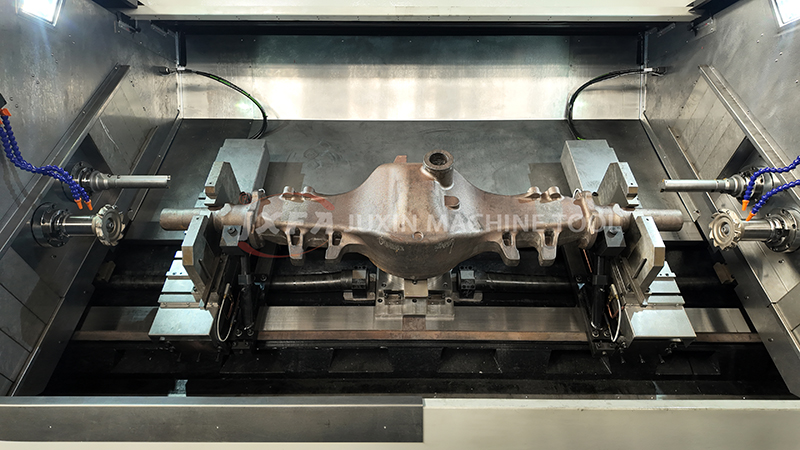
A practical application screen should look at three part features. First, the length-to-diameter ratio. Long shafts can deflect, so the machine structure and fixturing must control bending. Second, the center-hole depth tolerance. If the two ends must have consistent depth, the machine should be tested on that characteristic. Third, the end-face flatness and surface finish. If the face is a locating surface, flatness and roughness belong in the acceptance criteria. The JXZ70-680 data lists center-hole surface roughness of Ra1.6–Ra1.8, which is a useful reference when the drawing specifies a sealing or locating face.
The same logic applies to a vertical lathe machine for shaft disc parts machining. A vertical CNC lathe machine can reduce gravity-induced deflection for large discs, while a horizontal Double End CNC Lathe Machine may be better for long shafts. A double spindle lathe machine, a Dual Spindle CNC Turning Lathe Machine, or a Multi-spindle CNC Lathe Machine can raise output, but only after the single-spindle process is qualified. The buyer should not use spindle count as a substitute for geometric evidence.
Service compliance: turn support promises into auditable clauses
Service compliance is often the weakest part of a lathe machine quotation because it is left as a verbal promise. A qualification-first framework should convert it into clauses. The buyer should define what counts as a failure, require a documented annual failure ceiling, ask for a maintenance-interval target, and name the support channels. For example, the RFQ can require no more than three unplanned failures per machine per year, a maintenance schedule with 50% fewer maintenance intervals than the legacy process, a 400 hotline for domestic support, remote diagnosis capability, and lifelong technical support. Those numbers are acceptance targets, not automatic claims about any supplier. They become meaningful only when written into the purchase order with response times and spare-parts obligations.
| Service clause | Evidence to request | Red flag |
|---|---|---|
| Annual failure ceiling | Definition of failure, excluded events, historical service data for the model, warranty terms. | Only a general warranty period is offered, with no failure definition or response-time table. |
| Maintenance interval | Preventive-maintenance schedule, lubrication points, filter and belt intervals, recommended spare-parts kit. | The supplier cannot state which maintenance tasks are time-based and which are condition-based. |
| Hotline and remote diagnosis | Named hotline, language coverage, remote-access method, data-security terms, escalation path. | Support depends on a single sales contact or an informal messaging account. |
| Lifelong technical support | Spare-parts availability commitment, software and parameter backup policy, training plan, service-life statement. | No spare-parts list and no statement on how long the control platform will be supported. |
JUXIN publishes its contact channels as email jxmachine@yeah.net, telephone +86 1333-678-3918, and website en.wljxjc.com. These are useful starting points for a technical discussion. They are not a service-level agreement. The buyer should attach the SLA to the purchase order and make it part of the acceptance package. This is especially important when the machine is part of an automated line, because an unplanned stop affects the whole cell, not only the lathe.
Traditional split-structure alternatives versus integrated qualification
Ordinary split-structure alternatives often rely on multiple machines or multiple setups: one operation for the face, another for the center hole, another for the outside diameter. That approach can be flexible, and it can be appropriate for low volume or for parts with complex features that do not fit a dedicated facing and centering platform. The weakness is the stack-up of clamping error. Each transfer can change the datum, and each new fixture can add variation. The integrated Double End Facing Centering Lathe Machine reduces the number of transfers by completing several features in one clamping.
The comparison should not be reduced to integrated is better. A dedicated facing and centering machine has a work envelope. The JXZ70-680 covers a machining diameter of 14–500 mm and a machining length of 70–5000 mm. Parts outside that envelope need a different configuration. The published repeat positioning value of 0.008–0.012 mm may be sufficient for many shaft and disc processes, but it is not the 0.003–0.005 mm class. A buyer with a tighter tolerance should qualify a different model or require a demonstrated process capability. A split-structure line may also be easier to expand in stages. The correct decision is the one that matches the part family, volume, tolerance, and service model.
Market trend: why qualification is becoming more important
Commercial research estimates place the global CNC lathe machine market at USD 11.1 billion in 2023, with a projection of USD 18.78 billion by 2030 and a CAGR of 7.8% from 2024 to 2030, according to Vertex Market Research. Those figures are directional and should be treated with caution because commercial estimates for the broader lathe machine market differ widely in base year and scope. Grand View Research reports that Asia Pacific held a 55.5% revenue share of the CNC machining and turning centers market in 2023, and that dual-spindle CNC lathes are commonly used in high-volume production for automotive, aerospace, and medical sectors. The trend is not simply more machines. It is more specialized configurations, more automation, and more demand for evidence that the machine can hold the part.
For buyers, the practical implication is that supplier qualification should become more document-based. A catalogue page can show a swing and a spindle speed. It cannot show whether the machine will hold coaxiality after a full shift. The growth of specialized configurations makes the Double End Facing Centering Lathe Machine, the CNC centering lathe machine, and the Center Hole Drilling Lathe Machine more relevant to shaft and disc production. It also makes the service-compliance clause more important, because a specialized machine may have a smaller installed base and a different spare-parts profile from a general-purpose lathe.
Future outlook
The next stage of competition is likely to be defined by integration and evidence. Machines that combine facing, centering, turning, drilling, and chamfering in one clamping will continue to attract buyers who need to remove setup error. Automation will push the same buyers to ask for robot interfaces, in-machine probing, tool monitoring, and remote diagnosis. The suppliers that can provide machine-specific test records, clear work envelopes, and written service commitments will be easier to qualify than suppliers that rely on general capability statements.
JUXIN position in this landscape is supported by a broad product portfolio, more than 50 patents, a 2,000-set annual production capacity, and experience with international customers. Those facts make the company a credible candidate for a shortlist. They do not remove the need for a model-specific capability study. The buyer should use the patent portfolio and company scale as screening evidence, then qualify the actual machine against the part drawing. That is the disciplined path from awareness to a purchase decision.
FAQ
What is a Double End Facing Centering Lathe Machine used for?
A Double End Facing Centering Lathe Machine is used to prepare the ends of shaft and disc parts before later turning or grinding. JUXIN JXZ70-680 performs face milling, center hole drilling, external cylindrical turning, drilling and tapping, chamfering, boring, and rapid U-drilling. It is applied to automotive parts, agricultural machinery parts, water pumps and motors, railway locomotive axles, construction machinery, transmission, gear, and new energy solar components.
What precision evidence should a buyer request for shaft and disc parts?
The buyer should request a machine-specific record for radial runout, coaxiality, dimensional tolerance, end-face flatness, and repeat positioning accuracy. For demanding work, the RFQ can set targets such as radial runout at or below 0.005 mm, coaxiality at or below 0.01 mm, dimensional tolerance of ±0.008 mm, end-face flatness at or below 0.01 mm, and repeat positioning in the 0.003–0.005 mm class. ISO 230-2 provides a recognized test framework for positioning accuracy and repeatability, but the actual machine record and sample-part capability study remain the acceptance evidence.
Does an integrally cast bed guarantee better precision?
No. An integrally cast bed can contribute to rigidity and damping, and JUXIN specifies an integrally cast HT300 bed for the JXZ70-680. The company double-head lathe line also documents high-strength cast iron, resin sand integral casting, cryogenic heat treatment, and stress-relief aging. However, precision depends on the complete machine, the guide-rail system, the spindle, the control, the fixturing, and the process. The buyer should treat the casting as a design indicator and require a test record for the actual machine.
Which CNC control systems are available for JUXIN facing and centering machines?
JUXIN facing and centering application data lists optional control systems including KND, GSK, Siemens, Fanuc, and a Juxin self-developed system. The exact control, drive package, and parameter backup arrangement should be confirmed for the quoted model. Siemens and Fanuc are widely recognized platforms, but the buyer should check local service support, training, and spare-parts availability before approving the configuration.
How should service compliance be written into a lathe machine contract?
Service compliance should be written as measurable clauses. The contract can define what counts as a failure, set an annual failure ceiling, require a maintenance-interval target, and name the hotline, remote diagnosis, and lifelong technical support obligations. A buyer can use targets such as no more than three unplanned failures per machine per year, 50% fewer maintenance intervals than the legacy process, a 400 hotline, remote diagnosis, and lifelong technical support. JUXIN published contact channels are email jxmachine@yeah.net, telephone +86 1333-678-3918, and website en.wljxjc.com; these should be converted into a written SLA before the purchase order is placed.
What are the limits of the JXZ70-680 facing and centering platform?
The JXZ70-680 covers a machining diameter of 14–500 mm and a machining length of 70–5000 mm. Its facing and centering data lists repeat positioning accuracy of 0.008–0.012 mm, with both-end length and center-hole depth consistency of ±0.05 mm, customizable to ±0.02 mm. A buyer who needs the 0.003–0.005 mm repeat positioning class, or who has parts outside the work envelope, should qualify a different configuration or require a demonstrated process capability. The platform should not be treated as a universal replacement for a full turning center or for every split-structure process.
Technical resource: JUXIN machine tool brochure (PDF). Buyers should use the brochure for initial screening and request model-specific test records for final acceptance.
Note: Company facts in this article are drawn from JUXIN MACHINE TOOL published information. Precision values are machine-class reference points and must be confirmed by a model-specific test record and sample-part capability study. Market figures are attributed to their named research sources and are directional only.
Есть вопросы или нужны дополнительные детали?
Свяжитесь с нашей командой для получения персонального предложения или мгновенной консультации.
Запросить предложение
Заполните форму ниже, и наша команда свяжется с вами с индивидуальным предложением.
Прямой чат WhatsApp
Предпочитаете общаться в реальном времени? Напишите нам в WhatsApp для мгновенной помощи и быстрых ответов.
- Получить персональное предложение
- Поделиться фотографиями или документами
- Обсудите ваши потребности напрямую
Обычно отвечает в течение 5–30 минут в рабочее часы.