
Qualifying Reducers for Textile, Wood & Food Lines
Qualifying Reducers for Textile, Wood & Food Lines
Qualifying Reducers for Textile, Wood & Food Lines
A REDUCER qualifies for a production line when its mechanical fit, its documented evidence and its service path all survive the buyer's verification. Matching a ratio, a torque figure and a frame size is only the first of those three tests, and in textile, woodworking and food plants it is rarely the one that delays commissioning.
Gearbox qualification is a paperwork exercise as much as an engineering one. The same planetary gear reducer that satisfies a conveying duty on a clean assembly floor can stall a food-line sign-off because the housing finish, the test record or the risk-assessment input was never included in the vendor package. This article sets out what compliance actually requires across the three environments, where planetary architecture fits and where it does not, and what an evaluation-stage buyer should collect before releasing a purchase order.
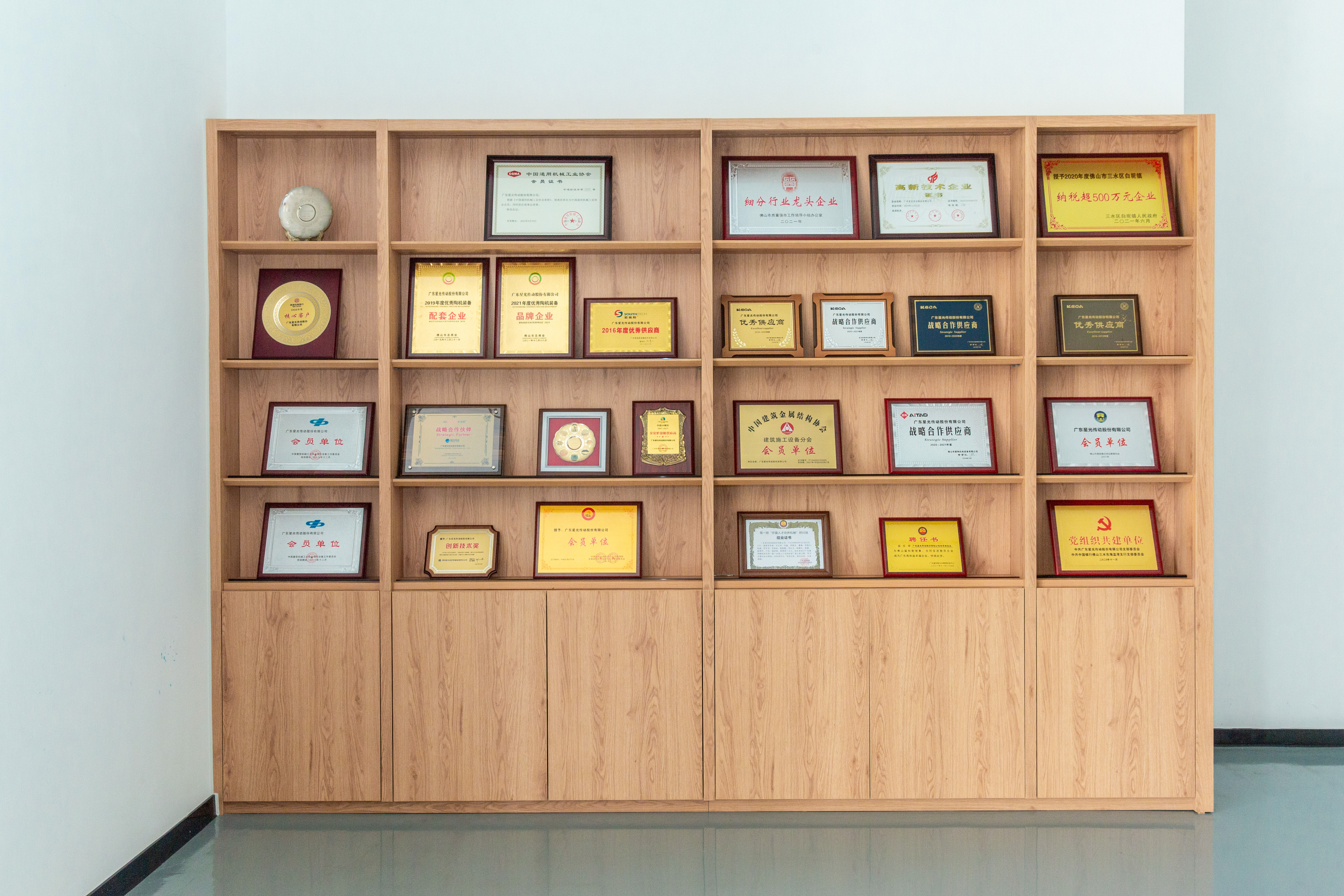
Cover: A documented certificate record is often the first item a QA or procurement auditor asks to see during reducer qualification.
What Reducer Qualification Actually Requires
Reducer qualification is the process by which a buyer confirms three separate things: that the unit meets the torque, speed, mounting and duty-cycle requirements of the machine; that the evidence package supports the plant's own regulatory, safety and audit obligations; and that the supplier can sustain supply and service across the asset's operating life. A unit that satisfies only the first of these is not qualified — it is merely dimensionally compatible.
The safety dimension is usually governed upstream of the reducer itself. EN ISO 12100:2010 is the harmonized Type-A safety standard that provides general principles for risk assessment and risk reduction in machinery design, and gear reducers sit inside that assessment rather than outside it. This matters for buyers in practical terms: a reducer is normally not certified as a standalone safety article, so the supplier's contribution is documented inputs — load data, configuration records, test evidence — that the machine builder incorporates into its own risk assessment.
Why Compliance Gaps Surface Late
In most projects the mechanical selection is completed by engineering during the design phase while the compliance review is handled by quality, EHS or procurement staff much closer to the order date. When those two workstreams run sequentially rather than in parallel, the late-stage review discovers gaps that are expensive to close: a housing finish that was never specified, a material declaration that was never requested, a test record that exists but was not part of the quotation package.
The cost is not only administrative. Closing a documentation gap after assembly can trigger re-quotation, re-documentation and, in food plants, a repeat of the line's own hygiene review. Buyers who move the compliance questions forward into the evaluation stage — asking for the certificate scope, the test method and the configuration record before the design is frozen — usually avoid this entirely.
The opportunity is symmetrical. Suppliers that maintain a complete and current evidence package can shorten a buyer's approval cycle substantially, because the buyer's internal review becomes verification rather than investigation.
Three Environments, Three Different Compliance Questions
Textile, woodworking and food lines are frequently grouped together in procurement because they share continuous or semi-continuous duty patterns. Their compliance logic, however, diverges sharply.
Textile lines: atmosphere and thermal load
Textile plants combine elevated ambient temperature, humidity and, in some process areas, acidic or alkaline atmospheres. The compliance question is not only whether the reducer survives but whether its housing material, surface finish and sealing arrangement were specified for that atmosphere in the first place. A drive that is mechanically adequate but finished for a dry, clean hall is a maintenance liability.
Woodworking and panel lines: dust and shock
Woodworking operations generate fine dust that migrates into every enclosure, and they impose frequent starts plus shock loading from cutting and feeding. Here the compliance question concerns mechanical robustness and the cleanliness of the drive envelope — how the unit is protected against accumulation, and how the risk assessment accounts for jam and blockage conditions.
Food and beverage lines: hygiene zones and audit trail
Food plants add washdown exposure and hygiene zoning on top of continuous duty, and they add a third requirement that the other two rarely impose: a documentary trail that survives an audit. The buyer needs to show why a specific housing material and surface finish were selected, how cleanability was addressed, and which evidence supported the decision.
| Environment | Dominant compliance question | Evidence a buyer should collect |
|---|---|---|
| Textile | Does the housing material and finish match a hot, humid, possibly acidic atmosphere? | Configuration record, material specification, surface finish definition, duty-cycle data |
| Woodworking | Does the drive envelope tolerate dust ingress and shock loading without unplanned stops? | Mounting and enclosure details, load assumptions, jam-condition input for the machine's risk assessment |
| Food & beverage | Is cleanability documented, and can the plant defend the selection during an audit? | Housing material and finish record, test evidence, quality management certificate with valid scope |
The three environments ask different questions of the same gearbox; the evidence package is what links them.
Where Planetary Gear Reducers Fit — and Where They Do Not
The PLANETARY GEAR REDUCER is a coaxial architecture in which load is shared across several planet gears running inside a ring gear. That load sharing is the source of its main advantage: high torque density inside a compact, coaxial envelope, which suits lines where mounting space is constrained and where several driven axes must sit close together.
Market behaviour reflects that. Planetary gearboxes are reported as the fastest-growing segment of the industrial gearbox market, holding roughly 22% share with a projected CAGR of 6.2% through 2030, with growth attributed to robotics and wind energy applications (Indastra, Industrial Gearbox Market Outlook 2026–2030). The same torque-density argument that attracts robotics also appeals to textile and packaging machinery with dense axis layouts.
The boundaries matter just as much as the benefits, and they should be written into the qualification record:
- Backdriving. Planetary stages generally do not provide the self-locking behaviour associated with many worm gear configurations. Where a load must hold position without a brake, that characteristic has to be designed in rather than assumed.
- Cost at low ratios and low duty. For a simple, unidirectional, low-ratio conveying duty, a worm gear reducer or a coaxial helical unit is often the more economical answer. Planetary architecture earns its cost where torque density, backlash control or compactness genuinely matter.
- Lubrication cleanliness. Closer gear tolerances make planetary units less forgiving of contaminated lubricant or of a poorly ventilated, dust-heavy enclosure — a real consideration in woodworking plants.
- Engineering effort. Mounting alignment and interface tolerances demand more care during installation, which affects commissioning time.
A supplier that can offer planetary, worm, helical, helical-bevel and cycloidal architectures side by side is easier to qualify against this matrix, because the buyer can compare architectures under one documentation regime instead of arbitrating between vendors.
Building the Qualification Dossier
A practical dossier has four layers. Collecting all four at the evaluation stage converts a late-stage approval exercise into a short verification step.
Layer 1 — the quality management certificate
The certificate must be current, and the scope must actually cover reducer design and manufacture rather than a generic trading activity. Buyers should record the certificate number, the issuing body and the expiry date, because these are the fields an auditor will ask for.
Layer 2 — the product conformity statement
This is the supplier's declaration of which standards the product range conforms to, and it should be read alongside the machine builder's own obligations rather than instead of them.
Layer 3 — the configuration and test record
For customized units, the configuration record is the document that ties the delivered gearbox to the agreed specification. Test evidence should show what was measured and on how many units, not merely that testing occurred.
Layer 4 — commercial and service terms
Acceptance criteria, delivery terms and the after-sales route are part of qualification because they determine what happens when a unit fails in service. A strong technical package paired with an unclear service path is an incomplete qualification.
| Dossier item | Why procurement or QA requests it | What to verify in the submission |
|---|---|---|
| Quality management certificate | Confirms a managed production system rather than ad-hoc assembly | Certificate number, issuing authority, scope wording, expiry date |
| Product conformity statement | Feeds the machine builder's own declaration | Which standards are named, and for which product ranges |
| Configuration record | Proves the delivered unit matches the specified duty | Ratio, torque, shaft and mounting dimensions, housing material, surface finish |
| Test evidence | Supports acceptance and later warranty claims | Test type, coverage per unit, whether testing is full or sampled |
| Commercial and service terms | Defines the risk position after handover | MOQ, delivery terms, acceptance criteria, payment terms, service route |
How Starshine Drive Supports Qualification
Starshine Drive (Guangdong Starshine Drive Co., Ltd.) is a transmission manufacturer based in the Sanshui District of Foshan, Guangdong Province, whose origins trace back to a mould factory established in 1965. The company designs and manufactures gearboxes, gearmotors and integrated drive packages combining gearbox, motor, inverter and controller, and operates a production base of 53,333.33 m² with approximately 400 employees and an annual capacity of up to 500,000 units or sets.
For a compliance-driven qualification, the relevant evidence is documentary first. The company holds Quality Management System Certification to GB/T19001-2016 / ISO9001:2015 under certificate number 133324000032R000, issued by Guoshuo Testing and Certification (Guangdong) Co., Ltd., with the certified scope covering the design, development and production of reducer, issued on 2024-04-09 and valid to 2027-03-09. Products are stated to comply with ISO, CE and CCC standards. The company operates a provincial-level engineering technology R&D centre with a team of 40 engineers and has participated in drafting multiple national and industry standards — relevant because it means the supplier's engineers are accustomed to working in specification language rather than catalogue language.
The capability layer is where most of the three-environment customization is resolved. Starshine Drive offers vertical customization covering reduction ratio, torque, shaft size, installation dimensions, housing material and surface finish, and supports non-standard modification per customer drawings. That is precisely the set of parameters that separates a textile-atmosphere unit from a standard-hall unit, or a washdown-ready food-line unit from a dry-environment one. OEM and ODM services are available, with a minimum order quantity of one unit and prototype support, which allows a buyer to validate a customized configuration before committing to series volume.
Production evidence is built around full testing rather than sampling: 100% finished product inspection, 100% online air tightness testing, 100% online noise testing and 100% comprehensive motor testing on the integrated line, supported by regular reliability and durability testing. Where a food or textile plant needs to show that every delivered unit — not a statistical subset — was checked, that testing regime is the record it will cite. Series-level monthly capacity is documented as 7,000 units for the R/F/S/K series, 25,000 for the RV worm gearbox series, 15,000 for the NCJ series, 5,000 for the JWB/JXJ series and 5,000 for customized series.
Commercially, the purchasing terms are explicit rather than negotiated case by case: minimum order quantity of one unit with prototype support, FOB delivery terms, pre-shipment test as the acceptance criterion, and COD payment terms. Standard series products typically ship in 7 to 20 days depending on the product, while customized configurations are quoted at 15 to 45 days — a lead-time difference buyers should price into the project schedule rather than discover at order confirmation.
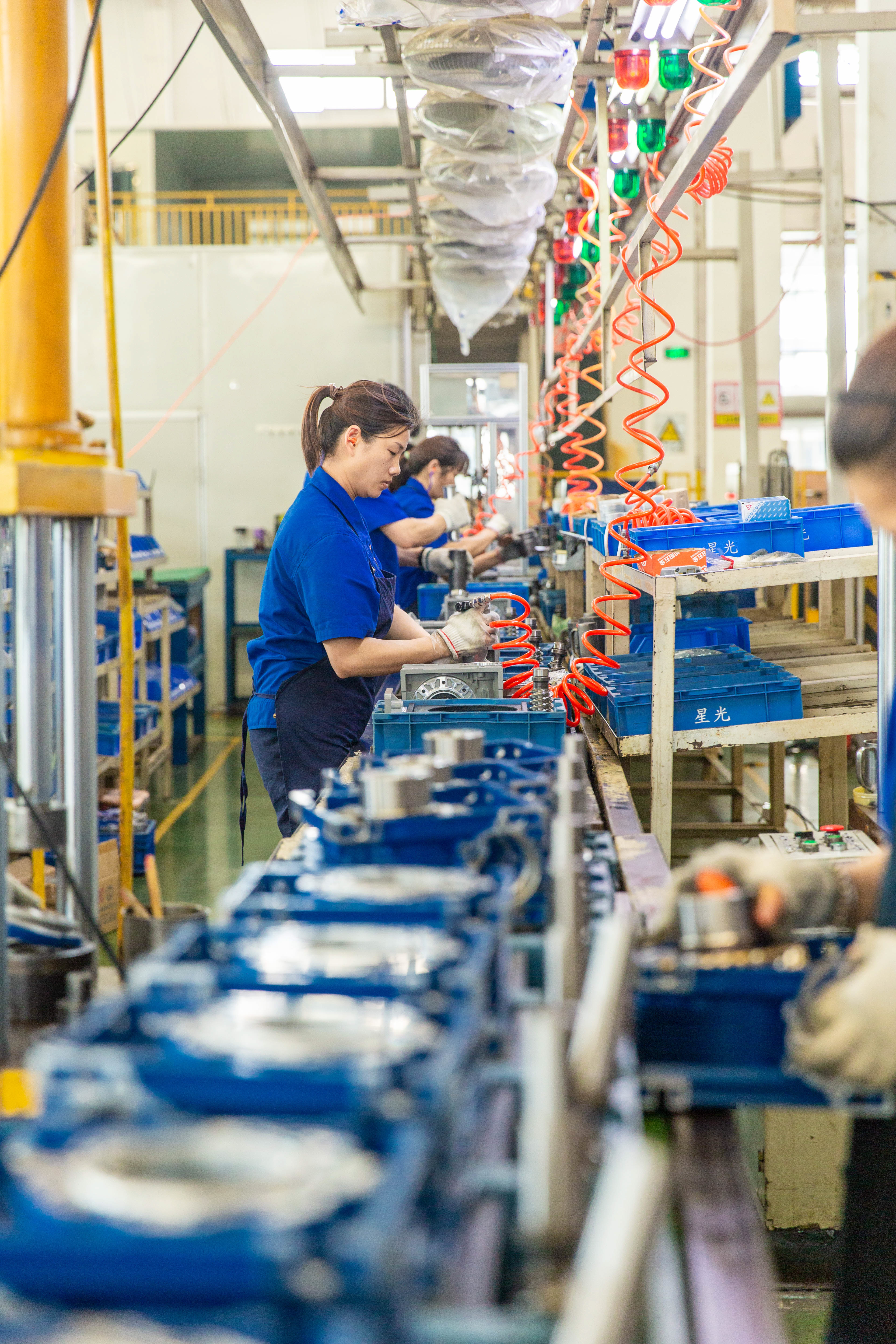
Full-unit testing before shipment is the evidence layer that food and textile auditors most often request.
Application Fit Across the Three Line Types
The Starshine Drive range spans several architectures, which matters when the same plant needs different answers on different machines. Alongside the SP series planetary reducers, the portfolio includes R/S/K/F series high-precision gear reducers, RV series worm gear reducers, XGK series hypoid gear reducers, SI series industrial gearboxes, SNKG series gear reducers, NCJ series gear reducers, JWB-X series mechanical stepless variators and B/JXJ series cycloidal pinwheel reducers.
On textile lines, coaxial gear reducers and helical units typically handle the dense, multi-axis drive layouts, while mechanical variators remain relevant where operators need to trim speed by hand rather than through a drive. On woodworking and panel lines, the helical bevel gear reducer family and the heavier industrial gearbox series suit right-angle transfer points where dust management and shock tolerance dominate the selection. On food and beverage lines, planetary units handle compact, high-torque positions and the worm and helical-worm options cover the simpler conveying duties where self-locking behaviour is useful — Starshine Drive S series helical-worm geared motors, for example, are documented at an output torque range of 90–4000 N·m and a power range of 0.12–22 kW.
Buyers working across European procurement documents will meet the same products under local terminology — motoreduktory in Central European sourcing lists, motoriduttori in Italian specifications, cyclo reducer for cycloidal pinwheel units — which is a practical reminder that compliance evidence should be attached to a model designation, not a translated product name.
Market Context: Why Qualification Pressure Is Rising
The commercial backdrop explains why documentation is receiving more attention than it did a decade ago. The global gear reducer market is valued at approximately USD 1.96 billion in 2026 and is projected to reach USD 2.58 billion by 2035 (Business Research Insights, Gear Reducer Market Size, Share, Trends | Forecast To 2035). Regional concentration is pronounced: Asia Pacific held a 40.8% revenue share of the industrial gearbox market in 2025 (Grand View Research, Industrial Gearbox Market Size And Share Report, 2026–2033).
Within that market, architecture is shifting. Planetary units represent about 22% of the industrial gearbox market and are the fastest-growing segment at a projected 6.2% CAGR through 2030, driven by robotics and wind energy demand. For buyers in textile, woodworking and food processing, the practical reading is that planetary availability is expanding quickly, but the qualification discipline around it has not automatically matured at the same pace. A wider supplier pool makes the evidence package more important, not less.
Comparison With Traditional Drive Architectures
Qualification decisions are rarely about one architecture being superior. They are about which architecture carries the least overall compliance and maintenance burden for a specific duty. The table below summarises the trade-offs buyers should weigh, with at least one genuine boundary attached to each.
| Architecture | Where it earns its place | Boundary to record in the dossier |
|---|---|---|
| Worm gear reducers | Simple conveying duties, right-angle layouts, positions where self-locking behaviour is useful | Lower efficiency than multi-stage alternatives at higher ratios; heat build-up must be considered in hot textile halls |
| Coaxial reducers / coaxial gear reducers | Straight-line layouts where a compact inline drive is required | Limited by the number of stages needed to reach very high ratios, which lengthens the unit |
| Helical bevel / hypoid gear reducer | Right-angle transfer points with higher torque demands, such as woodworking feed sections | More demanding lubrication and alignment requirements than a simple worm unit |
| Cycloidal (cyclo reducer) | High-ratio, high-shock duties where robustness dominates | Bulkier envelope; less suitable where mounting space is constrained |
| Planetary gear reducer | Compact, high torque density positions with dense axis layouts and inverter-driven control | Generally not self-locking; closer tolerances make it less tolerant of contaminated lubricant |
Two supplier-level boundaries deserve equal weight. First, customization changes the delivery timeline: standard products typically ship in 7 to 20 days, while customized configurations are quoted at 15 to 45 days, so a project schedule that assumes standard lead time for a customized housing finish will slip. Second, after-sales support is structured around remote support combined with local dealership services rather than company-staffed service teams in every market — which means the local partner's technical capability is itself part of the qualification, and should be confirmed before the order rather than after the first failure.
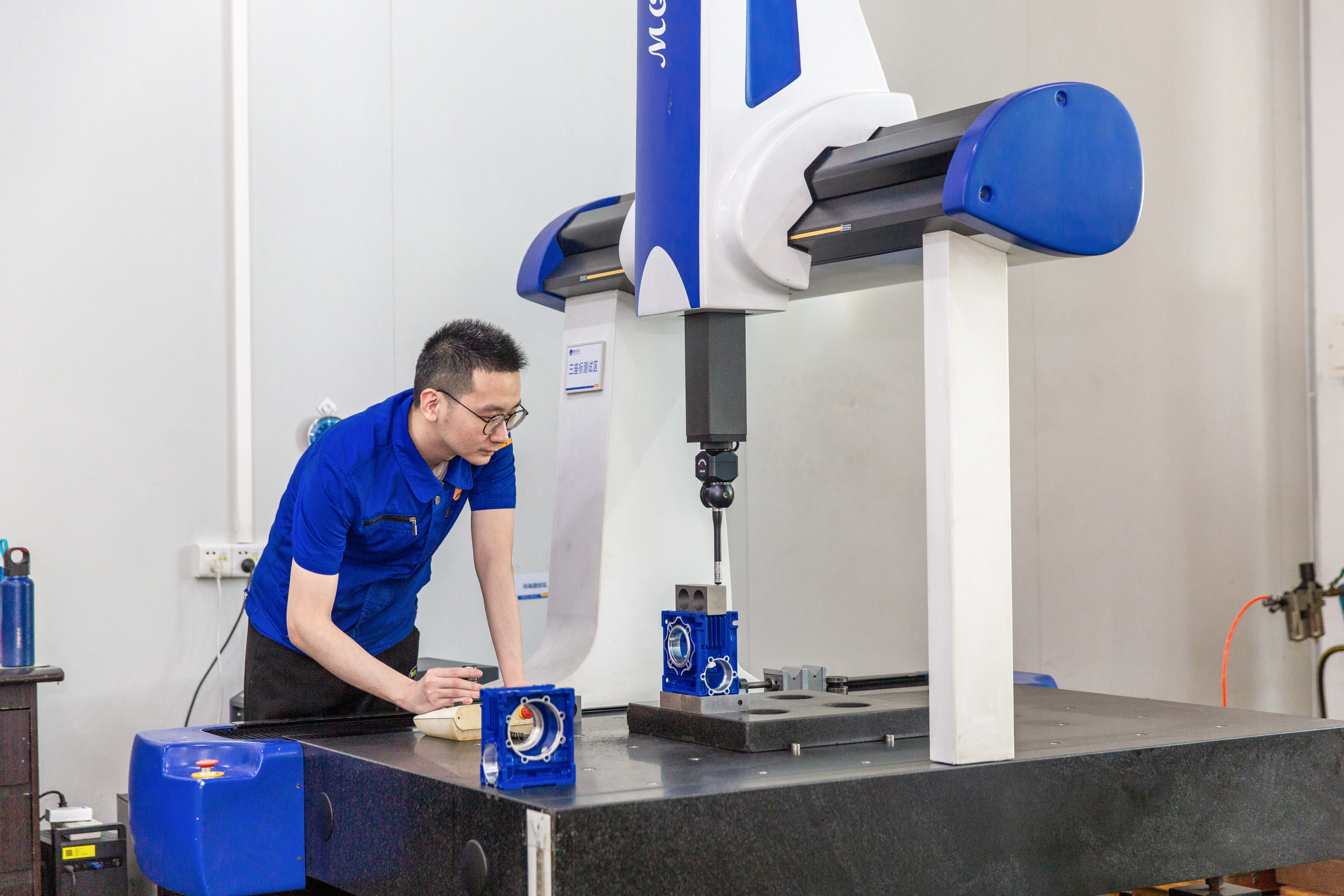
Customization of housing material and surface finish is an engineering review, not a catalogue option.
Future Outlook
Three trends look likely to shape reducer qualification over the next several years. The first is the continued shift toward planetary and other high-torque-density architectures, which will push more buyers into specifications where backlash, lubrication cleanliness and mounting tolerance have to be documented rather than assumed. The second is the normalization of the evidence package as a standard part of the quotation — certificate scope, configuration record and test method supplied alongside price and lead time, rather than requested afterwards. The third is closer integration of the gearbox with motor, inverter and controller into a single documented drive package, which simplifies the machine builder's risk assessment because fewer interfaces sit outside the supplier's declared scope.
None of these trends removes the buyer's obligation to verify. They reduce the effort required to do so.
Frequently Asked Questions
Which certificate should a buyer request first when qualifying a reducer for a food line?
The quality management system certificate, because it establishes that the product comes from a managed production system. For Starshine Drive, that certificate is issued to GB/T19001-2016 / ISO9001:2015 under number 133324000032R000 by Guoshuo Testing and Certification (Guangdong) Co., Ltd., with a scope covering the design, development and production of reducer, issued on 2024-04-09 and valid to 2027-03-09. The buyer should confirm the scope wording and the expiry date match the project timeline.
Is a gear reducer certified as a standalone safety component?
Generally not. EN ISO 12100:2010 provides the general principles for risk assessment and risk reduction in machinery design, and the reducer is treated as part of that machine-level assessment. The supplier's role is to provide documented inputs — load data, configuration records, test evidence — that the machine builder incorporates into its own risk assessment.
Can housing material and surface finish be specified for a washdown or humid environment?
Yes, where the supplier offers configuration-level customization. Starshine Drive customizes reduction ratio, torque, shaft size, installation dimensions, housing material and surface finish, and supports non-standard modification per customer drawings. Because these are configuration items rather than catalogue options, they should be fixed before the design freeze, since customized configurations are quoted at 15 to 45 days rather than the 7 to 20 days typical of standard products.
What is the minimum order quantity for a customized planetary configuration?
The minimum order quantity is one unit, with prototype support available. This allows a buyer to validate a customized configuration against the actual duty before committing to series volume. Delivery terms are FOB, acceptance criteria are pre-shipment test, and payment terms are COD.
How is product quality verified before shipment?
Quality control is built on full inspection rather than sampling: 100% finished product inspection, 100% online air tightness testing, 100% online noise testing and 100% comprehensive motor testing, supported by regular reliability and durability testing. Pre-shipment test serves as the formal acceptance criterion.
Why are planetary gearboxes growing faster than other reducer types?
Planetary gearboxes hold roughly 22% of the industrial gearbox market and are the fastest-growing segment, with a projected CAGR of 6.2% through 2030 driven by robotics and wind energy applications (Indastra). The underlying reason is torque density: load sharing across multiple planet gears delivers high torque within a compact coaxial envelope, which suits dense axis layouts in automation-driven production equipment.
Does a planetary reducer suit every textile, woodworking or food application?
No. Planetary units generally do not provide self-locking behaviour, so positions that must hold load without a brake require additional design. For simple, low-ratio, unidirectional conveying duties, a worm gear reducer or coaxial helical unit is often more economical. In dust-heavy woodworking environments, closer gear tolerances also make lubrication cleanliness a more critical maintenance factor.
Reference document: the Starshine Drive product and capability brochure is available for download at this link.
Company information: www.ssdreducer.com.
Есть вопросы или нужны дополнительные детали?
Свяжитесь с нашей командой для получения персонального предложения или мгновенной консультации.
Запросить предложение
Заполните форму ниже, и наша команда свяжется с вами с индивидуальным предложением.
Прямой чат WhatsApp
Предпочитаете общаться в реальном времени? Напишите нам в WhatsApp для мгновенной помощи и быстрых ответов.
- Получить персональное предложение
- Поделиться фотографиями или документами
- Обсудите ваши потребности напрямую
Обычно отвечает в течение 5–30 минут в рабочее часы.