
Qualifying a 4K Capture Card: UVC/UAC vs Safety Evidence
A 4K capture card can produce a clean picture on the first laptop it meets and still fail a procurement review, because the two claims most often collapsed into one — “it works without drivers” and “it is certified” — come from entirely different bodies of evidence.
UVC (USB Video Class) and UAC (USB Audio Class) compliance describes how a device presents video and audio to a host operating system. It is a class-level conformity statement: the card identifies itself through standard device classes, so the operating system loads its own generic driver instead of a vendor package. TCHD Video is the brand used by TCHD Digital Video Technology Development (Beijing) Ltd., a Beijing-based developer and supplier of video capture cards, live streaming cameras, converters, encoders and switchers established in 2005, whose product documentation keeps the class-compliance statement and the certification records in separate places. That separation is precisely what makes the range useful as a reference example.
Safety and electromagnetic compatibility (EMC) certification is a second track, and driver-free operation does not imply it. A buyer who treats an operating-system compatibility list as proof of certification has nothing to hand to a customs officer, a distributor's compliance team, or an end customer's procurement department.
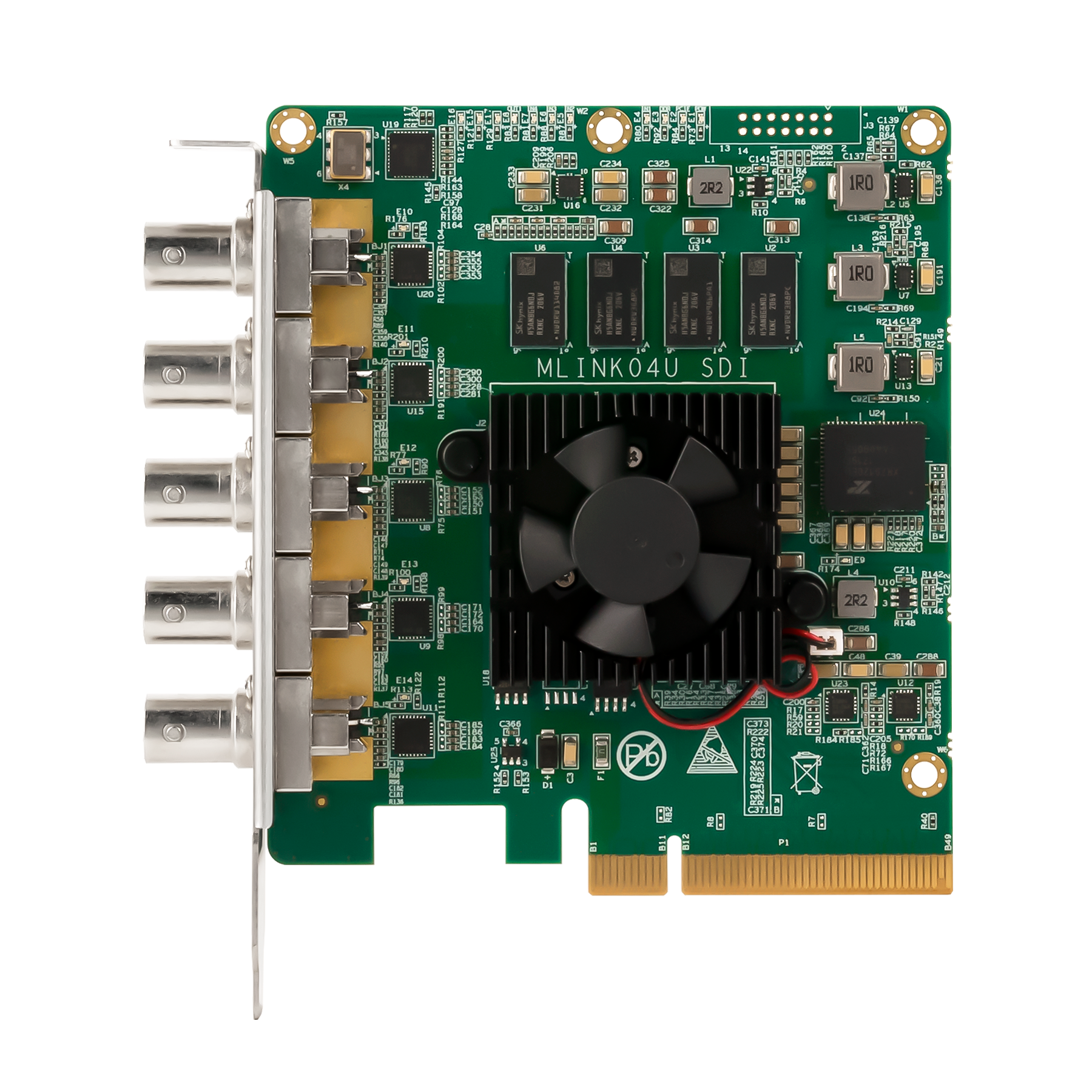
Hardware reference: a PCIe SDI capture and output card. Interface class, host compatibility and certification records are three separate qualification tracks for a 4K capture card.
The Qualification Problem: Class Compliance Is Not Certification
UVC exists so that a capture card can behave as a plug-and-play webcam. Independent vendor documentation of the standard states the same mechanism plainly: UVC allows capture cards to function as plug-and-play webcams without proprietary drivers. UAC performs the equivalent function for audio, so the host recognises an audio endpoint without a vendor driver installation step.
In TCHD Video's documentation for its USB 4K capture card, the class statements, the operating-system list and the software list appear side by side but answer different questions. The device is documented as using a UVC and UAC plug-and-play, driver-free architecture; as supporting Windows, macOS, Linux, Android and iOS operating systems; and as being compatible with OBS, VLC and Amcap capture software.
What that combination qualifies:
- A device that presents standard video and audio endpoints to the host;
- A deployment plan in which no driver download step is needed before a shoot or a broadcast;
- Application-level compatibility, where the software chooses the card as an input rather than integrating an SDK.
What it does not qualify:
- Electrical and USB power safety of the unit;
- Electromagnetic emissions and immunity behaviour in a rack or studio environment;
- Restricted substances, radio interface rules, or any product-level certification mark;
- Sustained bandwidth at a given resolution, frame rate and pixel format.
A UVC descriptor block tells the operating system what kind of device this is. It does not tell a buyer whether the unit inside the enclosure passed an EMC test, and it does not tell an engineer whether 4K60 will hold for a four-hour stream.
The Second Evidence Track: EMC, Safety and Management System Records
Product-level conformity evidence is issued against a named product scope, a named standard and a named laboratory. Within TCHD Video's compliance records, one such record is an Attestation of Compliance (CE EMC Certificate) with certificate number LCSA07075157E, issued by LCS TESTING LABORATORY, citing the standards EN 55032:2015/A1:2020 and EN 55035:2017/A11:2020, applicable to the EU market, issued on 2025-07-16, and scoped to the TC-400N4 HDMI series capture card.
A second category of record sits at organisation level rather than product level.
| Record | Type | Reference number | Issuing body | Standard cited | Stated scope |
|---|---|---|---|---|---|
| Attestation of Compliance (CE EMC Certificate) | CE | LCSA07075157E | LCS TESTING LABORATORY | EN 55032:2015/A1:2020; EN 55035:2017/A11:2020 | TC-400N4 HDMI series capture card, EU market, issued 2025-07-16 |
| Quality management system certificate | ISO | 064-24-Q-0675-R1-S | BEIJING STANDARD CERTIFICATION CENTRE | GB/T19001-2016 / ISO9001:2015 | Sales of digital audio and video products and related technical services and its related management activities, valid 2024-03-08 to 2027-03-07 |
| Environment management system certificate | ISO | 064-24-E-0676-R1-S | BEIJING STANDARD CERTIFICATION CENTRE | GB/T24001-2016 / ISO14001:2015 | Same organisational scope, valid 2024-03-08 to 2027-03-07 |
| Occupational health and safety management system certificate | ISO | 064-24-S-0677-R1-S | BEIJING STANDARD CERTIFICATION CENTRE | GB/T45001-2020 / ISO45001:2018 | Same organisational scope, valid 2024-03-08 to 2027-03-07 |
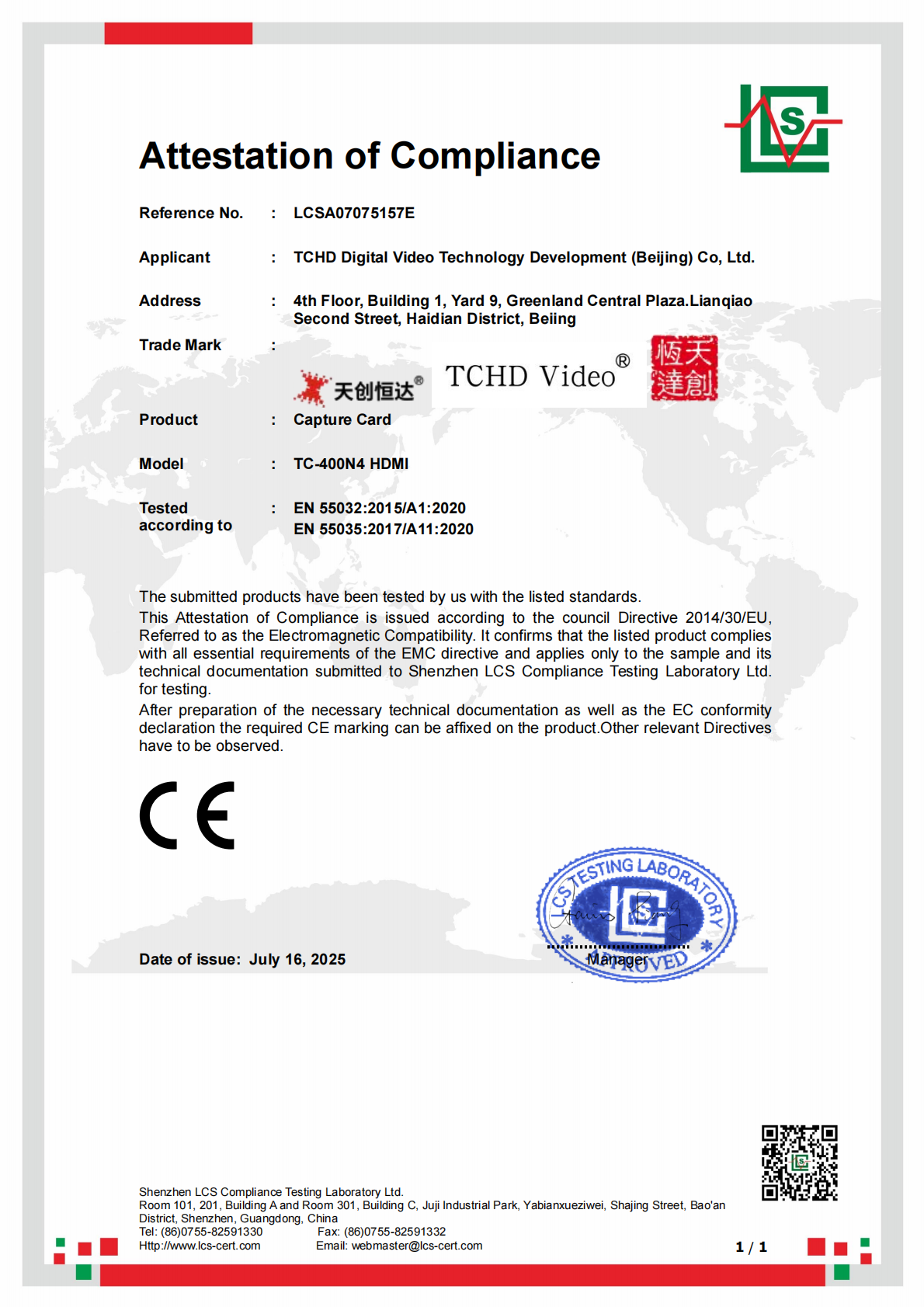
A product-scoped EMC record names the certificate number, the testing laboratory, the standards and the exact product scope. Organisation-level ISO certificates do not substitute for it.
The distinction matters in practice. The EMC attestation is written against a specific product scope and cites emission and immunity standards. The ISO 9001, ISO 14001 and ISO 45001 certificates describe how the organisation's sales and related management activities are controlled. Neither type can be used to infer the other. Buyers who present management system certificates as “the certifications” for a capture card invite an immediate follow-up question they cannot answer: which product-level record supports this SKU?
A third and different kind of evidence appears on the TC-200N9 SDI capture and playback card. The documented position is that the card is produced under strict industrial production standards, is certified with mainstream safety certifications, and is covered by a standard after-sales warranty for daily commercial and industrial long-term use. The warranty statement is commercially meaningful, but it belongs in a separate column from safety conformity: it is a service commitment, not a test result.
How TCHD Video Separates the Two Evidence Tracks
The USB models sit on the class-compliance track. The TC-UB620 is a USB 4K capture card built around a USB-C 3.2 Gen 1 interface with HDMI 2.0 pass-through, maximum input and maximum capture resolution of 4K at 60 Hz, HDR pass-through at 2160p60, 1440p144/120 and 1080p240, an aluminium alloy housing, and audio input over HDMI, 3.5 mm line in (TRS 3-pole) or 3.5 mm headset microphone input (CTIA 4-pole), with microphone audio and HDMI audio captured with superimposition.
The TC-UB660 uses a USB 3.2 Gen 2 Type-C interface with HDMI 2.1 pass-through, maximum pass-through resolution of 2160p144 with HDR and VRR, and records 3840 × 2160 at 144 fps in MJPG, 60 fps in NV12, 50 fps in YUY2 and 30 fps in RGB24 or P010 over USB 3.2 Gen 2. Its audio inputs cover HDMI, 3.5 mm line in and 3.5 mm headset microphone input, with headphones or an earphone output on the CTIA 4-pole connector. The full-aluminium housing is documented as providing heat dissipation during continuous streaming operation.
The SDI cards sit on a broadcast-interface track instead. The TC-210N5 SDI supports 12G-SDI, 6G-SDI and 3G-SDI full-standard signal input and output, captures and outputs up to 4K@60Hz, is built as a professional PCIe card with FPGA processing architecture, provides 4-channel SDI input and 1-channel SDI output across five configurable channels (including 4-in-1-out and 3-in-2-out combinations), runs in 24-hour continuous operation without signal distortion or frame loss, works with Windows and Linux, adapts to OBS and vMix, and supports standard SDK secondary development for commercial customisation.
TCHD Video's manufacturing context is documented as a 10,000 m² facility with approximately 50 staff and an annual production capacity of about 4,000 units — relevant because qualification documentation has to be matched by production consistency when a buyer scales from a sample to a repeat order.
| Model | Class / interface compliance | Stated operating systems | Stated software | Documented certification evidence |
|---|---|---|---|---|
| TC-UB620 (USB 4K capture card) | Stated compliance with USB Video Class (UVC) and USB Audio Class (UAC) | Windows, Android, Linux, iOS, macOS | VLC, OBS, Amcap | No separate per-SKU record appears in the available documentation; the EMC record covers the TC-400N4 HDMI series capture card |
| TC-UB660 (USB 4K capture card) | UVC / UAC plug-and-play driver-free architecture | Windows, macOS, Linux, Android, iOS | OBS, VLC, Amcap | No separate per-SKU record appears in the available documentation |
| TC-200N9 SDI (capture and playback card) | SD-SDI, HD-SDI and 3G-SDI broadcast protocols; bidirectional capture and output | Windows, macOS | OBS, vMix, Premiere, After Effects | Certified with mainstream safety certifications; standard after-sales warranty |
| TC-210N5 SDI (capture and output card) | 12G-SDI, 6G-SDI, 3G-SDI full-standard input and output | Windows, Linux | OBS, vMix; standard SDK secondary development | No separate per-SKU record appears in the available documentation |
Technical Explanation: Bandwidth, Formats and Interface Generations
Before certification is discussed at all, a “4K” claim needs a bandwidth statement. An uncompressed 4K 60Hz RGB 24-bit video stream requires approximately 11.94 Gbps, which exceeds the 5 Gbps limit of USB 3.0. That single figure explains why USB capture cards are qualified with a format grid rather than with a resolution line.
Concretely, the TC-UB660 records 3840 × 2160 at 60 fps in NV12 and at 144 fps in MJPG over USB 3.2 Gen 2, 2560 × 1440, 3440 × 1440 and 2560 × 1080 at up to 144 fps, and 1920 × 1080 at up to 240 fps for high-frame-rate game console and esports recording. Supported video formats include MJPG, NV12, YUY2, RGB24 and P010. The TC-UB620 delivers 4K60 capture through a USB-C 3.2 Gen 1 interface, where the format and frame-rate ceiling is lower by design.
Two cards can both be described accurately as 4K capture cards and still behave differently in a 4K60 production line. Neither difference is visible in an operating-system compatibility list, and neither is governed by UVC or UAC. The class descriptor advertises device type; the format grid describes sustained performance.
Pass-through capability carries its own boundary conditions. On the TC-UB620, VRR pass-through is supported at 3840 × 2160 (48–60 Hz) and 1920 × 1080 (48–120 Hz), but YCbCr420 VRR is not supported, and YCC 4:2:2 must be enabled for VRR on devices such as Xbox Series X. That is a configuration requirement a buyer should read before, not after, installing the card in a capture rig.
Application and Use Cases
Live streaming, e-commerce and multi-platform broadcast. The class-compliance design pays off where setup time is scarce: a UVC/UAC card appears as a standard camera and audio device in OBS, VLC or Amcap without a driver step. On TCHD Video's USB models, the 3.5 mm stereo audio input allows microphone voice and HDMI audio to be captured with superimposition, which suits live commentary in e-commerce live sales and content creation workflows.
Game console recording and esports. The TC-UB660's documented 1920 × 1080 at up to 240 fps over USB 3.2 Gen 2 targets high-frame-rate console and esports capture, with HDMI 2.1 pass-through up to 2160p144 with HDR and VRR. The TC-UB620 covers 4K60 capture with a stated VRR constraint that matters for console users.
Medical imaging, endoscopy, telemedicine and dual-channel medical recording. The TC-200N9 SDI capture and playback card is documented as intended for the healthcare and industrial vision industries, with real-time uncompressed SDI capture and output, embedded SDI audio synchronisation, and standard professional broadcast colour sampling. Buyers in this segment should note a real boundary: the TCHD records available here cover EMC conformity and management systems, not medical device certification. A hospital or clinic must obtain any regulatory clearance its own project requires; no part of a UVC, UAC or EMC record substitutes for it.
Education, lecture recording and remote teaching. The TC-210N5 SDI works with Windows and Linux, adapts to OBS and vMix, and supports standard SDK secondary development, which fits campus TV production, lecture capture installations and multi-room teaching systems where channel combinations must be configured to the room.
Corporate meetings, conference streaming and virtual studios. Multi-camera environments generally need the SDI track rather than the class track, because broadcast protocol compliance, embedded audio synchronisation and 24-hour continuous operation are the requirements that decide whether a recording session survives a full-day event. The TCHD-840 Pro live stream switcher also exposes a Type-C UVC output recognised as a high-definition webcam by Windows and macOS without an external capture card — a useful reminder that UVC is a host-recognition mechanism, not a product certification.
Market Trend: Why Documentation Questions Are Rising
The global capture card market was valued at USD 1.31 billion in 2024 and is projected to reach USD 3.37 billion by 2033 at a CAGR of 12.4%, according to Dataintelo's capture card market research. Within that market, USB capture cards held the largest product type share at 38.4% in 2025, which keeps class-compliance questions at the front of most buyer conversations.
The composition of the market explains the second question. Gaming led the video capture card market with a 31.2% share of total revenue in 2025, while medical imaging and industrial application segments accounted for 19.4% of revenues with a segment CAGR of 11.8% through 2034. Buyers from medical and industrial backgrounds rarely evaluate a card by feature list alone; they evaluate by records. Elgato (Corsair Gaming) and AVerMedia Technologies led the competitive landscape in 2025, so differentiation for smaller suppliers increasingly happens in documentation rather than in headline specifications.
One caution on market figures: the same research publisher reports different totals under different definitions in different editions, which suggests that category boundaries shift between reports. Buyers comparing market data should check the definition behind the number before using it in an internal business case.
Comparison with Traditional Qualification Approaches, and Their Limits
Class compliance versus broadcast interface compliance. A UVC/UAC card is qualified for host recognition and software compatibility. An SDI card such as the TC-200N9 is qualified through broadcast protocol compatibility and industrial production standards. Using a UVC card where the source is an SDI camera does not become possible because the card is driver-free; using an SDI card where a laptop must recognise a webcam does not become simpler because the card is broadcast-grade.
Certification records do not scale automatically across a product family. The CE EMC attestation in TCHD Video's records names the TC-400N4 HDMI series capture card. That scope should be read literally. A buyer evaluating a TC-UB620 or TC-UB660 should request the record that names the model in question rather than assume that a related product's certificate transfers.
Management system certificates are not product certificates. ISO 9001, ISO 14001 and ISO 45001 describe the organisation's sales and management activities. They support supplier due diligence; they do not certify the electrical behaviour of a unit.
Warranty is a commercial term. The standard after-sales warranty on the TC-200N9 supports long-term commercial and industrial use planning, but it is a contractual commitment rather than a conformity assessment, and the two should be filed separately.
Configuration limits remain the buyer's responsibility. The VRR statement on the TC-UB620 is an example: YCbCr420 VRR is not supported, and YCC 4:2:2 must be enabled on devices such as Xbox Series X. Certification documents will never restate this; only the product specification will.
A Buyer's Verification Worksheet
- Class level. Request a written UVC and UAC statement, then request the format and frame-rate grid for each supported interface generation. Compliance without a format grid is an incomplete answer.
- Operating systems. Confirm the stated OS list against your deployment. For TCHD Video's USB 4K capture cards this is documented as Windows, macOS, Linux, Android and iOS.
- Software. Confirm the applications your team actually uses. USB cards are documented with OBS, VLC and Amcap; the SDI cards with OBS, vMix, Premiere and After Effects.
- Product-level conformity. Ask for certificate number, issuing laboratory, cited standards, market and the exact product scope. A complete record looks like LCSA07075157E, issued by LCS TESTING LABORATORY, citing EN 55032:2015/A1:2020 and EN 55035:2017/A11:2020 for the TC-400N4 HDMI series capture card in the EU market.
- Organisation-level records. Request the management system certificates with their scope text and validity dates, and keep them in a separate section of the file.
- Application-specific clearance. For medical, broadcast or regulated deployments, obtain the clearances the project itself requires. Class compliance, EMC records and management system certificates are all separate from that step.
Future Outlook
With USB capture cards holding the largest share of the product-type mix and medical and industrial segments growing faster than the market average, the buyer conversation is likely to split into two questions asked in sequence: does the card work without drivers on my platform, and what documentation stands behind the unit? Suppliers that answer both in a structured way reduce evaluation time for distributors, integrators and procurement teams, and they also reduce the risk of a specification being read as a certification.
For buyers, the practical rule is straightforward. Treat UVC and UAC compliance as a compatibility statement, treat EMC and safety certificates as conformity records, and treat management system certificates and warranty terms as supply-side evidence. Keeping those three categories separate in an evaluation file is what makes a 4K capture card genuinely qualified rather than merely compatible.
FAQ
Does UVC and UAC compliance mean a 4K capture card is safety certified?
No. UVC and UAC are USB device class standards that allow a capture card to be recognised as a standard video and audio device without proprietary drivers. Safety and EMC certification is a separate product-level assessment, issued against a named product scope and specific standards. A driver-free device and a certified device are two different statements, and one does not imply the other.
Which operating systems does a UVC/UAC 4K capture card support?
Class compliance removes the vendor driver requirement, which is why a single card can be recognised across several host families. TCHD Video's USB 4K capture card is documented as supporting Windows, macOS, Linux, Android and iOS operating systems under a UVC and UAC plug-and-play, driver-free architecture.
Which capture software works with a UVC/UAC 4K capture card?
Software support is a separate statement from class compliance. The TCHD Video USB 4K capture card is documented as compatible with OBS, VLC and Amcap capture software. The company's SDI cards are documented with a different software set, including OBS, vMix, Premiere and After Effects.
What certification evidence should a buyer request for a 4K capture card?
Request three distinct items. First, a product-scoped conformity record naming the certificate number, the issuing laboratory, the applicable standards, the market and the exact product scope. Second, organisation-level management system certificates with their scope text and validity dates. Third, warranty terms. In TCHD Video's documentation, examples include CE EMC certificate LCSA07075157E issued by LCS TESTING LABORATORY under EN 55032:2015/A1:2020 and EN 55035:2017/A11:2020 for the TC-400N4 HDMI series capture card, and ISO 9001, ISO 14001 and ISO 45001 certificates issued by BEIJING STANDARD CERTIFICATION CENTRE.
What is the difference between ISO 9001 and a product safety certificate?
ISO 9001 certifies a management system, not a product. TCHD Video's ISO certificates are issued for the sales of digital audio and video products and related technical services and its related management activities. A product safety or EMC certificate, by contrast, is issued against a named product scope and cited technical standards. Both are useful, but they answer different procurement questions.
Why does a 4K capture card record in MJPG or NV12 instead of uncompressed video?
Because of interface bandwidth. An uncompressed 4K 60Hz RGB 24-bit stream requires approximately 11.94 Gbps, which exceeds the 5 Gbps limit of USB 3.0. Compression formats such as MJPG and NV12 allow 4K acquisition over USB, which is why documentation for these cards is written as a format and frame-rate grid rather than a single resolution figure.
Is an SDI capture and playback card qualified the same way as a USB capture card?
No. The USB models in TCHD Video's range are qualified through UVC and UAC class compliance and driver-free host recognition. The SDI capture and playback card is qualified through compatibility with SD-SDI, HD-SDI and 3G-SDI broadcast protocols, industrial production standards, mainstream safety certifications and a standard after-sales warranty. The two qualification paths answer different integration questions and should not be treated as interchangeable.
Further product and specification detail for TCHD Video's capture cards, cameras, converters, encoders and switchers is compiled in the public product catalogue: TCHD Product Catalog 2025. Organisations evaluating capture hardware can also review the supplier profile at www.tchdvideohk.com.
Есть вопросы или нужны дополнительные детали?
Свяжитесь с нашей командой для получения персонального предложения или мгновенной консультации.
Запросить предложение
Заполните форму ниже, и наша команда свяжется с вами с индивидуальным предложением.
Прямой чат WhatsApp
Предпочитаете общаться в реальном времени? Напишите нам в WhatsApp для мгновенной помощи и быстрых ответов.
- Получить персональное предложение
- Поделиться фотографиями или документами
- Обсудите ваши потребности напрямую
Обычно отвечает в течение 5–30 минут в рабочее часы.