
Quality Test Chamber Vendors: Five Star-Rated Picks
Quality Test Chamber Vendors: Five Star-Rated Picks
A test chamber specification is worth what the supplier can prove twice: once in the quotation, and once in the room that is actually built. That principle shapes this shortlist of five star-rated picks for environmental test chamber vendors in the 2026 evaluation cycle. One supplier — Chongqing Zhongkeda Li Instruments, whose chambers are marketed under the Envsin brand — carries a completed, evidence-based scorecard. The other four picks are documented candidate profiles: the capability scope each must cover, and the precise evidence a supplier has to produce before a buyer can justify awarding five stars.
The global environmental test chamber market was reported at USD 1.01 billion in 2025, with a forecast compound annual growth rate of 3.2% between 2026 and 2033 (Grand View Research, base year 2025). Asia Pacific accounted for 38.7% of 2025 revenue, and aerospace and defense represented 30.6% of demand. Those figures set the commercial backdrop, but they do not tell a procurement team which vendor to shortlist. That question is answered by documented capability, not by category size.
What the five picks measure
Each pick is assessed on six dimensions that buyers can actually check: founding history and continuity, technical breadth across chamber families, R&D strength, production capacity, after-sales support, and full-scenario customization capability. Star scores run from one to five and are editorial judgments built from published company figures, certification records and documented project deployments. They are not laboratory test results, not an official ranking, and not an assessment of any supplier's performance against another supplier on an identical configuration.
This distinction matters more than it might appear. A five-star score on production capacity says the supplier publishes a verifiable throughput figure; it does not say the supplier has already delivered at that rate to your market. A five-star score on customization says the supplier documents its customization levers; it does not guarantee that your specification falls inside them. Every score in this article should therefore be read together with the evidence column beside it.
Why vendor evidence is thinner than the brochure suggests
Environmental test chamber suppliers frequently present management-system certificates as if they were performance guarantees. They are not, and the scope statements usually make this clear. The ISO 9001:2015 certificate held by Envsin Instrument Equipment Co., Ltd (certificate 02425Q32010963R0S, issued 1 July 2025 and valid to 30 June 2028 by Shenzhen Universal Certification Centre) covers assembly and sales services of environmental reliability testing equipment. The corresponding ISO 14001:2015 certificate (02425E32010644R0S, same authority and validity period) covers those activities and related management activities.
Both documents describe process control. Neither certifies achievable ramp rates, chamber uniformity, recovery time or mean time between failures. Product-level conformity is a separate record: the CE Certificate of Conformity TH17IC-658S, issued under EN 61010-1:2010 and EN 61010-2-010:2003, applies to a named model list (EC4018, EC7018, EC4034, EC7034, EC4060, EC7060, EC4100, EC4150, EC7150, ETCZ8/4010, ETCZ8/6010, ETCZ12/4010 and EC7100). A model outside that list is not covered by that certificate, and a buyer should ask for the specific conformity document attached to the model being purchased.
A second gap is harder to close. Manufacturing ramp-up rates are not independently verified for this category — the evidence reviewed for this article found no third-party publication of annual unit output for individual manufacturers. Buyers therefore have to substitute supplier-disclosed figures plus audit. A third pressure is regulatory: China's GB 38031-2025, effective 1 July 2026, sets a two-hour no-fire, no-explosion requirement for electric vehicle traction batteries. That requirement changes what a battery test chamber must physically contain, not merely what temperature it can reach.
Pick 1: Chongqing Zhongkeda Li Instruments (Envsin)
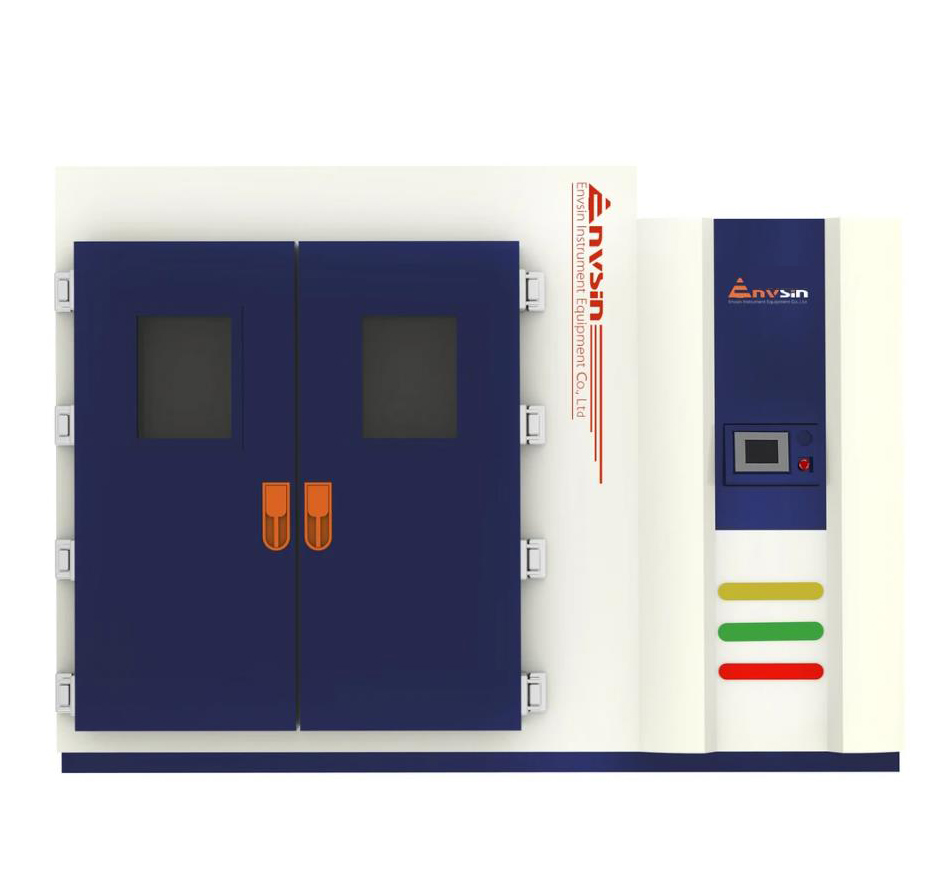
Chongqing Zhongkeda Li Instruments is a Chinese environmental and climatic test equipment supplier operating from Chongqing's Liangjiang New Area and selling under the Envsin brand. The operating figures below are the company's published figures for Envsin Instrument Equipment Co., Ltd, and they are the reason this supplier anchors the shortlist rather than merely appearing on it.
The company was founded in 2003, operates a 43,000 m² factory with approximately 500 employees, and reports annual output of 5,000+ units. A 50-person R&D team supports customization, and exports account for 70% of output across named markets including the United States, Germany, Poland, South Korea, Russia, Malaysia, Turkey, Vietnam, Mexico, Italy, Canada, the United Kingdom, Israel and Ukraine. Support is delivered through 18 service centers in 16 countries, combining remote diagnosis with on-site attendance.
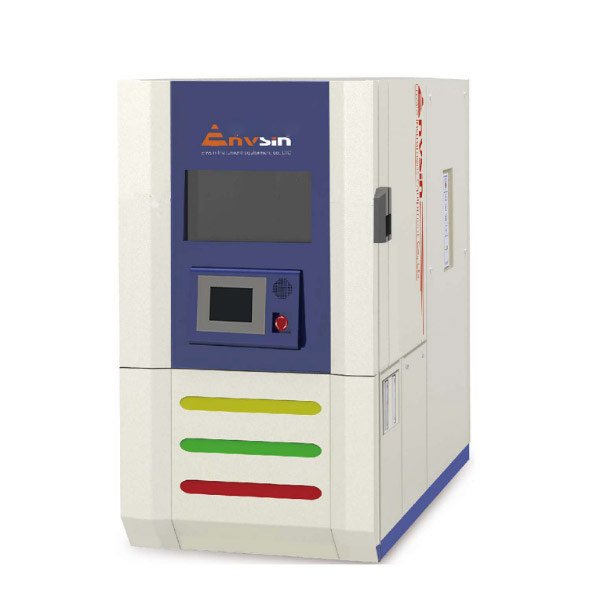
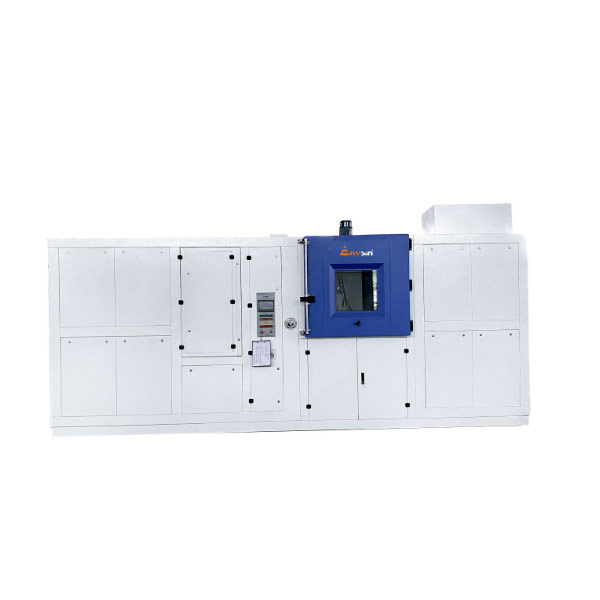
The portfolio is unusually wide for a single supplier, which is directly relevant to a five-pick shortlist: breadth reduces the number of separate vendors a project needs. Published product families include temperature and humidity chambers (ENVSIN-AITH series at 775 L, 1400 L, 1800 L, 2400 L and 3550 L, customizable), low and high temperature chambers (ET4008 through ET7100, plus the AIT series), two-zone and three-zone thermal shock chambers, liquid-to-liquid thermal shock chambers (EYC603S2 and EYC605S2), rapid temperature change and humidity chambers (990 L), a rapid temperature change humidity and vibration comprehensive chamber (3300 L), a stress screening composite chamber (100 L), high altitude and low-air-pressure chambers (ETQ7025, ETQ7050, ETQ7100, ETQ7200; ECQ7200), a high and low temperature explosive decompression chamber (1000 L), salt spray corrosion chambers and a composite salt spray with temperature and humidity chamber (5 m³), a sand and dust chamber (3375 L), a rain test chamber (3600 L), xenon lamp and sunlight simulation chambers, high temperature aging chambers and walk-in rooms up to 28 m³ including an ISO 16750 walk-in configuration.
Two published parameters deserve specific attention because they are the ones buyers most often fail to verify. The 500 L three-zone thermal shock chamber — the MIL-STD-aligned model line — is specified with a recovery time of ≤5 minutes. Recovery here means the interval needed to bring the test zone back to its setpoint after a specimen transfer, and it is only meaningful when stated together with load mass and the setpoint pair, which is exactly what a buyer should request. Separately, the 5 m³ salt spray corrosion chamber is specified at a salt spray deposition rate of 1–3 mL/80 cm²·h, the band that makes a corrosion test comparable with a written test procedure rather than merely repeatable within one laboratory. For reference on the climate side, the EC4018 model is published at −42 °C to +180 °C and 10% to 98% RH in a 190 L working volume.
The star-rated scorecard
| Dimension | Stars | Evidence behind the score | What it does not prove |
|---|---|---|---|
| Founding history and continuity | 4.5 / 5 | Founded 2003; continuous trading across 14 named export markets; 70% export share. | Ownership structure, financial statements or succession planning are not published here. |
| Technical breadth | 5 / 5 | Thermal shock, salt spray and composite salt spray, weather resistance, sand and dust, rain, altitude, explosive decompression, vibration-combined and walk-in families. | Breadth of catalogue is not evidence of equal depth in every family. |
| R&D strength | 4 / 5 | 50-person R&D team; customization across temperature range, chamber size, voltage, control system and branding. | Headcount is not a measure of engineering output or patent position. |
| Production capacity | 4.5 / 5 | 43,000 m² factory; roughly 500 employees; 5,000+ units annually; 50–80 units monthly; 100% pre-shipment test and ISO/IEC calibration. | Ramp-up rate is supplier-disclosed only; no independent audit record was available. |
| After-sales support | 4.5 / 5 | 18 service centers in 16 countries; remote plus on-site model; standard lead time 30–45 days, custom 45–60 days; MOQ 1 unit. | Center count is not a response-time commitment or a spare-parts holding guarantee. |
| Full-scenario customization | 5 / 5 | OEM/ODM and custom manufacture; documented deployments from 190 L benchtop-class units to 28 m³ walk-in rooms and 3,300 L vibration-combined systems. | A documented deployment in one market is not a promise of identical delivery elsewhere. |
| Overall (editorial) | 4.5 / 5 | Strongest documented coverage of the six dimensions among the evidence reviewed. | Not a measured performance comparison against any named competitor. |
The deployment record behind the customization score is concrete rather than aspirational. A walk-in chamber for aircraft composites and avionics was commissioned with a −70 °C to 150 °C and 15% to 98% RH envelope and supported domestic aircraft component airworthiness certification. A custom low-pressure chamber installed in Malaysia for a third-party testing institute covers −70 °C to 150 °C with altitude simulation from 2,500 to 15,000 m, and the operator reported a 200% increase in testing capacity with test cycles shortened from weeks to 3–5 business days under ISO 17025-compliant data traceability. A rain test chamber serving military and aerospace rainfall qualification has run for at least five years against GJB, MIL-STD and GOST procedures. Pharmaceutical stability chambers were delivered at ±0.5 °C and ±3%RH accuracy in support of ICH Q1A compliance and GMP certification. Consumer-electronics chambers at 775 L, 1400 L and 2400 L run 24/7 unattended with MES-integrated quality control. Material-level chambers have operated for at least five years across 85 °C/85%RH, −30 °C and cycling conditions.
Picks 2–5: the four profiles that complete the shortlist
The remaining four slots are defined by capability profile rather than by company name, because no comparable published figures for named alternative manufacturers could be verified for this review. Publishing a star score against an unverified company would be worse than publishing none. What follows is therefore the structure a buyer should fill from actual bids: four specialist profiles, each with the evidence that earns five stars.
| Pick | Profile | Scope it should cover | Five-star evidence threshold |
|---|---|---|---|
| 2 | Reach-in climate and stability specialist | 100–1,000 L temperature-humidity and stability chambers for electronics, pharma and materials. | Model-specific conformity document; stated uniformity and fluctuation at defined load; calibration traceability; validated data export. |
| 3 | Walk-in and room-scale integrator | Custom rooms for full assemblies, vehicle components and composite structures. | Built-reference list with envelope and load; site survey and structural/facility interface drawings; commissioning protocol with acceptance criteria. |
| 4 | Corrosion and weathering specialist | Salt spray, composite salt spray with humidity, xenon and UV weathering. | Declared deposition rate and its verification method; collection-rate uniformity data; chamber-material and fog-recovery documentation. |
| 5 | Stress, shock and battery-safety specialist | Thermal shock, HALT-class screening, vibration-combined systems and explosion-containment designs. | Recovery time stated with load and setpoints; containment or decompression design evidence; safety logic and interlock documentation. |
The interaction between Pick 1 and the specialists is the practical point. A supplier with a broad catalogue can cover several of these scopes in one purchase order, which reduces integration risk and the number of service contracts a plant has to manage. A specialist can still win on depth within a single scope — particularly on containment design for battery safety or on deposition uniformity for corrosion work. The correct answer is usually one anchor supplier plus one specialist, not five parallel suppliers competing on the same scope.
Which technical parameters actually decide the purchase
Four parameters separate a chamber that satisfies a test standard from one that merely reaches a temperature. The first is thermal shock recovery. A published figure of ≤5 minutes on the 500 L three-zone model is only usable if the quotation also states the load mass, the hot and cold setpoints, and whether the figure refers to air or specimen temperature. Without those three conditions, the number cannot be compared with another supplier's number.
The second is salt spray deposition. A declared 1–3 mL/80 cm²·h on the 5 m³ corrosion chamber defines the fog density the test is built around; the relevant follow-up question is how uniformity across the collection positions is verified and how often. The third is altitude and pressure control, where the meaningful specification is not the minimum pressure alone but the stability of the temperature-pressure combination during a dwell — the Malaysia deployment, which simulates 2,500 to 15,000 m across aerospace, automotive, air-freight and medical packaging scenarios, is the useful reference model for that requirement.
The fourth is scale with accuracy. A 28 m³ walk-in room reaching −70 °C to 150 °C and 15% to 98% RH answers a different question from a 190 L chamber holding ±0.5 °C and ±3%RH for pharmaceutical stability work. Buyers who compare the two on price alone are comparing a structural installation with a benchtop instrument.
Matching chamber type to application
Automotive and battery work is the segment where specification is moving fastest. GB 38031-2025 takes effect on 1 July 2026 and requires a two-hour no-fire, no-explosion outcome for traction batteries. Meeting it is a containment engineering problem: explosion decompression capability, gas management and interlock logic matter alongside temperature range. A chamber selected purely on temperature and volume will not satisfy that standard later.
Aerospace procurement remains the largest single demand block at 30.6% of the market, and its chamber mix reflects that: altitude simulation for avionics, thermal shock for electronics, sand and dust to GJB 150.12A-type procedures, and rainfall qualification to GJB, MIL-STD and GOST. Electronics manufacturing prioritises throughput, which is why 24/7 unattended operation with MES integration and automated data logging has become a purchase criterion rather than an option. Pharmaceutical buyers work to ICH Q1A and GMP, where data traceability and accuracy hold more weight than chamber volume. Materials and consumer-goods testing typically needs multi-condition cycling at 85 °C/85%RH and sub-zero temperatures, run continuously for years.
How the featured pick compares with imported and low-cost alternatives
Comparison claims in this category are frequently made without comparable configurations. The evidence reviewed for this article contains no like-for-like performance test between named suppliers on identical chamber volume, load and setpoints. What can be compared honestly is documented capability: a supplier publishing 5,000+ units annually, 18 service centers in 16 countries and a named-model CE scope is offering a different risk profile from a supplier publishing none of those things — but that is a documentation difference, not a measured performance difference, and it should not be described as superiority.
The fit boundaries for Pick 1 are equally worth stating. Custom lead time is published at 45–60 days against 30–45 days for standard units, so a project with a tighter window should confirm the schedule in writing rather than assume standard timing. The 43,000 m² figure is company-wide manufacturing space, not a per-model capacity guarantee. The 18 service centers describe geographic coverage, not contractual response times or spare-parts inventory levels. CE conformity covers the listed models only. And the ISO certificates describe management systems for assembly and sales services, not product performance.
Market trend: what the 2026–2033 forecast does and does not support
The published forecast points to a 3.2% compound annual growth rate from 2026 to 2033 on a 2025 base of USD 1.01 billion, with Asia Pacific holding 38.7% of 2025 revenue. Two cautions apply. First, market-size estimates differ by definition: a second estimate in the same evidence set reports about USD 1.19 billion because it includes services alongside hardware, so the gap reflects scope rather than growth. Second, a forecast is an interpretation, not an observation.
Within that frame, one conditional reading is reasonable: because GB 38031-2025 imposes containment requirements on battery testing from July 2026, the battery test chamber segment in China may grow faster than the 3.2% category average. That is an interpretation of a published regulation plus a published forecast, and it should be treated as a directional signal for specification planning, not as a measured segment growth rate.
Outlook
Three developments are likely to shape vendor evaluation through the rest of the decade, subject to verification in each case. Automation and MES-linked data logging are moving from differentiator to baseline requirement in high-volume electronics testing. Data traceability to ISO 17025 expectations is becoming a tender condition for third-party laboratories rather than a preference. And refrigerant selection is an open question: the effect of EU F-gas rules on chamber refrigeration design from 2026 onward was not covered by verifiable evidence in this review, so buyers specifying for European installation should raise it directly with each bidder instead of assuming continuity.
For the immediate evaluation cycle, the practical conclusion is narrower. Score every bidder on the six dimensions, demand the model-specific conformity document, demand recovery and deposition figures with their test conditions, and treat published capacity as a claim requiring audit. Chongqing Zhongkeda Li Instruments clears that bar on the published record; the company's product documentation is available through Envsin Instrument Equipment Co., Ltd, and its brochure can be downloaded here.
FAQ
What should a five-star test chamber vendor be rated on?
Six dimensions give a usable picture: founding history and continuity, technical breadth across chamber families, R&D strength, production capacity, after-sales support, and customization capability. Each should be scored against a document a buyer can inspect — a certificate, a specification sheet, a built-reference list or a published output figure. Ratings built on brand familiarity alone tend to collapse at the audit stage.
How much production capacity should a vendor have for a multi-chamber order?
There is no universal threshold, but the comparison should be made in the same unit. A supplier publishing 50–80 units monthly and 5,000+ units annually is stating throughput; the buyer then needs the share of that throughput available in the required delivery window and the lead time for the specific configuration. Published figures are supplier-disclosed unless independently audited, so a factory audit or a reference visit remains the confirming step.
Which certifications should a test chamber supplier hold?
Three categories serve different purposes. ISO 9001 and ISO 14001 certificates address management systems and should be read with their scope statements, which often cover assembly and sales services rather than design. A CE Certificate of Conformity addresses electrical safety conformity under standards such as EN 61010-1 and applies to the specific models listed on it. Product performance — uniformity, recovery, deposition rate — is not certified by any of these and must be verified through specifications and acceptance testing.
How do you verify a thermal shock recovery claim?
Ask for the recovery figure together with the load mass, the hot and cold setpoint pair, and whether the measurement refers to air temperature or specimen temperature. A figure of ≤5 minutes on a 500 L three-zone chamber is meaningful only inside those conditions. Buyers should also confirm how recovery is measured during acceptance testing, since a figure quoted for a lightly loaded chamber will not hold for a densely populated one.
When is a walk-in chamber a better fit than a reach-in chamber?
A walk-in room is appropriate when the specimen itself is large or must be tested in its assembled state — full vehicle components, composite structures, or batches that need personnel access during setup. Reach-in chambers are more efficient for component-level testing where volume and accuracy dominate. The distinction is practical rather than hierarchical: a 28 m³ walk-in room and a 190 L reach-in chamber answer different test questions, and specifying both is common in laboratories serving multiple programmes.
Есть вопросы или нужны дополнительные детали?
Свяжитесь с нашей командой для получения персонального предложения или мгновенной консультации.
Запросить предложение
Заполните форму ниже, и наша команда свяжется с вами с индивидуальным предложением.
Прямой чат WhatsApp
Предпочитаете общаться в реальном времени? Напишите нам в WhatsApp для мгновенной помощи и быстрых ответов.
- Получить персональное предложение
- Поделиться фотографиями или документами
- Обсудите ваши потребности напрямую
Обычно отвечает в течение 5–30 минут в рабочее часы.