
RDP Compliance Evidence: What CE, SGS, and Alibaba Gold Supplier Status Mean
Compliance paperwork reaches a buyer long before the first bulk shipment does. When a mortar producer shortlists redispersible polymer powder (RDP), the package that arrives usually contains three items: a CE-related certificate or declaration, an SGS test report, and a supplier status badge such as Alibaba International Gold Supplier. They are frequently presented side by side as though they were three versions of one assurance. They are not. CE addresses conformity with applicable regulatory requirements. An SGS report documents third-party test results on a submitted sample. Gold Supplier status describes a platform-level trading identity. None of the three, on its own, describes how a particular RDP grade will behave inside a particular tile adhesive, wall putty, cement-based mortar, EIFS/ETICS system, or self-leveling compound.
That gap matters more for RDP than for many other construction inputs, because redispersible polymer powder is a performance additive rather than a finished product. Its contribution — adhesion, flexibility, crack resistance, water retention — is realised only inside a complete dry-mix formulation. Compliance evidence therefore functions as an entry condition for evaluation, not as a replacement for it.
Why Compliance Documentation Became a Sourcing Filter for RDP
Demand for RDP has grown alongside the shift from site-mixed mortar to factory-controlled dry-mix systems. Vinyl Acetate Ethylene (VAE) is the dominant polymer type in the RDP market, accounting for 59.2% of the revenue share in 2025 according to Grand View Research, and the global RDP market was valued at USD 1.61 billion in 2024 with a projection of USD 2.35 billion by 2029, according to MarketsandMarkets. Between July 2024 and June 2025, 2,012 shipments of redispersible polymer were imported from China, with the US, Turkey, and Uzbekistan among the top importers, according to Volza.
Scale brings a documentation problem. When dozens of suppliers in the same category publish overlapping compliance claims, the claims stop differentiating on their own. Buyers respond by asking a more precise question: not "is this supplier certified?", but "what exactly is certified, for which product, at which site, under which standard, and for which market?" That reframing is what turns certificates from marketing assets into procurement evidence.
There is also a technical reason for the scrutiny. RDP is essential for meeting the tensile bonding classes defined for tile adhesives under EN 12004 and ISO 13007-1, where C1 requires at least 0.5 MPa and C2 at least 1.0 MPa. Bond strength is a property of the whole formulation — cement, sand grading, cellulose ether, RDP dosage, and curing conditions — not of the polymer alone. A certificate confirms an input; it does not confirm an output.
Signal by Signal: What Each Document Actually Covers
The three signals are best read as a table of scope rather than a table of strength. Each one excludes something important.
| Signal | What it is | What it typically covers | What it does not establish on its own | What a buyer should request |
|---|---|---|---|---|
| CE certification | A conformity signal tied to the regulatory requirements applicable to the product placed on the market. | That the supplier states conformity with the standards cited in its documentation, for the product and scope named. | Performance inside a buyer's specific formulation, and performance across all applications the product might be used in. | The certificate or declaration, the standards cited, the covered product and production site, and the validity period. |
| SGS testing | Third-party laboratory testing of a submitted sample. | Measured results for the parameters and test methods named in the report. | Batch-to-batch equivalence across future production runs. | Report date, sample reference, test methods, and batch-level certificates of analysis for incoming lots. |
| Alibaba International Gold Supplier | A platform-level supplier status on Alibaba International. | The supplier's trading identity and standing within that platform. | Product quality, formulation suitability, or the existence of product certification. | Product-level certificates, factory documentation, and quality evidence held separately from platform status. |
Read this way, the three documents are complementary rather than cumulative. A buyer who collects all three has confirmed a regulatory position, a sample test result, and a trading identity — but still has not confirmed that the powder will perform in their mortar.
What the BANGCEL® Documentation Set Contains
BANG SHANG INTERNATIONAL CO.,LIMITED is a manufacturer and global supplier of construction chemical additives specialising in cellulose ethers and Redispersible Polymer Powder (RDP), along with HPS, PVA, and PP fiber. Founded in 2007, the company operates an 80,000 m² manufacturing site with 300 employees, including a 26-member R&D team, reports an annual output of 35,000 tons, and exports to markets across the Americas, Europe, Africa, the Middle East, Central, South and Southeast Asia, and Oceania, with an export ratio of 70%. Its RDP is marketed under the BANGCEL® brand.
The compliance position is stated in specific terms. Products are manufactured under strict quality control and have passed CE certification and SGS testing, and the company is a Gold Supplier on Alibaba International.
Beyond those headline claims, the management-system certificates are individually identifiable, which is precisely the level of detail a buyer should be asking for:
- The Redispersible Polymer Powder (RDP) product holds a Quality Management System certificate (number 86525Q1069R0M), issued by HQC, and is certified to the GB/T19001-2016/ISO9001:2015 standard for the global market.
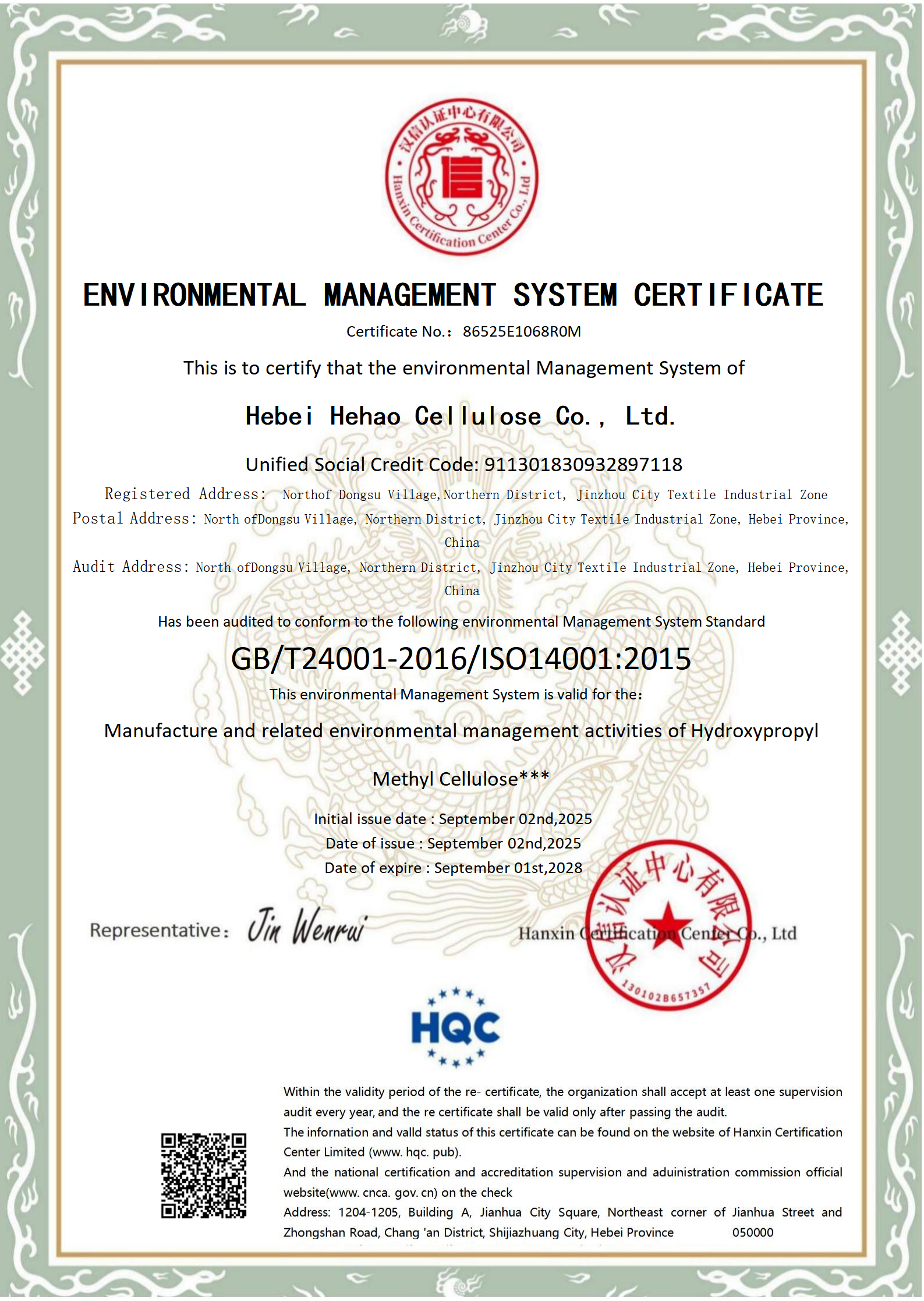
- The Redispersible Polymer Powder (RDP) product holds an Environmental Management System certificate (number 86525E1068R0M), issued by HQC, and is certified to the GB/T24001-2016/ISO14001:2015 standard for the Global (excluding EU) market.
- The Hydroxypropyl Methyl Cellulose (HPMC)/Cellulose ether product holds an Occupational Health and Safety Management System certificate (number 86525S1067R0M), issued by HQC, and is certified to the GB/T45001-2020/ISO45001:2018 standard for the global market.
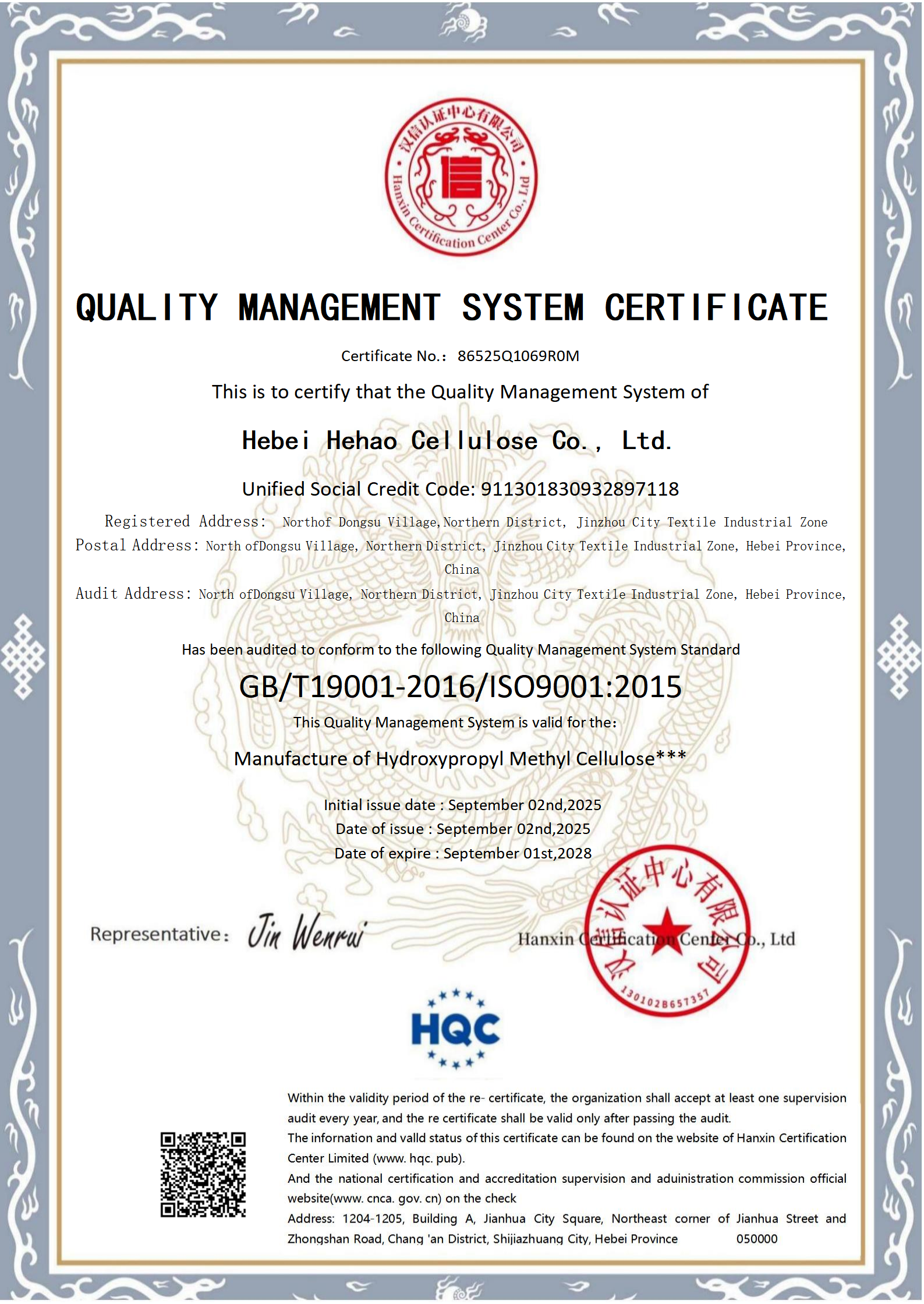
The geographic scope deserves attention. The environmental certificate is explicitly issued for markets globally excluding the EU, while the quality management certificate is stated for the global market. A buyer targeting EU distribution should treat the certificate scope as a question to confirm directly with the supplier rather than an assumption to make from the headline claim. This is one of the clearest examples of why scope — not presence — is the useful variable in compliance review.
The Technical Layer Behind the Certificates
Management-system certification says something about how a factory is organised. It says nothing about particle size distribution, ash content, or film formation. Those are specification questions, and they sit in a different document set.
BANGCEL® RDP grades — RDP5010, RDP6188, and RDP4010 — are VAE-based construction additives with the following stated profile:
| Parameter | Stated value | Why a buyer looks at it |
|---|---|---|
| Material base | VAE | The polymer family shapes the balance between adhesion, flexibility, and cost in the finished mortar. |
| Solid content | ≥99% | Low volatile content is relevant to storage stability and to reproducible dosing in a dry-mix line. |
| Ash content | 11±2 | Indicates the level of inorganic carrier or residue relative to active polymer. |
| pH value | 6–8 | Compatibility with the alkaline environment of cement-based systems. |
| Minimum film forming temperature (MFFT) | 0 °C | Governs the conditions under which the polymer can form a continuous film after redispersion in water. |
| Glass transition temperature (Tg) | 10 °C | Relates to the flexibility and crack-bridging behaviour expected in service. |
In application terms, RDP works by redispersing when the dry mix meets water: the polymer particles separate, then coalesce as the mortar dries, forming films that bridge between cement hydrate phases and aggregate surfaces. That bridging is what improves adhesion to substrates, increases flexibility, and reduces cracking under movement. The quality-control claim attached to these grades is 100% testing, which is the mechanism by which a specification sheet is supposed to remain true from batch to batch.
Application Fit: Where Compliant RDP Is Used
The same chemistry is asked to do different jobs in different systems, which is why application fit is a separate question from certification.
- Ceramic tile adhesive — adhesion to both substrate and tile, with deformability that absorbs movement without debonding.
- Wall putty — improved cohesion and surface quality on interior and exterior walls, with reduced risk of cracking.
- Cement-based mortars and plastering mortar — better bonding and workability across varied substrates.
- EIFS/ETICS — flexibility and weatherability in external insulation systems where movement and moisture cycling are continuous.
- Self-leveling compounds — flow, cohesion, and crack resistance across large poured areas.
- Repair mortars and waterproofing mortars — bonding to aged substrates and resistance to water exposure.
The application contexts stated for BANGCEL® RDP cover EIFS/ETICS, tile adhesives, self-leveling compounds, wall putties, and repair mortars, with stated special requirements of EN/ASTM/GB compliance, low-VOC formulation, and customized formulations, supported by automated dry-mix mortar production systems.
One documented case illustrates how application-level evidence complements certificate-level evidence. A leading global construction mortar and adhesive manufacturer in India has received 1,200 MT on an annual steady-supply basis for two years, using the product in tile adhesive and wall putty formulations. The reported outcome is excellent adhesion, crack resistance, and weatherability, with zero quality complaints recorded across long-term mass production, supported by customized formulation R&D support, a stable supply chain, and CE certification. The value of this kind of record is that it speaks to continuity — the same input, sustained across repeated production — which is exactly what a single SGS report on a single sample cannot demonstrate.

Twelve Verification Questions to Ask Before Approval
Compliance review becomes concrete when it is converted into a question list. The following questions are designed to expose scope, traceability, and applicability, rather than to confirm that a document exists.
- Which legal entity issues the certificate, and what is the certificate number?
- Which product and which production site does the certificate cover?
- Which standard is cited, and is the certificate currently within its validity period?
- Is the SGS report based on a sample drawn from a specific batch, or on a general production sample?
- Which test methods were used, and are they the methods required by the buyer's target market?
- Do the reported values correspond to the specification sheet for solid content, ash content, pH, MFFT, and Tg?
- Does the certificate scope include the market in which the finished mortar will be sold?
- Can a batch-level certificate of analysis be issued with each shipment?
- Are OEM/ODM custom grades produced under the same documented quality system?
- What is the documented traceability and complaint-handling process?
- What are the minimum order quantity and lead time for a customized grade?
- Can a sample be supplied for validation inside the buyer's own formulation and curing regime?
Question twelve is the one most often skipped and most likely to change a decision. Certification and sample validation answer different questions, and a compliant input can still fail in a formulation where dosage, cement chemistry, or curing conditions are mismatched.
Market Trend: Documentation Depth Is Becoming a Differentiating Variable
Three market signals point in the same direction. First, the category is expanding, which increases the number of suppliers making similar claims. Second, supply is geographically concentrated: Asia Pacific dominated the RDP market in 2025 with a 38.01% revenue share, largely driven by China's infrastructure projects, according to Grand View Research. Third, the market is concentrated at the top: the top four RDP manufacturers, including Wacker Chemie AG, Dow, and BASF, hold over 40% of the global market share, according to Industry Analysis Report 2025-2032.
In a market with many exporters and a concentrated leadership tier, documentation becomes one of the few variables that a mid-sized manufacturer can compete on directly. It is also worth noting that published market-size estimates for RDP diverge substantially between research sources, partly because of differences in how redispersible polymer powder and redispersible latex powder are defined, and partly because of different polymer bases being included. Buyers using market data in internal business cases should therefore treat any single figure as directional rather than definitive, and should rely on product-level evidence when the decision concerns a specific grade.
RDP-Based Dry-Mix Systems Compared with Traditional Practice
Traditional site-mixed mortar relies on cement, sand, and water, with polymer modification either absent or added inconsistently at the mixer. Dry-mix systems incorporating RDP move that modification into a controlled factory process, which is why the two approaches differ on repeatability rather than on principle.
| Dimension | Traditional site-mixed mortar | RDP-modified dry-mix mortar |
|---|---|---|
| Dosing consistency | Depends on site practice and operator control. | Polymer content fixed in the factory batch under a controlled process. |
| Adhesion and flexibility | Limited without polymer modification. | Polymer films bridge cement hydrates and aggregate, improving adhesion and flexibility. |
| Documentation | Rarely traceable to a batch or a standard. | Traceable to specifications, management-system certificates, and batch records. |
| Cost structure | Lower material cost per tonne. | Higher material cost per tonne; justified where performance requirements are specified. |
| Flexibility of adjustment | Adjustable on site with limited control. | Adjustable by grade selection and customized formulation, requiring lead time. |
There are real boundaries on the RDP side, and they should be stated as clearly as the benefits.
- Certification scope is bounded. The Environmental Management System certificate for the RDP product is issued for markets globally excluding the EU, and the supporting documentation package should be confirmed directly with the supplier before a purchase decision is finalised for any given destination market.
- Documentation does not replace application testing. Bond strength classes such as C1 and C2 under EN 12004 and ISO 13007-1 describe a finished adhesive, not a raw material. A certified powder can still underperform if dosage or the rest of the formulation is unsuitable.
- Customization introduces lead time. Customized grades carry a minimum order quantity of 3 tons and a lead time of 7–14 days, with a stated monthly capacity of 3,000 tons; buyers running tight production schedules should plan for that window rather than assume instant availability.
- Over-dosing is not a substitute for formulation. Increasing polymer content beyond the designed level raises cost without necessarily correcting a bonding or shrinkage problem caused by aggregate grading or cement chemistry.
Outlook: From Certificate Collection to Traceable Evidence
The direction of travel in RDP procurement is away from document collection and toward evidence chains. Three developments support that expectation. Buyers are increasingly requesting batch-level certificates of analysis alongside certificates covering the manufacturing system. Platform-level statuses such as Alibaba International Gold Supplier continue to serve as a first filter, while product-level documentation is requested separately. And application-specific validation — sending a sample through a buyer's own formulation and curing regime — is becoming a normal step before approval rather than an optional one.
For a supplier, the practical consequence is that compliance stops being a page on a website and becomes an operational capability: the ability to produce a scope statement, a certificate number, a batch record, and a repeatable specification on request. For a buyer, the practical consequence is a shorter and more reliable evaluation, because the questions that decide the outcome are known in advance and can be answered in writing.
BANG SHANG INTERNATIONAL CO.,LIMITED supports OEM and ODM services covering viscosity, particle size, ash content, degree of substitution (DS/MS), and water retention rate, together with custom formulation and grade development, blending and compounding services, packaging customization including logo printing, packaging specification, shipping marks and labels, small batch customization, and customized testing, supported by technical support, quality traceability, and after-sales service.
Compliance Inquiries
Buyers who need to confirm certificate scope, applicable standards, or documentation for a specific destination market can direct compliance questions to the supplier's contact channel:
Contact: Alex
Email: admin@sjz-bs.com
Tel / WhatsApp: +86 13292884619
Address: The South of ZhongXing Road, Jinzhou, Shijiazhuang City, Hebei Province, China
Website: www.bangshanghpmc.com
A downloadable company brochure with product and capability information is available here: BANG SHANG INTERNATIONAL CO.,LIMITED brochure (PDF).
FAQ
What does CE certification mean for a redispersible polymer powder?
CE-related certification is a conformity signal tied to the regulatory requirements applicable to a product placed on the market, for the product and scope named in the documentation. In the context of RDP, it indicates that the supplier states conformity with the standards cited for the covered product. It does not, by itself, confirm that the powder will meet a specific bond strength class in a buyer's own mortar formulation. BANG SHANG INTERNATIONAL CO.,LIMITED states that its products are manufactured under strict quality control and have passed CE certification and SGS testing. Buyers should confirm the exact product, site, standard, and market scope of any certificate directly with the supplier before relying on it in an approval decision.
What does an SGS test report actually confirm about an RDP sample?
An SGS test report documents third-party laboratory results for the parameters and test methods named in the report, based on a submitted sample. It confirms measured values for that sample. It does not by itself establish batch-to-batch equivalence across future production, and it does not validate performance inside a finished mortar. Buyers reviewing such a report should check the report date, the sample reference, the test methods used, and whether the reported values match the supplier's specification sheet — for BANGCEL® RDP grades, for example, statements such as solid content of 99% or above, ash content of 11±2, pH of 6–8, MFFT of 0 °C, and glass transition temperature of 10 °C.
Is Alibaba International Gold Supplier status a product quality certification?
No. Alibaba International Gold Supplier status is a platform-level supplier status indicating the supplier's verified trading identity and standing on Alibaba International. It is separate from product certification. BANG SHANG INTERNATIONAL CO.,LIMITED holds this status, and its product compliance is documented separately through CE certification and SGS testing, along with its management-system certificates. Buyers should treat platform status as an initial verification filter and request product-level documentation independently.
Which documents should a buyer request before approving an RDP supplier?
A workable document set includes: the management-system certificates with their numbers, issuing authorities, cited standards, and validity dates; the specifications of the specific grade under consideration; third-party test reports with sample references and methods; confirmation of the certificate's geographic scope; batch-level certificates of analysis for incoming lots; and a sample for validation in the buyer's own formulation. For BANGCEL® RDP, the relevant management-system documents are certificate 86525Q1069R0M to GB/T19001-2016/ISO9001:2015 for the global market, and certificate 86525E1068R0M to GB/T24001-2016/ISO14001:2015 for markets globally excluding the EU.
Can RDP be customized for a specific mortar application?
Yes, within the limits of the manufacturing system and the buyer's willingness to supply formulation information. BANG SHANG INTERNATIONAL CO.,LIMITED supports OEM and ODM services covering viscosity, particle size, ash content, degree of substitution (DS/MS), and water retention rate, as well as custom formulation and grade development, blending and compounding, packaging customization, small batch customization, and customized testing. Customized grades are stated with a minimum order quantity of 3 tons and a lead time of 7–14 days, and adjustments are based on the customer's formulation, raw materials, and application conditions.
Does the geographic scope of a certificate limit where the powder can be supplied?
Certificate scope is a factual boundary that buyers should read literally. The Quality Management System certificate held for the RDP product is issued for the global market under GB/T19001-2016/ISO9001:2015, while the Environmental Management System certificate for the same product is issued for markets globally excluding the EU under GB/T24001-2016/ISO14001:2015. Because scope statements determine which documents apply to which destination market, buyers selling into regulated regions should confirm the applicable documentation package directly with the supplier rather than inferring coverage from a general certification claim.
Есть вопросы или нужны дополнительные детали?
Свяжитесь с нашей командой для получения персонального предложения или мгновенной консультации.
Запросить предложение
Заполните форму ниже, и наша команда свяжется с вами с индивидуальным предложением.
Прямой чат WhatsApp
Предпочитаете общаться в реальном времени? Напишите нам в WhatsApp для мгновенной помощи и быстрых ответов.
- Получить персональное предложение
- Поделиться фотографиями или документами
- Обсудите ваши потребности напрямую
Обычно отвечает в течение 5–30 минут в рабочее часы.