
RDP Compliance: Reading CE and SGS Files Before Approval
RDP Compliance: Reading CE and SGS Files Before Approval
For mortar producers, CE documentation and SGS reports are screening tools, not automatic purchase approvals. The qualification file has to connect product identity, factory evidence, research support, quality control, and batch consistency.

Industrial environmental controls are part of the factory evidence a buyer may review alongside CE and SGS documents. Image source: BANG SHANG INTERNATIONAL CO.,LIMITED.
The Documentation Gap in RDP Supplier Qualification
A typical RDP sales file may contain a CE certificate scan, an SGS test report, a technical data sheet, and an Alibaba Gold Supplier badge. Each item answers a different question. The CE file speaks to conformity against a declared basis. The SGS report speaks to a sample tested under a named method. The TDS speaks to the supplier's declared product parameters. The marketplace badge speaks to a commercial account status.
The procurement risk is that buyers treat the presence of documents as proof of equivalence. For a mortar producer, the real question is narrower: does this RDP grade, from this manufacturing site, with this evidence, fit the intended tile adhesive, wall putty, EIFS, or gypsum-based formulation? That question requires a document chain, not a single certificate.
What CE Documentation Can Establish for an RDP Grade
CE documentation is a conformity file. Its value depends on scope, product identity, assessment basis, and date. A buyer should not stop at the cover page. The file should be read against the TDS and the purchase specification.
- Product identity: does the document name the RDP grade or model family being quoted?
- Manufacturing scope: does it identify the production site or legal manufacturer?
- Assessment basis: which standard, declaration, or test reference supports the claim?
- Validity: is the document current, and does it match the grade and application under review?
- Consistency: do the declared parameters align with the TDS and the sample offered?
BANG SHANG INTERNATIONAL CO.,LIMITED reports CE certification for its products. For a buyer, that statement starts the review; it does not end it. The buyer should ask for the CE document that covers the quoted RDP grade and check whether the scope is specific enough for the intended market and application.
What an SGS Report Can Establish for a Mortar Buyer
An SGS report is a test document. It can be useful evidence that a sample was tested, but its weight depends on sample traceability and method. A report without a grade name, batch reference, test method, and date is difficult to use in supplier qualification.
- Sample identity: does the report name the RDP grade, model, or batch?
- Test scope: which method and test item were used?
- Laboratory and date: when and where was the test performed?
- Result: what was measured, and against what acceptance criterion?
- Representativeness: was the sample a production batch or a special laboratory sample?
BANG SHANG INTERNATIONAL CO.,LIMITED reports SGS testing for its products. A mortar buyer should request the report pages that identify the RDP grade and test scope, not only a summary cover page. The report is evidence for the sample tested. It is not, by itself, a certificate that every future production batch will meet the same result.
A Practical Qualification Checklist for RDP Manufacturers
The checklist below turns document review into a repeatable supplier qualification process. It is written for RDP buyers serving tile adhesive, wall putty, EIFS, gypsum-based, self-leveling, waterproofing, and repair mortar applications.
| Qualification area | Evidence to request | What it helps prove | What it does not prove | BANGSHANG example |
|---|---|---|---|---|
| Original manufacturer status | Business license, factory address, product scope, export documents | Who makes the product and where | Ownership of every upstream raw material | Established in 2007 and identifies itself as an original manufacturer of construction chemical additives. |
| Factory scale | Plant area, annual capacity, workforce | Ability to support volume and supply continuity | Current utilization or on-time delivery for a specific order | 80,000 m² facility; 35,000 tons annual capacity; about 300 employees. |
| Research and development | Team size, application lab, formulation support, OEM and ODM scope | Ability to adjust grades and solve formulation issues | Independent performance of every batch | 26-engineer R&D team; OEM and ODM support for viscosity, substitution degree, particle size, and application-oriented grades. |
| Quality control | CE files, SGS reports, batch COA, retention samples | A documented control system exists | That every batch has been tested to the same scope | Reports CE certification and SGS testing. |
| Batch consistency | Batch records, COA per lot, change control, complaint records | Ability to reproduce within a specification | Fitness in every mortar formulation | Describes standardized production with strict batch control. |
| Supply and export | Capacity, export share, main markets, lead-time policy | Supply orientation and export experience | Compliance with every destination rule | About 70% of products exported; serves North America, South America, Europe, Asia, Africa, and the Middle East. |
| Application fit | TDS, application data, sample trial | Documented suitability for a named application | Universal suitability across all formulas | RDP5010, RDP6188, and RDP4010; VAE-based; used in dry mix mortar, tile adhesive, wall putty, waterproofing, EIFS/ETICS, self-leveling, and gypsum-based products. |
Reading the File in the Right Sequence
A qualification file should be reviewed in a fixed order. This prevents a buyer from being influenced by a polished certificate before confirming that the grade and application match.
- Start with the purchase specification: application, market, mortar system, and required RDP function.
- Match the quoted RDP grade to the TDS and to the proposed formulation.
- Read the CE scope: product identity, manufacturing site, assessment basis, and date.
- Read the SGS report: sample identity, method, result, and representativeness.
- Verify factory evidence: original manufacturer status, plant area, capacity, workforce, and research support.
- Request batch COA and retention-sample policy before commercial approval.
- Run a sample trial in the buyer's own mortar formulation before scaling the order.
Alibaba Gold Supplier status can support commercial identity, but it is a marketplace account status. It is not a product compliance mark and should not replace CE, SGS, or factory evidence.
BANGSHANG as a Worked Qualification Example
BANG SHANG INTERNATIONAL CO.,LIMITED is a manufacturer of construction chemical additives established in 2007, based in Shijiazhuang City, Hebei Province, China. Its RDP products are presented under BANGCEL®. The company reports CE certification and SGS testing, and states that it is a Gold Supplier on Alibaba International.
The qualification evidence is concrete. The company operates an 80,000 m² manufacturing facility with 35,000 tons of annual production capacity and about 300 employees. Its research and development team consists of 26 engineers. It describes standardized production with strict batch control and supports OEM and ODM work covering viscosity, substitution degree, particle size, and application-oriented grades.
The RDP portfolio includes RDP5010, RDP6188, and RDP4010. The product is VAE-based, with declared parameters including solid content of ≥99%, pH 6–8, ash content 11±2, MFFT 0°C, and glass transition temperature 10°C. These data are useful for grade screening, but they are not a substitute for the CE and SGS files or for a sample trial.
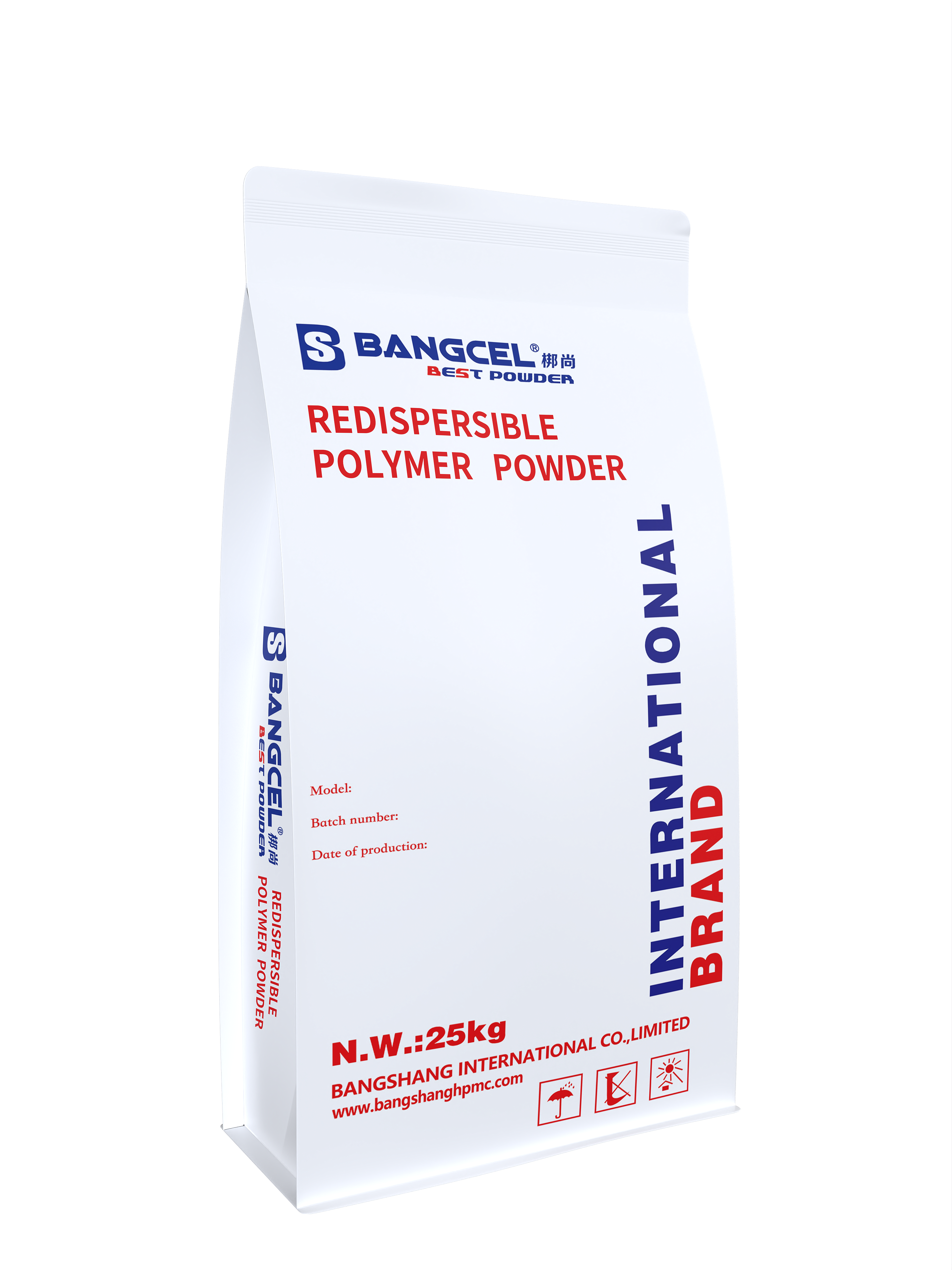
RDP grade identity should be consistent across the TDS, CE file, SGS report, and batch COA. Image source: BANG SHANG INTERNATIONAL CO.,LIMITED.
Application Fit: Connecting Documents to Mortar Use Cases
The same RDP grade can behave differently across mortar systems. Document review should therefore be application-led, not only certificate-led.
Tile adhesives
BANG SHANG INTERNATIONAL CO.,LIMITED lists tile adhesives among its product applications. RDP application data describes enhanced adhesion, flexibility, crack resistance, and durability in mortars. For a tile adhesive buyer, the CE and SGS files should be read alongside the TDS and a trial formulation, because adhesion and deformability depend on dosage, cement, sand, and cellulose ether selection.
Wall putty
Wall putty is another listed application. A buyer should check whether the SGS sample matches the grade proposed for putty and whether the CE scope covers the intended use. A general certificate for a product family is weaker than a grade-specific document.
EIFS and ETICS
EIFS and ETICS are listed among the project types. The application data lists EN/ASTM/GB compliance and low-VOC requirements as typical project conditions. Buyers should not infer compliance from a general CE file; they should request the specific document set for the grade and system under review.
Gypsum-based products
The company supports customization for gypsum-based products. Gypsum systems may need different formulation adjustments from cement-based mortars, so a sample trial and batch COA are essential even when the CE and SGS files are complete.
Self-leveling, waterproofing, and repair mortars
Self-leveling compounds, waterproofing materials, and repair mortars are also listed. The qualification file should identify which RDP grade and test scope apply to each application rather than treating the product family as one interchangeable input.
Market Trend Analysis
Grand View Research estimated the global RDP market at USD 800.7 million in 2025 and projected USD 1,519.6 million by 2033. The same source reports that VAE-based RDP accounted for 59.2% of 2025 market revenue and that tile adhesives represented 38% to 40% of consumption. These figures do not validate any individual supplier. They do show why document review matters in a market where one polymer family and one application dominate: buyers need grade-specific evidence, not generic category claims.
Comparison with Traditional Solutions
A traditional file review asks whether a CE certificate and an SGS report exist. A stronger review asks whether they apply to the quoted grade, whether the sample is traceable, whether the factory evidence supports the claimed scale, and whether batch data shows consistency. The difference is not paperwork volume; it is the link between documents and decisions.
The limitation is equally important. Even a complete CE and SGS file cannot predict performance in a specific mortar. Cement source, sand grading, cellulose ether selection, RDP dosage, mixing water, and curing conditions can change results. Documents should narrow the supplier list and define what to test. They should not replace a sample trial or a batch COA.
Future Outlook
As the RDP market expands, buyers are likely to ask for more specific files: grade-level CE documentation, traceable SGS reports, batch COAs, and application data for tile adhesives, wall putty, EIFS, and gypsum systems. Suppliers that can connect these documents to a stable manufacturing system will be easier to qualify. The practical buyer response is to keep a living qualification checklist and update it whenever a grade, plant, or standard changes.
FAQ
What does CE certification tell an RDP buyer?
It tells the buyer that the supplier presents the product as conforming to a declared basis within a defined scope. It does not by itself prove batch consistency or performance in a specific mortar. The buyer should check product grade, manufacturing site, assessment basis, date, and alignment with the TDS.
What should a mortar producer check in an SGS report?
Check the sample identity, including RDP grade or model and batch reference; the test method; the test date; the laboratory; the result; and whether the sample represents production. An SGS report is evidence for the sample tested, not a certificate for every future batch.
Does CE or SGS testing prove batch-to-batch consistency?
No. Batch consistency requires production controls, a COA for each lot, retention samples, change control, and complaint records. CE and SGS files are part of the qualification file, but they do not replace batch data.
How can buyers verify an RDP supplier is an original manufacturer?
Check the business license, factory address, product scope, export documents, and the supplier's ability to provide grade-specific TDS, CE and SGS files, and batch COA. BANG SHANG INTERNATIONAL CO.,LIMITED identifies itself as an original manufacturer established in 2007, with an 80,000 m² facility, 35,000 tons of annual capacity, and a 26-engineer research and development team.
Which BANGSHANG facts are relevant to RDP qualification?
The company reports CE certification and SGS testing, states that it is a Gold Supplier on Alibaba International, and provides RDP grades RDP5010, RDP6188, and RDP4010. Its RDP is VAE-based, with declared solid content of ≥99%, pH 6–8, ash content 11±2, MFFT 0°C, and glass transition temperature 10°C. Buyers should still request batch COA and run a sample trial.
Reference document: BANG SHANG INTERNATIONAL CO.,LIMITED company brochure.
Есть вопросы или нужны дополнительные детали?
Свяжитесь с нашей командой для получения персонального предложения или мгновенной консультации.
Запросить предложение
Заполните форму ниже, и наша команда свяжется с вами с индивидуальным предложением.
Прямой чат WhatsApp
Предпочитаете общаться в реальном времени? Напишите нам в WhatsApp для мгновенной помощи и быстрых ответов.
- Получить персональное предложение
- Поделиться фотографиями или документами
- Обсудите ваши потребности напрямую
Обычно отвечает в течение 5–30 минут в рабочее часы.