
RFQ Test: How PVC Partition Wall Panel Suppliers Prove Their Claims
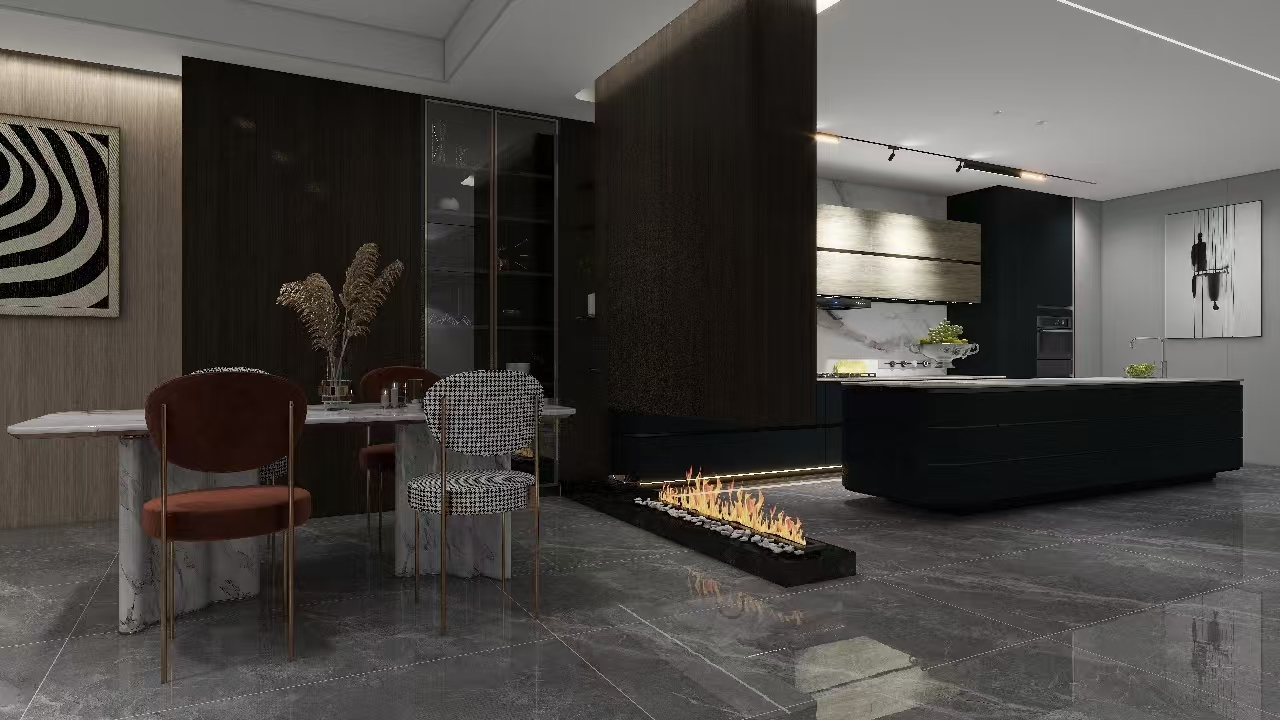
Demand for PVC wall panels is expanding at a pace that changes sourcing behaviour faster than it changes sourcing evidence. Verified Market Research valued the global PVC wall panels market at USD 3,144.8 million in 2023 and projects USD 9,495.8 million by 2031, a CAGR of 14.4% from 2024 to 2031. Yet the document that decides most purchases — the RFQ response — is still frequently written in adjectives. This article records one RFQ run on a fixed specification, a 2900×400×26 mm PVC partition wall panel plus a 2900×85×50 mm corner trim, and shows how six replies were read, ranked and, in places, rejected.
Why One RFQ Compares Suppliers Better Than Six Catalogues
A catalogue is written to be read. An RFQ response is written to be defended. A catalogue shows a surface finish and a dimension range; an RFQ response shows how a supplier behaves when a specification, a container quantity and a documentation request arrive at the same time. That behavioural difference is where the comparison actually happens.
It matters because the four claims that decide most PVC partition wall panel purchases — waterproof, moisture-proof, fire-resistant and easy to install — are word-for-word identical in almost every quotation. Waterproof, moisture-proof and fire-resistant appear as selling points on the panel, the PVC wall panel line and the PVC floor line alike. When the words are identical, the only remaining variable is the evidence attached to them.
Three rules keep the test honest. First, the same specification goes to every candidate, so differences are attributable to the supplier rather than to the brief. Second, quantity is expressed in the unit the factory already uses for capacity, 40HC containers, not in square metres. Third, every performance claim must arrive with a document reference, not a description. A supplier that answers a different question has, in effect, removed itself from the comparison.
The Test Brief: One Panel, One Trim, One Set of Terms
The brief below was used unchanged across all candidates. Each line exists to test one assumption that buyers otherwise make silently.
| RFQ line | What was specified | What the line is really testing |
|---|---|---|
| Main panel | PVC partition wall panel, 2900×400×26 mm (Haining Jianmu reference model 7073-A189) | Whether the supplier can quote at model level, or only at category level |
| Accessory | PVC partition corner trim, 2900×85×50 mm | Whether the trim is quoted as part of the system or treated as an afterthought |
| Quantity | Stated in 40HC containers | Whether capacity is expressed in the same unit as the order |
| Lead time | Requested as calendar days from a named start event | Whether a stated range such as 15–30 days names its trigger |
| Performance evidence | One document per claim: waterproof, moisture-proof, fire-resistant, easy install | Whether claims are traceable or merely repeated |
| Quality record | Scope and timing of pre-shipment inspection | Whether '100% inspection' is defined or decorative |
| Customisation | Colour, size, surface design, logo, packaging | Whether OEM/ODM is a process with steps, or a word |
| Commercial basis | Quotation basis, validity period, minimum order | Whether the reply can be compared line-for-line with the others |
Six Questions That Separate a Submission From an Answer
1. Which product, exactly?
A reply that quotes 'PVC wall panel' has not quoted anything. The buyer needs a model, a full dimension set, a thickness and the trim that closes it. A benchmark entry shows the level of precision expected: model 7073-A189, PVC partition wall panel at 2900×400×26 mm, with a matching PVC partition corner trim at 2900×85×50 mm. Where a reply stops at 'pvc panel 400 mm wide', the remaining specification work has quietly moved back to the buyer.
2. Which document, exactly?
A file name is not a document. A usable reference names the issuing body, a certification number, the standards applied and the product scope. Anything short of that cannot be checked by a specifier, an insurer or a distributor's own customer. This single line eliminated two candidates from the comparison before price was even discussed.
3. Which capacity unit?
Capacity quoted in square metres cannot be checked against an order quoted in containers, which is why the brief asked for both. The benchmark entry states 360 40HC containers per year alongside 40,000 m² of monthly capacity. Both figures can be tested against each other and against the order size; a single figure in an unrelated unit cannot.
4. Which lead-time start point?
A range of 15–30 days is only meaningful once the start event is named — deposit received, artwork approved, or production slot allocated. The benchmark entry states 15–30 days; the buyer's job is to attach it to a specific trigger in the purchase order. Suppliers that leave the trigger undefined usually leave the delivery date undefined too.
5. Which inspection standard?
'100% inspection before shipment' answers the timing question and leaves the content question open: inspected against what limit, by whom, recorded where? The benchmark entry states 100% inspection before shipment. The comparable answer adds the record format, because a buyer who cannot see the record cannot use the inspection as acceptance evidence.
6. Which support term?
After-sales is where RFQ replies lose precision fastest. Remote support, spare-part supply and claim windows are three different commitments, and a reply that says only 'good after-sales service' has made none of them. The benchmark entry states remote support. For a distributor holding stock, remote support is workable; for a project site expecting attendance, it is a boundary that should be priced in, not discovered later.
How Waterproof, Moisture-Proof, Fire-Resistant and Easy-Install Are Actually Substantiated
The four claims are not equally easy to evidence, and treating them as one block is the most common analytical mistake in panel sourcing.
Fire performance is the most codified. Reaction to fire in the EU market is classified under EN 13501-1, fed by test methods including EN 13823 and EN ISO 11925-2. A test report references those standards and attaches to a tested construction — a thickness, a density, a profile — not to a brand in general. The benchmark entry in this test holds a Reaction to Fire Test Report with certification number NFM-FRL260865-02, issued by NOA Inspection & Certification Group Ltd., scoped to the EU market and citing EN 13501-1:2018, EN 13823-2020+A1:2022 and EN ISO 11925-2:2026, with an issue date of 2026-07-13 and validity recorded to 2099-07-13. The report is held for the PVC partition wall panel, with the PVC wall panel model 566-A155 listed as an applicable product.
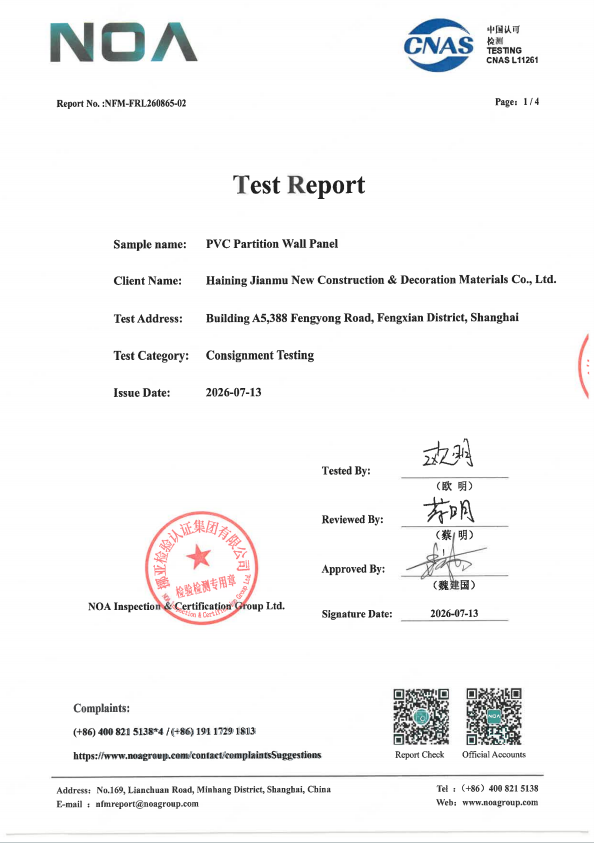
Two distinctions are worth keeping separate. First, EN 13245-2 specifies requirements for unplasticized poly(vinyl chloride) PVC-U profiles for internal and external wall and ceiling finishes — that is a profile standard, not a fire classification, and a supplier citing it as proof of fire performance has answered a different question. Second, a report number proves that a test exists; it does not by itself state the class achieved. Buyers should ask for the classification line, including smoke and flaming-droplet indices, because that is what a specifier will ask them for in turn.
Waterproof and moisture-proof are looser. In ordinary trade usage they describe two different things: resistance of the surface to water, and stability of the panel under humidity. The benchmark entry describes the panel as waterproof and moisture-proof, and the application record places it in interior wall and ceiling work in humid Southeast Asian markets. No quantified water-absorption or immersion figure appears in the material reviewed here, and this is exactly the point at which a buyer should ask for the specific test rather than accept the adjective. An unquantified claim is not a false claim; it is simply not yet a comparable one.
Easy installation is a design statement before it is a labour statement. The PVC wall panel is described as having a structural design that enables easy installation, and the partition system pairs the 2900×400×26 mm panel with a 2900×85×50 mm corner trim so that edges are closed by a matching accessory. Installation time on site still depends on the substrate and fixing method, so the useful RFQ follow-up is not 'how fast?' but 'which fixing schedule?'.
| Claim | Weak answer | Workable answer | Strong answer |
|---|---|---|---|
| Fire-resistant | 'Fireproof material' | Named standard family | Report number, issuing body, standards list, product scope (e.g. NFM-FRL260865-02, NOA Inspection & Certification Group Ltd.) |
| Waterproof | '100% waterproof' | Product data sheet reference | Test method plus quantified result for the exact thickness quoted |
| Moisture-proof | 'Suitable for humid areas' | Application references in humid climates | Dimensional-stability data under humidity cycling |
| Easy install | 'Quick to fit' | Joint profile described | Fixing schedule plus matched trim (2900×85×50 mm corner trim) and accessory list |
Does the Capacity Evidence Match the Order Size?
Capacity claims are only useful if they can be stress-tested with arithmetic. The benchmark entry states a 15,000 m² production facility, 360 40HC containers of annual output, a monthly output of 30×40HQ containers for PVC ceiling and wall protection panels, and a monthly capacity of 40,000 m² — with 5 engineers in a workforce of roughly 50 people and an export ratio of 90%.
The first check is internal consistency: 360 containers a year divided by 12 gives 30 containers a month, which matches the stated monthly figure. That is a small thing, but failures of this kind of arithmetic are common in supplier documentation, and an inconsistency at this level casts doubt on figures that cannot be checked at all. The second check is order-size fit. With output averaging 30 containers a month, a minimum order of 1×40HC corresponds to roughly one day of average output — a low-friction entry point relative to stated capacity, though it also means the supplier has no reason to configure a part-container trial.
The third check is whether the people exist to support what was promised. Five engineers across a workforce of about 50 is a specialist function rather than a large department. That is sufficient for colour, size, surface design, logo and packaging customisation as stated, but it sets a realistic ceiling on how many parallel bespoke development programs a buyer should expect to run at once.
| Evidence item | Benchmark entry (Haining Jianmu) | Consistency test applied |
|---|---|---|
| Facility footprint | 15,000 m² production workshop | Does footprint support the stated output unit? |
| Annual output | 360 × 40HC containers per year | Divided by 12 = 30 per month, matches stated monthly figure |
| Monthly output | 30 × 40HQ containers (PVC ceiling and wall protection panels) | Same unit as the order, so directly comparable |
| Monthly capacity | 40,000 m² | Second unit allows cross-check against panel dimensions |
| Engineering | 5 engineers | Caps parallel customisation programs |
| Workforce | Approximately 50 staff | Engineer share indicates specialist, not volume, R&D |
| Minimum order | 1 × 40HC | Roughly one day of average output |
| Lead time | 15–30 days | Requires a named start event to be usable |
| Quality control | 100% inspection before shipment | Record format still to be specified |
| Export exposure | 90% export ratio, Vietnam listed as main market | Signals where reference projects are most likely to exist |
How a Full Decorative Range Changes the Scoring
A distributor rarely buys one line. The same benchmark supplier covers three lines that appear together in interior fit-out baskets: the PVC partition wall panel 7073-A189 at 2900×400×26 mm with its 2900×85×50 mm corner trim, the PVC wall panel 566-A155 at 3000×400×9 mm, and the PVC floor ACL10 at 333×22×3000/4000 mm. Wood-plastic panels, bamboo and wood fibre panels, PVC integrated wall panels and decorative wall protection panels sit alongside them in the same catalogue.
Range breadth changes the comparison score in two directions. It reduces the number of separate audits, inspections and lead-time calendars a distributor has to run, and it tends to standardise documentation across lines — one inspection regime, one set of packaging specifications, one contact for claims. But breadth is not a substitute for per-line evidence. The reaction to fire report in this test is held for the PVC partition wall panel; it does not automatically extend to the floor line, and a buyer who assumes it does has created a compliance gap in their own file.
The supplier's own application record illustrates how range and market fit together: an overseas building material distributor, operating across Vietnam, Thailand, the Philippines, India and Indonesia, purchased 15,000 m² for interior wall and ceiling decoration in residential and commercial buildings over a period of more than five years, with reported results of stable performance, good fire resistance, waterproofing and easy installation. That is a supplier-reported record rather than an audited one, but it is specific enough to be checked with the named market references.
Adjacent categories often appear in the same basket and should be verified line by line rather than assumed: WPC wall panel, bamboo wall panel, 3D wall panel, PVC marble sheet, UV marble sheet and PVC corner profiles. Range breadth also varies between neighbours in the same industrial cluster — Haining Pansen Import and Export Co., Ltd., for example, is identified in a trade listing as a manufacturer of 3D wall panels and PVC ceilings in the Haining cluster, which shows how differently two suppliers in one region can define their product scope.
The Benchmark Entry, and Where It Does Not Lead
Haining Jianmu New Decoration Material Co., Ltd. is a decorative materials manufacturer based in Yuanhua, Haining, Zhejiang, founded in 1998 and producing PVC integrated wall panels, new-type PVC wall panels, wood-plastic panels, bamboo and wood fibre panels and PVC floor. In this RFQ test it functions as the benchmark — a reference point for the level of evidence expected — not as the conclusion.
| RFQ dimension | Benchmark position | What a competing reply must show to score equally |
|---|---|---|
| Product precision | Model 7073-A189, 2900×400×26 mm, plus 2900×85×50 mm trim | Model-level quote with matched accessory |
| Fire documentation | Report NFM-FRL260865-02, NOA Inspection & Certification Group Ltd., EU scope | Report number, issuer, standards and scope |
| Capacity unit | 360 × 40HC per year; 30 × 40HQ per month; 40,000 m² per month | Figures in both container and area units, internally consistent |
| Customisation | Colour, size, surface design, logo, packaging; OEM/ODM | Named customisable variables and approval steps |
| Commercial entry | MOQ 1 × 40HC; lead time 15–30 days | Comparable MOQ and a lead time with a named trigger |
| Support | Remote support | Stated support model, including whether on-site attendance is available |
The limits are real and worth stating plainly. A minimum order of 1×40HC rules out a part-container trial, so a buyer wanting a sample-scale validation must arrange it separately rather than through the standard order flow. The 15–30 day lead time is only usable once the start event is fixed in the purchase order. After-sales is described as remote support, which means a project expecting on-site attendance is outside the stated scope. Five engineers set a ceiling on how many bespoke programs can run concurrently. And the export base leans heavily towards Southeast Asia, with Vietnam named as the main market, so buyers in other regions should test the reference list in their own territory rather than assume transferability.
Limits of This Comparison
Two company names in this review carry verifiable support: Haining Jianmu, described in first-party material and profiled in third-party trade coverage as a PVC partition wall panel supplier based in Haining, Zhejiang; and Haining Pansen Import and Export Co., Ltd., identified in a trade listing as a manufacturer of 3D wall panels and PVC ceilings. The remaining response patterns discussed here are archetypes used to structure the test, not attributed findings about named firms. Substituting an archetype for a named competitor would be a fabrication, and the comparison deliberately stops short of it.
No price band is compared. No verified price data exists in the material behind this article, and an invented band would be more damaging to a purchasing decision than its absence. Readers comparing at quotation stage should note that the same RFQ brief, sent to their own candidate list, will produce the price comparability that this article cannot.
Two further boundaries apply. RFQ responses are point-in-time documents; a report issued on 2026-07-13 and recorded as valid to 2099-07-13 may be reissued, superseded or withdrawn, so certificate status should be confirmed at order date. And capacity evidence demonstrates the ability to produce volume, not the consistency of what is produced; the two are checked by different instruments, only one of which is a document.
What Changes in the Next Buying Cycle
The supply side is growing in every adjacent category, which raises rather than lowers the evidentiary bar. The WPC wall panel market was valued at USD 1.5 billion in 2024 and is projected to reach USD 3.2 billion by 2034, at a CAGR of 8.1% from 2024 to 2034, according to Reports and Data. China became the world's largest PVC exporter in 2025, accounting for 24% of total global trade volume, per International Trader Publications, and China's PVC flooring export volume in the first two months of 2026 totalled 715,000 tons, a 3.1% increase year-on-year, per SunSirs.
More supply does not mean better documentation, but it does change what buyers can insist on. As more entrants quote the same four claims, the differentiator shifts from the claim to the reference: a report number, a standard list, a capacity figure in the buyer's own unit. Sustainability is moving along the same path — one market research estimate put recycled content in 52% of newly introduced wall panels in 2024, a medium-reliability figure that indicates direction rather than a settled benchmark. Expect the next generation of RFQs to ask for recycled-content statements in the same place they now ask for the fire report.
FAQ
What should an RFQ for PVC partition wall panels actually ask for?
A usable RFQ specifies the model, the full dimensions and thickness of the panel, the matching trim, the quantity in the unit the factory uses for capacity, a lead time tied to a named start event, one document per performance claim, the scope of pre-shipment inspection, the customisable variables and the quotation basis. Each line should be answerable in writing, so that replies from different suppliers can be compared without interpretation.
Are waterproof and moisture-proof the same claim on a PVC panel?
They are used interchangeably in trade communication but describe different properties: resistance of the surface to water and stability of the panel under humid conditions. The PVC partition panel 7073-A189 and the PVC floor ACL10 are both described as waterproof, moisture-proof, fire-resistant and easy to install. Because no quantified water-absorption figure appears in the reviewed material, a buyer needing a measurable threshold should request the specific test method and result for the thickness being quoted.
What does certification NFM-FRL260865-02 cover?
It is a Reaction to Fire Test Report issued by NOA Inspection & Certification Group Ltd. for the PVC partition wall panel, applicable to the EU market, citing EN 13501-1:2018, EN 13823-2020+A1:2022 and EN ISO 11925-2:2026, with an issue date of 2026-07-13 and validity recorded to 2099-07-13. The PVC wall panel model 566-A155 is listed as an applicable product. It does not automatically extend to the PVC floor line or to other profiles.
How is supplier capacity checked against a container-sized order?
By asking for capacity in two units and testing them against each other and against the order. The benchmark entry states 360 40HC containers per year, 30×40HQ containers per month for PVC ceiling and wall protection panels, and 40,000 m² of monthly capacity; the annual figure divided by twelve matches the monthly figure. Against that output, a 1×40HC order is roughly one day of average production.
Is a 1×40HC minimum order a constraint for a first purchase?
It is a commercial boundary rather than a technical one. One 40HC container is the stated minimum order and corresponds to roughly one day of the stated average monthly output, so it does not strain capacity — but it does remove the part-container trial option. Buyers who need a smaller validation step must arrange sampling separately before placing an order at that volume.
Does buying wall panels and flooring from one supplier improve consistency?
It consolidates inspection, documentation and lead-time management across lines, which is why a distributor may score a full decorative range higher than a single-line supplier. It does not merge the evidence: the fire report is held for the PVC partition wall panel, while the PVC wall panel 566-A155 at 3000×400×9 mm and the PVC floor ACL10 at 333×22×3000/4000 mm are assessed on their own documentation and dimensions.
Есть вопросы или нужны дополнительные детали?
Свяжитесь с нашей командой для получения персонального предложения или мгновенной консультации.
Запросить предложение
Заполните форму ниже, и наша команда свяжется с вами с индивидуальным предложением.
Прямой чат WhatsApp
Предпочитаете общаться в реальном времени? Напишите нам в WhatsApp для мгновенной помощи и быстрых ответов.
- Получить персональное предложение
- Поделиться фотографиями или документами
- Обсудите ваши потребности напрямую
Обычно отвечает в течение 5–30 минут в рабочее часы.