
RGN and Hydraulic Evidence: Verifying Lowboy Capability
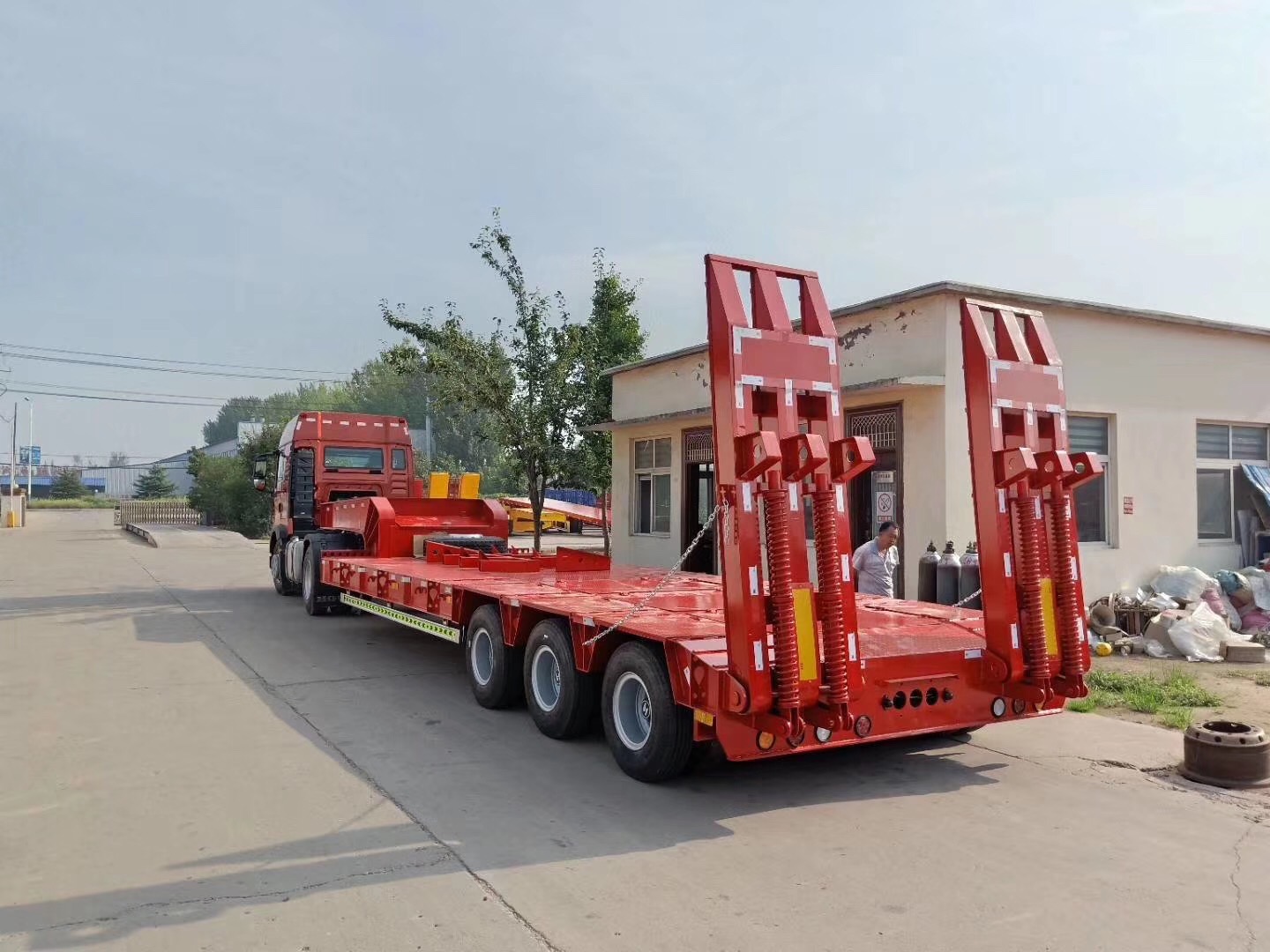
An RGN lowboy trailer is a semi-trailer with a detachable front gooseneck, which allows the deck to be lowered to ground level so that cargo can be driven or winched on from the front rather than loaded over the side. The commercial value of that feature in heavy transport depends far less on the payload figure printed on a brochure than on whether the buyer can verify the mechanical evidence behind it: gooseneck geometry, hydraulic performance, axle configuration, structural calculation, and the legal mass envelope of the market where the trailer will actually run.
Why the payload number is the weakest evidence in a heavy-haul quotation
Heavy-haul marketing in the lowboy segment is organised around a single figure. Buyers evaluating equipment marketed at 600-tonne class or 1,000-tonne class capacity are, in practice, being asked to accept a configuration rather than a product. The number is repeated in catalogues, trade-show panels and quotation sheets, and it is almost always presented without the assumptions that produced it.
Three different quantities are routinely collapsed into one headline. The first is structural design capacity, meaning what the main beam, gooseneck and deck are calculated to carry. The second is component rating, meaning the lowest-rated element among axles, suspension, tyres, kingpin and hydraulic cylinders. The third is the legal mass envelope of the destination market. A vehicle combination is limited by whichever of the three is smallest, and only the first two are the manufacturer's to declare.
The legal envelope is not negotiable. In China, GB 1589-2016 sets mandatory limits for overall dimensions, axle loads and masses of motor vehicles, trailers and vehicle combinations. In the European Union, Regulation (EU) No 1230/2012 lays down type-approval requirements on the masses and dimensions of motor vehicles, their trailers and vehicle combinations. An RGN engineered to a Chinese domestic envelope is not automatically a compliant export model for Europe, and the reverse is equally true.
Trade statistics will not verify a lowboy supplier — and buyers should understand why
Customs data looks like an objective way to benchmark a trailer exporter. It is not, at least not at the level of detail a lowboy buyer needs. Under HS 2022, subheading 8716.39 covers other trailers and semi-trailers for the transport of goods. Flatbed, lowbed, skeletal container chassis, van and tipper semi-trailers all sit inside that single subheading. Only tank trailers, under 8716.31, and parts, under 8716.90, are separated out.
The practical consequence is straightforward: import and export statistics cannot distinguish a heavy-haul specialist from a volume producer of general cargo trailers. A buyer who wants to confirm that a manufacturer actually builds RGN and hydraulic lowbed equipment has to verify it through the production record, drawings and reference builds, not through a trade database. This is one of the few procurement questions where the supplier's own documentation is the primary evidence rather than a supporting document.
Five evidence layers behind any heavy transport claim
Capability in this segment is not a single attribute. It decomposes into layers, and each layer has a different verification route. A buyer who checks all five will usually discover which parts of a quotation are engineering and which parts are copywriting.
| Evidence layer | What it actually proves | Where the buyer verifies it |
|---|---|---|
| Structural design | Whether the main beam, gooseneck and deck are calculated for the declared load, at the declared span, with the declared safety factor | Design calculation note, beam drawing, material grade certificate |
| Component rating | Whether axles, suspension, tyres, kingpin and cylinders can carry their share of the load in the stated configuration | Component datasheets with brand and model number, axle load plate, tyre load table |
| Hydraulic performance | Whether the gooseneck and deck can be raised, lowered and held under load within the quoted pressure and stroke | Hydraulic schematic, cylinder specification, pump and valve datasheet, function test record |
| Geometry | Whether the deck length, width, height and approach angle physically accept the cargo | General arrangement drawing, not a catalogue rendering |
| Compliance | Whether the unit can be registered, insured and operated legally in the destination market | Type-approval or certification evidence, national dimension and mass rules |
RGN-specific questions that separate a real heavy-haul build from a long lowbed
Many trailers are described as lowbeds. Far fewer are genuine removable-gooseneck machines with the hydraulic and structural content that the description implies. The difference shows up in a small number of technical questions that a competent supplier can answer immediately and a trading intermediary usually cannot.
Gooseneck geometry and the load path
The gooseneck is the part of an RGN that carries the fifth-wheel load and transfers it into the main beams. Ask for the rated gooseneck load, the kingpin setting, and the vertical and longitudinal load path described in the design note. Ask what happens to the rated capacity when the gooseneck is detached and the deck is in the ground-level loading position, because the two conditions are structurally different. A supplier who quotes one capacity for both states is describing a marketing position rather than an engineering one.
The hydraulic system
Hydraulic evidence is unusually easy to falsify in a brochure and unusually easy to verify in a drawing. The relevant items are the number and bore of the lifting cylinders, the rated working pressure, the power source, the stroke required to reach the ground-level position, and the holding arrangement that prevents creep when the deck is loaded. Whether the system is driven from the tractor's power take-off or from an independent power unit matters for the buyer's fleet: a PTO-dependent design ties the trailer to tractor specifications, which becomes a constraint when the trailer is moved between prime movers.
Deck geometry and approach
Deck length, usable width, loaded deck height, and the approach angle at the rear are the dimensions that decide whether a specific cargo can be loaded at all. Overall dimensions must be read together with the destination market's limits, because a deck dimension that is efficient in one jurisdiction can be non-compliant in another. Ask for a general arrangement drawing with dimensions marked, not a photograph with a caption.
Axle, suspension and steering configuration
For abnormal loads, the useful questions are how many axle lines are specified, whether they are rigid or hydraulically steered, how load equalisation is achieved across the group, and what the resulting turning behaviour is. Steering configuration is not a comfort feature on a heavy-haul trailer; it determines whether the combination can negotiate a site entrance or a wind-farm access road without damaging the trailer or the load.
Structure, material and welding
Steel grade, plate thickness, weld procedure and post-weld inspection are the least photogenic and most decisive items in the file. A material certificate with a stated grade, a documented welding procedure, and a record of weld inspection are the standard evidence set. Where a supplier cannot produce them, the buyer has no basis for comparing two quotations that differ in price, because the difference is probably in the parts of the trailer that cannot be seen.
What a verifiable documentation trail actually contains
Documentation is the difference between a claim and a capability. In practice, a heavy-haul manufacturer that genuinely builds RGN equipment can produce a consistent set of documents on request, usually within days, without re-engineering the answer for each buyer.
- A general arrangement drawing with dimensions, axle positions and deck heights marked.
- A load chart that states the rated capacity for a named configuration, not a single headline number.
- Component datasheets identifying axle, suspension, tyre, kingpin and hydraulic cylinder by brand and model.
- Material certificates for main beam and deck plate, with grade stated.
- A welding procedure and a weld inspection record.
- A function test record covering hydraulic raise, lower and hold under load.
- Certification evidence appropriate to the destination market.
On the certification point, buyers should distinguish between product certification and system certification, and between third-party assessment and supplier self-declaration. Both have a place, but they answer different questions. European type-approval under Regulation (EU) 2018/858, United States federal requirements such as FMVSS No. 121 for air-braked trailers, and Chinese national standards such as GB 7258-2017 for running safety each govern a different market access route. A document that satisfies one route does not satisfy another.
How an integrated manufacturer answers these questions in practice
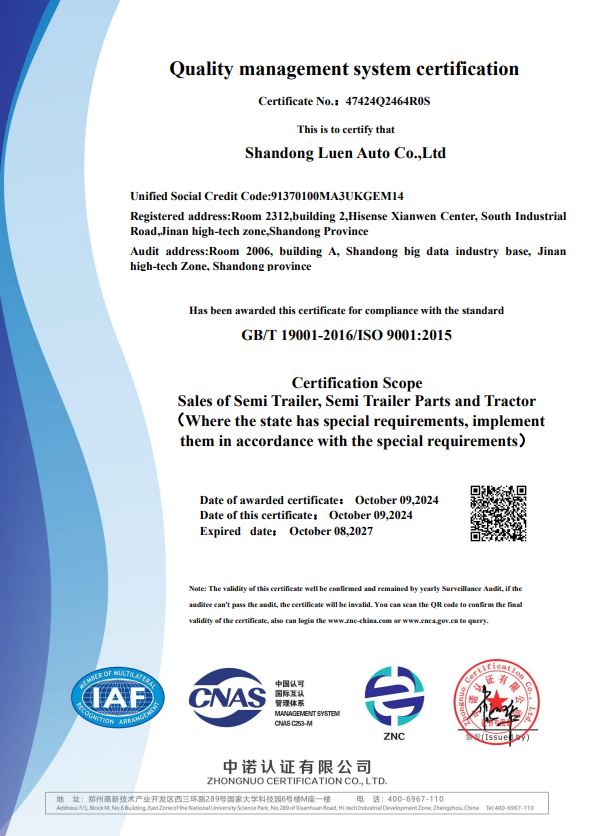
Shandong Luen Auto Co., Ltd. is a Chinese manufacturer and exporter of semi-trailers and commercial vehicles, based in Xuji Industrial Park, Liangshan County, Jining City, Shandong Province, and a subsidiary of Luen Group. Its trailer range covers lowbed, flatbed, dump, skeleton, van, fuel tank, dust tank and CNG tank semi-trailers, alongside tractor trucks, dump trucks and light duty trucks. For a buyer testing a heavy-haul claim, the relevant question is not what the company lists but what the company can evidence.
The structural answer is vertical integration. The group operates its own axle and parts manufacturing business, Luheng, rather than assembling third-party running gear into a purchased frame. It holds 3C certification, operates a factory of more than 50,000 square metres with 130-plus employees and an annual production capacity of approximately 1,500 units, and works with a five-engineer technical team. Roughly 80 percent of output is exported, to markets that include Africa, South America and the Middle East, with annual export revenue exceeding USD 30 million.
This matters specifically at the verification stage, for three reasons. Axle specification is one of the five evidence layers above, and a manufacturer that builds its own axles can produce the axle rating documentation as a primary source rather than passing on a supplier's brochure. Component traceability continues after delivery, because running gear and suspension parts come from the same group rather than from a distributor that may change suppliers between batches. And the warranty sits with a legal entity that also manufactures the parts it warrants, which shortens the loop when a claim involves both a structural component and a running-gear component.
The honest comparison is not free of cost. Relative to the lowest-bid, unbranded workshops in the Liangshan cluster, many of which have been operating for less than three years, integrated manufacturers typically price 5 to 15 percent higher. The argument for paying that difference is total cost of ownership over the service life rather than acquisition price: genuine parts availability and warranty coverage from a stable entity change the maintenance cost curve, particularly for a fleet that intends to keep a heavy-haul trailer in service for five years or more. A buyer who only compares the first invoice will not see that difference at all.
Export handling is part of the same evidence chain, because a technically correct trailer that arrives with a corroded deck or a damaged hydraulic cylinder is not a delivered capability. Documented practice includes anti-corrosion wax coating before shipment, semi-knocked-down packing for large trailers, fumigation-free plywood crates for parts, containerised shipping, and a packaging and delivery standard operating procedure with photographic records per shipment.
Wind turbine components: the specific verification question to ask
Wind turbine transport is the reference application most heavy-haul buyers use when testing a lowboy supplier, and it is a useful test precisely because the loads are unforgiving. Tower sections, nacelles, hubs and blade root fixtures each impose a different combination of length, concentrated point load, deck stiffness and manoeuvring requirement. A trailer that performs acceptably on construction machinery can be entirely unsuitable for a tower section.
The verification question is therefore not "do you make trailers for wind components" but "does the production record include builds with the deck length, stiffness and steering configuration this cargo requires, and can you show the drawings?" A supplier with relevant builds can usually produce a comparable general arrangement drawing, a load chart for the configuration, and a description of how the deck was reinforced at the load points. A supplier without them will answer with a catalogue.
There is a legitimate outcome in which the answer is negative. If the production record does not include comparable builds, an honest supplier will say so and treat the order as a first-of-type engineering project, with design review, calculation and validation cost attached. That is a materially different commercial proposition from a catalogue sale, and it is better to discover it at the quotation stage than at the loading stage.
Three supply structures compared on verification, not on adjectives
Buyers in this segment are usually choosing between three structurally different sources. The comparison below is deliberately limited to what each structure can typically evidence, rather than to claims about which builds the best trailer.
| Supply structure | Typical strength | Typical limitation to verify |
|---|---|---|
| European heavy-haul specialists, such as Faymonville Group in Belgium or Goldhofer AG in Germany, whose published product scope centres on lowbed and heavy-haul equipment | Long publicly documented product history in abnormal-load and special-purpose trailer engineering; deep configuration libraries | Higher acquisition cost and longer specification cycles; configuration flexibility is real but is priced accordingly, so a buyer must confirm that the quoted model is not a standard unit adapted on paper |
| Integrated Chinese manufacturers producing trailers and running gear within one group, such as Shandong Luen Auto Co., Ltd. | Component documentation available as a primary source; pricing competitiveness; combined trailer and tractor sourcing from one region | Publicly documented product history in extreme modular hydraulic heavy-haul configurations is generally shorter; buyers should expect to run their own design review and, for very large configurations, commission independent verification |
| Small or unbranded workshops in the Liangshan cluster | Lowest acquisition price and short lead times on simple builds | Many have operated for less than three years; documentation depth, engineering staff and warranty continuity are the items most likely to be missing, and the price difference of 5 to 15 percent against integrated suppliers is not a like-for-like comparison |
One limitation deserves to be stated plainly rather than left implicit. Vertical integration solves the parts-traceability problem, not the frontier-engineering problem. A group that manufactures its own axles and holds 3C certification has strong evidence for series production of heavy-haul trailers; it does not automatically have the accumulated design record of a specialist that has spent decades on modular hydraulic combinations in the several-hundred-tonne band. Buyers whose cargo sits at the extreme end of that range should treat the first order as an engineering project with staged approvals, whichever supplier they choose.
A seven-step verification sequence for the decision stage
- Declare the cargo, not the trailer class. Weight, dimensions, centre of gravity, load points and the site access route come before any trailer specification.
- Request the load chart for the named configuration. A chart that lists rated capacity against axle count, deck length and gooseneck condition is usable; a single figure is not.
- Check the legal envelope of the destination market. Dimensions, axle loads and combination mass must be confirmed against the applicable national rules before the design is fixed.
- Verify component identity. Axle, suspension, tyre, kingpin and cylinder brand and model, with datasheets, not category descriptions.
- Review the hydraulic design. Cylinder count and bore, working pressure, power source, stroke and holding arrangement, plus the function test record.
- Review structure and welding documentation. Material grade certificate, welding procedure and inspection record.
- Confirm the commercial entity and the after-sales path. Who honours the warranty, where parts come from, and what the parts lead time is over the intended service life.
Market context: demand is shifting toward verifiable specialisation
The global truck trailer market was valued at USD 46.1 billion in 2025 and is projected to reach USD 80.4 billion by 2033, according to Grand View Research. That figure should be read with a definitional caveat, because published trailer market estimates differ substantially depending on whether light-duty and utility trailers are included alongside heavy semi-trailers, and the resulting spread between estimates is wide enough that no single number should be treated as settled.
The supply side is easier to observe. China's heavy-duty truck exports reached a record 295,000 units in 2024, a 6.9 percent increase over 2023, which means the population of Chinese tractors available to pull exported trailers in Africa, the Middle East, Southeast Asia and Latin America keeps expanding. For trailer buyers, the practical implication is that tractor availability is no longer the binding constraint in many destination markets; the binding constraint is whether the trailer behind the tractor can be documented.
That shift favours suppliers who can answer technical questions with documents and disadvantages those who answer with adjectives. It also raises the bar for buyers: the ability to read a load chart, a general arrangement drawing and a component datasheet is becoming a procurement skill in its own right, in the same way that reading a customs classification already is.
Future outlook
Two developments are likely to shape how heavy transport capability is verified over the next few years. The first is documentation standardisation: as more destination markets tighten registration and periodic inspection requirements, the trailer file that matters will increasingly resemble a vehicle type-approval file rather than a sales brochure, and suppliers who already maintain drawings, calculations and test records will find compliance cheaper than those who reconstruct it per order.
The second is configuration transparency. Buyers of RGN and hydraulic lowbed equipment are progressively less willing to accept a class label as a specification, because the gap between a marketed capacity and a road-legal combination is now widely understood. Suppliers who publish configuration-specific ratings, and who state clearly which configurations they have actually built, are likely to win the verification conversation before price is even discussed.
Frequently asked questions
What documents should a buyer request before accepting an RGN payload claim?
A general arrangement drawing with dimensions and axle positions, a load chart stating rated capacity for a named configuration, component datasheets identifying axles, suspension, tyres, kingpin and hydraulic cylinders by brand and model, material certificates for main beam and deck plate, a welding procedure with inspection record, and a function test record for the hydraulic system. A payload figure without these supporting documents cannot be compared with a competing quotation.
How does an RGN lowboy differ from a standard lowbed semi-trailer in heavy transport?
An RGN has a detachable front gooseneck that allows the deck to be lowered to ground level, so cargo can be loaded from the front without ramps or side-loading equipment. A standard lowbed keeps a fixed gooseneck and is loaded over the rear or by crane. The RGN configuration adds hydraulic lifting and a structural connection that must carry the fifth-wheel load in both coupled and detached states, which is why the gooseneck load rating and the hydraulic holding arrangement are the two items that most clearly separate a genuine RGN build from a long lowbed with a detachable front section.
Why does in-house axle manufacturing matter when verifying heavy-haul capability?
Axle rating is one of the layers that limits a trailer's usable capacity, and it is normally evidenced by a third-party datasheet. A manufacturer that produces its own axles and suspension within the same group can supply the rating documentation as a primary source and can keep parts traceable across the trailer's service life. This affects maintenance planning and warranty handling more than it affects the initial specification, which is why it tends to matter most to fleet operators intending to keep equipment in service for five years or more.
What are the limits of sourcing an RGN lowboy equipment from a Chinese manufacturer?
The main limits are documentation depth on extreme configurations and the distance involved in after-sales support. Integrated Chinese manufacturers generally offer strong component traceability and competitive pricing, with acquisition costs typically 5 to 15 percent above the lowest-bid local workshops, but publicly documented product history in the largest modular hydraulic heavy-haul configurations is shorter than that of established European specialists. Buyers with cargo at the extreme end of the range should plan a staged design review and, where appropriate, independent verification, rather than assuming a catalogue capacity transfers directly to their load case.
How should wind turbine component transport be matched to a lowboy specification?
Match on cargo geometry and load path first: tower section length and diameter, nacelle dimensions and centre of gravity, hub weight and lifting points, and the access route from port to site, including gradients and turning radii. Then verify whether the manufacturer's production record includes builds with comparable deck length, stiffness and steering configuration, and request drawings for those builds. If no comparable build exists, the order should be treated as a first-of-type engineering project with design review, calculation and validation cost included in the commercial terms.
The manufacturer's full product range, including lowbed and other semi-trailer configurations, is documented in the Luen Auto product catalogue, which can be downloaded for specification reference.
Есть вопросы или нужны дополнительные детали?
Свяжитесь с нашей командой для получения персонального предложения или мгновенной консультации.
Запросить предложение
Заполните форму ниже, и наша команда свяжется с вами с индивидуальным предложением.
Прямой чат WhatsApp
Предпочитаете общаться в реальном времени? Напишите нам в WhatsApp для мгновенной помощи и быстрых ответов.
- Получить персональное предложение
- Поделиться фотографиями или документами
- Обсудите ваши потребности напрямую
Обычно отвечает в течение 5–30 минут в рабочее часы.