
RTP Compliance and Qualification: What Buyers Must Verify
RTP Compliance and Qualification: What Buyers Must Verify
Reinforced thermoplastic pipe (RTP) is a spoolable composite line pipe in which a thermoplastic liner and outer layer are combined with a continuous reinforcement layer — polyester filament, aramid fiber tape, glass fiber tape or steel wire tape. Because field joints are mechanical rather than welded, project acceptance depends on manufacturing qualification, standardized product testing and documented scope control. For oil and gas and mining buyers moving from research into evaluation, compliance evidence is therefore the constraint that shapes the shortlist before price is discussed.
This reference examines what compliance and qualification actually look like for RTP, using the documentation ZYfire Hose Corporation holds for its reinforced thermoplastic pipe range, and sets out verification checkpoints that apply to any supplier.
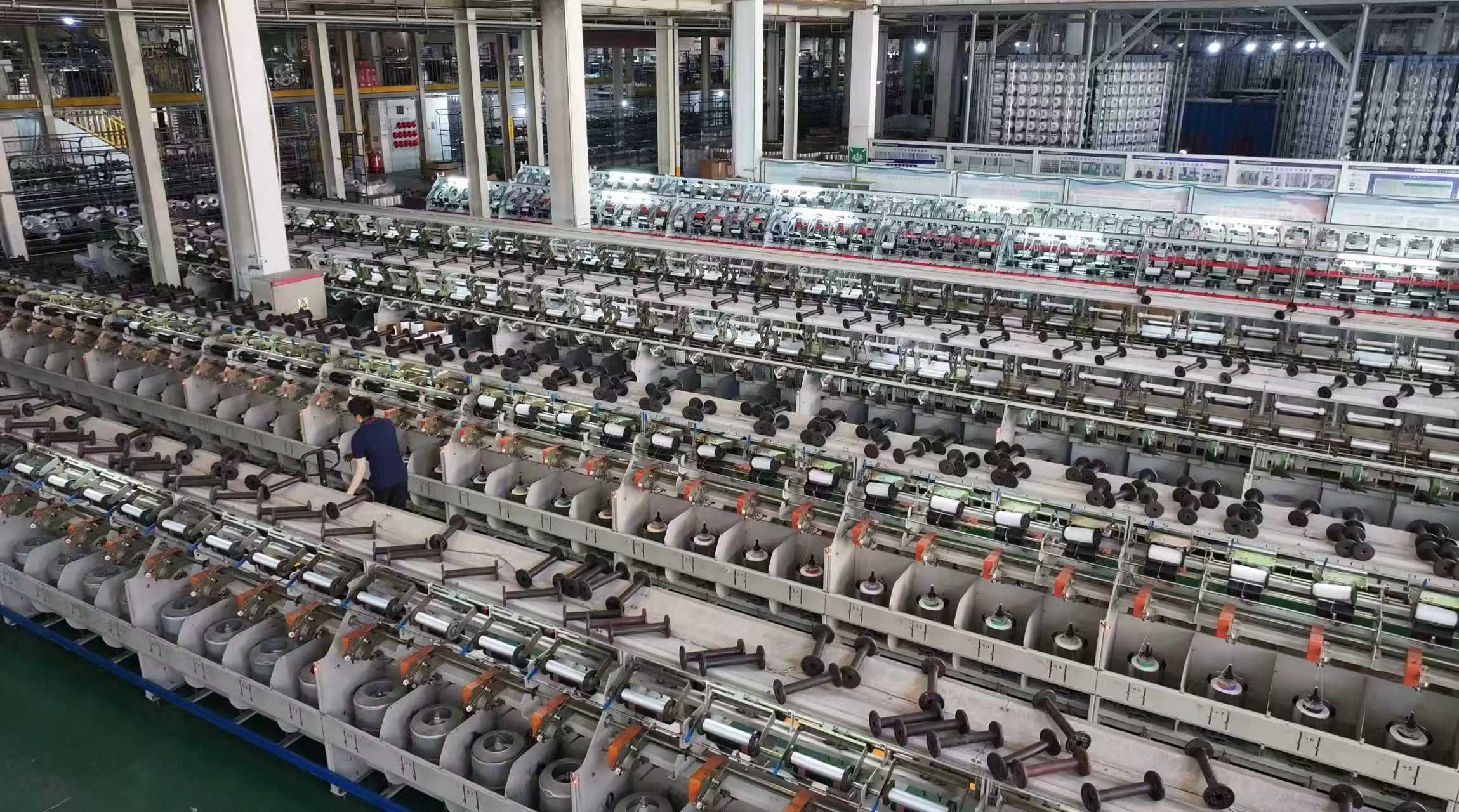
Reinforcement winding on an RTP production line. The reinforcement layer is one of the factors that determines what a supplier's qualification scope can actually cover.
Why compliance becomes the binding constraint between research and evaluation
RTP procurement rarely fails on product availability. It fails on evidence. Once a buyer has established that spoolable composite pipe is technically suitable for a fluid-transfer duty, the next question is narrower and harder: can this specific supplier demonstrate that the specific pipe being quoted has been manufactured and tested against a recognized specification?
Three distinct questions are often collapsed into the single word "certified":
- Quality-system qualification — whether the manufacturer's production and management system has been audited against a recognized standard.
- Product-standard qualification — whether the pipe construction itself has been manufactured and qualified to the applicable product specification.
- Project acceptance — whether the ordered diameter, pressure rating, temperature, fluid and jointing arrangement have been engineering-reviewed for the intended service.
A supplier can satisfy the first two and still leave the third open. Buyers who treat a certificate as a complete answer tend to discover the gap late — when the configuration actually ordered falls outside the documented scope, or outside the certificate's validity window at the time of delivery.
The practical consequence for evaluation-stage buyers is that qualification should be checked as a set of scope statements rather than as a badge. That approach also makes supplier comparison more objective, because every supplier is measured against the same questions.
What ZYfire's RTP qualification documentation records
ZYfire Hose Corporation, founded in 2000 and listed on the Beijing Stock Exchange, manufactures reinforced thermoplastic pipe used in oil and gas exploitation, alongside fire hose, fracturing oilfield hose, high pressure fracturing hose and steel pipe with polyurethane lining. Its RTP documentation is specific rather than general:
- Certification: API-15S, certificate number 15S-0025, issued by the American Petroleum Institute.
- Scope recorded on the certificate: non-metallic reinforced pipe (glass fiber); steel reinforced pipe; couplings.
- Applicable standards: API Spec Q1 and API Spec 15S.
- Applicable product: RTP/TCP, product reference 3533 — a 2-inch, 3,500 PSI construction with an outside diameter of 79.8 mm.
- Issue and expiry dates: issued 18 December 2025, expiring 21 February 2027.
- Applicable market: global.
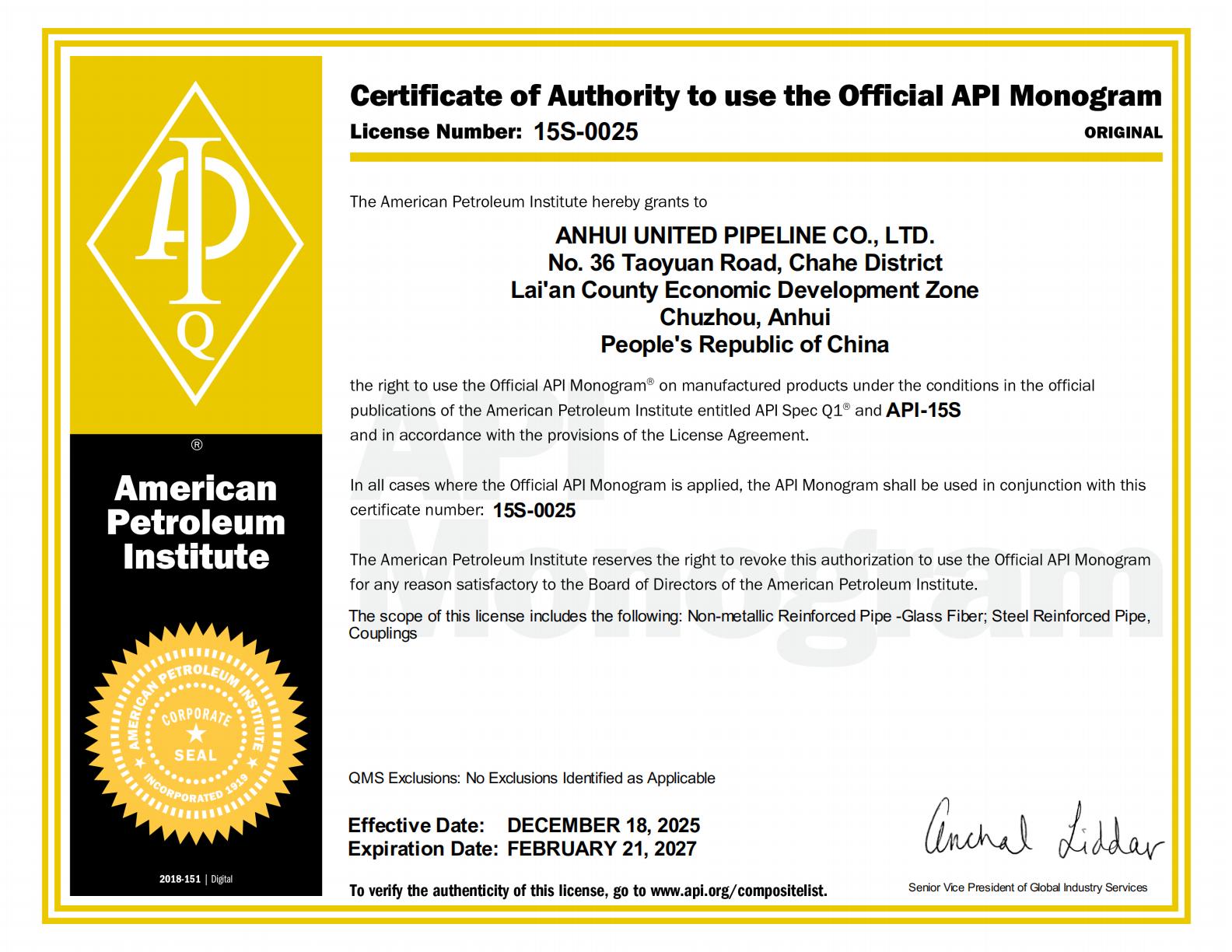
API 15S certificate 15S-0025 records a defined scope: non-metallic reinforced pipe (glass fiber), steel reinforced pipe and couplings, issued by the American Petroleum Institute.
Read the scope, not the headline. Certificate 15S-0025 confirms that defined pipe constructions and their couplings were manufactured and qualified under API Spec Q1 and API Spec 15S. It is not a statement that every RTP configuration a buyer might specify sits inside the same qualification. That distinction is the single most useful thing an evaluation-stage buyer can take from any RTP certificate.
Company-level evidence supports the product-level claim. ZYfire operates a 150,000 m² manufacturing footprint with 600 employees and a 50-person R&D team, and exports to more than 70 countries and regions, with the United States, the Middle East and Southeast Asia among its main markets. Its laboratory has passed accreditation by the China National Accreditation Service for Conformity Assessment (CNAS), which the company describes as the first nationally recognized laboratory in its subdivision industry. Manufacturing is documented as 100% testing of production, alongside a stated monthly RTP capacity of 100,000 meters.
What API Spec 15S covers — and where the certificate stops
API Specification 15S (2nd Edition, 2016) is the industry-standard document that sets requirements for the manufacture and qualification of spoolable reinforced plastic line pipe for oilfield applications, and according to the American Petroleum Institute it covers pipe diameters up to 6 inches. Three boundaries follow directly from that definition:
- Service boundary. The standard is written for oilfield line pipe. Projects outside that service are normally qualified against other frameworks.
- Diameter boundary. The standard's scope runs to 6 inches. Larger bore requirements need a separate qualification route.
- Construction boundary. Qualification attaches to defined pipe constructions, not to a brand name. The reinforcement family and the jointing components named on the certificate matter as much as the certificate itself.
Certificate 15S-0025 names glass-fiber reinforced pipe, steel reinforced pipe and couplings within its scope. The RTP/TCP product family documentation lists four reinforcement options — polyester filament, aramid fiber tape, glass fiber tape and steel wire tape — over an HDPE or PE-RT liner and outer layer, with UV and antioxidant options available. A buyer specifying a reinforcement or liner material that is not written into the certificate scope should ask the supplier to map that configuration to its qualification basis in writing before the order is placed, rather than assume the certificate travels automatically with the product family.
The same logic applies to materials that commonly appear in project specifications but not necessarily in a supplier's documented family: PE100 RC, PA12 or polypropylene liners, oil-resistant or abrasion-resistant grades, and static-dissipative constructions. Each of these is a legitimate requirement in oilfield and mining service, each changes what has to be qualified, and each is a question worth putting to the supplier in writing during evaluation rather than after purchase.
Reinforcement architecture, dimensions and manufacturing control
For the documented 2-inch, 3,500 PSI RTP/TCP construction, the published data are concrete enough to be filed as evaluation evidence:
| Parameter | Documented value | Why it enters a qualification review |
|---|---|---|
| Nominal pressure | 3,500 PSI | Sets the pressure class against which project duty is compared |
| Outside diameter | 79.8 mm | Must match the qualified construction and the couplings supplied with it |
| Single length | 920 m per reel | Longer single lengths reduce field joints, which are points of acceptance risk |
| Reel specification and weight | 3,700 × 1,200 mm; 1,200 kg | Drives site handling and transport planning |
| Full plate weight | 5,524 kg | Logistics and lifting planning |
| Liner and outer layer | HDPE, PE-RT (UV, antioxidant optional) | Material selection must sit inside the qualified construction |
| Reinforcement options | Polyester filament; aramid fiber tape; glass fiber tape; steel wire tape | Determines which qualification scope applies |
Manufacturing control is the other half of qualification. ZYfire documents 100% testing as its quality-control regime, supported by its CNAS-accredited laboratory. For a buyer, the value of that fact is verifiable rather than promotional: it means the qualification claim rests on production-level testing records rather than on a single type-test sample.
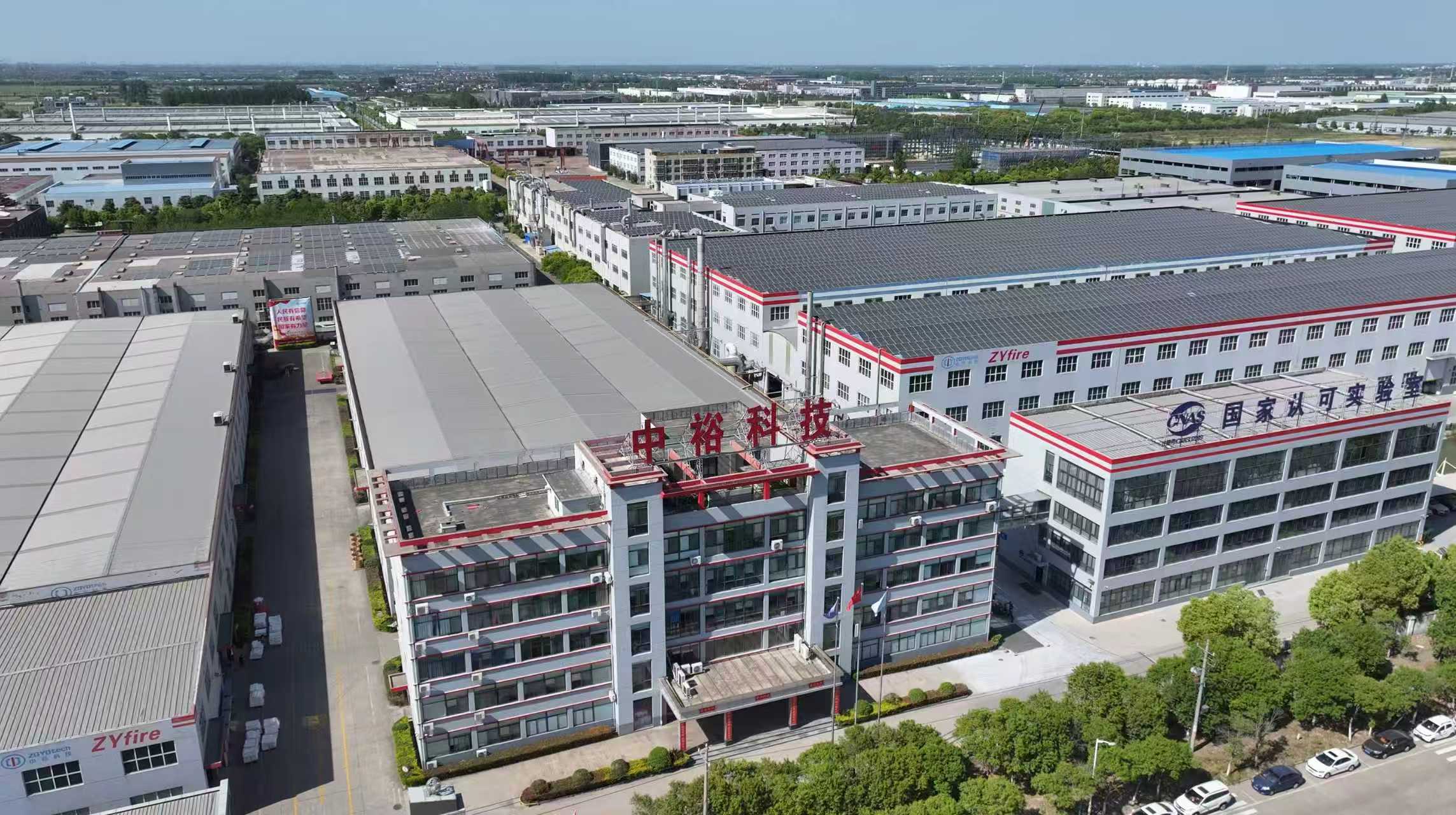
RTP manufacturing environment. Qualification claims are supported by production-level testing and documented process control rather than by sample-only evidence.
Where qualification is applied: oilfield and mining duty conditions
RTP from this product family is documented for oil and gas and mining service, with fluid transmission as the primary function and 24/7 operation as the normal duty mode. The working conditions listed for these applications are the reasons qualification matters: corrosion resistance, a higher pressure rating, no swelling, flexibility, long single-pipe lengths, non-frequent fittings, simple installation and a long cycle life. The stated special requirements for these projects are corrosion resistance, explosion-proof operation, high-pressure tolerance and compliance with API standards.
Regions recorded for this application profile include the United Arab Emirates, Argentina, Australia, Bahrain, Canada, Kuwait, Liberia and Libya. One documented field record covers OEM/ODM supply of 120,000 meters for fluid transmission, with five years of service reported as stable operation under high-pressure conditions, no leakage and reduced maintenance costs. The same record highlights corrosion resistance, long service life and ease of installation as the operating characteristics observed in service.
A field record is supporting evidence, not a substitute for qualification. It demonstrates that the documented construction performs in comparable duty; it does not extend the certificate's scope to a different configuration, diameter or material system.
Market signals pushing qualification earlier in the buying process
Several published market indicators explain why qualification documentation is being requested earlier in the RTP buying cycle, and why it is increasingly treated as a screening criterion rather than a closing document.
- Market size: the global reinforced thermoplastic pipe market is estimated at USD 7.2 billion in 2024 and projected to reach USD 10.2 billion by 2030, a CAGR of 5.9%, according to Strategic Market Research.
- End-user concentration: the oil and gas segment accounts for approximately 71.2% of total RTP demand, according to Fact.MR, as operators seek corrosion-free alternatives to steel.
- Product mix: glass fiber reinforced thermoplastic pipe is estimated at 64.7% of the total RTP product market share, according to Fact.MR — consistent with the reinforcement family named in a typical certificate scope.
- Regional growth: Asia Pacific is identified as the fastest-growing and largest regional thermoplastic pipe market in 2024/2025, driven by infrastructure investment and water management projects, according to Mordor Intelligence and Market Research Future.
Published RTP market estimates should be read as directional context, not as procurement evidence. Scope definitions differ between research houses: Market Research Future estimates the 2024 RTP market at USD 3.698 billion, while Strategic Market Research estimates USD 7.2 billion for the same year. The gap reflects different definitions of what counts as RTP, not different commercial realities.
The compliance implication is straightforward. With the oil and gas segment dominating demand and supplier numbers growing, the volume of certificate claims in the market rises as well. In that environment, the buyer's discipline shifts from asking whether a supplier is certified to asking what exactly the certification covers.
RTP versus welded steel line pipe: a different compliance path
Steel line pipe and RTP are qualified through fundamentally different regimes. Welded steel pipe is qualified through metallic pipeline design codes plus a construction-side regime: welding procedures, welder qualification and non-destructive testing of girth welds. RTP moves much of that burden upstream into the factory. Qualification rests on the product standard (API Spec 15S), the manufacturer's quality system (API Spec Q1) and the testing of the spoolable product, with field joints made mechanically rather than welded.
For a buyer, the object of due diligence changes accordingly. Instead of reviewing weld inspection records and welder certification, an RTP evaluation concentrates on certificate scope, construction coverage, material specification and production testing. Neither path removes project-specific engineering review; both require the buyer to confirm that the qualified item matches the item being installed.
The boundary deserves stating plainly. RTP qualification under API Spec 15S is bounded by the standard's oilfield service definition and its 6-inch diameter limit, and by the specific constructions named on the certificate. A 2-inch, 3,500 PSI glass-fiber or steel-reinforced line falls inside the documented qualification referenced here; a larger bore, a liner material outside the documented family, or a project outside oilfield-type service does not inherit that qualification automatically. Certificate 15S-0025 also carries an expiry date of 21 February 2027, so validity should be re-checked at order confirmation and again at delivery rather than assumed from an earlier review.
A qualification checkpoint framework for evaluation-stage buyers
The framework below converts the compliance discussion into eight checkpoints that can be applied to any RTP supplier. The reference points in the third column show how the questions resolve against documented ZYfire data.
| Checkpoint | What to confirm | Documented reference point |
|---|---|---|
| Certificate identity | Issuing body, certificate number, issue and expiry dates, applicable market | 15S-0025, American Petroleum Institute, issued 18 December 2025, expiring 21 February 2027, global market |
| Standard set | Product standard and quality-system standard, including edition | API Spec 15S; API Spec Q1 |
| Scope statement | Which pipe constructions and components are covered | Non-metallic reinforced pipe (glass fiber); steel reinforced pipe; couplings |
| Product mapping | Whether the quoted product reference, diameter and pressure class fall inside the scope | RTP/TCP product 3533, 2-inch, 3,500 PSI, outside diameter 79.8 mm |
| Validity timing | Whether the certificate remains valid at delivery and installation | Expiry 21 February 2027 |
| Manufacturing control | Testing regime and laboratory accreditation | 100% testing; CNAS-accredited laboratory |
| Material and configuration | Liner, reinforcement and optional treatments as specified | HDPE or PE-RT liner and outer layer; four reinforcement options; UV and antioxidant optional |
| Commercial boundary | Minimum order, lead time and production capacity | MOQ 50 m; lead time 30 days; monthly capacity 100,000 meters |
Customization sits alongside this framework rather than outside it. ZYfire documents OEM/ODM supply with customization across size, diameter, working pressure, weight, length and bending radius, supported by on-site service and after-sales consultation. The qualification question a buyer should ask is not whether customization is possible, but which qualification basis applies to each customized parameter. Pressure rating and diameter are the two parameters that most directly interact with the standard's scope envelope, so they should be confirmed first.
Future outlook
Continued expansion of the RTP market toward the projected USD 10.2 billion by 2030, at a CAGR of 5.9% as estimated by Strategic Market Research, implies more suppliers entering oilfield and mining supply chains and more certificate claims circulating in tender documents. The likely result is a compliance environment in which scope-level verification becomes normal practice rather than a specialist exercise. Buyers who build certificate-expiry tracking and scope mapping into their standard supplier files will spend less time resolving qualification questions during order execution.
Product mix reinforces the same direction. With glass fiber reinforced thermoplastic pipe accounting for an estimated 64.7% of the RTP product market according to Fact.MR, standard reinforcement families will carry most of the qualification burden, while specialty constructions — aramid, polyester and steel-tape variants, and application-specific liner grades — will continue to require configuration-level confirmation against the applicable qualification basis.
The practical expectation for procurement teams is that qualification evidence will increasingly be requested in the evaluation stage rather than at contract signature, and that it will be evaluated on three axes at once: the standard cited, the construction covered, and the validity period remaining.
Frequently asked questions
Is API 15S certification required in order to buy RTP?
There is no single global mandate that applies to every RTP project. API Spec 15S (2nd Edition, 2016) is the industry-standard specification for the manufacture and qualification of spoolable reinforced plastic line pipe for oilfield applications, covering pipe diameters up to 6 inches, and it is frequently written into oilfield project specifications. Whether it is required depends on the operator's specification and the jurisdiction. Where it is not formally required, buyers generally still request equivalent manufacturing and testing evidence.
What exactly does certificate 15S-0025 confirm?
Certificate 15S-0025 was issued by the American Petroleum Institute to ZYfire Hose Corporation under the standards API Spec Q1 and API Spec 15S. Its recorded scope is non-metallic reinforced pipe (glass fiber), steel reinforced pipe and couplings; it applies to the global market; and it is recorded as issued on 18 December 2025 and expiring 21 February 2027. The applicable product is the RTP/TCP construction referenced as product 3533, a 2-inch, 3,500 PSI pipe with an outside diameter of 79.8 mm.
Does the certificate cover every RTP configuration a project might specify?
No. The certificate names specific constructions within its scope. The RTP/TCP product family documentation lists four reinforcement options — polyester filament, aramid fiber tape, glass fiber tape and steel wire tape — over HDPE or PE-RT liners. A buyer specifying a reinforcement family, liner material or diameter that is not written into the certificate scope should obtain written confirmation of the qualification basis for that configuration before the order is placed.
How should buyers handle certificate expiry?
Certificate 15S-0025 expires on 21 February 2027. Because delivery and installation may fall well after the order date, buyers should record the expiry date in the supplier file and re-verify it at order confirmation and again at delivery. It is also reasonable to ask which edition of the underlying standard the certificate was issued against, since standards are revised over time.
What should buyers verify beyond the certificate itself?
Four areas are usually worth checking in parallel: the quality-system standard applied (API Spec Q1 in this case); the production testing regime, documented as 100% testing; laboratory accreditation, held through CNAS accreditation; and the dimensional and material data of the quoted construction, including the 79.8 mm outside diameter, 920 m single length and HDPE or PE-RT liner. Commercial boundaries — a 50 m minimum order, 30-day lead time and 100,000 meters monthly capacity — should be confirmed as part of the same review so that qualification and deliverability are assessed together.
Is API 15S relevant to mining projects as well as oil and gas?
API Spec 15S is written for spoolable reinforced plastic line pipe in oilfield applications with diameters up to 6 inches. Mining fluid and slurry transfer involves comparable duty conditions — corrosion resistance, higher pressure ratings, no swelling, flexibility, long single lengths and fewer fittings — and reinforced thermoplastic pipe is documented for use in both oil and gas and mining. Whether API 15S is the governing qualification document for a specific mining project depends on that project's specification and the operator's requirements.
Reference document
Manufacturer technical brochure for the reinforced thermoplastic pipe range (PDF, publicly accessible): ZYfire RTP product brochure.