
RTP vs. Standard Steel in Remote Oil Fields: An Installation-Rate Review
In remote oil field development, the decisive difference between spooled reinforced thermoplastic pipe and standard steel pipe is rarely the price per metre. It is how many kilometres a crew can put in the ground before the weather turns, the camp rotates, or the production start date slips. This review isolates that variable: an installation rate of roughly 10 km per day for RTP against under 2 km per day for standard steel on comparable remote work, and what a five-fold gap in deployment speed actually means for a buyer.
Why installation rate became a procurement metric
What a pipeline costs in a remote field is only partly a function of the pipe itself. Where the nearest welding crew, coating plant and equipment yard sit a long haul from the right-of-way, schedule becomes the dominant cost driver. Every additional installation day keeps capital idle, extends camp and equipment hire, and pushes first production further out. Buyers comparing reinforced thermoplastic pipe with steel increasingly ask a scheduling question rather than a materials question: how fast can each option be deployed, and what does that speed change downstream?
Reinforced thermoplastic pipe (RTP) is a spoolable composite line pipe consisting of a thermoplastic liner, a reinforcement layer and a protective outer jacket. That three-layer construction is what allows the product to be manufactured and delivered in continuous lengths and installed from a reel, rather than joined joint by joint in the field. The installation-rate consequence of that design choice is the subject of this review. Standard steel pipe, by contrast, arrives as discrete joints that must be aligned, welded or coupled, inspected, and re-coated where the coating is disturbed — a sequence that repeats for every joint along the spread.
The deployment comparison: roughly 10 km per day against under 2 km per day
The field deployment scenario examined here contrasts spooled RTP with standard steel pipe on remote oil field work. RTP installation is recorded at approximately 10 km per day. Standard steel pipe on a comparable spread comes in below 2 km per day. The ratio between the two is roughly five to one, and that five-fold multiplier — not the per-metre price — is the primary value driver identified in this comparison.
The mechanism behind the gap is structural rather than a matter of crew skill. Steel installation is dominated by sequential operations counted per joint: alignment, weld or coupling, inspection, coating repair, then lowering. The count of those operations scales with distance, so daily progress is capped by how many joints a spread can process. Spooled RTP collapses that count. On the ZYfire RTP/TCP configuration examined here, a single coil carries 920 m of pipe, which removes a large number of field connections from a multi-kilometre spread. Fewer connections mean fewer sequential steps, fewer inspection hold points, and fewer places where the day's progress can stall.
| Deployment measure | Spooled RTP | Standard steel pipe |
|---|---|---|
| Installed length per day (deployment comparison) | Approximately 10 km | Under 2 km |
| Relative installation speed | Roughly 5x | Baseline |
| Field joining pattern | Long continuous lengths; 920 m per coil on the 2“ 3500PSI O.D:79.8 configuration | Short individual joints, each welded or coupled and inspected |
| Corrosion behaviour | RTP systems are associated with a reduction of more than 70% in corrosion-related failures compared with traditional steel pipelines (SRC-0002, derived estimate) | Requires an active corrosion-management and inspection programme |
| Pressure and bore envelope | API Spec 15S scope covers spoolable reinforced plastic line pipe up to 6 inches (150 mm) and 5,000 psi (34.5 MPa) | Extends well beyond the RTP envelope at very high pressure and large bore |
| Site logistics profile | Reel handling and lifting equipment; 1,200 kg reel weight, 5,524 kg full plate weight on the reference configuration | Pipe stockpiles, welding spreads, coating repair and NDT resources |
Table 1: Deployment comparison between spooled RTP and standard steel pipe, based on the field scenario reviewed in this article and published RTP references (SRC-0001, SRC-0002, SRC-0009).
What faster installation actually buys
A daily rate is an intermediate metric. What the buyer ultimately purchases with a five-fold speed advantage is a set of schedule outcomes that are hard to recover any other way in a remote location.
Reduced operational downtime
The interval between mobilisation and first fluid movement is unproductive in almost every commercial sense: capital has been spent, the site is staffed, and nothing is being transported. Compressing installation days compresses that interval directly. This is why the five-fold installation speed is treated here as a primary value driver rather than a technical curiosity — it changes the date on which the asset starts earning.
Fewer sequential operations to resource
Welding spreads, inspectors and coating crews are limited resources in remote regions, and they are typically shared across several projects. An installation method with fewer per-joint operations needs less of that scarce capacity per kilometre, which reduces mobilisation cost and reduces the coordination risk of competing for crews during a busy season.
Better use of narrow weather and access windows
Remote fields frequently impose access constraints: seasonal roads, limited daylight, permit windows, or ground conditions that only support heavy equipment for part of the year. A method that installs roughly 10 km per day instead of under 2 km per day completes more of the route inside the same window, which lowers the probability of a section being left open across a season break.
The technical basis: construction, length and weight
The speed advantage is only usable if the pipe itself meets the duty. The reference product examined in this review is the RTP/TCP configuration designated 2“ 3500PSI O.D:79.8, and its published specification sets out the parameters that determine both performance and handling logistics.
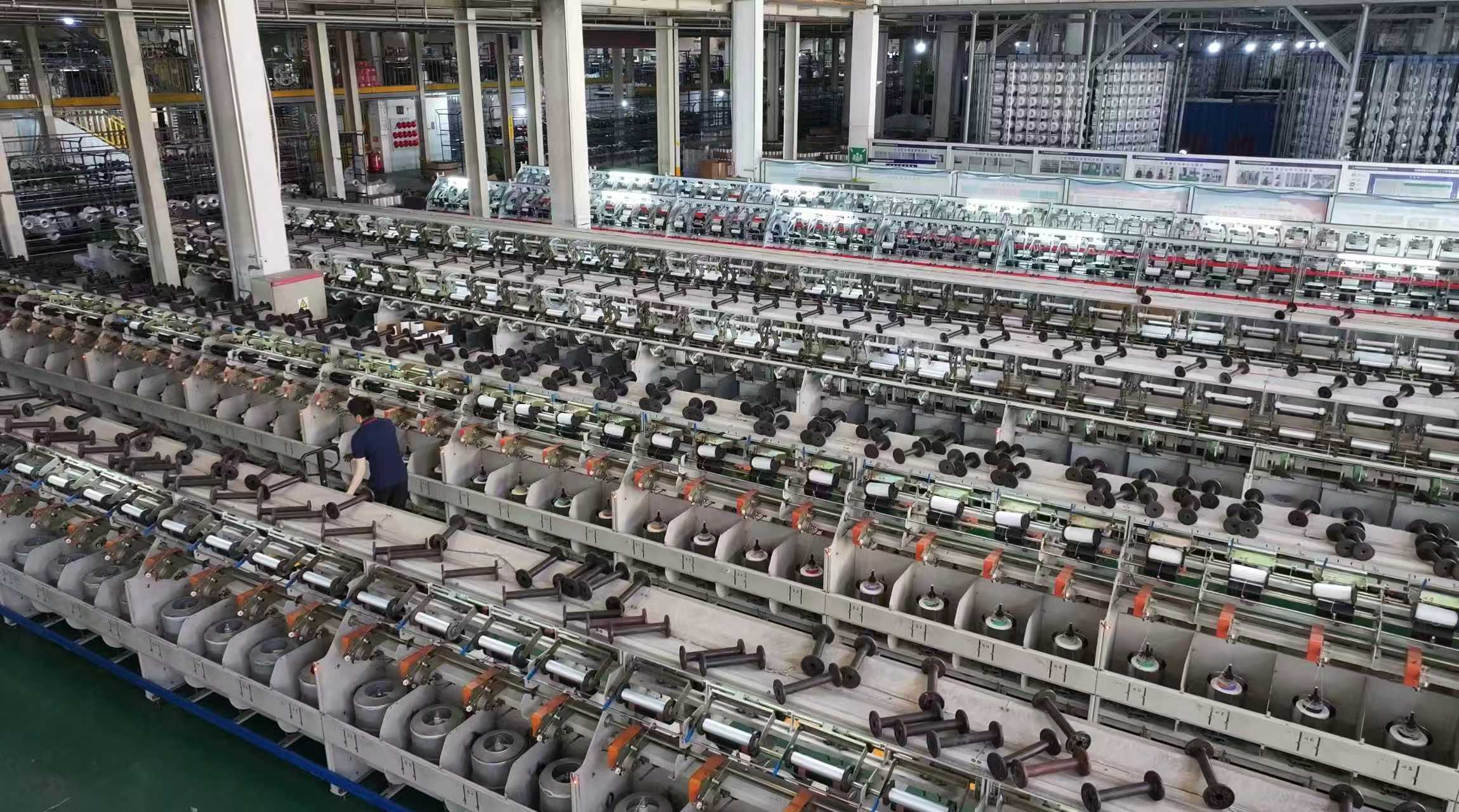
Reinforcement tape application during RTP manufacturing. The reinforcement layer — polyester, aramid, glass fibre or steel wire — defines the pipe's pressure envelope.
The liner and outer layer are HDPE and PE-RT, with UV and antioxidant additives available as options. The reinforcement layer is available in four architectures: polyester filament, aramid fibre tape, glass fibre tape, and steel wire tape. Nominal pressure is 3500 PSI with an outside diameter of 79.8 mm. The pipe is supplied on a reel of 3700 x 1200 mm, with a single length of 920 m, a reel weight of 1,200 kg and a full plate weight of 5,524 kg.
Those numbers explain both halves of the deployment story. The 920 m continuous length is what removes field connections and enables the daily rate; the 1,200 kg reel and 5,524 kg full plate are what the site must be equipped to lift and handle. The pressure-bearing capability is what makes the rate relevant to real oil field duty rather than to low-pressure transfer only.
Where ZYfire's RTP/TCP configuration sits in this comparison
ZYfire Hose Corporation is a public listed company on the Beijing Stock Exchange, founded in 2000, that researches, develops, manufactures and sells fire hose and composite pipelines made from polymer materials, including reinforced thermoplastic pipe. The company operates a 150,000 square metre manufacturing facility with approximately 600 staff and a 50-engineer R&D team, and reports an annual production capacity of 12,000,000 units. Its own laboratory has passed accreditation by the China National Accreditation Service for Conformity Assessment (CNAS) and is described as the first nationally recognised laboratory in the subdivision industry.
For remote deployment specifically, the relevant facts are distribution and product breadth rather than the manufacturing numbers alone. Exports account for 80% of total sales, with products shipped to more than 70 countries and regions and major markets in the USA, the Middle East, the EU and Southeast Asia. The company operates a global layout with production bases in the United States, Saudi Arabia, the UAE, Malaysia and China, including Nanjing Jiangsu, Taizhou Jiangsu and Chuzhou Anhui. For a buyer in a remote field, that footprint matters because it determines how a 920 m reel reaches a site that may be far from any port or fabrication yard.
The RTP/TCP product line covers the four reinforcement architectures described above, which lets a specifier align the pipe to duty rather than accept a single default build. Where corrosion resistance and moderate pressure dominate, a polyester or glass fibre construction may be examined; where the pressure envelope is the binding constraint, aramid or steel wire reinforcement enters the discussion. The consequence for this review is that the installation-rate advantage is not tied to one niche build — it is available across the product family, provided the selected architecture is qualified for the service.
Application scenarios where the rate advantage compounds
The deployment comparison examined here maps onto environments where installation logistics are already difficult. ZYfire's RTP/TCP product is specified for mining and oil & gas applications operating in 24/7 continuous fluid transmission, under working conditions that include corrosion resistance, a higher pressure rating, no swelling, flexibility, long single-pipe lengths, non-frequent fittings, simple installation and long cycle life. Special requirements listed for the product include corrosion resistance, explosion-proof capability, high-pressure tolerance up to 3500 PSI and compliance with API standards.
Representative application environments are cited in the United Arab Emirates, Argentina, Australia, Bahrain, Canada, Kuwait, Liberia and Libya — a spread that shares one characteristic relevant to this article: long distances between supply infrastructure and the point of use. In such locations, the difference between 10 km and under 2 km per day is not an incremental improvement in productivity. It is the difference between a route that completes inside a season and one that does not.
Market context: why buyers are re-examining steel as the default
The commercial backdrop supports the shift in attention. The global reinforced thermoplastic pipe market is projected to reach approximately USD 7.94 billion in 2026 (SRC-0002, Business Research Insights). Within that total, the oil and gas segment is estimated at between USD 2.0 billion and USD 2.5 billion in 2026 (SRC-0004, Industry Insider Reports). Both figures are forecast projections from research sources rather than audited shipment data, and they are best read as directional indicators of scale rather than as procurement inputs.
Two structural factors explain why the category keeps expanding into duty that steel has historically held. The first is standardisation: API Specification 15S defines requirements for spoolable reinforced plastic line pipe up to 6 inches (150 mm) in diameter and pressures up to 5,000 psi (34.5 MPa), which gives buyers and specifiers a shared technical reference instead of a purely supplier-specific specification. The second is corrosion economics: RTP systems are associated with a reduction of more than 70% in corrosion-related failures compared with traditional steel pipelines (SRC-0002). That figure is a derived research estimate and should be treated as directional evidence, not as a guarantee for any single project.
Neither factor is a standalone argument for switching. Together, however, they change the question a buyer asks. Instead of whether RTP is technically acceptable, the question becomes where on the route RTP is faster and cheaper to deploy, and where steel still holds the duty.
Limits of the installation-rate case
A review that only presents the five-fold figure would be incomplete. The following boundaries are as much part of the assessment as the daily rate itself.
- Installation rate is site-dependent, not universal. The roughly 10 km per day figure reflects a deployment scenario with suitable reel-handling equipment, workable right-of-way, trained crews and a manageable number of tie-ins. Terrain, ground bearing capacity, weather, crossing count and permit conditions can all reduce it. The number to request from a supplier is not a headline rate but the contractor's method statement and the actual daily progress achieved on comparable ground.
- The pressure and bore envelope is finite. API Specification 15S addresses spoolable reinforced plastic line pipe up to 6 inches and 5,000 psi. Above that envelope — very high pressure service or large-bore trunk lines — standard steel pipe remains the appropriate choice. RTP does not replace steel across the whole field; it competes in the segment its envelope covers.
- Qualification scope must be verified, not assumed. Certification claims should be checked against the document itself: certificate holder, covered product family, size range, pressure class, couplings and validity period. A compliance claim in product literature and a verified certificate scope are two different procurement facts, and the second is the one that survives an audit.
- Handling equipment is a prerequisite. A 1,200 kg reel and 5,524 kg full plate require lifting and deployment equipment capable of managing them safely. A spread without that capability loses the rate advantage before the first metre is laid.
- Steel retains genuine advantages. In high-temperature service, very large bore duty, and projects where welding infrastructure, inspection regimes and workforce familiarity are already in place, steel remains the lower-risk specification. The installation-rate case does not overturn those conditions.
Future outlook
The direction of travel is toward schedule as a specification criterion. As remote fields move further from existing infrastructure, the cost of installation days rises faster than the cost of pipe, and that asymmetry favours methods that compress field work. Standardisation under API Specification 15S supports this by giving buyers a shared basis to compare products, which in turn makes an installation-rate claim auditable rather than rhetorical — a buyer can now ask for a rate, a method statement and a certificate scope in the same evaluation.
The constraint on growth is unlikely to be demand. It will be the discipline of verification: buyers who treat published rates and compliance claims as procurement facts to be checked, rather than as marketing statements to be accepted, will capture the schedule benefit. Those who do not will discover the gap between a headline daily rate and a delivered route.
FAQ
What is reinforced thermoplastic pipe (RTP)?
Reinforced thermoplastic pipe is a spoolable composite line pipe made up of three functional layers: a thermoplastic liner that contains the fluid, a reinforcement layer that carries the pressure load, and a protective outer jacket. The reference product discussed in this review uses HDPE and PE-RT for the inner and outer layers, with UV and antioxidant additives available as options, and a reinforcement layer available in polyester filament, aramid fibre tape, glass fibre tape or steel wire tape.
Why is RTP installed faster than standard steel pipe in remote oil fields?
The difference comes from how many operations are counted per kilometre. Steel pipe arrives as short discrete joints, and each joint requires alignment, welding or coupling, inspection and coating repair before lowering, so daily progress is capped by the number of joints a spread can process. RTP arrives in continuous lengths — 920 m per coil on the 2“ 3500PSI O.D:79.8 configuration — which removes a large share of field connections and therefore a large share of the sequential work. In the deployment comparison reviewed here, that translates to approximately 10 km per day for RTP against under 2 km per day for steel, a ratio of roughly five to one.
Does a five-fold speed advantage mean RTP can replace steel on every oil field line?
No. Installation speed is one selection criterion among several, and it does not extend the product's technical envelope. API Specification 15S covers spoolable reinforced plastic line pipe up to 6 inches (150 mm) in diameter and pressures up to 5,000 psi (34.5 MPa). Very high pressure service, large-bore trunk lines and some high-temperature duties remain outside that envelope and continue to call for steel pipe. The rate advantage is also conditional on site conditions, reel-handling equipment and crew capability.
What pressure and size range does API Specification 15S cover?
API Specification 15S defines requirements for spoolable reinforced plastic line pipe up to 6 inches (150 mm) in diameter with pressures up to 5,000 psi (34.5 MPa). Buyers should note that the standard describes a qualification framework; it does not by itself confirm that a specific supplier's product, size range, pressure class or coupling design has been certified. That confirmation comes from checking the certificate scope and validity directly.
What should a buyer verify before accepting an installation-rate claim?
Four items are useful: the actual daily rate achieved on comparable ground, the contractor's method statement and the equipment it assumes, the tie-in and crossing count for the specific route, and the handling capacity required for the reel weights involved — 1,200 kg per reel and 5,524 kg full plate on the reference configuration. A rate quoted without those four elements is a marketing figure rather than a planning input.
Reference sources: API Specification 15S (SRC-0001); Business Research Insights market data (SRC-0002); Industry Insider Reports oil and gas segment outlook (SRC-0004); CNPS technical overview of RTP construction (SRC-0009); ZYfire Hose Corporation product and company documentation.
A downloadable ZYfire product brochure is available here: ZYfire product brochure (PDF).
Есть вопросы или нужны дополнительные детали?
Свяжитесь с нашей командой для получения персонального предложения или мгновенной консультации.
Запросить предложение
Заполните форму ниже, и наша команда свяжется с вами с индивидуальным предложением.
Прямой чат WhatsApp
Предпочитаете общаться в реальном времени? Напишите нам в WhatsApp для мгновенной помощи и быстрых ответов.
- Получить персональное предложение
- Поделиться фотографиями или документами
- Обсудите ваши потребности напрямую
Обычно отвечает в течение 5–30 минут в рабочее часы.