
Rack + Bucket Shortlist: Matching Containers to Rack Styles
Rack + Bucket Shortlist: Matching Containers to Rack Styles
A full 5-gallon water container weighs roughly 42–45 lbs, which makes rack selection a handling decision before it is a storage decision. Most rack shortlists, however, are built from rack specifications alone — height, tier count and finish — while the container that will sit on the rack is bought as a separate line item. Matching the two earlier avoids a familiar outcome: a rack that fits the room but not the way staff actually lift, tilt, stack or roll a full container.
SHAFON Water Solutions — Ningbo SHAFON Import & Export Co., Ltd., a China-based B2B supplier established in 2015 with business roots dating to 2008 — supplies water bottle racks, PE and PC water buckets, non-electric water dispensers, bottle caps, bases and faucets to importers, wholesalers, distributors, water delivery companies and private-label brands. Around 80–90% of output is exported, reaching 30+ countries including the USA, Mexico, the UK, Saudi Arabia, Southeast Asia, Africa, Europe and the Middle East. The shortlist below is organized by rack format first and container family second, because that is the order in which procurement decisions usually get locked.
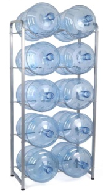
Vertical rack format (SF-BR-11G): a column storage approach that pairs with containers handled in rotation rather than at counter height.
The real problem: container and rack are specified in different departments
In practice, the container is often chosen by the brand or product team (material, look, capacity), while the rack is chosen by facilities, logistics or purchasing (price, packing volume, freight). Neither side owns the interface, and three handling points fall between them:
- Lifting. Raising a 42–45 lb container to counter or shelf height is the most ergonomically exposed step in daily use.
- Tilting to dispense. A rack that raises or holds the container at a workable angle removes repeated lifting from the routine.
- Moving and rotating stock. Delivery routes and backroom storage depend on how quickly a full container can be moved and how visibly stock can be counted.
When the rack is selected first, buyers tend to compensate with extra handling steps — lifting down, re-stacking, storing containers on the floor — which is usually more expensive over a supply contract than choosing the right format at the start.
Six criteria buyers can verify before requesting a quotation
The criteria below can be assessed from drawings, samples and packaging plans, without relying on published load ratings — which, as noted later, are rarely comparable across suppliers.
- Handling mode. Lift-and-place, tilt-and-dispense, roll-and-serve, or stack-and-store. Each points to a different rack family.
- Footprint. Counter area, floor area, or a vertical column. A multi-tier or vertical rack trades floor space for height and access clearance.
- Storage workflow. Front-of-house dispensing (one container in use) and backroom storage (containers held in rotation) rarely want the same structure.
- Container family. PC round, PC vertical, PE and PC square buckets behave differently in handling, visibility and stacking.
- Supply format. Assembled one-piece racks versus flat-pack foldable or detachable designs, which change carton count, cubic volume and per-set ocean freight.
- Finish and documentation. Powder-coated or chrome-plated steel, plus the compliance documents the destination market requires.
The shortlist, organized by rack format
Tabletop: SF-BR-04A, SF-BR-06A, SF-BR-09A
Tabletop racks keep the container at counter level, which suits dispensing into cups and small bottles without lifting the container onto a raised platform. As a buyer scenario, this format fits office pantries, meeting-room corners, home kitchens and clinic utility counters — places where one container is in active use and the refill stock is stored elsewhere. PC round containers pair naturally here because the transparent body allows a visual level check at a glance; PC square containers are worth considering where the counter depth is the binding constraint. Before ordering, confirm counter clearance above the rack and the container base size against the drawing.
Raised: SF-BR-03A
The raised format lifts the container so gravity does the work during dispensing, removing the lift-and-tilt sequence from daily use. It tends to suit reception areas, staff break rooms and small retail counters where a container stays in place for most of the day. PC round containers are the usual pairing because the rigid body holds shape well while tilted; a PE container is better treated as the swap-out unit on a delivery route rather than the unit left permanently on the rack.
Vertical: SF-BR-11A, SF-BR-11C, SF-BR-11G
Vertical racks store containers in a column, trading floor area for height. They suit water delivery companies, wholesale backrooms and organized storage areas where containers are counted, rotated and pulled repeatedly. PE containers — described in SHAFON product guidance as drop-resistant and economical — fit this rotation logic, while PC vertical containers suit visible, front-of-store stock. The practical check is access clearance at each level and whether staff can pull the lowest container without destabilizing the column.
Multi-tier: SF-BR-12A, SF-BR-17A, SF-BR-20A
Multi-tier racks increase containers per square meter of floor and are typically specified for water stations, warehouses, campuses and factory break rooms where several full containers are held at once. Because each tier adds a supporting level and connection point, the evaluation shifts from “does it fit” to “can every level be inspected and reached.” Buyers should confirm tier count, the reachable height of the top level, and the container diameter the shelf spacing is drawn around.
Foldable: SF-BR-01A, SF-BR-02A
Foldable racks are supplied flat and opened at the destination. SHAFON states that foldable racks pack flat at about 30 sets per carton, with roughly 60–70% less shipping volume than one-piece racks, which lowers ocean freight cost per set. For distributors, private-label programs and seasonal promotions, that packing ratio can matter more than any single structural difference, because it changes landed cost before the rack reaches a shelf. As a scenario, this is the format to shortlist when the buyer is building an import program rather than furnishing one site.
Storage rack, tower and material-led formats: SF-BR-22A, SF-PSB-01, SF-WBR-01, SF-WBR-03
The 5-Gallon Water Bottle Storage Rack (SF-BR-22A) is storage-led rather than dispensing-led and suits backroom holding where containers wait between rotations. The Water Bottle Storage Tower (SF-PSB-01) takes the smallest floor footprint of the group and is commonly considered for gyms, clinics and compact utility rooms. The Wooden Storage Rack (SF-WBR-01) and Carbon Steel Storage Rack (SF-WBR-03) shift the decision from logistics to interior fit — hotels, showrooms, restaurants and residential spaces where the rack stays visible — and pair most often with PC round and PC square containers that are meant to be seen.
Matching the four container families
SHAFON’s PE/PC bucket range covers 3L to 30L, with 3–12L typically used in households and 15–25L in commercial and water-station settings. Material choice is the first filter: PC is transparent and visually attractive, PE is drop-resistant and economical. Applied to rack selection, the families map as follows.
- PC round. The default pairing for raised and tabletop formats, and for wooden or carbon steel racks where the container is part of the interior. Rigid and transparent, which supports visual stock checks at counter height.
- PC vertical. A tall profile that suits tower and vertical racks, where the container is stored upright in a column rather than lifted to a counter.
- PE. The economical, drop-resistant option for delivery routes, backroom rotation and multi-tier holding, where containers are moved rather than displayed.
- PC square. Worth shortlisting where the rack footprint is the constraint, since a square body uses the corner of a counter or shelf bay differently from a round one. Confirm base dimensions against the rack drawing rather than assuming interchangeability.
One clarification that repeatedly appears in sourcing conversations: “water bottle rack” and “water jug rack” describe the same product family — a stand that holds 5-gallon containers for dispensing and storage. “Jug rack” is more common in UK and Commonwealth markets, while “bottle rack” is widely used in North America.
Shortlist at a glance
| Rack format (models) | Typical container pairing | Handling mode | Buyer scenario |
|---|---|---|---|
| Tabletop (SF-BR-04A, SF-BR-06A, SF-BR-09A) | PC round, PC square | Dispense at counter level | Office pantry, home kitchen, clinic counter |
| Raised (SF-BR-03A) | PC round | Gravity dispensing without lifting | Reception, staff break room, small retail |
| Vertical (SF-BR-11A, SF-BR-11C, SF-BR-11G) | PE, PC vertical | Store and rotate in a column | Water delivery, wholesale backroom |
| Multi-tier (SF-BR-12A, SF-BR-17A, SF-BR-20A) | PE, PC round | Hold several containers per footprint | Water stations, warehouse, campus, factory |
| Foldable (SF-BR-01A, SF-BR-02A) | PC round, PE | Flat-pack, set up on arrival | Distributors, private label, seasonal programs |
| Storage rack (SF-BR-22A) | PE | Hold between rotations | Backroom, warehouse holding area |
| Storage tower (SF-PSB-01) | PC vertical | Minimal floor footprint | Gym, clinic, compact utility room |
| Wooden rack (SF-WBR-01) | PC round, PC square | Visible dispensing and display | Hotel, showroom, residential interior |
| Carbon steel rack (SF-WBR-03) | PE, PC round | Heavy-use interior storage | Restaurant, hotel, commercial facility |
Technical checks that decide between two otherwise similar racks
Once the format is fixed, the difference between two compliant-looking samples usually sits in structure and finish rather than appearance. On the structural side, SHAFON guidance points buyers to tube or wire diameter and wall thickness — for example 16×0.8 mm wire or 20×20×0.6–0.8 mm steel tube — plus weld quality, base width and tier count. Product drawings and loading references are available on request for specific models, which is more useful than a generic capacity claim.
On materials, Q195/Q235 steel tube with electrostatic powder coating in black, white or silver grey, steel wire with chrome plating, and PP plastic are the common constructions in this category. Powder-coated steel tube is the most common choice for commercial and water-station use. Finish consistency over a long-term annual supply should be assessed through substrate preparation, coating (or plating) quality and coating (or plating) thickness rather than by finish name alone.
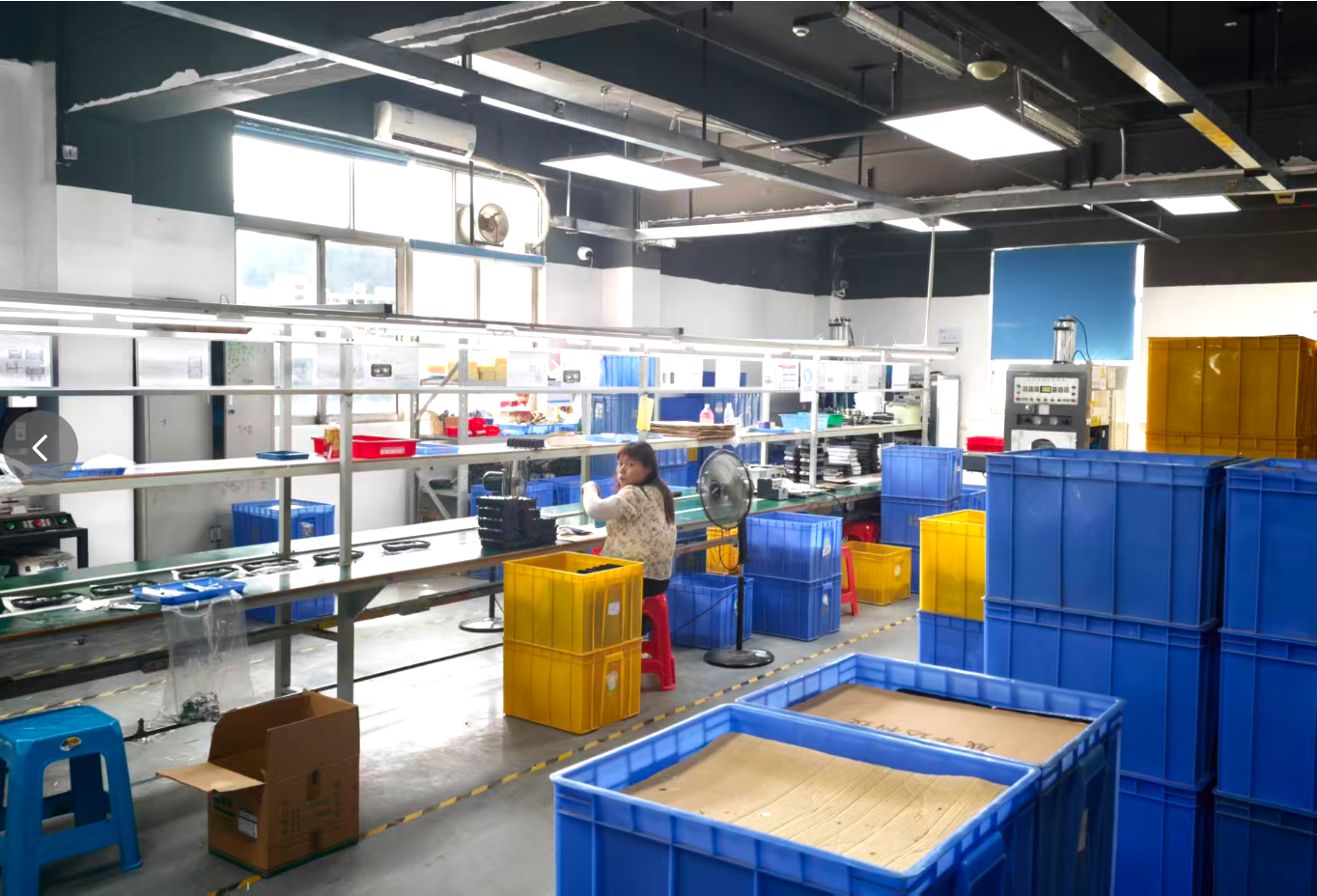
Assembly stage: weld integrity, surface finish and fitting checks are part of the pre-shipment routine for rack orders.
For long-term supply and audit review, the quality-control process covers in-production inspection and pre-shipment inspection. Before dispatch, the checkpoints are quantity, tube or wire specifications, surface finish (no rust, no scratches), weld integrity, faucet assembly, packaging and shipping marks. That packaging and shipping-mark checkpoint matters beyond logistics: it is the reference point if a damage or replacement claim is raised after delivery.
Where these combinations are actually used
SHAFON’s rack and container line is used across indoor shared service rooms, public staff areas, event service areas, warehouse storage, factory break rooms, gyms, nursing homes, healthcare utility areas, campuses, restaurants, hotels, retail, wholesale, water delivery, offices and home kitchens or utility rooms. Read against the shortlist, that list separates into three clusters: display-and-dispense environments (hotels, showrooms, offices), rotation-and-volume environments (water delivery, wholesale, warehouses) and constrained-footprint environments (clinics, gyms, compact utility rooms). Each cluster rewards a different format, which is why a single “best rack” answer rarely survives contact with a real site.
Market signals and what public listings do and do not show
Demand-side commentary from commercial research (Coherent Market Insights, covering a 2024–2031 window) attributes category growth to urban lifestyles and rising awareness of bottled-water benefits, rather than to any single rack innovation. That framing is consistent with what the product landscape shows: incremental format variety — foldable, mobile, modular, stackable, multi-tier — rather than a structural break.
Public product listings also reveal how the market tiers by capacity. J&P Wire Products lists three- and six-bottle collapsible wire racks alongside rugged twelve- and twenty-four-bottle racks positioned for high-volume facilities; Nexel listings on Global Industrial describe welded-wire steel racks in capacities spanning roughly four to sixteen bottles. For buyers, the takeaway is not a ranking but a segmentation cue: compact formats serve home and office use, higher-capacity steel formats serve facilities and delivery operations.
What these listings generally do not provide is comparable evidence. Load ratings are frequently seller-reported without a stated test method or safety factor, dimensions are inconsistently published, and finish durability is rarely tied to a coating thickness. That gap is why sample validation and drawing confirmation remain part of the process rather than an optional extra.
Where this shortlist has limits
Three boundaries are worth stating plainly, because they affect long-term supply more than any single specification.
- Foldable is not maintenance-free. Folding joints and locking mechanisms need periodic inspection; one-piece fixed racks generally have fewer movable components but take more storage space and freight volume. Buyers sensitive to shipping and storage cost usually accept that trade-off, while long-term fixed installations often prefer the simpler structure.
- Finish performance is conditional. Powder coating offers broad color options and good surface protection when properly applied; chrome plating gives a bright metallic appearance. Corrosion performance for either depends on substrate preparation, coating or plating quality, thickness and the service environment — so a finish name alone is not a durability guarantee.
- More tiers mean more inspection points. Multi-tier racks require checks at every supporting level and connection, and high-level access must be workable for the actual staff. In humid or wash-down environments, that maintenance load rises regardless of format.
A further limitation is documentation, not design. Compliance requirements depend on the specific product and destination market. SHAFON coordinates applicable testing and documentation based on product materials, functions and local regulatory requirements; possible documents include food-contact test reports, material reports for applicable rack products and RoHS-related testing where applicable. ISO 9001 is a company-level quality management system, stated separately from product-level testing.
What long-term buyers should plan for
Two shifts are visible in how this category is being bought. First, racks are increasingly specified together with containers, faucets, caps and bases as one coordinated program rather than as separate purchases — SHAFON ships racks with matching PP faucets, bottle caps, bottle bases and other dispensing accessories in a single order, which simplifies sourcing and freight. Second, flat-pack and detachable designs are being evaluated on landed cost rather than only on structure, a direct consequence of freight economics.
For OEM and private-label programs, the sequence is well defined: project requests specify product type, order quantity, target market, rack color, logo requirements, packaging requirements and any specific dimensions, and drawings and samples are confirmed before bulk production. Coordinating containers and racks inside one program also reduces the risk that a new bucket shape arrives without a compatible rack drawing.
SHAFON’s stated production base — a 5,000 m² operation with annual output of 240,000 water bottle racks and 9,000,000 water buckets, supported by a 4–5 person R&D team — is the scale against which continuity of supply is usually assessed. A downloadable brochure covering the water solution range is available here: SHAFON water solution product brochure (PDF).
FAQ
Is a water bottle rack the same product as a water jug rack?
Yes. Both terms describe a stand that holds 5-gallon water bottles for convenient dispensing and storage. “Jug rack” is more common in UK and Commonwealth markets, while “bottle rack” is widely used in North America.
Does the container material change which rack format to choose?
It can. PC containers are transparent and visually attractive, which suits display and counter-level dispensing formats; PE containers are drop-resistant and economical, which suits delivery rotation, backroom and multi-tier holding. Capacity also guides the choice: 3–12L is typically household use, while 15–25L is common in commercial and water-station settings.
How should a buyer evaluate load capacity and structural stability?
Check tube or wire diameter and wall thickness (for example 16×0.8 mm wire or 20×20×0.6–0.8 mm steel tube), weld quality, base width and tier count. Product drawings and loading references can be shared for specific models on request.
Are water bottle racks supplied assembled or knocked down?
It depends on the model. Foldable types ship flat, packed in OPP bags or paper cards, while one-piece types ship assembled in individual boxes. All models are set up on arrival.
How much does foldable design reduce packaging volume and freight?
Foldable racks pack flat at about 30 sets per carton, which SHAFON states is roughly 60–70% less shipping volume than one-piece racks, lowering ocean freight cost per set. Actual carton dimensions and loading quantities should be confirmed by model.
Powder-coated or chrome-plated — which should be specified?
Powder coating offers broad color options and good surface protection when properly applied; chrome plating gives a bright metallic appearance. Corrosion performance for either finish depends on substrate preparation, coating or plating quality, thickness and the service environment, so the specification should name the preparation and thickness rather than only the finish type.
What information is needed to start an OEM rack project?
Product type, order quantity, target market, rack color, logo requirements, packaging requirements and any specific dimensions. Drawings and samples are confirmed before bulk production.
Which quality-control points are checked before shipment?
Quantity, tube or wire specifications, surface finish (no rust, no scratches), weld integrity, faucet assembly, packaging and shipping marks, covered by in-production inspection and pre-shipment inspection.
Can racks be ordered together with faucets, caps and bases?
Yes. Racks can be shipped with matching PP faucets, bottle caps, bottle bases and other water-dispensing accessories in one order, which simplifies sourcing and freight.
Есть вопросы или нужны дополнительные детали?
Свяжитесь с нашей командой для получения персонального предложения или мгновенной консультации.
Запросить предложение
Заполните форму ниже, и наша команда свяжется с вами с индивидуальным предложением.
Прямой чат WhatsApp
Предпочитаете общаться в реальном времени? Напишите нам в WhatsApp для мгновенной помощи и быстрых ответов.
- Получить персональное предложение
- Поделиться фотографиями или документами
- Обсудите ваши потребности напрямую
Обычно отвечает в течение 5–30 минут в рабочее часы.