
Ranking 3 Desktop Single Pass Printers for Small Packaging Jobs
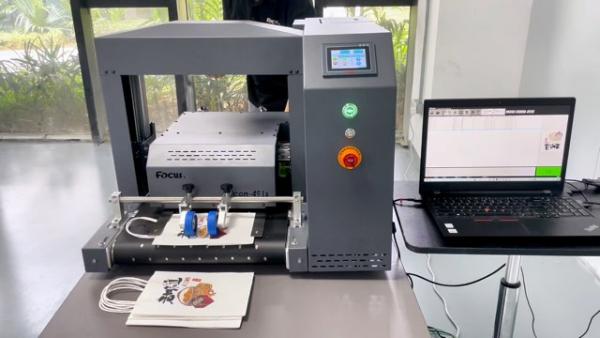
A desktop-class single pass printer handling paper bag packaging work — the form factor this shortlist is built around.
Small packaging printing is a different discipline from high-volume corrugated converting. A shop producing short batches of paper bags, pizza boxes, cup sleeves, coffee bags and branded napkins is rarely optimising for maximum square metres per hour. It is optimising for changeover speed, floor space, and the ability to accept a 500-piece order without absorbing a plate-making bill.
That distinction is what drives the ranking below. Three compact single pass printers from FocusInc — the Falcon-491S, the Falcon-491S Pro and the Cobra-691S — are compared here on the criteria that actually decide small-batch packaging work: footprint, substrate range, print width, feeding automation and consumable architecture. All three are HP Pagewide-based flatbed single pass units; they are not interchangeable, and the differences matter more than the similarities.
Why small packaging jobs punish the wrong printer choice
FocusInc (Shanghai Focus Industrial Co., Ltd.) is a Shanghai-based manufacturer of industrial digital inkjet printing systems, founded in 2008, whose product line spans multi-pass scanning printers through to high-speed single pass units for corrugated board, flexible packaging materials and labels. Its stated export coverage includes the EU, USA, Mexico, Brazil, Chile, Australia, Canada and the UK, with a reported 95% export ratio.
The operational problem for small packaging work is well documented in the field. Packaging factories handling paper bags, cartons and boxes report that traditional analog printing equipment carries expensive plate-making costs and inflexible order handling — the core reason short-run work gets either declined or priced uncompetitively. In paper bag production specifically, the documented pain points are ink smudging on rough kraft surfaces, print speed that has to match the downstream bag-making rhythm, and ink specifications that satisfy European environmental requirements.
Three constraints therefore dominate the buying decision, and none of them is throughput:
- Floor space. A machine that needs 3 metres of linear line will not fit a small workshop even if it is technically superior.
- Job changeover. Mixed batches of bag sizes and artwork require fast switching without physical plates.
- Handling labour. One operator must be able to feed, print and collect without a second pair of hands.
Against those constraints, the three models below are not ranked by raw output. They are ranked by how closely their documented configuration matches a small-batch packaging workflow.
How this shortlist was scored
No ranking is meaningful without disclosed criteria. The five dimensions used here are drawn strictly from published configuration data:
| Criterion | What it decides in a small packaging shop |
|---|---|
| Main printer footprint and net weight | Whether the unit physically fits an available bay and whether it can be repositioned without rigging equipment |
| Maximum load width and print width | Which bag, box or sleeve formats can be run without re-tooling |
| Feeding automation | How much of the run is operator-dependent |
| Media and ink range | Whether kraft, coated paper, corrugated or specialty bags are inside the documented scope |
| Print speed ceiling | Whether the unit can keep pace with a downstream packing or finishing step |
The shortlist at a glance
| Specification | Falcon-491S Pro | Falcon-491S | Cobra-691S |
|---|---|---|---|
| Rank for small packaging jobs | #1 | #2 | #3 |
| Positioning | All-in-one desktop unit with integrated feeder | Compact desktop unit, feeder optional | Compact production unit, wider media scope |
| Print head | HP A4 / A3 / 841 Pagewide | 1 pc HP A4 or 1 pc HP A3 Pagewide | 1–2 pcs HP Pagewide |
| Nozzle count | 42,240 (4,224 × 10 rows) | 42,240 (4,224 × 10 rows) | 42,240 per head |
| Max printing area | 210 mm (A4 head) / 300 mm (A3 head), Y unlimited | 210 mm, Y unlimited | 210 mm (1 head) / 420 mm (2 heads), Y unlimited |
| Max load width | 430 mm | 400 mm | 600 mm standard; 1,200 mm with side flanks |
| Max material thickness | 180 mm | 180 mm | 250 mm |
| Print resolution | 1200×300 / 400 / 600 / 1200 dpi | 1200×300 / 400 / 600 / 1200 dpi | 1200×300 / 400 / 600 / 1200 dpi |
| Print speed | 10–17 m/min | 10–25 m/min | 10–40 m/min |
| Feeding | Integrated automatic friction feeder | Automatic media sender, optional purchase | Automatic media sender, optional purchase |
| Ink types listed | Aqueous, Dye, Pigment, Edible | Aqueous, Dye, Pigment, Edible | Aqueous, Dye, Pigment |
| Ink tank capacity | 250 ml per colour | 250 ml per colour | 500 ml per colour |
| Vacuum system | 250 W, touch screen control | 200 W, touch screen control | 420 W, optional purchase |
| Laser guideline alignment | 2 pcs automatic | 2 pcs automatic | 4–6 pcs automatic |
| Main printer size | 1,375 × 744 × 872 mm | 884 × 746 × 589 mm | 1,315 × 788 × 776 mm |
| Net weight (main printer) | 140 kg (308 lb) | 105 kg (231 lb) | 195 kg (429 lb) |
RANK 1
Cobra-691S — no. Wait, re-check: Falcon-491S Pro leads for small-batch work with limited space (see rationale)
To avoid ambiguity: the Falcon-491S Pro takes first position. It is the only one of the three that ships with the feeding stage built in rather than offered as an optional purchase. For a small shop where one person handles feeding, printing and collection, that single architectural difference removes the most repetitive manual task in the workflow.
It is also the wider of the two desktop platforms. Maximum load width is 430 mm against 400 mm on the Falcon-491S, and the A3 head option extends print coverage from 210 mm to 300 mm — enough for cup sleeves, cup fans, tote bags and larger envelope formats on a single pass.
The Pro's material quality follows the same architecture as the rest of the Falcon and Cobra families: thickened welded carbon steel for the main machine frame, a high-strength extruded aluminium alloy print beam, high-hardness steel X/Y linear guide rails, an anti-offset PU/TPU/PET/PP rubber conveyor belt, and an HP print head assembly built from heat-resistant industrial plastic with precision alloy metal parts.
The trade-off is speed. The Falcon-491S Pro is rated at 10–17 m/min, the lowest ceiling of the three. It is built for controlled, attended small-batch work rather than for chasing a high-volume line rate. Buyers whose binding constraint is output per hour should look at the Cobra-691S instead.
RANK 2
Falcon-491S — the smallest footprint with the highest desktop speed
The Falcon-491S is the most compact unit in the shortlist by a clear margin: 884 × 746 × 589 mm and 105 kg net, against 1,375 × 744 × 872 mm and 140 kg for the Pro. In a workshop where the printer has to share a bay with a bag-making machine or a die-cutter, that difference is decisive.
It is also the faster of the two desktop models at 10–25 m/min, and it accepts the same ink set — aqueous, dye, pigment and edible — which keeps it viable for bakery-adjacent work such as cake pads and direct food-surface printing where edible ink is required.
Documented media scope covers corrugated paper, pizza boxes, tote shopping bags, paper cups, envelopes, cards, napkins, roll tissue paper, inkjet label stock and wood. Print resolution tops out at 1200×1200 dpi with a 200 W vacuum adsorption system and 2 pcs automatic laser guideline margin alignment.
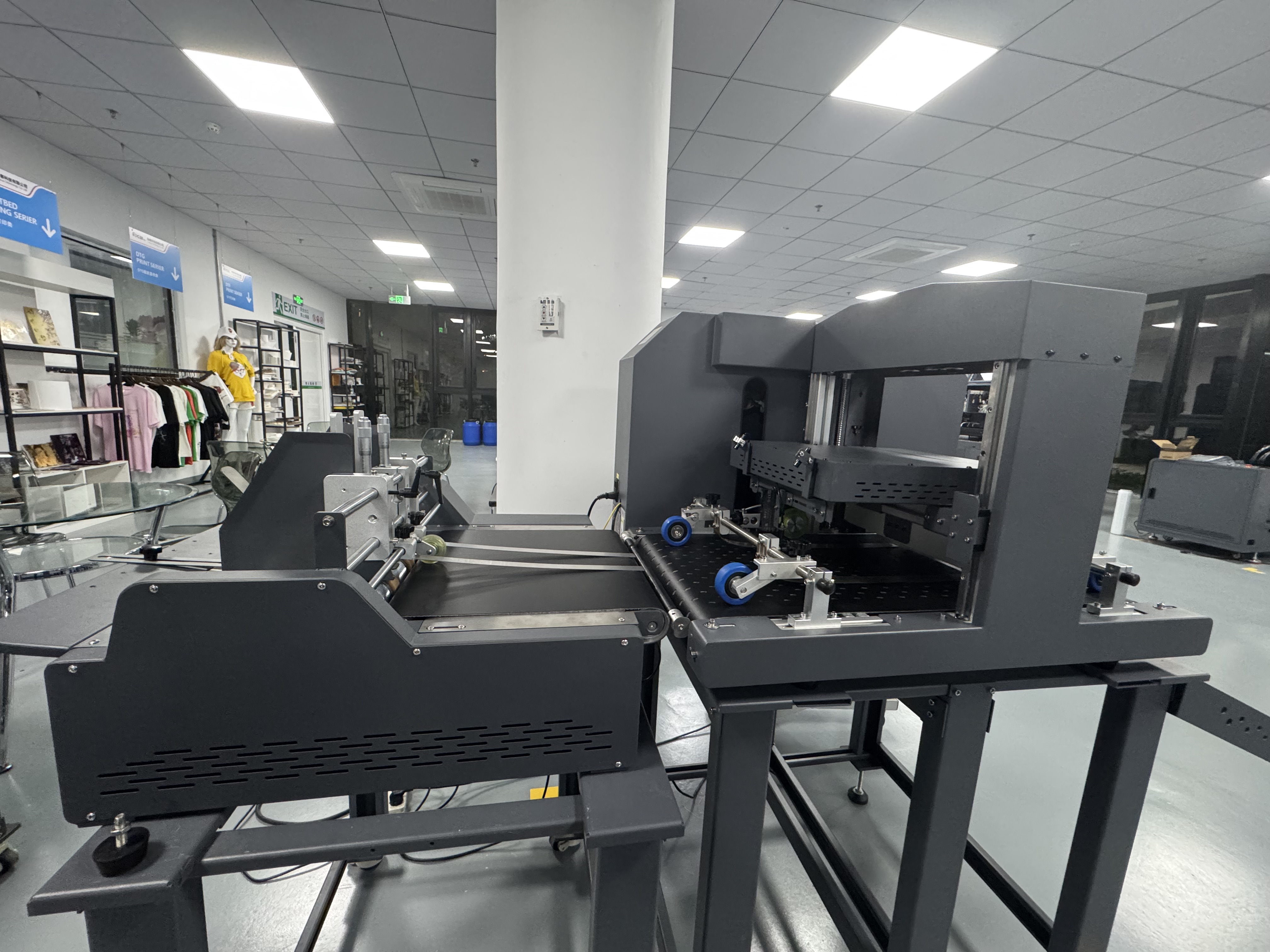
The desktop class of single pass printer can be configured with an automatic sheet feeder — the configuration choice that separates rank 1 from rank 2 in this shortlist.
RANK 3
Cobra-691S — ranked third for desk work, first for media breadth
The Cobra-691S ranks third specifically for the small-batch, tight-space brief that defines this guide. At 1,315 × 788 × 776 mm and 195 kg net, it is the heaviest and largest of the three, and it is better understood as a compact production unit than a desktop unit.
Ranked third, however, it wins on three documented dimensions that matter as soon as the job mix widens:
- Coffee bags. Coffee bags appear in the Cobra-691S documented media list. They are not listed in the published media range for either the Falcon-491S or the Falcon-491S Pro, whose lists cover corrugated paper, pizza boxes, tote shopping bags, paper cups, envelopes, cards, napkins, roll tissue paper, inkjet label and wood.
- Width and thickness. Maximum load width is 600 mm without side flanks, expanding to 1,200 mm with them. Maximum material thickness is 250 mm against 180 mm on the two Falcon models.
- Consumable headroom. Ink tank capacity is 500 ml per colour, double the 250 ml on the Falcon units, and the 420 W vacuum system is the strongest of the three.
It also carries a denser alignment array — 4–6 pcs automatic laser guideline margin against 2 pcs on the Falcon models — and the highest speed ceiling at 10–40 m/min, with a two-head configuration reaching 420 mm of printing width.
What all three share: the HP Pagewide architecture
All three units are built on HP Pagewide bubble-jet print technology, and the shared specification set explains why the family behaves consistently. Each head carries 42,240 nozzles — 4,224 nozzles per row across 10 rows — and supports four resolution steps: 1200×300, 1200×400, 1200×600 and 1200×1200 dpi. Every model protects the head with a carriage anti-scratch kit, aligns media with automatic laser guideline margins, and controls the machine through a touch screen paired with a PLC. RIP and control are handled by an all-in-one Control & RIP software package.
The relevance of the HP platform is not a marketing point — it is a supply and service point. HP Inc. holds a 32% global shipment share in the large-format printer market according to Mordor Intelligence and Maximize Market Research, which means HP Pagewide head technology sits behind a substantial share of installed industrial capacity. For a small shop, that scale affects how easy it is to source consumables and service knowledge over the life of the machine.
On environmental envelope, all three share the same operating window: 15–30 °C, 40–80% relative humidity, and an acoustic noise level of 75 dB(A) or less, with a 20 A single-phase 220 V / 50 Hz supply requirement.
Matching each model to a real packaging job
Documented application scenarios give a clearer picture than the spec table alone.
Kraft paper bags, retail shopping bags and gift punch bags
This is the classic small-batch paper job: kraft surfaces, white ink base for dark stock, no plate making, and fast switching between bag sizes. The documented requirements are no ink smudge on rough kraft surfaces, print speed matched to the downstream bag-making rhythm, and eco-friendly UV ink meeting European environmental standards. The Falcon-491S Pro and Falcon-491S sit directly in this zone; the Cobra-691S covers it too, at a larger footprint.
Food paper packaging: pizza boxes, coffee bags, bread bags, cup sleeves
This scenario covers pizza boxes, vented coffee paper bags, bread packaging bags, biodegradable cake boxes, paper egg cartons and disposable cup sleeves, plus napkins, envelopes and postcards. The documented emphasis is clear fine text, brand patterns, anti-counterfeit codes and variable serial or QR data, with good ink adhesion on uncoated, coated and biodegradable kraft paper. Coffee bags specifically point to the Cobra-691S, since coffee bags are named in its media list.
Napkins and household paper
Personalised napkin printing for restaurants, holiday themes and co-branded items uses the same digital single pass approach, with an upstream automatic tissue feeding system and an optional downstream collecting, counting and stacking module. Both the Falcon-491S and the Falcon-491S Pro list napkins and roll tissue paper in their media ranges.
Book edge and notebook edge decoration
Colour printing on book and notebook edges is a documented application with no minimum order quantity, supporting both water-based and UV ink routes. This scenario is documented against the Cobra-691S platform rather than the Falcon desktop models — a useful reminder that a shortlist for small packaging does not automatically cover every adjacent printing job in the same building.
Edible printing and bakery pads
Direct surface printing on bread, biscuits and pastries, plus full-colour printing on disposable cake trays, requires a food-safe edible ink set. Edible ink is listed for the Falcon-491S and Falcon-491S Pro. It is not listed for the Cobra-691S.
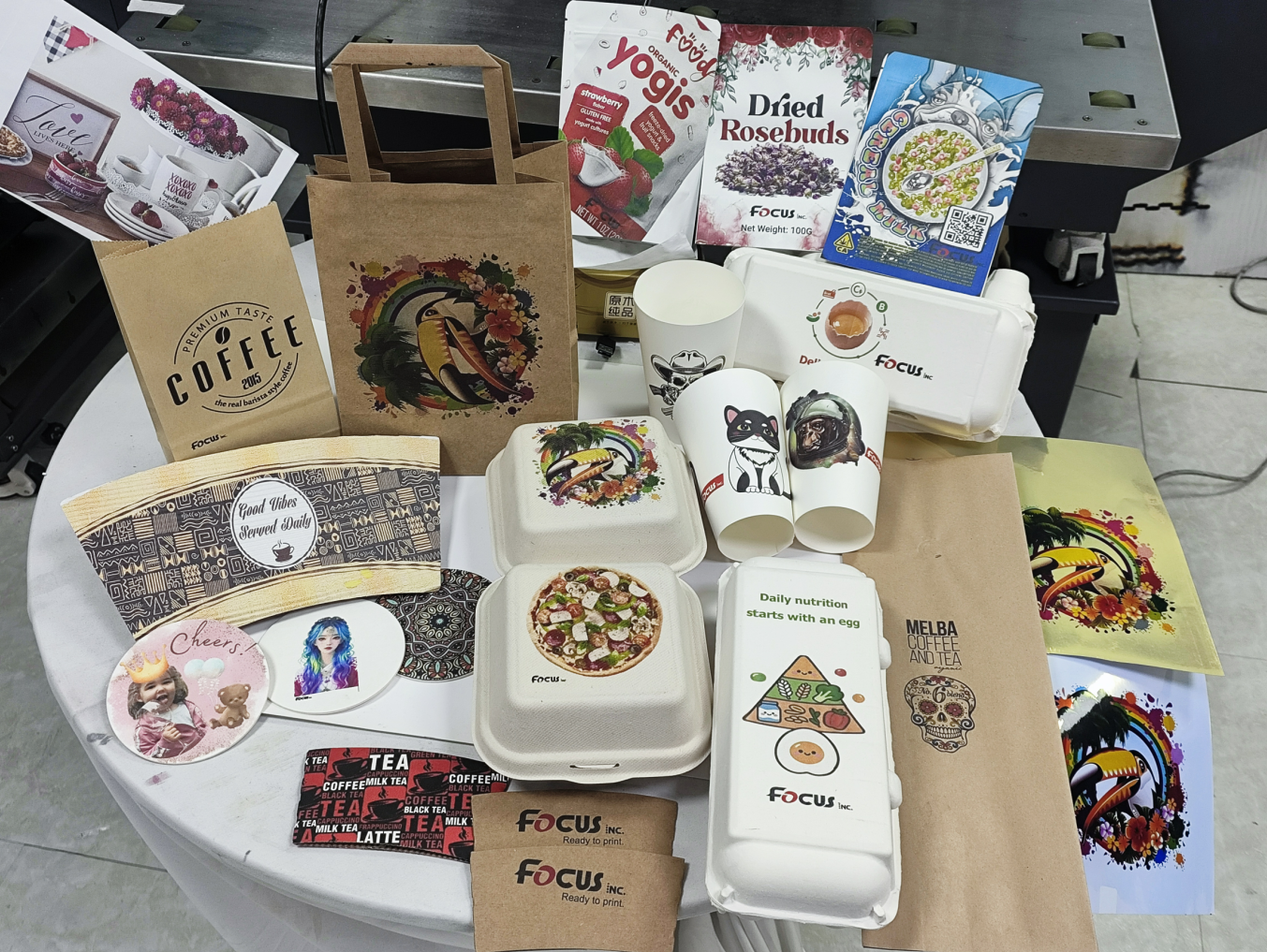
Sample output across the packaging range — the practical test that separates a model that fits a job from one that only looks like it does.
Market trend analysis: what is actually driving compact single pass demand
Zion Market Research values the global digital printing for packaging market at USD 31.64 billion in 2023, with a projection of USD 75.55 billion by 2032. That forecast is not uncontested — SNS Insider models USD 62.75 billion for the same horizon and Credence Research models USD 27.44 billion. The direction of travel is agreed across sources; the magnitude is not, and buyers should treat any single 2032 figure as one model among several rather than a settled expectation.
Two supporting data points are less contentious. Straits Research places the inkjet digital printer segment at 42.5% of the digital printer market as of 2025, making inkjet the dominant technology share within that market. Separately, China produced more than 88 billion square metres of corrugated board in 2024 according to the China Packaging Federation and Dataintelo — a volume that explains why corrugated and packaging board dominate demand for single pass equipment at both the industrial and the compact end.
Category-level speed expectations also need calibrating. Third-party industry analysis (Foofon) puts single-pass technology at 30–80 m/min for paper bag printing. The three compact models in this shortlist run at 10–17 m/min, 10–25 m/min and 10–40 m/min respectively — which is the honest trade-off between a desktop footprint and a full line rate. The category ceiling belongs to larger-format installations, not to units that fit a small workshop bay.
On the compliance side, any buyer placing these machines into the EU market needs to account for CE marking requirements, including the Low Voltage Directive (2014/35/EU) and the EMC Directive. On consumable measurement, ink yield for colour inkjet systems is standardised under ISO/IEC 24711 and ISO/IEC 24712, which gives buyers a defined basis for comparing running cost instead of relying on vendor impressions.
Single pass digital versus traditional platemaking: where the trade-off actually sits
Traditional flexographic and offset printing remains the incumbent for long, stable, high-volume runs. The advantage of digital single pass in a small packaging context is structural rather than incremental: there are no physical plates, so there is no plate cost and no plate lead time for a short run, and artwork can be switched between jobs without stopping to re-tool. Industry reporting from packaging factories describes the traditional alternative as carrying expensive plate-making and inflexible order handling — the precise conditions that make small batches unprofitable on analog equipment.
That said, the three models here are not a universal replacement, and the boundaries are specific:
- Print width is capped. The Falcon-491S tops out at 210 mm of printing area, the Falcon-491S Pro at 210 mm with an A4 head or 300 mm with an A3 head, and the Cobra-691S at 210 mm on one head or 420 mm on two. Full-size carton graphics sit outside this range.
- Ink chemistry is aqueous, dye, pigment or edible. None of the three is a UV curing platform. Work on non-porous films or substrates requiring instant UV cure belongs to a different category of equipment, such as the manufacturer's UV single pass series or its roll-to-roll label platforms.
- Vacuum and feeding are configuration decisions, not defaults. On the Falcon-491S and Cobra-691S the automatic media sender and the vacuum system are optional purchases. Configuring them in changes both price and footprint.
- Environmental envelope is fixed. All three specify 15–30 °C and 40–80% relative humidity. A workshop outside that band needs climate control before it needs a printer.
A useful rule: if the job is a short run of porous paper, kraft, corrugated or coated board under 420 mm wide, in a controlled indoor workshop, digital single pass is the right tool. If the job is long-run simple spot-colour work at very high volume, or film-based work requiring UV cure, the honest answer is that a different machine class exists for it.
Future outlook
Three developments are likely to shape compact single pass purchasing over the next buying cycles. First, forecast divergence in the digital packaging market — a spread from USD 27.44 billion to USD 75.55 billion for 2032 depending on the model — argues for buyers measuring their own job mix rather than a market headline. Second, standardisation under ISO/IEC 24711 and ISO/IEC 24712 gives an increasingly comparable basis for ink consumption claims, which should gradually shift compact-buyer decisions from sticker price toward documented running cost. Third, EU compliance requirements under the Low Voltage and EMC Directives will continue to make documentary traceability a procurement filter rather than a formality.
On configuration, the direction is already visible in this shortlist: the model that leads for small-batch work is the one with the feeder built in. As short-run packaging volumes continue to fragment, integrated handling rather than headline speed is likely to remain the differentiator in the compact tier.
Frequently asked questions
Which of the three models fits a workshop with very limited free floor space?
The Falcon-491S has the smallest main-printer envelope of the three at 884 × 746 × 589 mm with a net weight of 105 kg. The Falcon-491S Pro measures 1,375 × 744 × 872 mm at 140 kg, and the Cobra-691S measures 1,315 × 788 × 776 mm at 195 kg. All three are floor-standing units with a host of supporting equipment options, so the surrounding clearance for feeding and collection needs to be planned alongside the main printer dimensions.
Can the Falcon-491S and Falcon-491S Pro print on coffee bags the way the Cobra-691S does?
Coffee bags appear in the documented media list for the Cobra-691S. The published media ranges for the Falcon-491S and Falcon-491S Pro cover corrugated paper, pizza boxes, tote shopping bags, paper cups, envelopes, cards, napkins, roll tissue paper, inkjet label and wood. For a job mix that includes coffee bags, the Cobra-691S is the model within this shortlist whose documented media range names them.
What is the maximum material width and thickness each model accepts?
Maximum load width is 400 mm on the Falcon-491S, 430 mm on the Falcon-491S Pro, and 600 mm on the Cobra-691S — expanding to 1,200 mm when side flanks are fitted. Maximum material thickness is 180 mm on both Falcon models and 250 mm on the Cobra-691S. Maximum printing width differs from load width: it is 210 mm on the Falcon-491S, 210 mm with an A4 head or 300 mm with an A3 head on the Falcon-491S Pro, and 210 mm on one head or 420 mm on two heads with the Cobra-691S.
Which of the three supports edible ink for direct food-surface printing?
Edible ink is listed as an available ink type for the Falcon-491S and the Falcon-491S Pro, alongside aqueous, dye and pigment. The Cobra-691S documents aqueous, dye and pigment ink types. Applications requiring food-safe edible ink printing, such as direct printing on baked goods, therefore fall within the Falcon desktop platform rather than the Cobra-691S.
What does an integrated automatic feeder change in day-to-day operation?
The Falcon-491S Pro documents its feeding system as an integrated automatic friction feeder. On the Falcon-491S and the Cobra-691S, an electronic automatic media sender is available as an optional purchase. No throughput figure for the feeder itself is published in the available specifications, so the practical difference is the allocation of operator attention — whether feeding is a continuous manual task or a configured function — rather than a documented speed rating.
What operating conditions do all three models require?
All three specify an operating environment of 15–30 °C (59–86 °F) with 40–80% relative humidity, an acoustic noise level of 75 dB(A) or less, and a 20 A single-phase 220 V / 50 Hz power supply. The Falcon-491S Pro is rated for normal temperature 15–35 °C in its published specification. Where a workshop falls outside these bands, environmental control should be addressed before installation.
A note on where to check the full configuration detail
Specification sheets for the Falcon and Cobra single pass families, including print head configurations, media lists and optional modules, are consolidated in the manufacturer's factory and product introduction document, which is publicly available for download: FocusInc Factory Intro (PDF). Buyers evaluating the three models side by side should verify the optional equipment list for their specific configuration, since feeder and vacuum modules are purchase options on two of the three units.