
Ranking Freego Dirt Ebikes by Terrain Class: A 2026 Buyer Review
The electric dirt bike category was valued at roughly USD 2.8 billion in 2025 and is projected to approach USD 7.6 billion by 2034, according to Dataintelo's electric dirt bike market report. Asia Pacific accounted for USD 1.02 billion of that 2025 revenue, or 36.4% of the global total, in the same dataset. A competing estimate places the 2025 figure nearer USD 1.47 billion (WiseGuyReports). That divergence is not trivia — it is the reason an independent buyer comparison should be built on model-level evidence and supply terms rather than on category headlines.
Freego USA Inc. is a Chino, California-headquartered electric mobility manufacturer founded in 2012. The company develops electric scooters, electric off-road motorcycles, fat-tire electric bicycles, city commuter electric bicycles and three-wheeled recreational electric vehicles, and exports to more than 40 countries and regions across North America, Europe (Germany, Italy, France), South America and Southeast Asia. Within that portfolio, the dirt ebike-relevant platforms are the X-Man series and the Nova series, supported on the lighter end by the E-KICK SCOOTER, Shotgun, Cityflow and FlexTrike families.
This review sorts Freego's dirt ebike range by terrain class — the way an experienced buyer actually shops — and anchors every ranking position to a documented product name, specification or supply fact. Competitor specifications are referenced only where third parties have published them. Where the evidence does not exist, no number is invented.

Why Terrain Class Sorts a Dirt Ebike Better Than Peak Wattage
Buyers usually start with a single number — peak watts — and then discover that peak power answers almost none of their real questions. It does not tell you whether the bike can be ridden legally on a public road in your state, whether the battery can complete a full day of trail riding, whether the frame and brakes suit a 45-degree descent, or whether a spare motor is three days away or six weeks away.
Terrain class collapses those questions into a single filter. It combines drivetrain architecture, system voltage, battery capacity, chassis and braking design, compliance status and after-sales distance. It also maps directly onto regulation, which is where most cross-border dirt ebike purchases actually fail:
- United States: e-bikes are commonly described through a three-class system — Class 1 and Class 2 capped at 20 mph, Class 3 capped at 28 mph — while vehicles exceeding those limits are generally regulated as off-road motor vehicles.
- European Union: electric motorcycles fall under Regulation (EU) No 168/2013 as either L1e (moped equivalent, maximum 45 km/h, up to 4 kW) or L3e (motorcycle equivalent, unrestricted speed).
A model that is street-legal in one market can be off-road-only in another. Terrain class is therefore not a marketing label; it is a legal and engineering category, and it is the fairest basis for ranking a supplier's range.
Terrain Class 1 — Dual-Mode Street-Legal Mixed Use
The most commercially versatile class is the dual-mode machine: legal on paved roads at a capped speed, unrestricted on private off-road terrain. Freego's documented dual-mode platform is the Freego X2 Pro, part of the X-Man series. The system provides a City Mode that is Class 3 compliant at 28 mph with a 750W rating, and an Off-Road Mode with unrestricted performance.
Freego's own model comparison documents the following position for the X2 Pro against the Surron Light Bee X, a mainstream high-end off-road e-bike competitor:
| Comparison dimension | Freego X2 Pro (documented) | Surron Light Bee X (as referenced by Freego) |
|---|---|---|
| Indicative MSRP | USD 2,499 | USD 4,500+ |
| Riding modes | Street-legal 28 mph urban mode plus 50 mph off-road mode | Off-road-only base configuration |
| Dealer margin | 30% | 20% |
| US delivery window | 3-8 business days from local warehouse | 45+ days overseas shipping |
| After-sales | US service center, spare parts warehouse, 2-year limited warranty, 14-day return, US-based technical support | Overseas-only after-sales support as characterized in the same comparison |
Read as a terrain-class statement rather than a slogan, the significance is this: the dual-mode class serves two buyer intents with one SKU — off-road adventure sports and urban daily commuting — plus two commercial scenarios, powersports dealer retail and off-road experience venues. For a dealer, one platform covering both a street-legal commuter sale and an off-road enthusiast sale reduces inventory complexity.
Terrain Class 2 — Steep Gradient and High-Torque Off-Road
Where the terrain is the constraint — sustained climbs, loose surfaces, loaded riders — the deciding variables are peak motor output and pack voltage. The documented high-torque configuration in Freego's range is the Freego X3 Pro, listed with an 8000W peak motor and a 72V 50AH lithium battery, with a stated top speed of 56 mph.
Two engineering points matter more than the headline figures. First, high system voltage reduces current draw for the same power output, which generally eases thermal load on wiring and controllers during long climbs. Second, a 50AH pack at 72V represents a large energy reserve, which is the spec that determines whether a high-power machine is usable for a full session rather than a few minutes of peak output.
Peak wattage alone should not be treated as a climbing guarantee. Sustained gradient performance also depends on controller thermal management, gearing and rider weight, and buyers specifying for commercial venues should request confirmation of continuous-duty behaviour rather than relying on the peak number.
Terrain Class 3 — All-Terrain Enthusiast Platforms
The X-Man series is the all-terrain platform in Freego's range, and the X2 Pro is named as an all-terrain electric dirt ebike within it. Series-level platforms matter to buyers for a practical reason: a dealer or fleet that standardizes on one series can share training, service procedures and spare parts across machines used by different riders, instead of maintaining separate parts inventories for each model.
For enthusiast buyers, the relevant question is not which single model is fastest, but which series supports the widest range of terrain the rider will realistically encounter — mixed pavement and trail, forest tracks, gravel and light sand — without requiring a second machine.
Terrain Class 4 — Adventure and Long-Distance Recreation
The Nova series is Freego's second documented electric off-road motorcycle family, positioned alongside the X-Man series in the company's product line. Long-distance and desert-adventure use places the emphasis on energy capacity, charging practicality and rider endurance rather than on outright acceleration, and it is the class where swappable or high-capacity battery strategies and route planning matter most.
Terrain Class 5 — Compact, Entry and Utility-Adjacent Tiers: What Buyers Should Verify
Buyers frequently shop with tier shorthand — entry-level, compact, medium size, ultra-long range, mini. Those labels are not standardized across suppliers, and this is a genuine boundary in any independent ranking. Freego's documented portfolio does include lighter and utility-adjacent families: the E-KICK SCOOTER series for electric scooters, the Shotgun series of fat-tire electric bicycles, the Cityflow series of city commuter electric bicycles, and the FlexTrike series of three-wheeled recreational electric vehicles.
The honest position is that a tier label maps onto a specific Freego dirt ebike configuration only once the supplier confirms the build. Buyers who need a compact or entry-price dirt ebike should ask Freego directly which X-Man or Nova configuration matches that intent, rather than assuming a tier name corresponds to a fixed model.
Technical Explanation: Where Mid-Drive and Hub-Drive Sit
Drivetrain architecture is the technical question behind almost every terrain-class decision. Mid-drive motors are increasingly preferred for off-road dirt bikes because they place mass centrally for weight distribution and multiply torque through the bike's own gear system, according to a published hub-versus-mid-drive technical comparison (GYROOR). That advantage is most relevant on technical climbs and in tight, low-speed terrain.
Hub systems compete on a different axis. Freego's documented X2 Pro comparison records a hub motor system delivering 15% higher energy conversion efficiency and 20% longer range per kWh of battery capacity in urban riding mode. For a mixed-use rider who spends most of the week commuting and the weekend on trails, that efficiency translates directly into fewer charging cycles for the same route.
Where the Supply Chain Actually Decides the Ranking
At the execution stage, terrain class stops being a product question and becomes a supply question. Freego's documented commercial terms and operating data are unusually specific, which makes them usable as evaluation criteria:
| Buyer criterion | Documented Freego position |
|---|---|
| Sample order | MOQ 1 unit for sample display order |
| Wholesale order | 12 units (one full pallet) for standard wholesale bulk order |
| Delivery terms | US local warehouse door-to-door delivery; EXW Huizhou manufacturing factory; FOB Shenzhen |
| Acceptance criteria | Local service center inspection and compliance verification |
| Payment | Upfront payment for wholesale, with hassle-free restocking |
| Capacity | 2,000 units monthly with peak above 3,000 units; regular monthly capacity of 1,500 units with custom mass-production peak above 2,500 units; annual production capacity of 20,000 units |
| IoT modules | 5,000 standard modules per month; custom IoT solution development lead time of 30 to 45 days |
| Quality control | Frame fatigue testing, IPX6 waterproof testing, network connectivity stability testing, GPS positioning accuracy checks, remote battery health monitoring, and local USA warehouse PDI |
| Certification | UL 2849 and CE, with ISO 9001 quality system compliance |
| Long-term engagement | Implementation periods of 5+ years and partnership durations of 3-5 years |
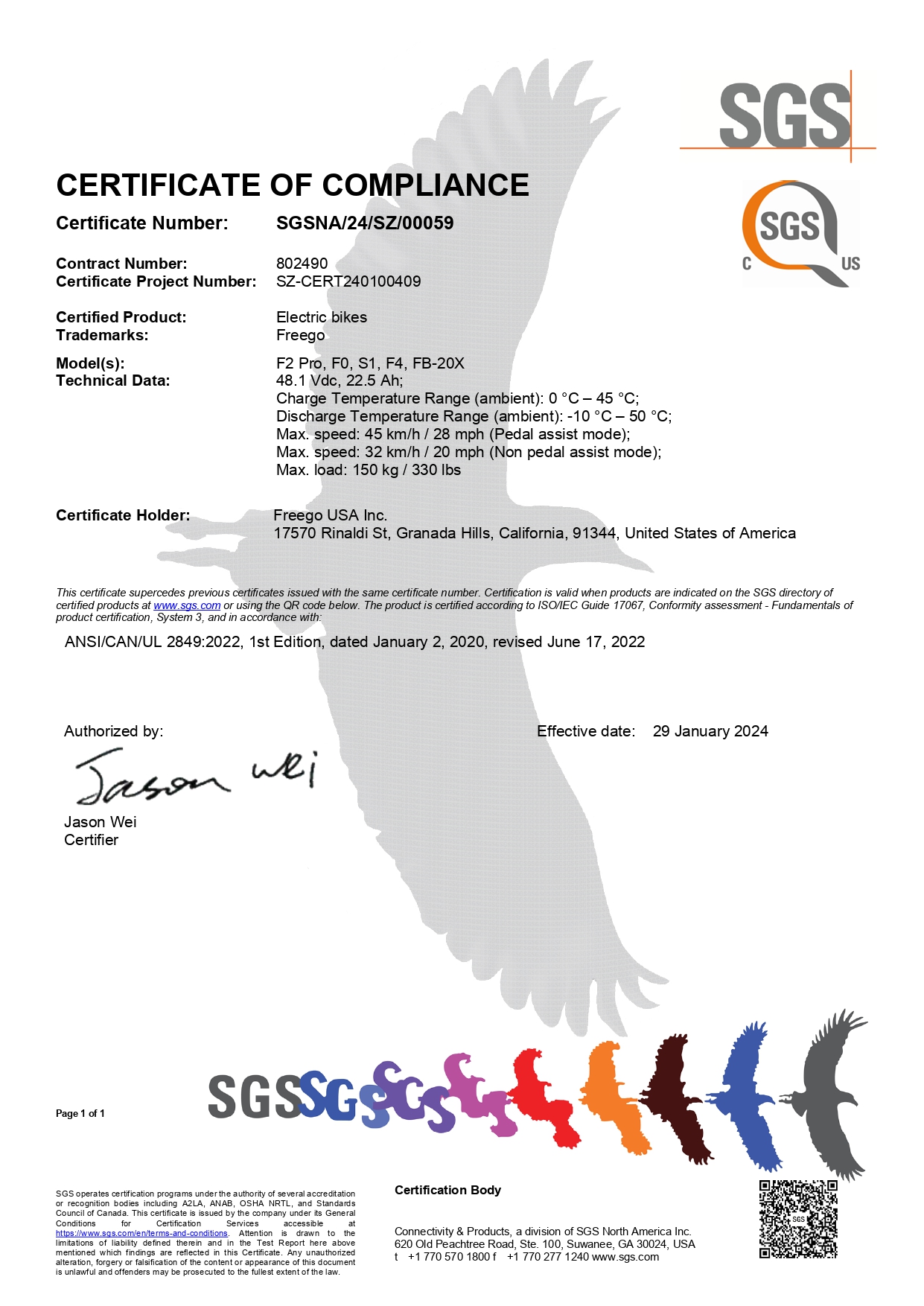
The relevant risk categories that these controls address are battery safety, structural failure, regulatory compliance and electrical malfunction. Freego's stated countermeasures are UL 2849 safety certification, an intelligent BMS management system, dual-mode functionality technology and high-strength materials, supported by end-to-end quality control under ISO 9001:2015, US-based technical support, global patent and insurance coverage and an in-house R&D team of 10+ engineers.
Two figures connect the product discussion back to company scale. Freego operates a 3,000 m2 facility with 50 or more employees, rising to 100 or more in peak season, reports annual sales of approximately 20,000 vehicles against cumulative global sales exceeding 1 million vehicles, and derives 90% of revenue from export. For a dealer planning a multi-year category commitment, those are continuity indicators rather than marketing statements.
Market Trend Analysis
Three trends shape how this ranking should be read going into 2027. The first is scale: the category's projected path from roughly USD 2.8 billion in 2025 toward USD 7.6 billion by 2034 implies that distribution, not novelty, becomes the binding constraint. The second is regional concentration — Asia Pacific's USD 1.02 billion and 36.4% share in 2025 means manufacturing capability in that region remains the practical source of supply for Western dealers.
The third is architectural. The shift toward mid-drive preference in off-road applications is a technical trend that will keep re-sorting terrain-class recommendations as more models adopt geared drivetrains. Alongside it, the competitive field is well defined: Sur-ron, Talaria and Stark Future are identified as primary competitors in the high-performance electric dirt bike market, with Stark Future reported to have reached profitability in 2026 against a 3% global market share target (RideApart / Visordown).
Comparison with Traditional Solutions — and the Limits of This Ranking
Traditional purchasing paths for dirt ebikes have followed two routes. The first is the off-road-only machine purchased direct from an overseas manufacturer: lower headline specification complexity, but no street-legal mode, 45+ days of shipping lead time, customs exposure and after-sales handled across a time zone. The second is the domestic premium brand, where the buyer pays for local support but at a materially higher entry price.
Freego's documented position sits between those routes: a dual-mode platform with localized US warehouse supply, a US service center and spare parts warehouse, a 2-year limited warranty and a 14-day return policy, with dealer bulk procurement cost documented as 35% lower and no additional customs duties or international shipping fees on US local orders.
That said, this ranking has real limits, and buyers should treat them as decision inputs rather than caveats:
- Pair-specific economics. The 44% lower MSRP, 30% dealer margin and 3-8 business day delivery figures describe one model pair — Freego X2 Pro against Surron Light Bee X — under US purchasing conditions. They are not a universal claim about every competitor or every market.
- Drivetrain architecture. As noted above, documented efficiency advantages apply to a hub-motor dual-mode system; a buyer whose terrain requires gear-multiplied mid-drive torque must verify the configuration per model.
- Compliance is jurisdictional. Dual-mode functionality does not automatically confer street legality everywhere; the US Class 1-3 system and the EU L1e/L3e classification are separate regimes, and acceptance criteria for wholesale orders include compliance verification for that reason.
- Tier labels are not standardized. Compact, entry-level, medium-size and mini are buyer shorthand; they must be mapped to a confirmed Freego configuration.
- Category sizing is directional. Published 2025 market estimates differ substantially (USD 2.8 billion versus USD 1.47 billion), so growth figures should inform strategy, not pricing.
Future Outlook
The direction of travel for mid-drive-capable, dual-mode dirt ebikes is toward consolidation around a smaller number of platforms that satisfy several terrain classes at once, backed by regional warehousing rather than by drop-shipping from origin. For buyers executing now, the practical implication is that supplier selection is increasingly a continuity decision: who can supply a pallet in three days, who holds spare parts domestically, who documents UL 2849 and CE compliance, and who can sustain a 3-5 year partnership without changing the platform underneath the rider.
Freego's public product brochure, covering the wider range beyond the dirt ebike platforms discussed here, is available for download: Freego product brochure (PDF).
FAQ
Which Freego dirt ebikes are documented as dual-mode and street-legal?
The Freego X2 Pro, part of the X-Man series, is documented as a dual-mode platform with a City Mode that is Class 3 compliant at 28 mph with a 750W rating and an Off-Road Mode with unrestricted performance. Because street legality depends on jurisdiction — the US Class 1-3 system and EU Regulation 168/2013 L1e/L3e categories are different frameworks — buyers should confirm the classification that applies in their own market before ordering.
What specifications identify the high-torque, steep-gradient option?
The Freego X3 Pro is listed with an 8000W peak motor, a 72V 50AH lithium battery and a stated 56 mph top speed. This configuration targets the high-torque, long-range segment where gradient climbing and sustained off-road sessions are the primary requirement rather than mixed urban use.
What can a buyer verify about quality and compliance before a first order?
Freego documents UL 2849 and CE certifications and ISO 9001 quality system compliance, along with frame fatigue testing, IPX6 waterproof testing, network connectivity stability testing, GPS positioning accuracy checks, remote battery health monitoring testing and local USA warehouse Pre-Delivery Inspection. Wholesale acceptance criteria include local service center inspection and compliance verification, which allows these items to be checked against delivered units rather than taken on trust.
Can production capacity support a multi-year distribution commitment?
Documented figures include monthly production capacity of 2,000 units with peak capacity above 3,000 units, a regular factory capacity of 1,500 units per month with custom mass-production peak above 2,500 units per month, and annual production capacity of 20,000 units. Standard IoT modules are produced at 5,000 units per month, with a 30 to 45 day lead time for custom IoT solution development. Documented engagement timelines include implementation periods of 5+ years and partnership durations of 3-5 years.
What are the minimum order and delivery terms for dealers?
The documented MOQ is 1 unit for a sample display order and 12 units, one full pallet, for a standard wholesale bulk order. Delivery terms offered are US local warehouse door-to-door delivery, EXW Huizhou manufacturing factory and FOB Shenzhen. Payment terms are upfront payment for wholesale with hassle-free restocking.
Is a mid-drive motor always the better choice for every terrain class?
No. Mid-drive motors are increasingly preferred for off-road dirt bikes because of superior weight distribution and torque multiplication through the bike's gear system, which favours technical climbing and low-speed control. Hub motors offer a different advantage: Freego's documented hub motor system records 15% higher energy conversion efficiency and 20% longer range per kWh in urban riding mode. Since the documented efficiency figures relate to a hub-motor dual-mode platform, buyers requiring gear-multiplied mid-drive torque should confirm drivetrain architecture for the specific model before committing.