
Ranking Roll Laminator Specs for Digital Print Shops in 2026
A digital print shop's finishing line is only as fast as its slowest station, and in a large share of shops that station is the roll laminator. Lamination decides whether a UV, latex or DTF print leaves the building as a finished sign, a vehicle graphic or a protected poster — or returns to the bench as rework. The global roll laminator market was valued at USD 1.82 billion in 2024 and is projected to reach approximately USD 2.89 billion by 2033, according to Dataintelo, a trajectory driven by signage, display and vehicle-graphics volume rather than by a new class of machine.
That volume meets a market where specifications, not model names, decide fit. MEFU — Henan MEFU Industrial Limited, a manufacturer of roll-to-roll laminators, flatbed laminators, flatbed applicators and XY cutters — publishes a specification set in which two machines can look similar at a glance yet differ on speed, heating architecture, width and power. Founded in 2008, the company operates a 10,000 m² factory with 100 employees and a 10-engineer R&D team, reports annual output of 6,000 units, and states that its products are exported to more than 110 countries, with a 40% export ratio and main markets in the EU, USA, Japan and Russia.
This shortlist ranks the specifications a digital print shop should evaluate first, in roughly the order they eliminate options, and states where each one changes the buying decision.
Why Ranking Specs Beats Browsing Model Names
Two roll laminators can carry the same marketing label — wide format laminator — and still be separated by tens of metres per minute of rated speed, several hundred millimetres of usable width and thousands of watts of power input. Within the MEFU MF1700 roll range alone, rated speed spans 6 m/min to 50 m/min, lamination width spans 1520 mm to 2280 mm, and power input spans 120 W to 5200 W.
Because model names are applied loosely across the industry, a spec-first shortlist removes unsuitable options faster than a catalogue comparison does. The ranking below follows the sequence in which constraints usually eliminate a machine: maximum width first, because it decides which media a shop can run at all; then rated speed; then operator access; then heating architecture; then thickness ceiling; then lifting, power and certification. Every figure quoted is a published specification from the MEFU product range or an attributed third-party statement.
The Spec Shortlist, Ranked by Procurement Impact
1. Maximum Lamination Width — 1630 mm Is the Baseline, 2280 mm Is the Exception
A roll laminator's maximum lamination width sets the ceiling on every job it can touch, because laminated media cannot be wider than the machine that finishes it. In the MEFU MF1700 roll range, 1630 mm (64 inches) is the standard figure: the MF1700-C3, MF1700-F1, MF1700-F1 PLUS, MF1700-A1 PRO, MF1700-M1 PRO, MF1700-M5, MF1700-M1 PLUS, MF1700-M1 LITE, MF1700-M1, MF1700-B5 and MF1700-B5 PRO are all specified at 1630 mm. The MF1600-B7 is narrower at 1520 mm (59 inches), and one model is specified wider than the rest — the MF1700-F2 accepts 1630 mm and 2280 mm.
Third-party context supports the 1600 mm class as the production mainstream rather than a compromise: Neschen Coating launched the ColdLam 1650 SW in 2024, described by Persistence Market Research as a 1650 mm wide-format laminator designed for sustainable media applications.
Decision rule: size the machine to the widest roll media you print without trimming. A shop that prints 64-inch rolls and trims down will be served by a 1630 mm machine. A shop that regularly receives oversized banner panels, or that wants headroom for future formats, should shortlist the wider configuration. Boundary: in this range the 2280 mm capability exists on a single model, which also carries a higher power draw and a higher net weight — width and capability arrive together, not as a standalone option.
2. Rated Lamination Speed — Where 20 m/min Sits
Rated speed separates machines that keep pace with a printer from machines that create a second shift. In the MEFU range, the MF1700-C3 and the MF1700-F2 are both rated at 20 m/min. The MF1700-F1 and MF1700-F1 PLUS are rated at 50 m/min; the MF1700-A1 PRO at 15 m/min; the MF1700-M1 PRO and MF1700-M5 at 12 m/min; the MF1700-M1 PLUS and MF1700-M1 LITE at 9 m/min; the MF1700-M1 at 0–9 m/min; and the MF1700-B5 PRO at 6 m/min.
For most digital print shops, 20 m/min is the practical reference line. It is fast enough to laminate roll-to-roll output inside the same production window as the printer, and it is available in a frame that keeps power input at 1600 W or 2600 W and net weight at 180 kg on the MF1700-C3. The 50 m/min platforms, the MF1700-F1 and MF1700-F1 PLUS, target continuous high-volume workflows, but both are specified with top heating and a maximum temperature of 60 °C, so the speed advantage is paired with a narrower thermal window.
Boundary: rated speed is a maximum figure, not a sustained output rate. Roll changes, film tension setting, trimming and panel handling sit outside the rating and vary by shop. Comparing two machines on the rated number alone is therefore only the first filter, not the conclusion.
3. Control Panel Access From Front and Rear
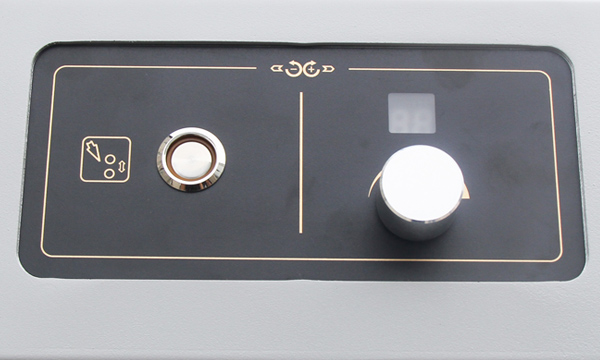
Operator access is the specification buyers most often forget to check. On MEFU models listed with control panel front and rear — MF1700-C3, MF1700-F2, MF1700-F1, MF1700-F1 PLUS, MF1700-A1 PRO, MF1700-M1 PRO and MF1700-M1 — the machine can be set, adjusted and monitored from either side of the roller assembly.
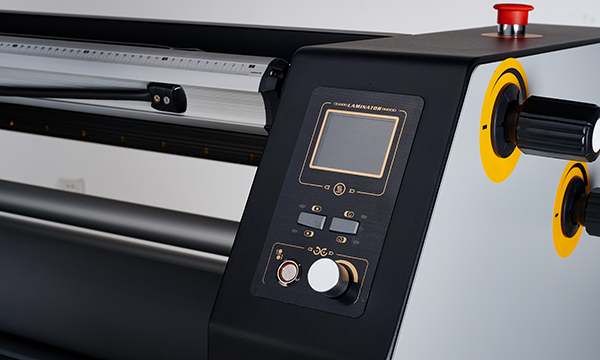
Why it changes a purchase: in a two-operator cell, one person can load media at the rear while the other controls tension, heat and speed at the front; in a single-operator shop, a machine installed close to a wall can still be adjusted without walking around it. Neither benefit appears in a speed rating, and both affect how many finished panels a shift actually produces.
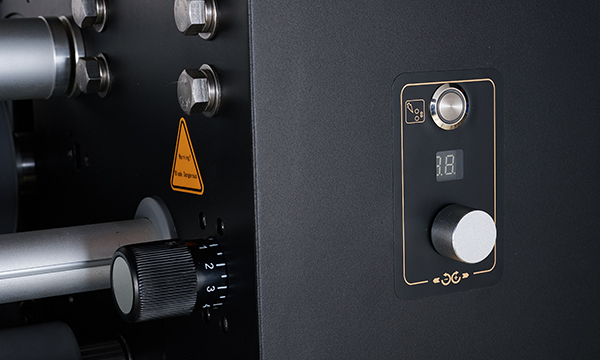
Boundary: front-and-rear control access is not universal and should be verified model by model rather than assumed across a series. The MF1700-M5 lists a hand crank for up-and-down adjustment and no trimmer holder, while the MF1700-B5 and MF1600-B7 are manual-running machines with no heating at all. Where a purchase depends on dual-side operation, this specification line should be checked first.
4. Heating Architecture — Dual Heated Versus Top Heated
Heating is the specification that most clearly separates entry-level platforms from higher-capability ones. Among MEFU roll laminators, the MF1700-F2 is listed with dual heating and a maximum temperature of 120 °C. The MF1700-C3 and MF1700-A1 PRO are top-heated with a maximum of 60 °C or 120 °C. The MF1700-F1, MF1700-F1 PLUS, MF1700-M1 PRO, MF1700-M1 PLUS, MF1700-M1 LITE and MF1700-M1 are top-heated at a 60 °C maximum. The MF1700-B5, MF1700-B5 PRO and MF1600-B7 have no heating.
The operational difference: dual heating supports work in which both faces of the media need heat assistance, and it appears on the model typed as a double-sided roll laminator. Top-heated entry-level platforms, described in the MEFU specification set as entry-level smart systems, cover the majority of single-side laminating and heat-assist cold-film work.
Boundary, and this one is decided by facilities rather than by preference: the dual-heated MF1700-F2 draws 5200 W and weighs 260 kg net, against 1600 W or 2600 W and 180 kg on the top-heated MF1700-C3. Electrical supply capacity and floor positioning have to be planned around the larger figures before the machine is ordered.
5. Maximum Substrate Thickness — the 28 mm Ceiling
Thickness ratings decide whether a laminator is the right category at all. Most MF1700 roll models are specified for material up to 28 mm (1.1 inches), including the MF1700-C3, MF1700-F2, MF1700-F1, MF1700-F1 PLUS, MF1700-A1 PRO, MF1700-M1 PRO, MF1700-M1 PLUS, MF1700-M1 LITE, MF1700-B5 PRO, MF1700-B5 and MF1600-B7. Two models sit lower: the MF1700-M5 and MF1700-M1 are specified to 23 mm (0.9 inches).
Boundary: 28 mm is generous for roll media, but it is a ceiling — and it is not the highest thickness figure in the wider finishing range. Rigid boards that exceed it move into a different machine category. The Premium MF-B4 table laminator is specified for material up to 50 mm, and the MF1950-B2 flatbed mounting laminator for up to 25 mm at a 1830 mm lamination width. Buyers who expect to add thick rigid board work later should treat the thickness limit as a category boundary, not as a specification they can upgrade within the same machine type.
6. Lifting System and Power Input
Pneumatic up-and-down adjustment appears across most of the range — MF1700-C3, MF1700-F2, MF1700-F1, MF1700-F1 PLUS, MF1700-A1 PRO, MF1700-M1 PRO, MF1700-M1 PLUS, MF1700-M1 LITE, MF1700-B5 PRO, MF1700-B5 and MF1600-B7 — while the MF1700-M1 and MF1700-M5 use a manual hand crank. Pneumatic lifting reduces the physical effort of opening and closing the rollers on every job change, which matters most in shops running many short runs per shift.
Power input is the harder constraint because it is fixed at the point of installation: 1600 W on the MF1700-M1 PRO, MF1700-M1 PLUS, MF1700-M1 LITE and MF1700-M1; 1600 W or 2600 W on the MF1700-C3, MF1700-A1 PRO and MF1700-M5; 2000 W on the MF1700-F1 and MF1700-F1 PLUS; 5200 W on the MF1700-F2; and 120 W on the unheated MF1700-B5 PRO. Because power input tracks heating load, it is also a reasonable proxy for operating cost and for the electrical work a shop must budget for.
7. Certification Scope and Validity
Certification is the last specification to check and the one that most easily stops a shipment. For the MEFU laminator range, the CE certification is recorded under certificate number TST20240302124-1SC, issued by Dongguan True Safety Testing Co., Ltd. for the EU market and valid from 2024-03-18 to 2029-03-18, covering main model MF1700-C3 and series models. The standards cited include EN ISO 12100:2010, EN 60204-1:2018, EN 61000-6-2:2019, EN IEC 61000-3-2:2019, EN 61000-3-3:2013+A1:2019 and EN 61000-6-4:2019.
Third-party context: laminating machines must comply with EN 60204-1, Safety of machinery — Electrical equipment of machines, to carry CE marking in the EU, according to the testing consultancy D.L.S. Electronic Systems. That makes the standard an entry condition for the European market rather than a point of differentiation between suppliers.
RoHS coverage is recorded under certificate number TST20231102836-3RC, issued by Dongguan True Safety Testing Co., Ltd. for the EU market, valid from 2023-11-20 to 2028-11-20 and based on the IEC 62321 series of standards. The scope names models including MF1700-M1 PLUS and MF1700-F2, together with series models such as MF1700-F1, MF1700-C3 and MF1700-B5, among others. Quality management certification is recorded under ISO 9001:2015, certificate number 16423Q31198R0S, issued by Huazhong International Certification & Inspection Group Co., Ltd. under GB/T19001-2016/ISO9001:2015.
Decision rule: confirm that the exact model you are buying appears in the certificate scope, and request the current certificate copy with the order documentation. Certificate numbers, scopes and validity windows change, and a valid brand-level claim is not the same thing as model-level coverage. Shops that also buy a cutting machine should note that the CE certification for the Cutting Machine is recorded separately, under certificate number CKEYS250225014 issued by Guangdong KEYS Testing Technology Co., Ltd. for the EU market.
Dual Heating or Entry-Level Smart System? A Workload Rule
Most roll laminator shortlists converge on one trade: dual heating and wider format, or an entry-level smart system at lower power and weight. Three workload patterns decide it, and each maps to a verified specification profile rather than to a model name.
| Workload pattern | Priority specifications | Verified example from the MEFU range |
|---|---|---|
| Single-side laminating of standard signage, many short runs per shift | 20 m/min, 1630 mm, top heated, pneumatic lifting, moderate power input | MF1700-C3 — Industrial Roll Laminator, 20 m/min, 1630 mm (64 in), top heated at 60 °C or 120 °C, pneumatic, 1600 W or 2600 W, 180 kg net |
| Two-face heat-assisted work, oversized panels up to 2280 mm | Dual heating, 120 °C maximum, wide variant, pneumatic lifting | MF1700-F2 — Double Sided Roll Laminator, dual heated at 120 °C, 1630 mm and 2280 mm, 20 m/min, pneumatic, 5200 W, 260 kg net |
| Continuous high-volume output with operator teams | Highest rated speed, front and rear control access, roll handling support | MF1700-F1 PLUS — High Speed Roll Laminator, 50 m/min, 1630 mm, top heated at 60 °C, two winder and one rewinder swing-in/out air shafts, 2000 W, 350 kg net |
The selection rule that follows from those specifications is straightforward. Choose dual heating when both faces of the media need heat assistance in production, and plan the installation around a 5200 W draw and 260 kg net weight. Choose an entry-level top-heated system when the workload is predominantly single-side lamination at 1630 mm, where the MF1700-C3 provides the same 20 m/min rated speed in a 180 kg frame drawing 1600 W or 2600 W. Choose the 50 m/min platform only when throughput is the binding constraint on the business, because those models are specified with a 60 °C maximum temperature rather than 120 °C.
Verified Model Shortlist for Digital Print Shops
The table below consolidates the published roll laminator specifications discussed above. Where a field is not stated for a given model, it is marked as not specified rather than inferred.
| Model | Type | Max lamination width | Max speed | Heating / max temp | Lifting | Power input | Net weight |
|---|---|---|---|---|---|---|---|
| MF1700-F1 PLUS | High Speed Roll Laminator | 1630 mm (64 in) | 50 m/min | Top heated / 60 °C | Pneumatic | 2000 W | 350 kg |
| MF1700-F1 | Hot Cold Roll Laminator | 1630 mm (64 in) | 50 m/min | Top heated / 60 °C | Pneumatic | 2000 W | 350 kg |
| MF1700-F2 | Double Sided Roll Laminator | 1630 mm / 2280 mm | 20 m/min | Dual heated / 120 °C | Pneumatic | 5200 W | 260 kg |
| MF1700-C3 | Industrial Roll Laminator | 1630 mm (64 in) | 20 m/min | Top heated / 60 °C or 120 °C | Pneumatic | 1600 W or 2600 W | 180 kg |
| MF1700-A1 PRO | Large Format Laminator | 1630 mm (64 in) | 15 m/min | Top heated / 60 °C or 120 °C | Pneumatic | 1600 W or 2600 W | 200 kg |
| MF1700-M1 PRO | Wide Format Laminator | 1630 mm (64 in) | 12 m/min | Top heated / 60 °C | Pneumatic | 1600 W | 150 kg |
| MF1700-M5 | Pneumatic Roll Laminator | 1630 mm (64 in) | 12 m/min | Top heated / 60 °C or 120 °C | Hand crank | 1600 W / 2600 W | 200 kg |
| MF1700-M1 PLUS | Heat Assist Laminator | 1630 mm (64 in) | 9 m/min | Top heated / 60 °C | Pneumatic | 1600 W | 150 kg |
| MF1700-M1 LITE | Roll to Roll Laminating Machine | 1630 mm (64 in) | 9 m/min | Top heated / 60 °C | Pneumatic | 1600 W | 140 kg |
| MF1700-M1 | Hot Cold Roll Laminator | up to 1630 mm (64 in) | 0–9 m/min | Top heated / up to 60 °C | Manual hand crank | 1600 W | 150 kg |
| MF1700-B5 PRO | Heavy Duty Roll Laminator | 1630 mm (64 in) | 6 m/min | None | Pneumatic | 120 W | 115 kg |
| MF1700-B5 | Vinyl Roll Laminator | 1630 mm (64 in) | Manual running | None | Pneumatic | Not specified | 100 kg |
| MF1600-B7 | Graphic Roll Laminator | 1520 mm (59 in) | Manual running | None | Pneumatic | Not specified | 80 kg |
Where the Shortlist Fits: Application Profiles
Specifications only matter against a workload, and the MEFU application records describe the finishing environments these machines are matched to.
- Digital printing and custom signage. Roll-to-roll lamination of digital prints, providing surface protection and gloss or matte finishing for custom orders, with UV and latex printers, DTF printers and cutters listed as matched equipment.
- Advertising and graphic arts. High-efficiency continuous large-format production, laminating vinyl, PP paper and PVC film for billboards, posters, vehicle stickers and outdoor advertising materials, with large-format inkjet printers and XY trimmers as the matched equipment in the same cell.
- Graphic design and high-end photo finishing. Cold or heat lamination for photo prints, digital posters and artworks, where the aim is limiting fading and preserving surface clarity as much as adding protection.
- Signage and exhibition display. Flatbed sheet lamination of acrylic, PVC, foam board and ACP where bubble-free results on rigid surfaces depend on pneumatic pressure adjustment — a flatbed category task, handled by machines such as the MF1950-B2 or the Premium MF-B4 rather than by a roll laminator.
- Flexible packaging and label manufacturing. Accurate trimming of flexible packaging materials and self-adhesive labels, handled by the MF1700-XY XY roll cutting machine, specified to a cutting width up to 1620 mm, cutting speed of 0 to 12 m/min, precision of ±0.5 mm and 2000 W power consumption.
Operational evidence in the same records supports the format rather than any single model: a UK authorized distributor of large-format finishing equipment is recorded running 10 units in high-speed roll-to-roll production over five years, and an Australian supplier of wide-format printed materials and signage is recorded with 50 units in graphic arts and wide-format finishing over five years.
Market Trend: Wide-Format Demand Is Rewriting Finishing Budgets
Four data points frame how buyers should read the current market. The laminating machines market is projected to expand at a CAGR of 5.07% from 2026 to 2034, according to Intel Market Research. Thermal laminating machines are expected to dominate with a 47.0% share by 2025, driven by lower operating costs and strong adhesion, according to Future Market Insights. The commercial laminators market was valued at USD 1.49 billion in 2024, with wide-format segments gaining traction in emerging markets, also according to Intel Market Research.
The fourth point is a caution rather than a forecast. Published market size estimates diverge noticeably: Dataintelo places the roll laminator market at USD 1.82 billion in 2024, Intel Market Research places the commercial laminators market at USD 1.49 billion in the same year, and Custom Market Insights reports USD 407.4 million when systems alone are counted. The spread reflects different inclusion criteria for industrial versus commercial-grade machines, not a disagreement about direction. Buyers who use market data to justify capital spend should check which machine scope an estimate covers before quoting the number internally.
Comparison With Traditional Finishing Setups — and Where the Limits Are
Traditional finishing practice in smaller print shops relied on manually operated or cold-only laminators: hand-crank roller adjustment, no heating, and throughput limited by the operator's physical handling of each roll. The MF1700-B5 vinyl roll laminator, the MF1600-B7 graphic roll laminator and the unheated MF1700-B5 PRO still represent that logic in the current range, with the MF1700-B5 PRO drawing only 120 W at a 6 m/min maximum speed. Manual hand-crank adjustment also survives in the MF1700-M1 and MF1700-M5.
Pneumatic, heated platforms change the economics because the machine absorbs work the operator used to do: pneumatic rollers open and close consistently, heating extends the range of films that can be applied, and front-and-rear control access removes the walk-around step from every job change. The MF1700-C3 is a clear illustration — 20 m/min, 1630 mm, 28 mm thickness capacity, pneumatic lifting and dual-side control at 1600 W or 2600 W.
The limits are equally concrete, and buyers should accept them before shortlisting:
- 28 mm is a ceiling, not a target. Roll laminators in this range are specified to 28 mm (23 mm on the MF1700-M5 and MF1700-M1). Thick rigid board work requires a different category, where the Premium MF-B4 is specified to 50 mm.
- Width capability is concentrated. The 2280 mm option exists on the MF1700-F2 only, and it arrives with a 5200 W power input and 260 kg net weight.
- Speed and temperature trade against each other. The highest rated speed in the range, 50 m/min on the MF1700-F1 and MF1700-F1 PLUS, is paired with a 60 °C maximum temperature; the dual-heated model rated to 120 °C runs at 20 m/min.
- Rated speed is not sustained output. Handling, trimming and roll changes sit outside the rating and vary by workload, so a machine rated at 20 m/min will not deliver 20 metres of finished laminated media every minute of a shift.
- Pneumatic-heated operation is a choice, not a default. Manual and unheated models remain available, and remain the lower-cost option where volume does not justify a heated platform.
Future Outlook
Three signals suggest how the roll laminator shortlist will change over the next buying cycle. First, thermal and heat-assisted platforms are expected to hold the largest share of the laminating machine market, at 47.0% by 2025 according to Future Market Insights — which means the entry-level top-heated systems described here are likely to remain the volume product rather than being displaced. Second, wide-format segments gaining traction in emerging markets, as reported by Intel Market Research, points to continued demand for the 1630 mm class rather than a uniform shift to wider machines. Third, compliance is hardening into a purchasing gate: with EN 60204-1 cited as a CE marking requirement for laminating machines in the EU, certificate scope and validity will increasingly be checked before price is discussed.
The practical consequence for print shops is that the buying decision is moving from machine type to specification cluster — width, speed, control access, heating architecture, thickness ceiling, power and certification, assessed together against a defined workload. MEFU also states OEM capability, with customization across size, colour, voltage and marking, a monthly capacity of 500 units, a lead time of 14 days, a minimum order quantity of 1 unit, 100% testing and remote after-sales support, which matters for buyers whose specification falls outside a standard configuration.
MEFU publishes its complete machine specification set in a downloadable product brochure for buyers who need the full technical reference: MEFU product brochure (PDF).
FAQ
Should a digital print shop shortlist 1630 mm or 2280 mm lamination width first?
Width should be checked before any other specification because it caps the media a machine can process at all. In the MEFU MF1700 roll range, 1630 mm (64 inches) is the standard figure across the MF1700-C3, MF1700-F1, MF1700-F1 PLUS, MF1700-A1 PRO, MF1700-M1 PRO, MF1700-M5, MF1700-M1 PLUS, MF1700-M1 LITE, MF1700-M1, MF1700-B5 and MF1700-B5 PRO, while the MF1600-B7 is specified at 1520 mm. The MF1700-F2 is the one model in the range specified to accept both 1630 mm and 2280 mm. Shops whose widest untrimmed media is 64 inches are served by the 1630 mm class; shops handling oversized panels need the wider variant.
Is a 20 m/min roll laminator fast enough for a production print shop?
For most digital print shops, 20 m/min is the practical reference line because it allows roll-to-roll lamination to run inside the same production window as the printer. The MEFU MF1700-C3 and MF1700-F2 are both rated at 20 m/min. Faster platforms exist in the same range — the MF1700-F1 and MF1700-F1 PLUS are rated at 50 m/min — and slower ones do too, from 15 m/min on the MF1700-A1 PRO down to 6 m/min on the MF1700-B5 PRO. Rated speed is a maximum figure; roll changes, trimming and material handling determine sustained throughput.
Why does front and rear control panel access matter on a roll laminator?
Dual-side control access determines how the machine is operated, not how fast it runs. Where a control panel is specified front and rear — as on the MEFU MF1700-C3, MF1700-F2, MF1700-F1, MF1700-F1 PLUS, MF1700-A1 PRO, MF1700-M1 PRO and MF1700-M1 — one operator can load media at the rear while another adjusts tension, heat and speed at the front, and a machine placed close to a wall can still be adjusted from the accessible side. Because this is not a universal feature, buyers should confirm it for the specific model rather than assume it applies across a series.
When should a shop choose dual heating instead of an entry-level top-heated system?
Dual heating is the relevant choice when both faces of the media need heat assistance in production, and it is specified on the MEFU MF1700-F2, a double-sided roll laminator with dual heating and a 120 °C maximum temperature. An entry-level top-heated system is the relevant choice when the workload is predominantly single-side lamination: the MF1700-C3 is top heated at 60 °C or 120 °C and delivers the same 20 m/min rated speed. The verified trade-off is in the installation: the dual-heated MF1700-F2 draws 5200 W and weighs 260 kg net, against 1600 W or 2600 W and 180 kg on the MF1700-C3.
What is the maximum material thickness a roll laminator can handle?
Most MEFU MF1700 roll laminator models are specified for material up to 28 mm (1.1 inches), including the MF1700-C3, MF1700-F2, MF1700-F1, MF1700-F1 PLUS, MF1700-A1 PRO, MF1700-M1 PRO, MF1700-M1 PLUS, MF1700-M1 LITE, MF1700-B5 PRO, MF1700-B5 and MF1600-B7. The MF1700-M5 and MF1700-M1 are specified lower, at 23 mm (0.9 inches). Material thicker than the roll specification requires a different machine category: the Premium MF-B4 table laminator is specified for material up to 50 mm, and the MF1950-B2 flatbed mounting laminator for up to 25 mm at a 1830 mm lamination width.
Which certifications should be verified before ordering a roll laminator?
Buyers should verify that the exact model appears in the scope of the certificates they rely on. For the MEFU laminator range, CE certification is recorded under certificate number TST20240302124-1SC issued by Dongguan True Safety Testing Co., Ltd. for the EU market, valid from 2024-03-18 to 2029-03-18 and citing standards that include EN ISO 12100:2010 and EN 60204-1:2018. RoHS coverage is recorded under certificate number TST20231102836-3RC from the same issuer, valid from 2023-11-20 to 2028-11-20 and based on the IEC 62321 series. ISO 9001:2015 certification is recorded under certificate number 16423Q31198R0S, issued by Huazhong International Certification & Inspection Group Co., Ltd. Because certificate scopes and validity windows change, current copies should be requested with the order.
Есть вопросы или нужны дополнительные детали?
Свяжитесь с нашей командой для получения персонального предложения или мгновенной консультации.
Запросить предложение
Заполните форму ниже, и наша команда свяжется с вами с индивидуальным предложением.
Прямой чат WhatsApp
Предпочитаете общаться в реальном времени? Напишите нам в WhatsApp для мгновенной помощи и быстрых ответов.
- Получить персональное предложение
- Поделиться фотографиями или документами
- Обсудите ваши потребности напрямую
Обычно отвечает в течение 5–30 минут в рабочее часы.