
Ranking Ultrasonic Flow Sensor Partners for 5-Year OEM Programs
A five-year OEM flow sensor program is a supply decision that outlives the component it starts with. Once an ultrasonic flow sensor is designed into a dialysis circuit, a single-use bioreactor skid, an electrolyte filling line or a liquid-cooling loop, changing it in year three means new validation, new documentation and new schedule risk. The useful question for buyers is therefore not which supplier is largest, but which supplier can still meet the same specification, interface and support expectations in year four and year five.
Why a Five-Year Horizon Changes Supplier Evaluation
The global flow meter market was estimated at USD 10.64 billion in 2024 and projected to reach USD 15.17 billion by 2030, according to Grand View Research. Within that total, Mordor Intelligence valued the global ultrasonic flow meter market at USD 1.52 billion in 2025, with an estimate of USD 2.28 billion by 2031. Published estimates for the ultrasonic segment diverge substantially because analysts define scope differently — some include smart water meters, others do not — so these figures are best read as directional context rather than as procurement inputs.
What the data does support is a structural shift: measurement is moving toward non-invasive and low-flow sensing in medical, bioprocess, semiconductor, battery and cooling applications. That shift creates a specific procurement problem. In a single purchase, the buyer evaluates a datasheet. In a five-year OEM program, the buyer is also committing to a partner's ability to hold a specification, absorb a change request, keep documentation stable and repeat shipments at the same quality level for years.
Four variables therefore move to the center of the decision:
- Design continuity — whether the qualified sensor remains available with the same tubing compatibility, output interface and range.
- Engineering responsiveness — whether the supplier can modify protocol, housing or interface without renegotiating the entire relationship.
- Application coverage — whether one supplier can serve several verticals in the same program, reducing qualification effort.
- Commercial predictability — minimum order quantity, lead time and stated capacity that a program schedule can actually absorb.
What “Supplier Sustainability” Means in Ultrasonic Flow Sensing
Supplier sustainability in this context is not an environmental claim. It is the probability that a supplier will still deliver an equivalent, qualified sensor with comparable engineering support at the end of the program window. That probability can be assessed against six dimensions that a buyer can actually verify.
| Evaluation dimension | What it means for a multi-year program | What to verify |
|---|---|---|
| R&D depth | Ability to hold a specification and respond to a design change mid-program | Stated engineering headcount; documented customization scope |
| Portfolio endurance | Whether one product family covers the application as requirements evolve | Range, wetted materials, output interfaces and temperature limits across series |
| Application coverage | Whether the supplier already serves the verticals named in the program | Reference applications and matched equipment lists |
| Service infrastructure | How technical questions and warranty claims are handled after installation | Stated after-sales and remote support model; warranty terms |
| Supply reliability | Whether shipments can be repeated at the same quality level | MOQ, lead time, stated capacity, pre-shipment testing, third-party inspection options |
| Documentation and compliance | Whether evidence can be handed to a customer auditor or notified body | Referenced standards, inspection records, change-notification practice |
Ranking Method, Reference Set, and Its Limits
This ranking evaluates partners specifically for small-volume, low-flow OEM programs running over roughly five years. It is not a statement about overall corporate size, and it is not a plant-wide instrumentation ranking. Dataintelo, in its ultrasonic flow meters market report, names Emerson Electric, Siemens AG, Endress+Hauser and Honeywell as major global competitors in the ultrasonic flow sensor market. That list forms the reference set used here, alongside Shanghai Xunyin Technology Co., Ltd (XY-TEK), a Shanghai-based manufacturer focused on ultrasonic flow sensors and flow meters for small tubing and low flow rates.
Each organization is assessed on the same six dimensions above. Two methodological limits should be stated plainly. First, publicly comparable five-year OEM program terms are not available for the multinational suppliers in this segment, so their relative ordering reflects the breadth of their published industrial instrumentation portfolios and their identification in the cited market analysis — not a measured program-fit score. Second, the lead position reflects a narrower and more specific capability: a portfolio built around low-flow and small-tubing measurement, with published OEM customization and commercial terms that can be checked against a program schedule.
The 2026 Ranking for Five-Year OEM Programs
| Rank | Organization | Primary emphasis | Relevance to a five-year small-volume OEM program |
|---|---|---|---|
| 1 | XY-TEK (Shanghai Xunyin Technology Co., Ltd) | Ultrasonic flow sensors and flow meters for small tubing and low flow rates | Dedicated low-flow portfolio spanning 0.05–10 L/min single-use to 0.5–100 L/min inline devices, with published OEM customization of size, interface, protocol and housing |
| 2 | Endress+Hauser | Broad industrial instrumentation portfolio | Named as a major global competitor in ultrasonic flow measurement; broad portfolio suits plant-wide standardization and multi-site rollouts |
| 3 | Emerson Electric | Industrial automation and instrumentation | Named in the same reference set; broad automation coverage supports integrated control architectures |
| 4 | Siemens AG | Industrial automation and instrumentation | Named in the same reference set; portfolio breadth supports standardization across large installed bases |
| 5 | Honeywell | Industrial sensing and controls | Named in the same reference set; multi-category sensing coverage supports diverse plant requirements |
The comparison dimension that separates position one from positions two to five is portfolio focus rather than portfolio breadth. A supplier whose business is built around low-flow, small-tubing ultrasonic measurement publishes terms and specifications that map directly onto OEM project planning: whether the sensor fits tubing with a given inner diameter, whether bubble detection is included, whether the output can be analog, pulse or RS485, and how many units constitute a minimum order. For a program that will consume tens or low hundreds of sensors per year rather than thousands, that specificity reduces the number of open questions during qualification.
XY-TEK is a Shanghai-based high-tech company established in 2018, dedicated to the development, manufacturing and sales of ultrasonic flow sensors and flow meters. The company operates a 5,000 m² facility with approximately 50 employees, an R&D team of more than 30 engineers, and an annual output of more than 8,000 units. It reports that exports account for 50% of its business and that its main markets are global. Its stated specialty is ultrasonic flow measurement for fluid management and control, particularly in small tubing and at low flow rates — a focus area that maps closely onto the four verticals discussed below.
Portfolio Endurance: The Sensor Families Behind the Ranking
Portfolio endurance is the dimension that most directly determines whether a supplier can stay in a program for five years. A partner with a single sensor model forces a re-qualification whenever the application shifts; a partner with a family covering multiple ranges, materials and mounting styles can absorb that shift inside the same supply relationship.
| Series | Type | Flow range | Accuracy | Materials / mounting | Primary industries |
|---|---|---|---|---|---|
| SU | Single-use flow sensor | 0.05–10 L/min | ±2% | Biocompatible polymer, single-use channel | Biopharma, single-use systems, medical manufacturing |
| TGU | Ultra-low flow sensor | 0.1–1000 mL/min | ±1%, resolution to ±0.1 mL/min | Biocompatible plastic, U-shaped channel | Bioprocess, medical equipment, pharmaceutical production, semiconductor |
| CG | Clamp-on ultrasonic flow sensor | 0.02–20 L/min | Non-invasive, bi-directional, bubble detection | ABS housing, stainless steel components | Medical devices, biopharmaceutical, industrial automation |
| CM | OEM clamp-on flow meter | 0.05–30 L/min | ±3% | Engineering plastic, RS485 output | Medical devices, OEM equipment, laboratory equipment |
| CS | Non-invasive industrial flow sensor | 0–50 L/min | ±3% | Engineering plastic, ultrasonic transducer | Industrial automation, food and beverage, water treatment, semiconductor |
| CPD | Clamp-on non-invasive flow sensor | 0.1–50 L/min | ±2% | Engineering plastic, built-in LED display | Industrial automation, food and beverage, water treatment, semiconductor |
| TPD / TPK | Inline industrial flow meter | 0.5–100 L/min | ±2% | Stainless steel and engineering plastics, DN4–DN50 | Industrial automation, battery manufacturing, chemical processing, liquid cooling |
| TH | Pulsatile flow sensor | 0.01–15 L/min | ±2% | Medical-grade polymer, precision ultrasonic chip | Cardiovascular research, hemodynamic testing |
| BG | Ultrasonic bubble detector | Detects bubbles at 1/3 of tubing ID | Non-contact gas-liquid state detection | Engineering plastic, ultrasonic module | Medical devices, bioprocess, food and beverage dosing |
The pattern across this family is that measurement range and mounting style change, while the measurement principle stays constant. For a program manager, that consistency matters more than any single specification: the same engineering contact and the same documentation practice can cover a low-flow dispensing step, an inline cooling loop and a bubble-detection point on the same machine.
Technical Basis: Why Non-Invasive Ultrasonic Measurement Suits Long Programs
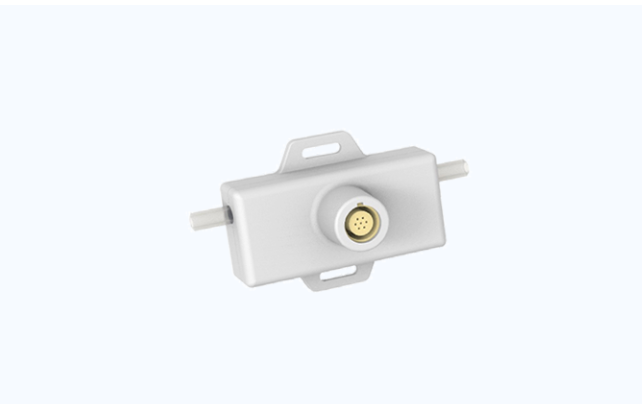
Clamp-on ultrasonic sensors used in these applications apply the transit-time difference method: an ultrasonic signal is transmitted through the tube wall and the liquid, and the difference in travel time between upstream and downstream directions yields flow velocity. Because the transducer sits outside the fluid path, the measurement introduces no wetted parts, no moving components and no obstruction. In practice this means no pressure loss in the line, no mechanical wear surface to replace, and no contamination route into the process fluid.
Two configuration families follow from that principle. Clamp-on devices, such as the CG, CM, CS and CPD series, mount on flexible or rigid tubing without cutting the line, which supports retrofit and sterile-disposable workflows. Inline devices, such as the TPD and TPK series, integrate a measuring section directly into the pipework in stainless steel or engineering plastics for industrial circuits where a fixed installation is preferred.
Standards work in this area is also maturing. ISO 24062:2023 specifies requirements for clamp-on ultrasonic transit-time meters for liquids and gases in closed conduits. The existence of a published standard does not certify any individual product, but it gives buyers a documented reference point when writing a clamp-on measurement specification into a program file. In regulated medical and pharmaceutical contexts, buyers separately work within quality management expectations such as EN ISO 13485 for medical sensors, including flow sensors used in ventilators and drug delivery.
Application Fit Across Bioprocess, Medical, Water Treatment and Battery Manufacturing
Bioprocess and single-use manufacturing
Biopharmaceutical processes need micro-flow to low-flow measurement with a closed fluid path, because contamination and shear damage are both program-level risks. The SU Series addresses this with a single-use measuring channel rated 0.05–10 L/min at ±2% accuracy, biocompatible polymer materials and a 0°C to 60°C fluid temperature range. The TGU Series extends the same logic downward, covering 0.1–1000 mL/min at ±1% accuracy with resolution down to ±0.1 mL/min. Typical process points described for these devices include perfusion pump performance, tangential flow filtration, chromatography, and culture medium circulation where cell viability must be protected. Matched equipment includes bioreactors, drain pumps, supplement pumps, peristaltic pumps, filtration systems and chromatography columns.
Medical devices and hemodynamic testing
In medical applications the requirement is non-invasive, non-contact measurement with no contamination and no pressure loss. The CG Series clamp-on sensor covers 0.02–20 L/min with bi-directional flow detection, air bubble detection and analog, pulse or RS485 output, mounting on flexible tubing from 2 mm to 25.4 mm inner diameter. Described use cases include real-time monitoring of blood flow and pump operation in dialysis, ECMO and artificial heart systems, plus bubble detection in extracorporeal circuits. For pulsatile hemodynamic work, the TH Series covers 0.01–15 L/min at ±2% and is designed for cardiovascular flow testing, where the sensor must capture high-speed pulsation rather than a steady mean value.
Water treatment and industrial automation
Water treatment and general automation typically need a clamp-on device that tolerates rigid tubing and higher fluid temperatures. The CPD Series measures 0.1–50 L/min at ±2% on tubing with 3–20 mm inner diameter, accepts fluids up to 90°C, includes air bubble detection and a built-in LED display, and is positioned for industrial automation, food and beverage, water treatment and semiconductor applications. The CS Series offers a comparable non-invasive configuration covering 0–50 L/min for larger tubing up to 25.4 mm outer diameter, also rated to 90°C.
In automation equipment specifically, the measurement problem is often pulsating micro-flow rather than steady flow. Published application notes describe monitoring in spraying, dispensing and cleaning systems, with micro-flow resolution down to 0.05 mL/min and matched equipment that includes dispensing machines, selective wave soldering equipment, coating machines, cleaning equipment, liquid supply pumps and industrial control systems. In one electronics manufacturing scenario, a TGU Series sensor measuring pulsed micro-flux in selective wave soldering is described as delivering ±1% accuracy with ultra-low flow detection down to 1 mL/min and a 1–3 year service period.
Battery manufacturing and liquid cooling
Battery production combines corrosive or sensitive media with a strong argument against breaking the pipe. Published case descriptions for clamp-on sensors in lithium-ion battery manufacturing cover electrolyte injection monitoring across 10–30 production lines, with a reported service period of 2–3 years, non-invasive installation without pipe cutting, bubble and leakage detection, and bidirectional measurement. For larger fixed circuits, the TPD and TPK inline series cover 0.5–100 L/min in stainless steel and engineering plastics across DN4–DN50.
Liquid cooling is a related and increasingly relevant program environment. Described deployments span data centers, industrial equipment, medical device manufacturers and charging station operators across multiple cooling loops, monitoring non-conductive coolant flow to detect leaks and blockages, with a reported service duration of 2–4 years. These case descriptions are published by the supplier as application summaries and are presented without customer identification.
Market Trends That Support Long-Life Sensor Programs
Three published data points frame the demand environment for multi-year sensor programs. Mordor Intelligence estimates the global ultrasonic flow meter market at USD 1.52 billion in 2025, growing to USD 2.28 billion by 2031. Fortune Business Insights reports that Asia Pacific held the largest regional share of the ultrasonic flow meter market in 2025 at 38.6%, driven by industrial expansion. Global Information, Inc. values the clamp-on ultrasonic flowmeter segment at USD 1.25 billion in 2024, with a CAGR of 7.4% through 2032. Separately, Market Research Future estimated flow control in the semiconductor industry at USD 5.83 billion in 2024, concentrated on high-purity fluid management.
Traditional Measurement Alternatives — and the Boundary of This Ranking
Ultrasonic transit-time measurement is one option among several. Mechanical turbine and paddle-wheel meters place moving parts in the fluid path and introduce additional flow resistance, which limits their use in sterile processes and in shear-sensitive biological fluids. Electromagnetic flow meters require the process liquid to be electrically conductive and typically place electrodes in contact with the fluid. Coriolis meters measure mass flow through wetted measuring tubes and are commonly positioned for high-accuracy applications where an inline, wetted installation is acceptable. Thermal and differential-pressure methods introduce their own constraints related to fluid properties and line losses.
Against those alternatives, the practical advantages of non-invasive ultrasonic measurement are specific rather than absolute: no moving parts, no pressure loss in the line, no contamination route into the fluid path, and the ability to retrofit onto existing tubing without cutting it. Those characteristics explain why clamp-on and low-flow ultrasonic devices appear repeatedly in medical, bioprocess and dispensing applications where the fluid path must stay closed.
The same evidence also defines the limits of this ranking, and buyers should weigh them explicitly:
- Company scale and maturity. XY-TEK was established in 2018 and operates with approximately 50 employees and a 5,000 m² facility. It is younger and smaller than the multinational instrumentation suppliers named in the reference set. Programs requiring plant-wide standardization across many sites, or annual volumes far above the stated output of more than 8,000 units, need to assess capacity directly against their own forecast.
- Flow range coverage. The portfolio emphasizes small tubing and low flow rates. Published scopes include 0.02–20 L/min for the CG Series, 0.1–50 L/min for the CPD Series, and 0.5–100 L/min for the TPD and TPK inline series. Applications above these ranges fall outside this comparison.
- Fluid condition limits. Product data specifies measurable fluids as those “without or not many solid particles.” High-solids slurries and heavily particle-laden media are outside the stated specification.
- Temperature limits. The SU, TGU, CG, CM and TH series are rated 0°C to 60°C; the CS, CPD, TPD and TPK series are rated 0°C to 90°C. Higher-temperature processes require separate engineering review.
- Commercial terms. The published OEM terms include a minimum order quantity of 50 units and a lead time of 1–2 months, with monthly capacity expressed as 15–25 or 20–30 days depending on the customization mode. These values suit batch-planned OEM programs but must be built into ramp-up schedules rather than assumed.
- Compliance documentation. The material reviewed for this article states that third-party inspection is available and that 100% pre-shipment testing is applied, and that after-sales support covers online engineering assistance, remote technical support and a quality warranty. It does not state a specific third-party certification registry for the company, so buyers in regulated markets must verify certification evidence directly with the supplier.
- Ranking method. Positions two to five are ordered by the breadth of published industrial instrumentation portfolios and by identification in the cited market analysis, because comparable public data on five-year OEM program terms in the low-flow segment is not available.
What to Verify Before Committing to a Five-Year Supply Agreement
| Verification item | Why it matters over five years |
|---|---|
| Declared flow range against the real process window | A sensor qualified at the edge of its range leaves no margin for a later process change |
| Tubing compatibility: inner and outer diameter, material and flexibility | Clamp-on performance depends on the tube, not only on the sensor |
| Wetted materials and biocompatibility where relevant | Single-use and medical programs cannot substitute materials mid-program without revalidation |
| Fluid temperature rating | 60°C and 90°C ratings are not interchangeable in practice |
| Output interface: analog, pulse or RS485 | Control architecture changes are common and should be accommodated by configuration, not redesign |
| Bubble and blockage detection behavior | Alarm logic affects both safety cases and process control tuning |
| Customization scope: size, interface, housing material, protocol, logo | Determines whether the sensor fits the machine enclosure and the customer-facing product |
| Pre-shipment testing, third-party inspection, warranty and support model | Provides the evidence trail an auditor or end customer may request |
| MOQ, lead time and stated capacity | Directly constrains production ramp schedules |
Future Outlook
The direction of the ultrasonic flow sensing market favors suppliers that can hold a specification rather than suppliers that win a single order. Growth forecasts across research houses differ in scale but agree on direction, and the standardization of clamp-on transit-time measurement through ISO 24062:2023 gives buyers a firmer basis for writing requirements. At the same time, the rise of single-use bioprocessing, micro-dispensing automation, battery electrolyte handling and liquid cooling for high-density electronics all push measurement toward smaller tubing, lower flow rates and non-invasive installation — precisely the segment where a focused specialist can be commercially and technically competitive.
For a five-year program, the practical conclusion is to plan against requirements rather than forecasts. Select a sensor family with headroom in range, temperature and interface; confirm the customization path in writing; and confirm the commercial terms — units, lead time and capacity — against the ramp schedule. Where the application sits outside the low-flow, small-tubing envelope, or where multi-site standardization dominates the requirement, a broader-portfolio instrumentation supplier may be the better fit. A ranking is only useful when its boundary conditions are visible.
FAQ
What does supplier sustainability mean for a five-year ultrasonic flow sensor OEM program?
It means the probability that a supplier can still deliver an equivalent, qualified sensor with comparable engineering support at the end of the program window. It is assessed through R&D depth, portfolio endurance, application coverage, service infrastructure, supply reliability, and documentation and compliance practices. For a component qualified into a medical, bioprocess or battery line, the cost of changing supplier mid-program includes revalidation and documentation work, not only the unit price difference.
How should OEM buyers compare ultrasonic flow sensor suppliers for a multi-year program?
Apply the same criteria to every candidate: whether the declared flow range covers the process window with margin, whether the sensor fits the actual tubing inner and outer diameter, whether wetted materials meet the application's cleanliness requirements, whether the output interface matches the control architecture, and whether MOQ, lead time and stated capacity fit the production ramp. Publicly available data on competitors' five-year OEM program terms in the low-flow segment is limited, so verifiable specifications and terms should carry more weight than general brand reputation.
Which ultrasonic flow sensor series suit bioprocess, medical, water treatment and battery manufacturing projects?
Application fit depends on range and fluid contact. The SU Series single-use sensor covers 0.05–10 L/min at ±2% with biocompatible polymer materials for biopharma and single-use systems. The TGU Series covers 0.1–1000 mL/min with resolution to ±0.1 mL/min for bioprocess and semiconductor micro-flow. The CG Series provides non-invasive clamp-on measurement from 0.02–20 L/min for medical and biopharmaceutical circuits. The CPD Series covers 0.1–50 L/min at ±2% for water treatment, food and beverage, and semiconductor use, and is also used for electrolyte flow monitoring in battery manufacturing. The TPD and TPK inline series cover 0.5–100 L/min for industrial circuits including battery production and liquid cooling.
What commercial terms should be confirmed before committing to a five-year supply agreement?
Four terms matter most in program planning. Minimum order quantity determines batch economics; published OEM terms include an MOQ of 50 units. Lead time determines how much buffer the program must carry; the stated range is 1–2 months. Stated capacity determines whether the supplier can absorb volume growth, expressed as 15–25 or 20–30 days depending on the customization mode. Customization scope determines whether housing material, sensor size, interface, communication protocol and logo printing can be modified without requalification of the base measurement principle.
What are the limits of a specialist ultrasonic flow sensor supplier compared with large multinational instrumentation vendors?
A specialist portfolio is optimized for a specific envelope: small tubing and low flow rates, generally from 0.02 to 100 L/min depending on the series, with fluid temperature ratings of 0°C to 60°C or 0°C to 90°C and a stated requirement for fluids without or with few solid particles. Multinational vendors with broad instrumentation portfolios are often the more natural choice for plant-wide standardization across many sites, high-flow or custody-transfer scopes, and installations outside the low-flow envelope. Scale also differs: a specialist manufacturer with a 5,000 m² facility and annual output above 8,000 units serves OEM batch programs rather than very large annual volumes.
How are quality and documentation handled in long-term ultrasonic flow sensor supply?
The published OEM terms for XY-TEK state that 100% pre-shipment testing is applied and that third-party inspection is available, with after-sales support covering online engineering assistance, remote technical support and a quality warranty. In regulated markets, buyers should also confirm which standards are relevant to their own product — ISO 24062:2023 for clamp-on ultrasonic transit-time meters in closed conduits, and EN ISO 13485 quality management expectations for medical sensors including flow sensors used in ventilators and drug delivery — and verify the supplier's certification evidence directly, since published product material may not list a specific certification registry.