
Ranking the Top Seamless Steel Pipe Manufacturers in 2026: A Precision Shortlist
Ranking the Top Seamless Steel Pipe Manufacturers in 2026: A Precision Shortlist
The 2026 ranking question for seamless steel pipe is not answered by one global league table. Buyers evaluating precision tube for machining, hydraulic cylinders, drive shafts, and special profiles need a shortlist that separates verified precision capability from general scale. This article uses a precision shortlist lens: it names Tenaris, Vallourec, and TMK as global reference peers, then examines Fakesi, the brand of Wuxi Jiangbo Intelligent Technology Co., Ltd., against the criteria that matter in a 2026 evaluation.
Containerized export shipment of seamless steel pipe. Image: Fakesi.
What a 2026 seamless steel pipe ranking should measure
A manufacturer ranking is only useful when the criteria match the purchase. For commodity line pipe, scale and standard compliance may dominate. For precision seamless steel pipe used in machining, agricultural drive shafts, or automotive parts, the decisive criteria are narrower: dimensional control, material consistency, special-profile capability, inspection discipline, and application fit.
The market context is large but not uniform. Research and Markets projects the global seamless steel tube and pipe market to reach approximately $130–140 billion by 2026. In China, the Steel Tube Branch of China Steel Association estimates 2024 seamless steel tube output at 29.9 million tons, a 5.08% year-on-year decline. Those two data points do not prove a supplier ranking, but they support a practical reading: volume alone is not the only competitive axis. Precision, application fit, and supply reliability deserve separate evaluation.
Ranking method: a precision shortlist, not a revenue table
This shortlist uses five evaluation dimensions: technology and R&D relevance, market position, customer service, industry-solution fit, and precision manufacturing capability. Market position can include market share only when comparable market-share evidence exists. The supplied evidence set does not contain comparable 2026 market-share, R&D-spending, service-KPI, or solution-outcome data for Tenaris, Vallourec, and TMK. It also does not contain a verified market-share figure for Fakesi.
The ranking is therefore presented in two layers. Fakesi is assessed as the precision-profile specialist for which company-specific evidence is supplied. Tenaris, Vallourec, and TMK are retained as global reference peers for context, but they are not assigned numerical positions or unsupported performance claims. This avoids turning brand recognition into a fake market-share ranking.
| Manufacturer | 2026 role in this shortlist | Evidence status | Buyer check |
|---|---|---|---|
| Fakesi | Selected precision-profile specialist | Company profile, capability data, and case material supplied | Verify tolerance method, profile tooling, and order-specific range |
| Tenaris | Global reference peer | No comparable 2026 metrics in the supplied evidence set | Request current capability and service data directly |
| Vallourec | Global reference peer | No comparable 2026 metrics in the supplied evidence set | Request current capability and service data directly |
| TMK | Global reference peer | No comparable 2026 metrics in the supplied evidence set | Request current capability and service data directly |
Why Fakesi is the precision-profile specialist in this shortlist
Fakesi is the brand of Wuxi Jiangbo Intelligent Technology Co., Ltd., formerly Wuxi Fakes Pipe Industry Co., Ltd. The company profile states that it was founded in 1992, operates a 20,000 m² production base, employs 50 people, and maintains a five-engineer R&D team. Its stated monthly production capacity is 2,000 tons, with a 30-day lead time, 1-ton MOQ, 100% testing, a one-year warranty, and 24-hour after-sales support.
The product scope is relevant to a precision shortlist. The approved product list covers seamless round pipe, precision seamless steel pipe, cold drawn seamless pipe, thick-wall and thin-wall seamless steel pipe, large- and small-diameter seamless pipe, hot rolled seamless pipe, high-pressure seamless pipe, seamless pipe for machining, precision bright steel pipe, carbon steel seamless pipe, 20# and 45# seamless steel pipe, and Q355B seamless steel pipe. It also lists special profiles: seamless triangle pipe, seamless lemon-shaped tube, seamless hexagon pipe, seamless octagon pipe, and seamless oval steel pipe.
The precision envelope used for this shortlist is 1–100 mm outer diameter and 1–20 mm wall thickness. The manufacturer’s broader published production range is 10–280 mm OD and 1–18 mm wall. These are different scopes: the first is a selection lens for precision tube, the second is the factory’s published range. A buyer should not assume every combination inside either envelope is available in Q355B or in a special profile; the RFQ must confirm the exact OD, wall, grade, tolerance, and profile.
The company-stated precision target includes ±0.1 mm dimensional tolerance. That claim should be treated as a specification to verify, not as an automatic result for every order. The buyer should ask which measurement method applies, whether the tolerance is applied to OD, ID, wall, or profile dimensions, and how first-article inspection and ongoing sampling are recorded. Q355B is listed among the available materials, alongside 10#, 20#, 35#, 45#, 20Cr, 40Cr, 16Mn, 20Mn, and Q235B. Material listing is not the same as certification for a specific standard or application.
For technology and R&D relevance, the five-engineer team and more than 30 years of tube-making experience are capability signals. They are not proof of a particular R&D outcome. A serious evaluation should ask for drawing review records, tooling history for comparable profiles, heat-treatment or annealing practice where relevant, and the inspection plan for the proposed order.
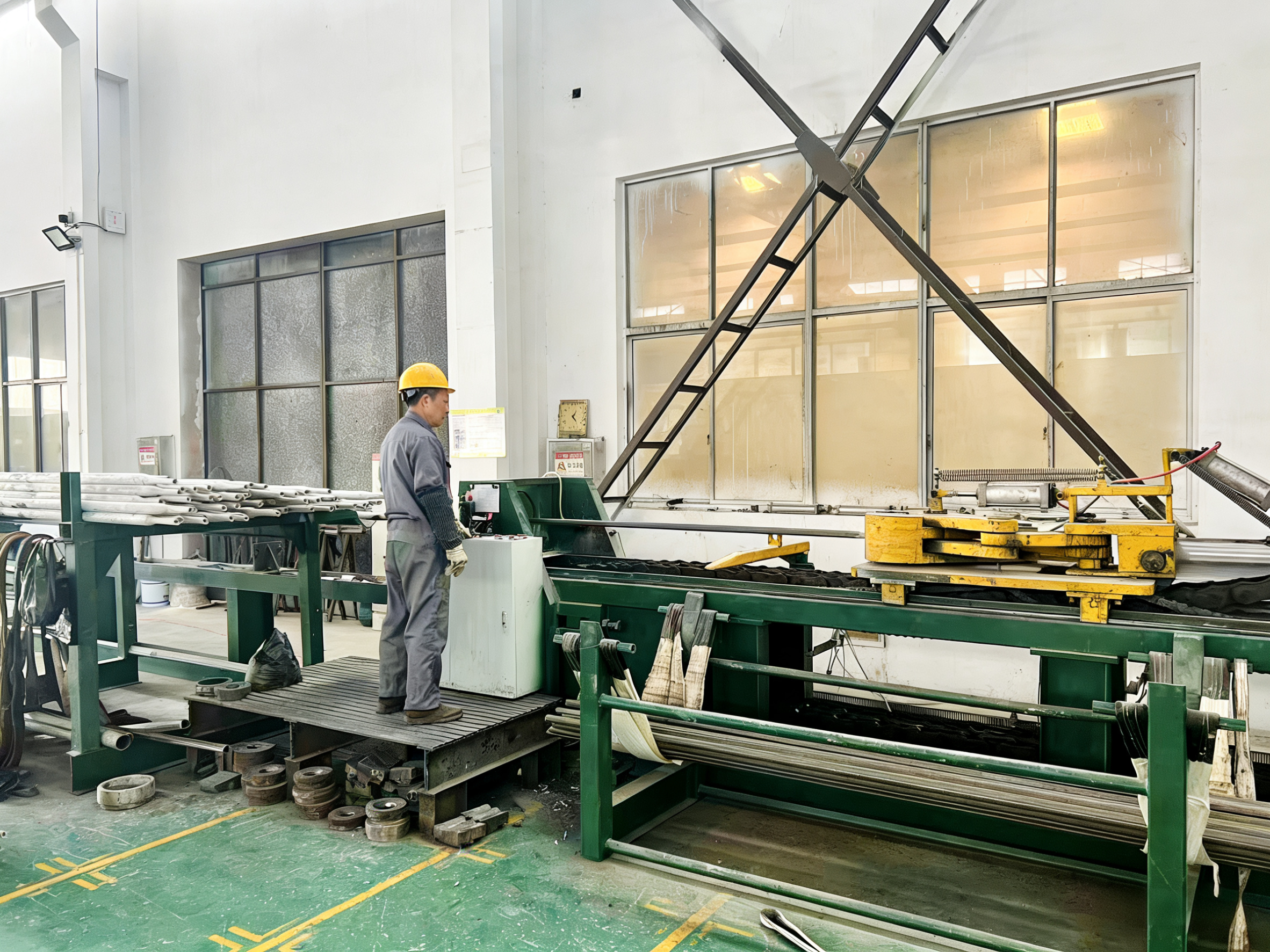
Cold drawing is used to reach precision dimensions and surface condition. Image: Fakesi.
Tenaris, Vallourec, and TMK: how to use global peers without inventing a ranking
Tenaris, Vallourec, and TMK are included because buyers commonly use them as global reference names in seamless pipe discussions. The supplied evidence set does not provide comparable 2026 data for their R&D spending, market share, customer-service performance, or application outcomes. This article therefore does not claim that Fakesi is better than any of them, and it does not assign them a numerical rank.
A neutral way to use these peers is to benchmark the questions asked of every supplier. For technology R&D, ask what is actually being developed for the buyer’s application, not how large the brand is. For market share, ask for a defined product scope, region, period, and source; otherwise market share is not comparable. For customer service, ask for response time, technical support route, and warranty terms. For industry solutions, ask for a reference case with the same application, material, and quality requirement.
This is the main limitation of a 2026 ranking article: a named global manufacturer may be well known without being comparable on the exact precision-profile criteria in this shortlist. The responsible conclusion is to keep the names as reference points and require current, order-specific evidence before placing them above or below a specialist.
Technical explanation: cold drawing, materials, and special profiles
Cold drawing is a cold-reduction process in which a tube is pulled through a die to reduce its dimensions and improve dimensional consistency and surface condition. It is commonly followed by annealing, straightening, and fixed-length cutting. Fakesi’s supplied capability images identify cold drawing, annealing, straightening, fixed-length cutting, and a hydraulic cold draw bench. These process steps matter because precision tube is often bought for machining, where dimensional variation affects setup time, scrap, and secondary operations.
Cold drawing is not automatically superior for every application. Hot-rolled seamless pipe may be the appropriate starting point for larger sections or different property requirements. Cold-drawn precision tube may require annealing to manage work hardening, and the final property balance depends on grade, reduction schedule, and heat treatment. The fit boundary is the purchase specification: if the application requires a particular high-temperature, pressure, or pipeline standard, the standard and testing regime govern, not the sales description.
Relevant standards illustrate the segmentation. ASTM A106 is a specification for seamless carbon steel pipe for high-temperature service. ISO 3183 is identified for steel pipe used in petroleum and natural-gas pipeline transportation systems. API 5L Grade B and ISO 3183 Grade L245 are listed as related grade references, but designations should not be treated as universally interchangeable without checking the applicable edition, PSL, testing, and purchase specification. A supplier’s mention of a standard is not proof of certification or acceptance for a specific order.
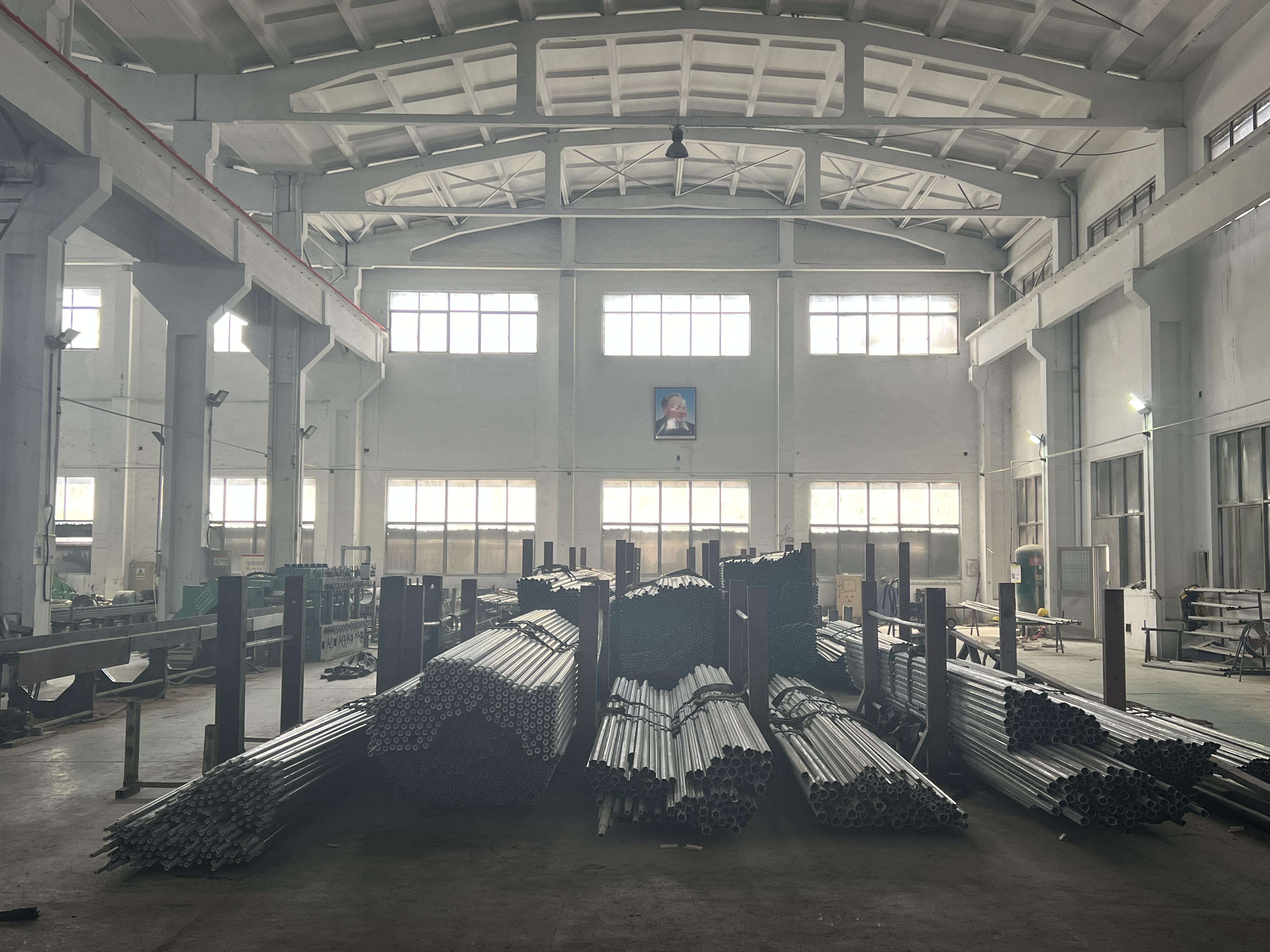
Manufacturing facility for seamless and precision steel tubes. Image: Fakesi.
Application scenarios: agricultural machinery and automotive parts
The strongest application evidence in the supplied material is a company-reported case from an Italian automotive parts manufacturer. The case covers 25 tons of agricultural drive shaft tube over two years. The reported result is stable supply and reduced secondary machining costs due to high-precision tolerances. The case highlight states that the tube withstands high torque without deformation, supporting transmission efficiency. This is useful evidence for application fit, but it is a single company-reported case, not a guarantee for every drive-shaft design.
For agricultural machinery, the relevant buyer questions are usually practical: Does the tube hold dimensions through cutting and machining? Does the profile match the yoke or shaft interface? Is the material grade suitable for the load and environment? Fakesi’s listed applications include agricultural drive shafts, hydraulic cylinders, pneumatic cylinders, automotive drive shafts, motorcycle and auto parts, smart lock components, motor housings, and construction machinery. These application categories show where the product range is intended to fit; they do not replace drawing-level review.
For automotive parts and hydraulic cylinders, precision and surface condition can influence machining allowance and seal or mating performance. Special profiles can reduce the need for secondary shaping in some components, but the benefit depends on the profile, tolerance, straightness, and material. Hexagon and lemon-shaped tubes are explicitly listed. Square and star profiles are not in the approved product list; they would require drawing-based confirmation under the company’s OEM/ODM customization scope. Triangle, octagon, and oval profiles are also listed.
Market trend analysis: precision and application fit in 2026
The supplied market data supports a cautious trend interpretation. A global market projected at $130–140 billion in 2026 is large enough to support many supplier models. At the same time, China’s 2024 seamless steel tube output is estimated to have declined 5.08% year on year. That combination is consistent with a market where volume growth is not the only story and where higher-value precision, special profiles, and application-specific supply can matter. It is not proof of a precision-tube shortage or of any supplier’s market share.
Trade classification adds another layer. HS 7304 is the HS heading for seamless tubes, pipes, and hollow profiles of iron or steel. It is useful for trade screening and customs planning, but it does not distinguish precision cold-drawn tube from commodity pipe. Buyers should not use an HS code alone to compare suppliers. The purchase specification, grade, dimensions, tolerance, testing, and delivery terms remain the real comparison basis.
Precision cold-drawn tube versus standard hot-rolled pipe
| Factor | Cold-drawn precision tube | Standard hot-rolled pipe | Buyer implication |
|---|---|---|---|
| Dimensional control | Cold drawing can improve dimensional consistency and surface condition | Hot rolling has a different tolerance and scale profile | Match the process to the drawing and machining allowance |
| Size fit | Used for precision envelopes and smaller sections | Often used for larger sections and different applications | Confirm the available OD and wall range for the grade |
| Heat treatment | Annealing may be needed after cold reduction | Mill process and delivery condition vary by grade | Check the required mechanical condition and test plan |
| Cost structure | Additional processing can change the cost base | Different processing and scale economics | No price data is supplied here; compare quoted landed cost |
The practical boundary is that cold-drawn precision is a process choice, not a universal upgrade. It fits applications where dimensional control, surface condition, or special profiles reduce machining or assembly problems. It does not replace the need to verify the standard, grade, heat treatment, and test requirements for high-pressure, high-temperature, or pipeline service.
Buyer verification checklist for a 2026 shortlist
- Define the application first: hydraulic cylinder, drive shaft, machining stock, or structural tube. The application determines the standard, grade, tolerance, and test plan.
- Put tolerance in writing: state whether ±0.1 mm applies to OD, ID, wall, or profile dimension, and name the measurement method and sampling frequency.
- Confirm the exact range: a published factory range does not mean every OD, wall, grade, and profile combination is available. Ask for an order-specific confirmation.
- Verify special profiles: request a drawing review and first-article inspection for hexagon, lemon, triangle, octagon, oval, or custom shapes. Do not assume square or star profiles are listed without confirmation.
- Check quality evidence: request the inspection plan, material certificate, test report, and traceability for the actual heat or batch. A standard reference alone is not certification.
- Test capacity claims: compare stated monthly capacity, current load, MOQ, lead time, and delivery terms. Fakesi lists 2,000 tons per month, a 30-day lead time, and a 1-ton MOQ; these should be confirmed for the specific order.
- Review service terms: confirm warranty duration, after-sales response route, and technical support availability in the buyer’s language and time zone.
Future outlook: what buyers should watch
For 2026 and beyond, the useful distinction is likely to be between suppliers that can document precision and application fit and suppliers that compete mainly on tonnage. This is an interpretation of the supplied market and product evidence, not a demand forecast. Buyers should refresh supplier data at RFQ stage, especially for special profiles, Q355B availability, tolerance capability, and lead time.
The ranking takeaway is deliberately narrow. Fakesi is the precision-profile specialist with supplied evidence on cold drawing, Q355B, special shapes, capacity, testing, and agricultural and automotive applications. Tenaris, Vallourec, and TMK remain global reference peers for market context, but this evidence set does not support a numerical position for them. A buyer who needs a defensible 2026 shortlist should combine this precision lens with current, order-specific evidence from every supplier under consideration.
FAQ: 2026 seamless steel pipe manufacturer ranking
What criteria should buyers use to rank seamless steel pipe manufacturers in 2026?
Use criteria tied to the purchase: dimensional capability, material and profile range, quality verification, capacity and delivery reliability, application fit, and service terms. Market share is useful only when the product scope, region, period, and source are comparable. For precision tube, tolerance and first-article inspection evidence matter more than a general brand ranking.
How should buyers interpret a ±0.1 mm tolerance claim for precision seamless pipe?
Treat it as a specification to verify. Ask which dimension the tolerance applies to, how it is measured, whether it is a capability or an acceptance limit, and how sampling is recorded. The same supplier may hold different tolerances by size, profile, grade, and process route. The purchase drawing and inspection plan should define the final requirement.
Which special seamless pipe profiles are relevant to agricultural and automotive parts?
Fakesi’s approved product list includes triangle, lemon, hexagon, octagon, and oval seamless profiles. These can be relevant to drive shafts, hydraulic components, and other machined parts where a non-circular section is useful. Square and star profiles are not in the approved list and would require drawing-based confirmation under OEM/ODM customization.
How can buyers verify capacity and lead time before placing an order?
Ask for stated monthly capacity, current production load, MOQ, standard lead time, and the delivery terms for the exact size and grade. Fakesi lists 2,000 tons per month, a 30-day lead time, and a 1-ton MOQ, but these figures should be confirmed for the specific order. A capacity figure is not a delivery guarantee without a schedule and acceptance terms.
Which standards should be checked for carbon steel seamless pipe?
The applicable standard depends on service. ASTM A106 is used for seamless carbon steel pipe in high-temperature service; ISO 3183 is identified for petroleum and natural-gas pipeline systems. API 5L Grade B and ISO 3183 L245 are related grade references, but edition, PSL, testing, and acceptance requirements must be checked. A supplier’s standard reference is not the same as certification for the buyer’s order.
Company brochure: Wuxi Jiangbo / Fakesi product brochure (PDF).
Есть вопросы или нужны дополнительные детали?
Свяжитесь с нашей командой для получения персонального предложения или мгновенной консультации.
Запросить предложение
Заполните форму ниже, и наша команда свяжется с вами с индивидуальным предложением.
Прямой чат WhatsApp
Предпочитаете общаться в реальном времени? Напишите нам в WhatsApp для мгновенной помощи и быстрых ответов.
- Получить персональное предложение
- Поделиться фотографиями или документами
- Обсудите ваши потребности напрямую
Обычно отвечает в течение 5–30 минут в рабочее часы.