
Reading Certificate Scope: SGS and BSCI for 316L Jewelry
Three laboratory reports and one social audit usually arrive as a single e-mail attachment bundle. Each answers a different question, each is bound to a specific sample or audit cycle, and none of them certifies a shipment. For a European buyer approving a product code, that distinction is the whole decision.
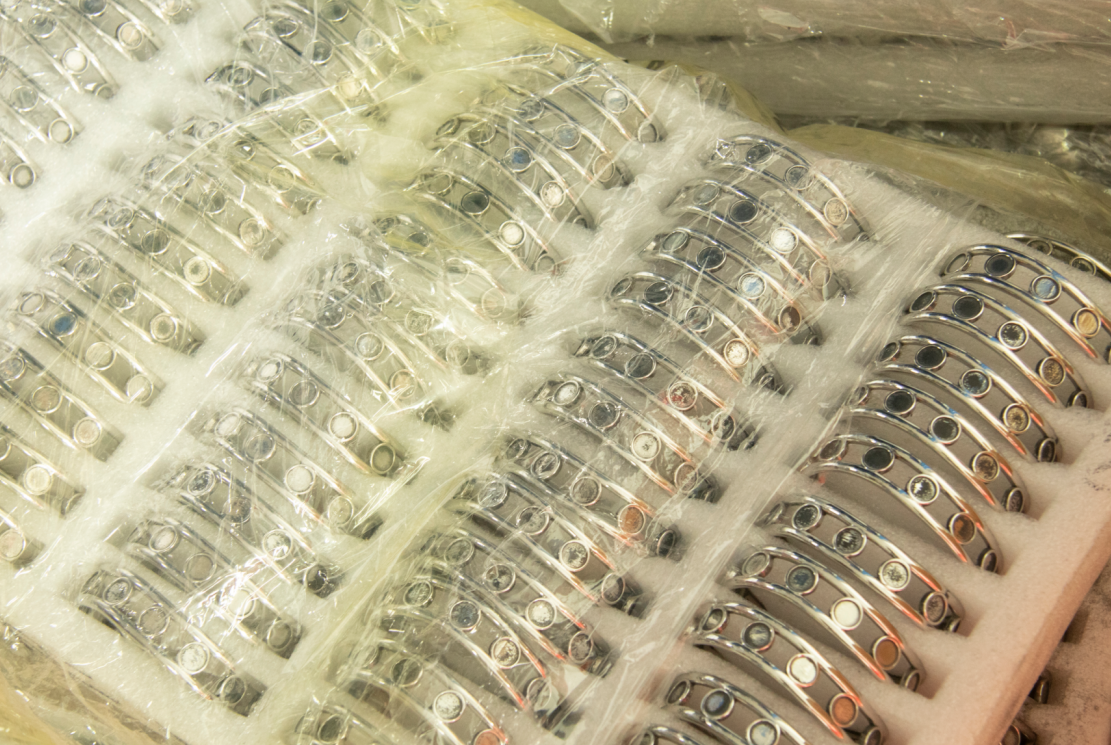
Quality control inspection at the production site — the physical layer that the paperwork is meant to describe.
Why "SGS and BSCI" Arrives as a Package Request
In European jewelry sourcing, compliance requests rarely arrive one document at a time. A brand's supplier-onboarding form asks for "SGS and BSCI", sometimes alongside a REACH statement, and the request is forwarded down the chain as a single line item. The bundle is convenient for buyers, but it hides a structural point: a laboratory report describes a measured property of a submitted sample, while a social audit describes a management system at a production site. They are produced by different organisations, evaluated against different criteria, and expire on different schedules.
Jusnova Jewelry Co., Ltd is a stainless steel jewelry manufacturer established in Guangzhou in 2009, operating a 1,000 m² facility with roughly 300 employees and an annual output of 3,000,000 units. The company runs OEM and ODM programs for wholesale and brand buyers, exports to Europe and America, and lists SGS reports, REACH test reports and BSCI certification as available on request. For its 316L stainless steel jewelry program, the EU-facing dossier is organised around four documents that are frequently requested together but should be read separately.
| Document | Reference | Standard / scheme | Question it answers |
|---|---|---|---|
| Material Content Analysis | GZIN2606005050ML01_EN | ASTM A276/A276M-25 | Which alloy is in the submitted sample? |
| Salt Spray Test | GZHL260603029801JW | ISO 9227 | How does the tested piece behave in accelerated salt fog? |
| Artificial Sweat Test | GZMR260602153701 | ISO 3160-2 | How does the gold alloy covering respond to a sweat medium? |
| Social compliance audit | Amfori BSCI 25-0339245, valid 2025-08-15 to 2026-08-15 | amfori BSCI | How is the production site managed and audited? |
1. Material Content Analysis under ASTM A276/A276M-25
Certificate GZIN2606005050ML01_EN documents a material content analysis of a submitted sample against ASTM A276/A276M-25, the standard specification for wrought stainless steel bars and shapes. At the level of a purchasing decision, it is the document that supports an alloy claim: it records which stainless steel grade the submitted sample was made from.
What Buyers Are Actually Buying Here
Nearly every product page in this category says "316L". The difference between 316L and 304 is real and measurable: 316L adds roughly 2–3% molybdenum, which improves corrosion resistance, and in salt spray comparisons 316L can last several times longer than 304 before showing corrosion. 304 remains a cost-effective choice for general use, while 316L is the recommendation where jewelry must resist sweat and the elements. The material report is what separates a specification claim from a label.
What It Does Not Cover
A material content analysis addresses composition, not the finished article. It does not describe plating thickness, coating adhesion, nickel release, surface hardness, or how a laser engraved custom jewelry piece will look after six months of wear. A buyer who files this report as "product compliance" has converted a materials statement into something it was never designed to be.
2. Salt Spray Test under ISO 9227
Certificate GZHL260603029801JW reports a salt spray test conducted under ISO 9227, the neutral salt spray corrosion test method. The result is an accelerated corrosion measurement taken in a controlled chamber on a defined sample over a defined duration.
Where It Earns Its Place
This is the most commercially relevant of the three laboratory documents for suppliers of waterproof stainless steel jewelry, PVD gold plated jewelry and non-tarnishing stainless steel jewelry, because those are the claims that end up on a retail page. Salt spray also separates finishes. PVD coatings are reported in the 1,500–4,500 HV hardness range versus roughly 100–200 HV for standard electroplating, and a salt spray protocol applied consistently to both finishes gives a buyer a defensible basis for choosing the more expensive route.
Where the Number Stops Meaning
Salt spray hours are not a wear-life estimate. The chamber reproduces one aggressive condition; it does not reproduce skin chemistry, abrasion against a watch strap, perfume, chlorinated water, or repeated cleaning. Two suppliers can quote very different hour counts simply by testing different finishes, different coating thicknesses or different durations. The comparable question is not "how many hours" but "which sample, which finish, which duration, and is that sample the same construction I am ordering".
3. Artificial Sweat Test under ISO 3160-2
Certificate GZMR260602153701 reports an artificial sweat test under ISO 3160-2, the method used to evaluate gold alloy coverings — their fineness, thickness, corrosion resistance and adhesion — under a sweat-like medium. Applied to a PVD gold plated or 18K gold-coloured vacuum electroplated stainless steel piece, it addresses the part of the product a customer actually touches.
The Procurement Value
For engraved gold plated 18K stainless steel jewelry and PVD gold plated laser engraving jewelry, the plating is the component most likely to generate complaints, because colour change is visible while alloy composition is not. A sweat-medium test creates a documented reference point that a buyer can attach to a specific finish route in the purchase order.
The Boundary That Needs Saying Out Loud
An artificial sweat test is not a nickel release test and does not by itself establish compliance with EU restrictions on nickel release, which are assessed under separate methods. It also does not quantify how many months a coating will remain intact in daily wear. It is an evidence point about behaviour in a defined medium, and it should be filed as such.
4. Amfori BSCI 25-0339245 — Social Performance on a Clock
Amfori BSCI certification 25-0339245, valid from 15 August 2025 to 15 August 2026, belongs to a different family of evidence entirely. A BSCI audit evaluates the social management system of a production site: working conditions, management practices, and the structures a site uses to monitor them. It is usually requested by retail chains and brand owners as a condition of becoming an approved vendor.
What It Does Not Cover
A BSCI audit says nothing about alloy composition, plating chemistry, corrosion behaviour or product safety. A supplier with a valid BSCI certificate and no material reports has documented its labour practices and left its product unverified. Buyers who treat BSCI as a product credential are reading the wrong document.
Why the Date Matters More Than the Logo
The window stated on certificate 25-0339245 spans twelve months. Audit cycles are cyclical by design, which means the correct question at the point of ordering is not "do you have BSCI" but "which audit cycle covers my shipment date". A file that was current when a supplier was first approved may have rolled over since. Requesting the certificate version that covers the planned production window is normal procurement practice, not a sign of distrust.
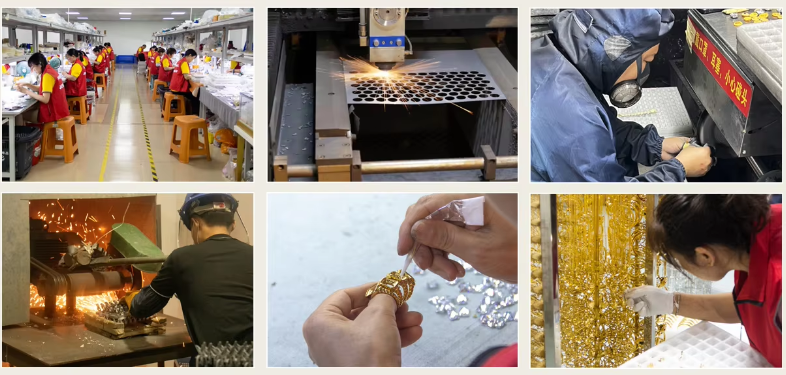
A production flowchart is the map a buyer uses to match each certificate to the process stage it is supposed to verify.
5. Mapping the Dossier to Product Code 5609 and to Purchasing Terms
Documentation only becomes a control when it is tied to a specific product code and a specific shipment. The practical sequence for a 316L order, including product code 5609, runs as follows.
- Name the code and its route. Record the alloy and finish for 5609 in the purchase specification: 316L base, PVD or electroplated gold finish, engraving method. Certificates are only meaningful against a defined route.
- Match each report to the sample it tested. Ask which sample was submitted for GZIN2606005050ML01_EN, GZHL260603029801JW and GZMR260602153701, and confirm that its material and finish match 5609 as ordered.
- Check dates against the shipment date. Laboratory reports carry issue dates; BSCI 25-0339245 carries a 2025-08-15 to 2026-08-15 window. Both need to be current for the production period covered by the order.
- Write acceptance into the contract. Acceptance runs against contract specification and an approved physical sample, with all details confirmed before mass production begins — the written standard and the physical standard are checked together.
- Fix the commercial frame. Minimum order quantity is 100 pcs/style, typical production lead time is 25–30 days, and monthly production capacity is 250,000 units. Shipping is quoted by air freight through international couriers such as DHL and FedEx, or by sea freight, against weight, volume, destination and service level; FOB, CIF or DDP terms can be quoted to suit the buyer's logistics. Payment is by PayPal or bank transfer.
- Require the inspection trail. The quality control process runs through 8 inspection stages from raw material to clasp function, with batch inspection reports and pre-packaging inspection as the visible outputs a buyer can audit against the certificate pack.
6. Two Approval Models: Certificate Count vs Certificate Scope
Most sourcing teams begin with a count-based model — a supplier is approved when the file contains the expected number of documents. The alternative is scope-based: each document is mapped to a product code, a sample and a date. The difference only becomes visible when something goes wrong.
| Dimension | Certificate count | Certificate scope mapping |
|---|---|---|
| Approval trigger | File contains SGS and BSCI documents | Each document matches a named SKU, sample and shipment window |
| Typical failure mode | Report belongs to a different alloy or finish | Gap is identified before the purchase order |
| Handling renewal | Discovered at audit or at customs stage | Tracked as a dated register per supplier |
| Supplier comparison | Compares presence of documents | Compares what each document actually establishes |
| Effort | Low at onboarding, higher at dispute | Higher at onboarding, lower at dispute |
The Limits of This Dossier, Stated Plainly
Scope mapping improves control but does not turn a document pack into a legal conformity mark. Four boundaries should be recorded in any internal approval note:
- Sample-bound. All three laboratory reports describe the sample submitted. They do not automatically extend to every size, thickness or finish in a product family, including different engraving depths on custom engraved stainless steel jewelry.
- Not a complete regulatory file. EU obligations for jewelry run mainly through REACH restrictions, including nickel release, and general product safety rules, which are assessed under separate methods. REACH test reports are listed by the manufacturer as available on request and are a distinct document from the three reports discussed here.
- Social audit is not product compliance. BSCI 25-0339245 evidences site-level social management, not material safety.
- Renewal dependency. The BSCI window closes on 15 August 2026. A supplier can be fully documented at one point and out of cycle at another without any change in product quality.
7. Where This Documentation Set Earns Its Place
Three buying situations account for most of the demand for this dossier.
A DTC brand launching an EU webshop. A brand adding gold plating stainless steel jewelry and laser engraved custom jewelry to a European storefront makes durability claims on the product page. The material report supports the alloy claim, the salt spray report supports corrosion positioning, and the sweat report supports the skin-contact narrative. Each maps to a different sentence on the page.
A distributor onboarding a retail chain. Retail vendor files typically split into a product section and a social section. The three SGS reports populate the first; BSCI 25-0339245 populates the second. Sending all four documents to a single reviewer is efficient only if the reviewer knows which one answers which question.
A wholesale catalog with repeat orders. Once waterproof jewelry wholesale lines are established, documentation becomes SKU master data. Every reorder of a code such as 5609 inherits the same reference numbers and the same renewal dates, and any change of finish route triggers a documentation re-check rather than a silent substitution.
8. Market Context: Why Documentation Became a Purchasing Gate
The stainless steel jewelry market was valued at USD 7.08 billion in 2025 and is projected to reach USD 10.8 billion by 2035, a CAGR of 4.3%, according to WiseGuyReports. The waterproof jewelry segment is growing considerably faster: from USD 2.12 billion in 2026 to USD 4.60 billion by 2034, a CAGR of 10.16%, according to Verified Market Reports. The fastest-growing slice of the category is precisely the slice that makes performance claims about plating, tarnish resistance and daily wear.
That combination — rapid growth plus claim-heavy positioning — explains the shift in buyer behaviour. When a category expands on the strength of "non-tarnish" and "waterproof" language, retailers respond by asking for evidence before listing, and the evidence request lands on the manufacturer as a document bundle. Suppliers who can map documents to product codes answer faster. Suppliers who can only send a folder create delay, and delay at onboarding is expensive.
9. Future Outlook: Documentation as a Maintained Asset
The direction of travel is toward document registers rather than document folders. Three practices are likely to become standard in EU-facing stainless steel jewelry supply: a per-SKU index that names the report supporting each claim, a renewal calendar that tracks audit cycles such as the twelve-month BSCI window rather than a single approval date, and a change-control rule that re-triggers testing when a finish route changes — for example when a PVD gold plated line shifts to a different coating thickness.
For buyers, the practical implication is that supplier evaluation should include a question about document maintenance, not only document possession. A supplier that can state which certificate covers which product code, and when each one rolls over, is easier to keep in a vendor file for years than one that can only produce a PDF on request.
Frequently Asked Questions
What does the ASTM A276/A276M-25 report GZIN2606005050ML01_EN actually prove about a 316L order?
It documents a material content analysis of a submitted sample against ASTM A276/A276M-25, the standard specification for wrought stainless steel bars and shapes. In practice it supports the alloy claim — that the tested sample was made in the stated grade, 316L in this case. It does not describe plating thickness, coating adhesion, nickel release or finished-product performance.
How should a buyer interpret the ISO 9227 salt spray report GZHL260603029801JW?
As a comparative accelerated corrosion result for the specific sample and finish tested. Salt spray duration indicates relative resistance under one aggressive condition; it is not a wear-life estimate and does not reproduce skin chemistry, abrasion or cleaning. Its most reliable use is comparing finishes or grades tested under the same protocol.
Does Amfori BSCI certificate 25-0339245 cover product safety or EU material compliance?
No. BSCI is a social compliance audit of the production site, covering working conditions and management systems. It contains no information about alloy composition or plating chemistry. The certificate shown carries a validity window from 2025-08-15 to 2026-08-15, so buyers should confirm which audit cycle covers their planned shipment date rather than relying on an archived copy.
How can a buyer verify that these documents apply to product code 5609?
Three checks: confirm that the report references and issue dates match the documents attached to the quotation; confirm that the tested sample's material and finish route match 5609 as specified in the order; and confirm that the BSCI validity window covers the production period. The result should be written into acceptance terms, which are governed by contract specification and an approved physical sample with all details confirmed before mass production.
Which purchasing terms normally accompany a certificate-based approval for stainless steel jewelry?
For Jusnova Jewelry Co., Ltd the standard frame is a minimum order quantity of 100 pcs/style and a typical production lead time of 25–30 days, against a monthly production capacity of 250,000 units. Shipping is quoted by air freight through international couriers such as DHL and FedEx, or by sea freight, depending on weight, volume, destination and service level, with FOB, CIF or DDP terms available. Payment is by PayPal or bank transfer, and the quality control process runs through 8 inspection stages from raw material to clasp function.
Есть вопросы или нужны дополнительные детали?
Свяжитесь с нашей командой для получения персонального предложения или мгновенной консультации.
Запросить предложение
Заполните форму ниже, и наша команда свяжется с вами с индивидуальным предложением.
Прямой чат WhatsApp
Предпочитаете общаться в реальном времени? Напишите нам в WhatsApp для мгновенной помощи и быстрых ответов.
- Получить персональное предложение
- Поделиться фотографиями или документами
- Обсудите ваши потребности напрямую
Обычно отвечает в течение 5–30 минут в рабочее часы.