
Reading PPWR Report 178251114a 001 for Bakery Packaging
Reading PPWR Report 178251114a 001 for Bakery Packaging
A product test report rarely answers the question buyers assume it answers. Report 178251114a 001, issued by TÜV Rheinland as a Product Test Report for plastic packaging, states a validity period running from 14 August 2026 to 14 August 2030 and names five market regions: North America, Europe, the Middle East, Southeast Asia and Latin America. For a bakery packaging buyer working between research and evaluation, the more useful question is narrower — which items does this document actually cover, what was tested on them, and what does it deliberately leave to other evidence?
This guide reads the report in the order a procurement or quality team should read it: scope first, test families second, conclusions last. It does not treat the report as a marketing document, and it does not extend its reach beyond what the document states.
What Report 178251114a 001 Is — and What It Is Not
The report is a third-party product test report, not a regulation-wide certificate of conformity and not a market authorisation. Its identifying fields are the first thing a buyer should transcribe into a supplier file, because every later claim in a quotation or specification sheet has to be traceable back to them.
| Document type | Product Test Report |
| Report number | 178251114a 001 |
| Issuing body | TÜV Rheinland |
| Product scope | Plastic packaging |
| Markets listed | North America, Europe, Middle East, Southeast Asia, Latin America |
| Validity | Issued 2026-08-14; expires 2030-08-14 |
| Standards named in the report record | Regulation (EU) 2025/40 (Packaging and Packaging Waste Regulation, PPWR) — total lead, cadmium, mercury and hexavalent chromium content; Regulation (EU) 2025/40 — per- and polyfluoroalkyl substances (PFAS) |
Two limits follow directly from those fields. First, the scope is plastic packaging, and within the bakery range the covered items are PET-based packs; the report is not a blanket statement about every material a supplier ships. Second, a validity window with a defined end date is an instruction to plan, not a permanent status. A buyer whose supply contract or product launch runs past 14 August 2030 should record the renewal point at the same time as the approval.
Why the Scope Line Outranks the Result Pages
Evaluation-stage buyers tend to open a test report at the results, look for a pass mark, and close it. That sequence produces the most common misreading in food-contact procurement: a passing result is quoted for an item that was never in the tested sample set. The scope line exists to prevent exactly that.
In practice, three conditions have to hold before a result can be cited for a specific bakery pack. The item must appear in the report's item schedule. The material named for that item must sit inside the report's stated plastic packaging scope. And the test in question must be one the report actually lists. If any of the three is uncertain, the correct action is to request the item-level confirmation rather than to infer it from a neighbouring model.
This is not a technicality. A bakery range typically mixes formats — clamshells, lidded containers, trays — and those formats may not share a material. Claiming a PET report for a PP tray is a scope error, not a rounding difference, and an auditor will treat it as one.
The Four Test Families a Bakery Buyer Should Locate First
The report file circulated with this evidence set contains a page sequence that a buyer can navigate directly. Four of those pages carry most of the weight in a bakery packaging evaluation, because they address both overall material behaviour and specific substances that retail quality teams and regulators now ask about by name.
1. Global migration
Global migration testing examines the overall transfer of constituents from the packaging material into a food simulant under defined contact conditions. It is the broadest of the checks: rather than targeting one substance, it establishes how much material in total migrates from the finished article. For a buyer, the practical value is that it covers the article as a whole, including the influence of the forming process, not just the resin specification. It is a starting gate, not a substitute for the substance-specific pages that follow.
2. Specific migration of metals
Specific migration looks at named substances rather than the total. In this report, one page is dedicated to the specific migration of metals. This matters for bakery packaging because metal-based additives, pigments and process residues can be present at trace levels in converted plastic articles even where the base polymer is unchanged. A buyer reviewing this page should note that it addresses migration of metals specifically, and should not read it as a general heavy-metal content statement — content and migration are different measurements, and the report treats them on separate pages.
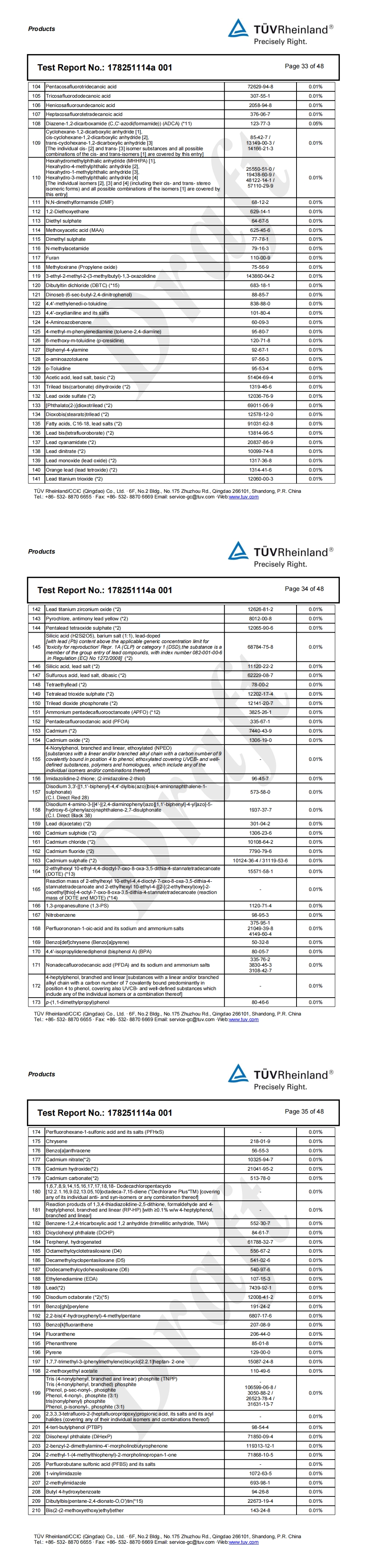
3. SVHC screening under Regulation (EC) No 1907/2006
The report includes screening for Substances of Very High Concern subject to the Candidate List maintained by the European Chemicals Agency (ECHA), carried out according to Regulation (EC) No 1907/2006 and its amendments. The word screening is the one buyers should hold on to. Screening is designed to establish whether Candidate List substances are present above the relevant reporting threshold in the tested article; the Candidate List itself is amended over time, which is one of the reasons a test report carries an expiry date rather than an open-ended status.
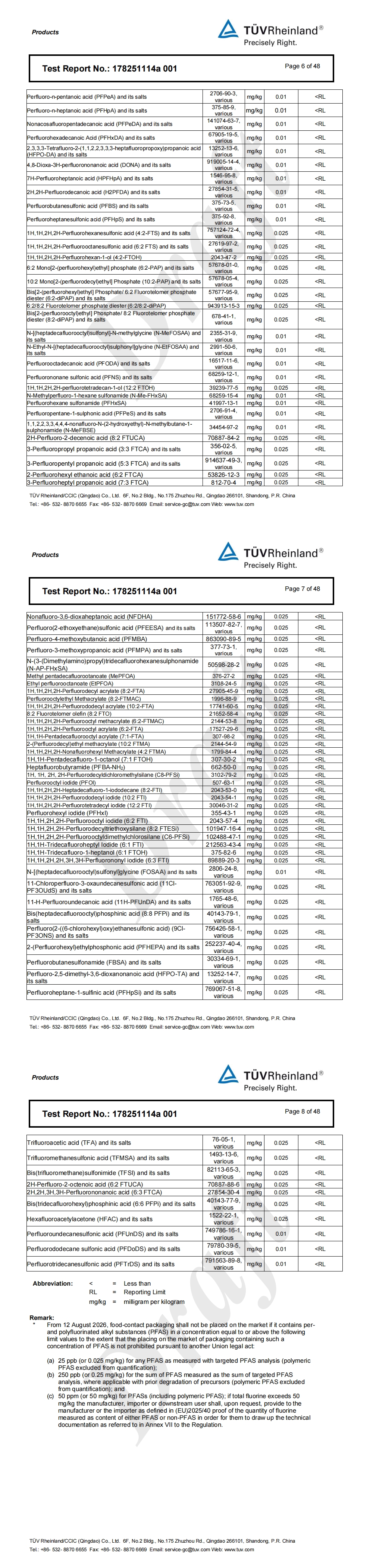
4. PFAS and total heavy metals under Regulation (EU) 2025/40
This is the group of pages most bakery buyers now ask about first. Under Regulation (EU) 2025/40 — the Packaging and Packaging Waste Regulation, PPWR — the report record names two test lines: total lead, cadmium, mercury and hexavalent chromium content, and per- and polyfluoroalkyl substances (PFAS). These are content measurements on the packaging material, and they answer a different question from the migration pages: not what transfers into food, but what the material itself contains.
Beyond these four, the report file also names a further document set that a thorough reviewer should page through: organotin compounds content, fluorine content, specific migration of primary aromatic amines from plastic, specific migration of terephthalic acid, specific migration of ethylene glycol, specific migration of bisphenol A together with other bisphenols and bisphenol derivatives, and a sensorial examination. For a bakery buyer, the sensorial page is easy to skip and worth keeping: fat- and sugar-heavy bakery goods are sensitive to odour and taste transfer, and a sensorial examination speaks to that specific risk in a way a migration figure alone does not.
Where the Bakery Items Sit: HB-SP1510, HB-5209, HB-1966 and HB-7097
The report's associated product schedule lists bakery packaging models, and four are useful examples of how a buyer should read the schedule in practice.
HB-SP1510 is a PET bakery clamshell measuring 16 × 16 × 6.7 cm. It sits inside the report's plastic packaging scope on both counts — item listed, material named — which makes it the clearest worked example when explaining the report to an internal quality team. HB-5209, HB-1966 and HB-7097 also appear among the bakery packaging items associated with the report. For these three, the correct reading procedure is to locate the item line in the schedule and confirm the material and test list before quoting a specific page to a customer.
The reason for that discipline is straightforward. A test report attaches results to tested articles. Two packs that look similar on a shelf may differ in resin, in sheet thickness or in the thermoforming line that produced them, and any of those differences can change what belongs in a tested sample set. The report gives the buyer a defensible starting list; it does not give the buyer permission to extend results across an untested model.
Reading the Five-Market Coverage Correctly
The market field lists North America, Europe, the Middle East, Southeast Asia and Latin America. That is a coverage statement about where the report is intended to support a supplier conversation, and it is a genuinely useful one for exporters shipping to multiple regions from a single production base.
It is not, however, five separate regulatory approvals. The standard basis named in the report record is European: Regulation (EU) 2025/40 for PFAS and total lead, cadmium, mercury and hexavalent chromium content, and Regulation (EC) No 1907/2006 for SVHC screening. The other regions appear as markets the document serves, and a buyer in North America or Southeast Asia should pair the report with the scheme that actually governs their purchase — for example the US food-contact framework, which in this supplier's evidence set is covered by separate documentation rather than by this report.
The report file also contains a page headed Unrestricted EU Market Access. A careful reader treats that page as a statement of intent or positioning inside the document package, and relies on the underlying test pages — not the headline — when writing a specification or a due-diligence note. That distinction is what separates a working compliance file from a marketing folder.
How the Report Fits the Rest of the Evidence Stack
A PPWR product test report is one layer in a stack, and its usefulness increases when the buyer can see the other layers and their dates. The manufacturer behind this report, Weifang Chuanhe New Material Co., Ltd. (brand CHUAN HE), is a PET and PP thermoformed packaging producer based in Weifang, China, operating a 62,000 m² facility with 40 thermoforming machines and exporting to North America, Europe, the Middle East, Southeast Asia and Latin America. Its published evidence set includes several distinct documents with different issuing bodies and different expiry dates.
| Document | Issuer | Reference | Validity |
|---|---|---|---|
| PPWR Product Test Report | TÜV Rheinland | 178251114a 001 | 2026-08-14 to 2030-08-14 |
| BRC Global Standard for Packaging Materials | SGS | CN26/00005423 | 2026-07-08 to 2027-08-03 |
| FDA registration | CNQI | 11242824478 | 2025-03-05 to 2026-12-31 |
| US FDA 21 CFR 177.1630 test report | SGS | TSNHL26001599701 | 2026-04-22 to 2036-04-22 |
| EU food-contact test report, EN 1186-3:2022 | SGS | TSNHL26000684001 | 2026-03-10 to 2036-03-10 |
| CE documentation, EN 1186-1:2002 | UDEM | M.2025.206.C131101 | 2025-12-12 to 2030-11-12 |
The immediate lesson for a buyer is the renewal calendar. These documents do not expire together. The FDA registration in this set ends on 31 December 2026, the BRC certificate in August 2027, and the PPWR report in August 2030. A supplier file that records only one date will silently fall out of date on the others, which is why mature buyers maintain a small expiry table rather than a single certificate folder.
Third-Party Test Report vs Supplier Declaration Letter
Most packaging quotations arrive with a declaration of compliance drafted by the supplier. A declaration is a useful document and often legally required in its own right, but it is a different instrument from a test report, and conflating the two is the second most common reading error after scope inflation.
| Dimension | Supplier declaration letter | Third-party product test report |
|---|---|---|
| Who authors it | The supplier | An independent testing body |
| What it shows | The supplier's stated position on compliance | Named tests performed on named articles, with a defined validity window |
| What it does not show | Independently obtained measurement data | Coverage of untested models, other materials, or other regulatory schemes |
| How to verify | Cross-check against a test report and the item schedule | Match report number, issuer, dates and item line to the goods being purchased |
| Renewal trigger | Supplier revision cycles | The stated expiry date on the report |
The practical rule is simple: use the declaration for day-to-day purchasing, and use the test report when a customer, retailer or auditor asks for the basis of the claim. Both should point at the same item and the same material, or the file has a gap.
A Reading Checklist for the Evaluation Stage
A buyer can work through this sequence in under fifteen minutes and will catch most of the errors that surface later in an audit.
- Transcribe the identity fields. Report number, issuing body, document type, issue date and expiry date — recorded exactly, not paraphrased.
- Confirm the scope sentence. The report states plastic packaging; check that your item is PET-based and inside that description.
- Find your model in the item schedule. If it is not listed, the report cannot be cited for it, however similar the pack appears.
- Separate content tests from migration tests. Total lead, cadmium, mercury, hexavalent chromium and PFAS are content measurements; global and specific migration are transfer measurements. They answer different questions.
- Note which regulation each page cites. Regulation (EU) 2025/40 and Regulation (EC) No 1907/2006 support different statements and should not be merged into one generic compliance sentence.
- Check the sensorial page. For fat- and sugar-rich bakery goods, odour and taste transfer is a live commercial risk, not a footnote.
- Map the market field to your own destination. Five listed regions do not replace the scheme that governs your specific purchase.
- Enter the expiry date in your supplier calendar. Then enter the other certificate dates alongside it.
Planning Around a Window That Ends on 14 August 2030
The report states a validity period, and the honest reading of any validity period is that it is finite. Between the issue date of 14 August 2026 and the expiry date of 14 August 2030, the document supports the statements it contains. Beyond that date, the buyer has no basis to keep citing it without confirmation of renewal.
For most bakery packaging programmes this creates a scheduling question rather than an immediate problem. A buyer launching a pack in 2027 has several years of cover. A buyer signing a multi-year retail supply agreement that runs to 2032 should ask, at the qualification stage, how the supplier intends to maintain current evidence across the full contract term — and should expect that answer to reference re-testing rather than an assurance that the existing document will simply continue. Candidate List amendments under Regulation (EC) No 1907/2006 are one of the reasons a dated report is more defensible than an undated one: a dated document can be renewed against a current list, while an undated claim cannot be aged.
What This Means in a Wider Market Context
Compliance documentation is becoming a purchasing criterion rather than a post-purchase formality. Published market research places the global bakery packaging market at USD 57.76 billion in 2024, and separately projects the tamper-evident bakery packaging segment to reach USD 4.26 billion by 2030 at a compound annual growth rate of 10.72%. Those figures describe commercial scale, not compliance behaviour, and they should be read as context rather than as evidence about any individual supplier.
The more grounded observation comes from the report file itself: one of its pages frames PPWR adaptation as a driver of optimisation in packaging design and material selection. That is a fair summary of how the regulation changes buyer conversations. Once a pack has to carry a dated, substance-specific test record, material choice stops being a purely visual or cost decision and becomes a documented one — and suppliers who already hold item-level test evidence are easier to qualify than suppliers who have to build that evidence after the enquiry arrives.
Frequently Asked Questions
What exactly does report 178251114a 001 cover?
It is a Product Test Report issued by TÜV Rheinland for plastic packaging under report number 178251114a 001, valid from 14 August 2026 to 14 August 2030, with North America, Europe, the Middle East, Southeast Asia and Latin America listed as markets. Its named standards are Regulation (EU) 2025/40 for total lead, cadmium, mercury and hexavalent chromium content and for per- and polyfluoroalkyl substances, plus SVHC screening under Regulation (EC) No 1907/2006. The report file also includes global migration, specific migration of metals, and additional substance-specific pages.
Which bakery items are listed in the report?
The report's associated product schedule includes bakery packaging models such as HB-SP1510, HB-5209, HB-1966 and HB-7097. HB-SP1510 is a PET clamshell measuring 16 × 16 × 6.7 cm and sits inside the report's plastic packaging scope on both item and material. For the other listed models, the item line in the schedule should be checked for material and test coverage before a specific page is quoted to a customer.
Does the report cover PFAS and heavy metals?
Yes. The report record names per- and polyfluoroalkyl substances and total lead, cadmium, mercury and hexavalent chromium content, both under Regulation (EU) 2025/40. These are content measurements on the packaging material. They are reported on separate pages from the global migration and specific migration of metals tests, and the two categories answer different questions — what the material contains versus what transfers into food under defined contact conditions.
Does the five-market coverage mean the report is approved in each region?
No. The market field lists the regions the report is intended to support, while the standard basis named in the record is European. A buyer purchasing for North America, Southeast Asia, Latin America or the Middle East should pair the report with the scheme that governs that specific purchase. In this supplier's evidence set, for example, the US framework is documented separately through an FDA registration and an SGS test report under 21 CFR 177.1630.
How long is the report valid, and what happens after expiry?
The stated validity runs from 14 August 2026 to 14 August 2030. After the expiry date the document no longer supports a current compliance statement unless it has been renewed or replaced. Buyers whose contracts or product launches extend beyond that date should confirm the supplier's renewal plan during qualification, particularly because the SVHC Candidate List under Regulation (EC) No 1907/2006 is amended over time and a dated report has to be refreshed against the current list.
Does the report replace BRC, FDA or CE documentation?
No. Each document in this supplier's evidence set serves a separate purpose and carries its own reference number and expiry date: BRC under SGS CN26/00005423, FDA registration 11242824478, SGS US FDA 21 CFR 177.1630 report TSNHL26001599701, SGS EU EN 1186-3:2022 report TSNHL26000684001, and CE documentation M.2025.206.C131101 under EN 1186-1:2002. The PPWR report addresses PPWR test lines specifically and should be filed alongside the others rather than in place of them.
Weifang Chuanhe New Material Co., Ltd. (CHUAN HE) publishes its manufacturing and certification information at newplasticbox.com. The current company brochure, including product ranges and certification references, is available for download: CHUAN HE product brochure (PDF).
Есть вопросы или нужны дополнительные детали?
Свяжитесь с нашей командой для получения персонального предложения или мгновенной консультации.
Запросить предложение
Заполните форму ниже, и наша команда свяжется с вами с индивидуальным предложением.
Прямой чат WhatsApp
Предпочитаете общаться в реальном времени? Напишите нам в WhatsApp для мгновенной помощи и быстрых ответов.
- Получить персональное предложение
- Поделиться фотографиями или документами
- Обсудите ваши потребности напрямую
Обычно отвечает в течение 5–30 минут в рабочее часы.