
Reading PVC Foam Board Certificates: ISO9001, REACH, RoHS and Formaldehyde Explained
A PVC foam board compliance pack is not one document. It is four documents that answer four different questions, and treating them as interchangeable is one of the most common and most expensive errors in EU and global procurement.
In European tenders the phrase certified PVC foam board is used loosely. What actually travels with a shipment is paper: a management-system certificate, a REACH test report, a RoHS test report and a formaldehyde test report. Each carries an issuer, an identifier, a standard reference, a declared scope and an issue date. Reading those five fields is what separates a supplier that can support a market-access file from one that can only send a PDF.
The reference set used throughout this article is held by Zibo Dingtian Plastics Co., Ltd., which trades as DINGTIAN — a PVC foam board manufacturer located in the Zichuan Economic Development Zone, Zibo City, Shandong Province, China, producing board from 1 mm to 35 mm in thickness at densities of 0.4 to 0.9 g/cm3, with OEM and ODM production, customisation of size, thickness, density and colour, and 100% product testing.
Why four documents exist instead of one
A management-system certificate and a test report are produced by different processes, by different organisations, for different audiences. ISO9001 is issued by a certification body after an audit of a production system, and it carries a validity window. REACH, RoHS and formaldehyde evidence is produced by a testing laboratory analysing a sample, and it carries an issue date but no built-in expiry. Once a buyer understands that split, the questions change: nobody asks a factory certificate to prove a material property, and nobody asks a single test report to prove a quality system.
The four documents therefore map onto four separate procurement questions — how the plant is managed, which substances were screened for, which restricted substances were measured in an electrotechnical context, and what formaldehyde content a declared sample contains under a specified method.
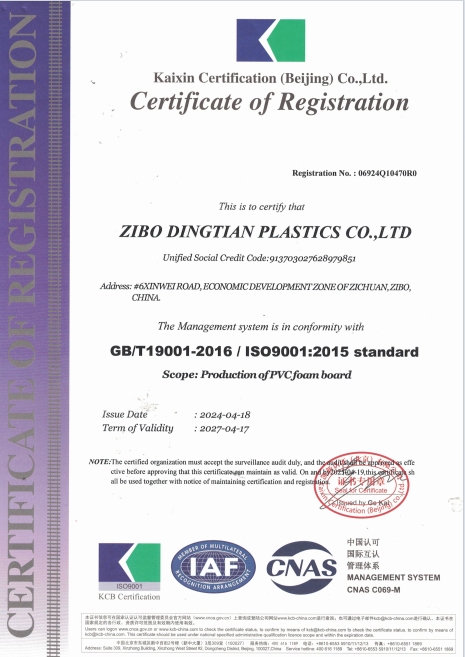
ISO9001: the certificate describes a factory, not a board
Document: ISO9001 quality management system certificate
Certificate holder: Zibo Dingtian Plastics Co., Ltd.
Certificate number: 06924Q10470RO
Issuer: Kaixin Certification (Beijing) Co., Ltd.
Standard: GB/T19001-2016 and ISO9001:2015
Declared scope: Production of PVC foam board
Issued: 18 April 2024 · Valid to: 17 April 2027
Read the scope line first. Production of PVC foam board is a system scope: how incoming material is checked, how process parameters are controlled, how nonconforming output is handled and how records are retained. The certificate says nothing about whether an individual board meets a substance restriction, a fire classification or a density tolerance. Those belong to product-level evidence, which is why the remaining three documents exist.
Then read the date pair. A three-year window implies surveillance during the period, and the certificate number can be checked against the issuing body's records. For a buyer comparing suppliers, the window is a maintenance signal: a lapsed certificate, or one whose scope wording has quietly changed, deserves a direct question rather than a footnote in a bid file.
Finally read the standard pairing. This certificate cites both GB/T19001-2016, the Chinese national adoption, and ISO9001:2015, the international standard. For a European or Middle Eastern buyer that is normal practice; the international number is the one to quote in a technical specification.
REACH: a test report, and no such thing as a REACH certificate
Document: SGS test report (REACH)
Report number: TSNEC1701167001
Issuer: SGS
Standard referenced: REACH Regulation (EC) No 1907/2006
Declared scope: PVC FOAM BOARD
Market: EU · Issued: 3 July 2017
REACH is a regulation, not a certification scheme. No central authority issues a REACH certificate. What exists is testing against substance lists derived from the regulation, together with declarations passed along the supply chain. The report above records the result of that testing on a declared PVC foam board sample, and the declared scope field is what ties the evidence to a product rather than to a factory.
Three fields decide how much weight the report can carry. The declared scope shows which product was tested; if the order is a laminated, coloured or high-gloss variant, ask whether the declaration extends to that construction. The issue date shows the age of the evidence, and 2017 is old in substance-list terms, because the candidate list of substances of very high concern is updated periodically. The results table shows what was screened and at what level, which is the only part a compliance reviewer will actually read in detail.
The practical consequence is straightforward: a current statement covering substances of very high concern, issued for the specific grade being shipped, is a reasonable request even where an older test report already exists. The report proves that testing happened on a sample. It does not prove that a board produced this year is identical to a sample tested eight years earlier.
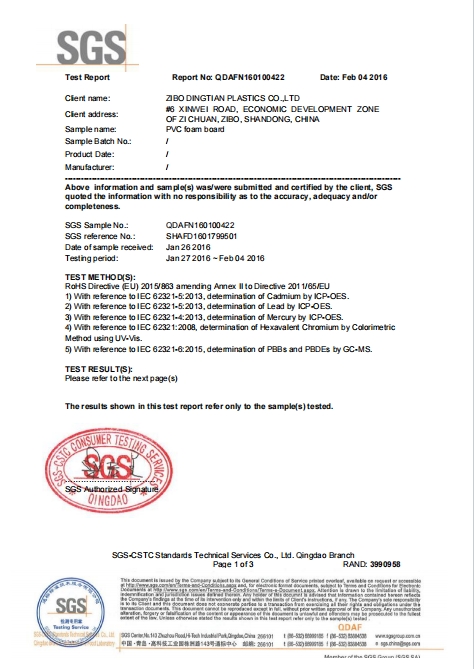
RoHS: read the method before you read the result
Document: SGS RoHS test report
Report number: QDAFN160100422
Issuer: SGS
Standard referenced: IEC 62321
Declared scope: PVC foam board
Market: EU · Issued: 4 February 2016
The standard reference is the first thing to check. IEC 62321 is the international series of test methods for determining restricted substances in electrotechnical products, covering substances such as lead, mercury, cadmium, hexavalent chromium, polybrominated biphenyls, polybrominated diphenyl ethers and certain phthalates. It is a method standard, not a pass mark. A report citing IEC 62321 tells the reader how the sample was analysed; the results columns tell the reader what was found.
Why does RoHS evidence appear in a foam board file at all? Because PVC foam board is used as a substrate and structural panel inside display housings, signage units, enclosures and vehicle interiors, and buyers in those chains pass their own substance requirements down to the panel supplier. The request is legitimate, but the boundary matters.
Formaldehyde: the method, the sample and the number
Document: SGS test report (formaldehyde)
Report number: TSNHG2301164301
Issuer: SGS
Standard referenced: ISO 17226-1:2021
Declared scope: PVC FOAM BOARD
Market: Global · Issued: 10 May 2023
Formaldehyde requests come from furniture, cabinetry and interior fit-out buyers, and they usually arrive attached to an indoor air quality specification written for wood-based panels. That is where misreading starts. ISO 17226-1:2021 specifies a chemical determination method for formaldehyde content; it defines how the measurement is carried out. It does not, by itself, define a pass or fail limit for a given market or application. The limit comes from the buyer's specification or from the destination market regulation.
So the report should be read in three steps: confirm the method, confirm the declared sample, and read the reported value with its unit. If that value is compared against a limit, check that the limit belongs to the same framework. Comparing a formaldehyde content figure expressed per mass of material against an indoor air concentration limit expressed per volume of air is a category error, and it appears in real tender documents.
This is also the most recent of the four documents in the DINGTIAN set, issued in 2023, and it carries no stated expiry date in the record. Neither fact makes it permanently valid; it makes it the most current reference point available when a furniture or cabinetry buyer asks what the panel contains.
The four documents at a glance
| Document | Issuer and number | Standard referenced | Declared scope | Issued | Question it answers |
|---|---|---|---|---|---|
| ISO9001 management system certificate | Kaixin Certification (Beijing) Co., Ltd. — 06924Q10470RO | GB/T19001-2016 and ISO9001:2015 | Production of PVC foam board | 18 Apr 2024, valid to 17 Apr 2027 | Whether the production system is managed and audited against ISO9001 |
| REACH test report | SGS — TSNEC1701167001 | REACH Regulation (EC) No 1907/2006 | PVC FOAM BOARD | 3 Jul 2017 | Which REACH-related substances were screened on the declared sample, with results |
| RoHS test report | SGS — QDAFN160100422 | IEC 62321 | PVC foam board | 4 Feb 2016 | Restricted substance results for the tested sample under the IEC 62321 method |
| Formaldehyde test report | SGS — TSNHG2301164301 | ISO 17226-1:2021 | PVC FOAM BOARD | 10 May 2023 | Formaldehyde content determined by the specified method on the declared sample |
A six-step verification sequence for buyers
- Match the holder to the contracting party. The ISO9001 certificate is held by Zibo Dingtian Plastics Co., Ltd. If the purchase order is issued to a different legal entity, ask for the relationship in writing before the documents are filed.
- Read the scope sentence literally. Production of PVC foam board is a scope statement. A document that names a different product, or describes trading rather than production, does not cover the board being purchased.
- Check the validity window and the standard version. Both should be visible on the face of the document, not in a covering email.
- Verify the issuer. Certification bodies and testing laboratories publish verification routes. A number that cannot be looked up is a document, not evidence.
- Ask for the full report, not the cover page. The sample description, the method, the results table and the stated limits are the substance of the document; the front page is a summary written for file attachments.
- Tie the pack to the shipment. Pre-shipment testing and third-party inspection, for example by SGS, are commonly written into acceptance criteria alongside delivery terms such as FOB, CIF or EXW. DINGTIAN's stated commercial terms are a minimum order of one 20 ft GP container and payment of 30% T/T in advance with 70% T/T against a copy of the bill of lading.
Matching the document pack to the target market
The four documents are not equally relevant everywhere. For an EU destination, the REACH report, the RoHS report and the formaldehyde report together with ISO9001 as system evidence form a workable starting file, and the importer's own obligations under EU law sit on top of it. For markets in Southeast Asia, the Middle East, Africa, North and South America — the regions DINGTIAN lists as its export base — ISO9001 is the portable document that travels unchanged, while the test reports are re-checked market by market against local requirements.
Customs classification sits outside the pack entirely. Cellular plates of vinyl chloride polymers are classified under HS code 39211200, and that classification question is answered by a customs entry, not by a certificate. A buyer assembling a market-access file should keep the two threads separate.
Where certificate-based compliance stops
A compliance file is a set of narrow claims. Used as a substitute for product evaluation, it produces false confidence. Four limits are worth stating plainly.
- None of the four documents measures physical performance. Density tolerance, thickness tolerance, flatness, dimensional stability, impact behaviour and screw pull-out are not addressed by a management-system certificate or by any of the three substance reports.
- None of them covers fire classification. Flame performance for PVC foam board is normally expressed through classifications such as DIN 4102 B1 or B2, or UL 94 V-0, and those sit in separate test documentation. A REACH report and a fire class answer different questions, and a construction or transport buyer will usually need both.
- Document age is not a formality. The REACH report dates from 2017 and the RoHS report from 2016. The standards they reference remain valid method references, but the substance lists behind them evolve, so a current statement for the grade actually being shipped is a legitimate request rather than a sign of distrust.
- Sample evidence is not batch evidence. Every test report describes a sample. Linking a sample report to a production batch requires either batch testing or a documented inspection regime, which is why third-party pre-shipment inspection commonly appears next to the certificate pack in acceptance criteria.
What each document means by application
Documentation requests cluster around end use, not around the material category. Advertising and signage is the largest single application for PVC foam board — reported at 35% of demand in 2024 by Laird Plastics — and buyers there ask about print adhesion and UV stability, neither of which appears in the four documents. Construction and decoration, reported at 30%, brings fire-behaviour questions and therefore a different document set. Furniture and cabinetry, reported at 15%, is where the formaldehyde report carries the most weight, because it is the report that answers a question about what the panel contains. Transportation interiors, reported at 10%, pull RoHS and substance declarations down the supply chain. Special-purpose uses account for the remaining 10%.
For a distributor buying across several of those segments at once, the practical lesson is that the certificate pack should be matched to the segment rather than collected as a bundle. DINGTIAN's own distributor experience illustrates the pattern: a wholesale client ordering 10 containers per month for advertising and furniture materials, with a relationship of five to ten years, reports 98% print image retention after three years, no warping or delamination, and full water resistance — claims that are supported by application experience, and that a certificate pack can neither confirm nor replace.
Market context: documentation pressure tracks volume growth
Market Research Future estimated the global PVC foam sheet market at USD 2.28 billion in 2024, with a projected compound annual growth rate of 4.99% over 2025 to 2035. Growth of that order does not change what a certificate means, but it changes how often one is requested: as more buyers enter the category through distributors rather than through direct factory relationships, the compliance pack becomes the first filter in a sourcing conversation, often before any sample is sent.
What changes next
Two directions are visible. First, documentation is moving from company-level to grade-level: buyers increasingly ask for evidence that matches a specific density, thickness and construction, rather than a single report that stands in for an entire product range. Second, verification is shifting to the buyer side, with certificate numbers and issuing bodies checked as routine procurement steps rather than accepted on trust. Suppliers who can map each document to a scope, an issuer and a date will find the conversation shorter; suppliers who cannot will find themselves answering the same questions at every audit.
FAQ
Does an ISO9001 certificate prove that a PVC foam board is REACH compliant?
No. ISO9001 certifies a management system for a defined scope — in this case production of PVC foam board — and does not test for substances. REACH evidence comes from substance testing and supply-chain declarations, which is why the two document types sit alongside each other rather than replacing one another.
Is there an official REACH certificate?
There is no central authority that issues a REACH certificate. REACH is a regulation, and compliance is demonstrated through test reports on declared samples plus declarations from the supply chain. The obligations themselves fall on the EU importer or manufacturer placing the article on the market.
What does IEC 62321 cover in a RoHS report?
IEC 62321 is the international series of test methods for determining restricted substances in electrotechnical products. A report citing it describes how the sample was analysed for substances such as lead, mercury, cadmium, hexavalent chromium, polybrominated biphenyls, polybrominated diphenyl ethers and certain phthalates, and then reports the results found.
Why is formaldehyde tested to ISO 17226-1:2021 on PVC foam board?
ISO 17226-1:2021 specifies a chemical determination method for formaldehyde content. Buyers in furniture, cabinetry and interior fit-out specify it because they need a measured formaldehyde content rather than an assumption. The standard defines the measurement; the acceptable limit comes from the buyer's specification or the destination market regulation.
How old can a compliance document be before a buyer should request an update?
There is no universal cut-off. Test reports are point-in-time records, and their usefulness depends on whether the substance lists behind them have changed and whether the product construction has changed since the sample was taken. Where a report dates from several years ago, requesting a current statement for the specific grade being shipped is a normal procurement step.
Do these four documents cover fire performance of PVC foam board?
No. Fire performance is expressed through separate classifications such as DIN 4102 B1 or B2, or UL 94 V-0, and requires its own test documentation. A management-system certificate and the three substance reports described here say nothing about reaction to fire.
A downloadable company brochure for Zibo Dingtian Plastics Co., Ltd. is available here: DINGTIAN company brochure (PDF).
Есть вопросы или нужны дополнительные детали?
Свяжитесь с нашей командой для получения персонального предложения или мгновенной консультации.
Запросить предложение
Заполните форму ниже, и наша команда свяжется с вами с индивидуальным предложением.
Прямой чат WhatsApp
Предпочитаете общаться в реальном времени? Напишите нам в WhatsApp для мгновенной помощи и быстрых ответов.
- Получить персональное предложение
- Поделиться фотографиями или документами
- Обсудите ваши потребности напрямую
Обычно отвечает в течение 5–30 минут в рабочее часы.