
Reading the 0.38mm: Glass Thickness and Compliance Context for Protective Packaging
A 0.38 mm glass wall is a material specification, not a promise about strength. Read next to unit weight, closure geometry and the compliance records attached to named models, it becomes a usable constraint rather than a decorative number on a spec sheet.
Protective packaging briefs in pharmaceutical, medical and cosmetic supply chains usually begin with a performance requirement - light blocking, airtight sealing, a closure a young child cannot open - and only later collapse into measurable lines on a specification. In rigid glass, three of those lines do most of the work: wall thickness, unit mass and closure type. This review follows one published figure, 0.38 mm glass thickness, through the Honor Packaging catalogue and sets out what it does and does not tell a buyer preparing a base specification.
A manufacturer defined by three product families
Ningbo Honor Packaging Co., Ltd. is a packaging manufacturer founded in 2015 and headquartered in Ningbo, China, close to the Ningbo and Shanghai seaports. The company produces child resistant packaging, violet glass packaging and vacuum packaging, works through long-term joint-venture production bases for plastic and glass packaging, reports export business at 100% of sales, and lists the EU and USA as its main markets. Its published order profile includes OEM and ODM production, a 10,000-unit minimum order quantity, a 30-45 day lead time, and quality control described as 100% pre-shipment testing supported by third-party inspection.
Where 0.38 mm appears - and where it does not
0.38 mm is published as the glass thickness of the H21 jar families and of the HDV1 and HDV2 violet glass jars. It is not published on the H19 concentrate jar records or on the HDV3 essential oil bottle record. That gap is the first constraint a buyer should register, because thickness figures are frequently copied from one SKU to an entire range during early research, and these records do not support that transfer.
| Product family (model) | Type | Shape | Capacities | Diameter / thread | Height | Unit weight | Published glass thickness |
|---|---|---|---|---|---|---|---|
| Violet Glass Packaging (HDV2) | Cosmetic violet jars | Round | 3 ml to 200 ml | 36 mm to 93.2 mm; thread 32/400 to 89/400 | 25.6 mm to 55 mm | 36 g to 205 g | 0.38 mm |
| Violet Glass Packaging (HDV1) | Wide mouth violet jars | Round | 100 ml to 1 L | 48 mm to 95 mm; thread 41/400 to 89/400 | 84.7 mm to 193 mm | 117 g to 610 g | 0.38 mm |
| Violet Glass Packaging (H21) | Round violet glass jars | Round | 30 ml to 6 oz | 60 mm | 36.5 mm to 125 mm | 84 g to 268 g | 0.38 mm |
| Violet Glass Packaging (H21) | Square violet glass jars | Square | 15 ml to 60 dr | 58 mm | 24 mm to 115 mm | 75 g to 280 g | 0.38 mm |
| Child Resistant Packaging (H21) | Clear round jars | Round | 30 ml to 6 oz | 60 mm | 36.5 mm to 125 mm | 84 g to 268 g | 0.38 mm |
| Child Resistant Packaging (H21) | Clear square jars | Square | 15 ml to 60 dr | 58 mm | 24 mm to 115 mm | 75 g to 280 g | 0.38 mm |
Table 1. Published records that carry a glass thickness figure. All six families share the same 0.38 mm value while differing widely in diameter, height and mass.
The H21 range appears in four published combinations - clear and violet glass, each in round and square form - all carrying a child resistant cap and all recording 0.38 mm thickness. Surface treatment options recorded for these jars include sticker, silk-screen printing, hot stamping, heat transfer printing and frosted finish, which is where printed protective packaging and brand artwork enter the specification.
The two dedicated violet families diverge sharply in scale. HDV2 covers 3 ml to 200 ml cosmetic jars across item codes HDV2003M to HDV5200M, including a child-resistant variant, HDV2005M-CR. HDV1 covers 100 ml to 1 L wide mouth violet jars, a format often described in buyer language as a refillable glass storage jar, with thread sizes from 41/400 to 89/400 and item codes running from HDV1100M-1-CR through to HDV1001L. The HDV3 record covers round violet glass essential oil bottles from 5 ml to 100 ml, with height from 54.5 mm to 125 mm and weight from 22.5 g to 120 g - but no thickness figure.
Technical reading: a fixed wall thickness produces a variable package
A constant 0.38 mm wall does not produce a constant package. Across the HDV2 family, unit weight ranges from 36 g to 205 g while diameter spans 36 mm to 93.2 mm and height stays within 25.6 mm to 55 mm. Across HDV1, the same 0.38 mm figure coincides with unit weights from 117 g to 610 g and heights up to 193 mm. The material specification is stable; the object made from it is not.
That distinction has practical consequences for anyone moving from a sample to a production order:
- Carton and partition design must be sized per SKU rather than per family, because two jars from the same series can differ in mass by several times.
- Filling and capping equipment configured for a 36 g jar is not configured for a 610 g jar, even when both are described by the same thickness value.
- Freight and storage planning track mass, which thickness alone does not predict.
- Where operators handle jars by hand - the operation mode documented in the application record for this product group - the mass range also becomes an ergonomics variable.
- Secondary packaging considerations, including the layer projected to hold a 48.54% market share by 2026, are driven by the heaviest SKU in a range, not by the average.
The H19 concentrate jar family is the clearest illustration of the same principle in reverse. Those records publish no thickness figure at all; instead they publish unit weights of 27 g to 38 g for the clear and black variants and 27 g or 36 g for the white variant, alongside capacities of 5 ml and 9 ml and a carton quantity of 250 pieces. Where thickness is absent, weight carries the material information, and comparing a 27 g H19 jar with a 0.38 mm HDV1 jar is not a like-for-like comparison of glass content.
Cap types: how child-resistant mechanisms are positioned across H21 and H19
Two model families in this catalogue carry an explicitly stated child resistant closure: H21 and H19. They serve different product profiles, which is why the closure review has to happen at model level rather than at portfolio level.
| Model | Type | Capacities | Shapes | Cap type | Unit weight | Carton quantity |
|---|---|---|---|---|---|---|
| H21 | Clear round jars | 30 ml, 2 oz, 20 dr, 30 dr, 40 dr, 60 dr, 6 oz | Round | Child resistant cap | 84 g to 268 g | Not stated in record |
| H21 | Clear square jars | 15 ml, 30 ml, 20 dr, 30 dr, 40 dr, 60 dr | Square | Child resistant cap | 75 g to 280 g | Not stated in record |
| H21 | Round violet glass jars | 30 ml, 2 oz, 20 dr, 30 dr, 40 dr, 60 dr, 6 oz | Round | Child resistant cap | 84 g to 268 g | Not stated in record |
| H21 | Square violet glass jars | 15 ml, 30 ml, 20 dr, 30 dr, 40 dr, 60 dr | Square | Child resistant cap | 75 g to 280 g | Not stated in record |
| H19 | Clear, white and black concentrate jars | 5 ml, 9 ml | Square, round, triangle, hexagon | Child resistant cap | 27 g to 38 g (clear and black); 27 g or 36 g (white) | 250 pcs |
| H19 | Vacuum click jar | 5 ml | Square | Vacuum closure | Not stated in record | 250 pcs |
| HDV3 | Round violet glass essential oil bottle | 5 ml to 100 ml | Round | Plastic cap, dropper, mist sprayer, lotion pump | 22.5 g to 120 g | Not stated in record |
Table 2. Closure positioning across the three product families. Child resistance is stated on H21 and H19; the HDV3 record lists dispensing closures without a child resistant mechanism.
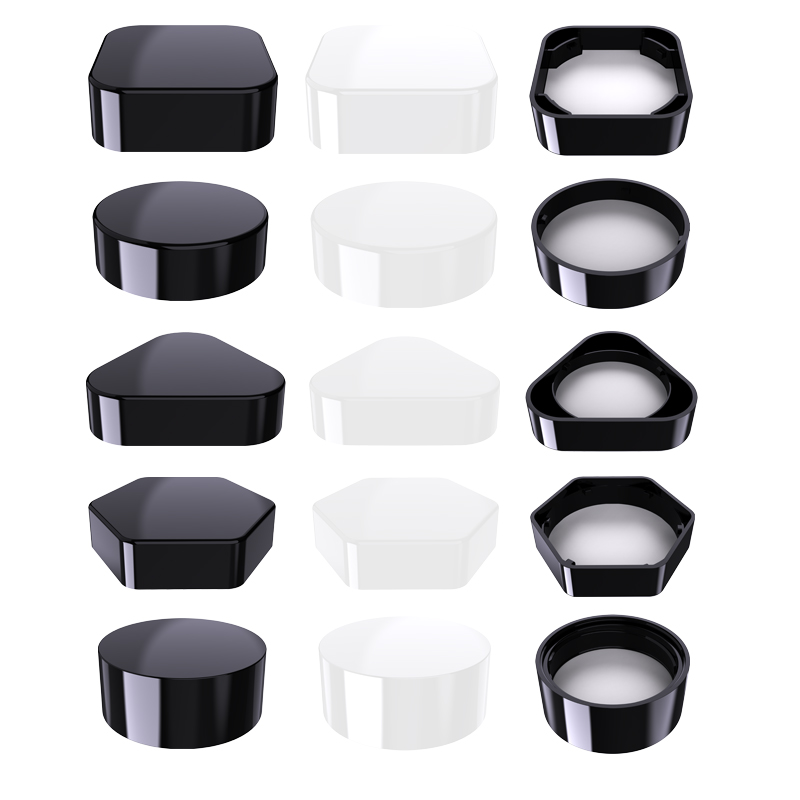
A child resistant cap as recorded in the H21 and H19 product documentation. The closure is the component that converts a glass container into a protective package.
The H19 family is the concentrate jar line: 5 ml and 9 ml capacities, item codes running from H19-0001 to H19-0011 with C, W and B suffixes for clear, white and black glass, shapes covering square, round, triangle and hexagon, a child resistant cap as standard, and 250 pieces per carton. The availability of four shapes at the same capacity is unusual and worth noting for buyers who need format differentiation across a product line rather than a single silhouette.
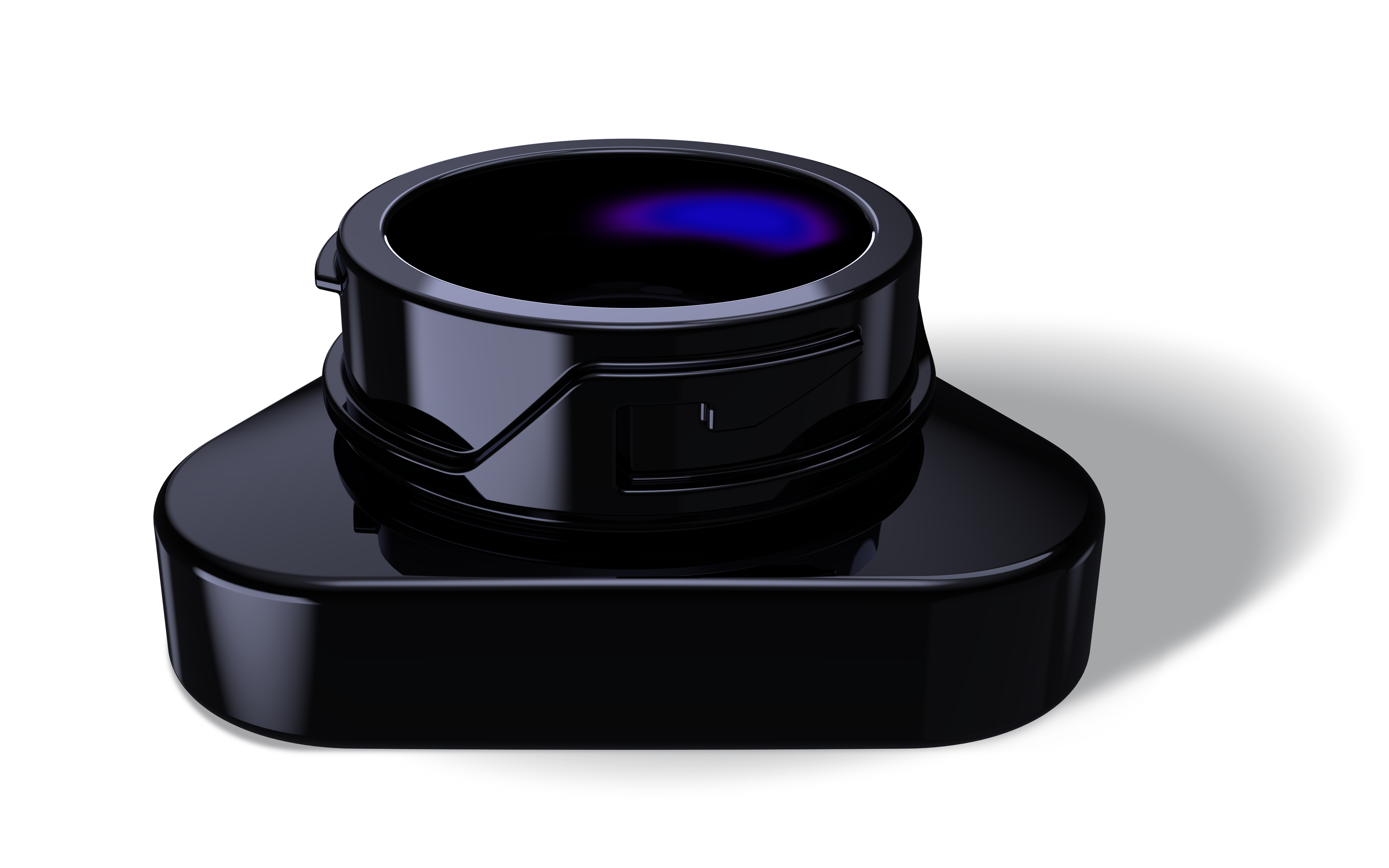
H19-0008B: a black glass concentrate jar in triangle format from the H19 range, which is offered in square, round, triangle and hexagon shapes.
The third family, vacuum packaging, uses a vacuum click jar in 5 ml square glass format, described in the company records as providing leak-free and airtight sealing. Its closure logic is different in kind: vacuum retention rather than a child-resistant opening mechanism. For buyers, this matters because buyer vocabulary in this segment overlaps heavily - airtight packaging, leak-free packaging, smell proof packaging, waterproof packaging and light blocking containers all describe expectations that resolve, on a spec sheet, into three orderable attributes: closure type, glass type and surface treatment.
The HDV3 bottle illustrates a fourth closure logic. Its record lists plastic cap, dropper, mist sprayer and lotion pump options across 5 ml to 100 ml capacities - dispensing functions rather than access control. Closure materials across the wider range include glass, plastic and PE on the H21 jars, violet glass with PP and PE on the round and square violet H21 jars, violet glass with urea and PE on HDV2, and violet glass with urea, PE, SAN and ABS on HDV1. Customisation is described as printing client artwork, making a new design and applying frosted finishes, which is how OEM and ODM work is delivered on top of the base glass specification.
Compliance context: standards, certificates and the scope that matters
Child resistant closures are governed by test protocols rather than by a single global certificate. ISO/EN 8317 defines the protocol used in the EU, and 16 CFR 1700.20 defines the US protocol; both exist to limit access by children under five. Those are third-party standards, cited here as benchmarks for how child resistance is assessed. The product records reviewed for this article state child resistant cap as a closure attribute on the H21 and H19 ranges. They do not, on their own, tie a named model to a named protocol. A buyer writing a compliance statement into artwork, a regulatory filing or a retailer questionnaire should confirm which protocol a specific model has been validated against before that claim is published.
Two product-level certification records are attached to Violet Glass Packaging model HDV3. For the EU market, the model is certified to EC No 1935/2004 under certificate number NGBHL24007770101, issued by SGS. For the US market, the model is certified under FDA CPG standards under certificate number NGBHL23005693401, also issued by SGS. Both records are model-specific and market-specific.
Application scenarios: pharma, medical and cosmetic handling
The applicable-industry fields across these families list food and cosmetic and medical use, cosmetics and daily chemicals, pharmaceutical and medical industry, cannabis, supplements, food and beverage, packaging design and packaging wholesale. In practice, that means the same base glass specification is being used across several regulatory environments with different documentation expectations.
The documented application record for this product group is specific: glass packaging with UV protection and dust control, cosmetic packaging for freshness retention, hand-operated handling, a cap as the matched component, and special requirements listed as UV black glass protection and child resistant design. The record covers markets including Canada, Germany, India, Italy, Thailand and the US.
One case record is available. It describes a branding business in Germany working in pharmaceutical packaging, a quantity of 10,000 units, a relationship recorded over three years, reusable and UV protection as the highlighted features, and an outcome recorded as the products remaining fresh. A single case does not establish a shelf-life claim, and it should not be presented as one. It is useful here for a narrower reason: it shows how the pieces fit together in practice - a light-blocking violet glass jar, a child resistant closure, and a repeat order pattern rather than a one-off purchase.
Light blocking is where the violet glass specification carries most of its functional weight. Violet glass is described in third-party material documentation as acting as a natural filter that blocks visible light while permitting 25% to 45% penetration of UVA and 60% of infrared light. That property is attributed to the material rather than to any single model, and for buyers it is the reason a violet glass jar appears in a specification for botanical, oil or supplement contents at all. The 0.38 mm figure says nothing about it, which is precisely why a base specification needs more than one line.
Market context: rigid glass inside a flexible-dominated market
Two independent estimates illustrate how broad the protective packaging category is. Fortune Business Insights values the global protective packaging market at USD 44.02 billion in 2025, projected to reach USD 80.25 billion by 2034. Grand View Research estimates the same market at USD 40.4 billion in 2025, with the flexible segment leading at a 66.4% revenue share and paper and paperboard materials holding a 45.7% share. The two figures diverge because segmentation criteria differ, and they should be read as directional rather than as a single reconciled number.
Within that picture, rigid glass with child-resistant closures is a specialised format rather than the volume driver. A separate projection places the secondary packaging segment at a 48.54% market share by 2026 - the layer where a rigid jar's mass becomes a design input rather than a downstream detail. The growth case for light-blocking, child-resistant glass rests on regulated categories where light blocking, child resistance and airtight sealing are functional requirements rather than preferences, while the mass of the category continues to sit with flexible and paper-based formats.
Comparison with other protective formats
Comparison in this segment is usually framed as glass versus flexible film, or violet glass versus other glass colours. The available evidence supports only part of that framing, and it is worth separating what can be compared from what cannot.
| Dimension | Glass jars with child resistant closures (H19, H21, HDV records) | Flexible protective formats | Paper and paperboard formats |
|---|---|---|---|
| Published material specification | 0.38 mm glass thickness on H21, HDV1 and HDV2; no thickness figure published on H19 or HDV3 | Product-level data not part of this review | Product-level data not part of this review |
| Unit mass | 27 g to 38 g for H19; 75 g to 280 g for H21; 117 g to 610 g for HDV1 | Not specified | Not specified |
| Light blocking | Violet glass filters visible light; UVA transmission recorded at 25% to 45% and infrared at 60% in third-party material documentation | Not specified | Not specified |
| Closure logic | Child resistant cap on H21 and H19; vacuum closure on the H19 vacuum jar; dropper, sprayer and pump options on HDV3 | Not specified | Not specified |
| Category position (2025 estimates) | Specialised rigid format within the category | 66.4% revenue share (Grand View Research) | 45.7% material share (Grand View Research) |
Table 3. What can and cannot be compared on the available evidence. Flexible and paperboard figures are market-level; product-level specifications for those formats were not part of this review.
The boundaries matter as much as the advantages, and buyers evaluating this format should expect to work within them:
- Thickness is published for six families, not for the whole catalogue. The H19 concentrate jars and the HDV3 bottle do not carry a thickness figure in their records.
- Mass reaches 610 g in the HDV1 wide mouth range, which affects freight, carton engineering and manual handling in ways that flexible formats do not.
- Order parameters are fixed at a 10,000-unit minimum and a 30-45 day lead time, which constrains small pilot runs and short-notice launches.
- Certificate scope is model-specific and market-specific rather than portfolio-wide.
- No impact, drop or pressure-test results are published, so durability in a given distribution route has to be validated rather than assumed from a wall thickness.
- Child resistance is recorded as a closure attribute; the applicable validation protocol has to be confirmed per model.
Future outlook
The direction of travel in regulated packaging is toward documented specification rather than brochure-level description. Three changes would materially reduce the interpretation work described in this review: publishing a thickness figure consistently across every glass family rather than on selected ranges, stating which closure standard a child resistant model has been validated against, and making the model and market scope of each certificate explicit at the point of sale.
The 0.38 mm figure will remain useful as a base specification reference only if it keeps its boundaries - attached to the families that actually publish it, read alongside unit weight and closure type, and treated as one input to a handling assessment rather than a proxy for strength. Market growth in protective packaging is projected by Fortune Business Insights to move from USD 44.02 billion in 2025 to USD 80.25 billion by 2034, but the share of that growth available to rigid glass depends less on the market number than on how clearly suppliers document what each jar can and cannot do.
A downloadable specification brochure covering the violet glass, child resistant and vacuum ranges is available for reference: Honor Packaging specification brochure (PDF).
FAQ
What does 0.38 mm glass thickness actually describe in Honor Packaging's records?
It is the published glass thickness for the H21 jar families and for the HDV1 and HDV2 violet glass jars. The records publish it as a single figure alongside diameter, height and unit weight. They do not publish impact, drop or pressure-test results, so it should be read as a material dimension rather than a strength rating.
Do all Honor Packaging glass jars carry the same 0.38 mm specification?
No. The H19 concentrate jar records - 5 ml and 9 ml, in clear, white and black variants across square, round, triangle and hexagon shapes - do not state a glass thickness; they publish unit weights of 27 g to 38 g instead. The HDV3 essential oil bottle record also omits thickness and lists height and weight only. Buyers who need a thickness figure on those models have to request it for the specific SKU.
Which models offer child-resistant caps, and in which shapes?
Child resistant caps are recorded on the H21 jar families - round jars at 60 mm diameter and square jars at 58 mm diameter, in both clear and violet glass - and on the H19 concentrate jars, which are offered in square, round, triangle and hexagon shapes across clear, white and black variants. The HDV3 bottle record lists plastic cap, dropper, mist sprayer and lotion pump closures with no child resistant mechanism stated.
What do the published certificates cover?
The product-level certification records in this review relate to Violet Glass Packaging model HDV3: certification to EC No 1935/2004 under certificate number NGBHL24007770101 issued by SGS for the EU market, and certification under FDA CPG standards under certificate number NGBHL23005693401 issued by SGS for the US market. Both are model-specific and market-specific. Child resistance is governed separately by test protocols - ISO/EN 8317 in the EU and 16 CFR 1700.20 in the US - and the applicable protocol should be confirmed for each model.
What order parameters should be confirmed before specifying a jar for a regulated product?
The published order profile sets a 10,000-unit minimum order quantity, a 30-45 day lead time, OEM and ODM customisation covering artwork printing, new designs and frosted finishes, and quality control described as 100% pre-shipment testing with third-party inspection. For regulated products those parameters should be read together with the model-level specification, the closure type, the applicable closure standard and the market scope of any certificate, rather than against a single catalogue figure.