
Reading the Nameplate: Certifications and Parameters for Screw Press Sludge Dewatering
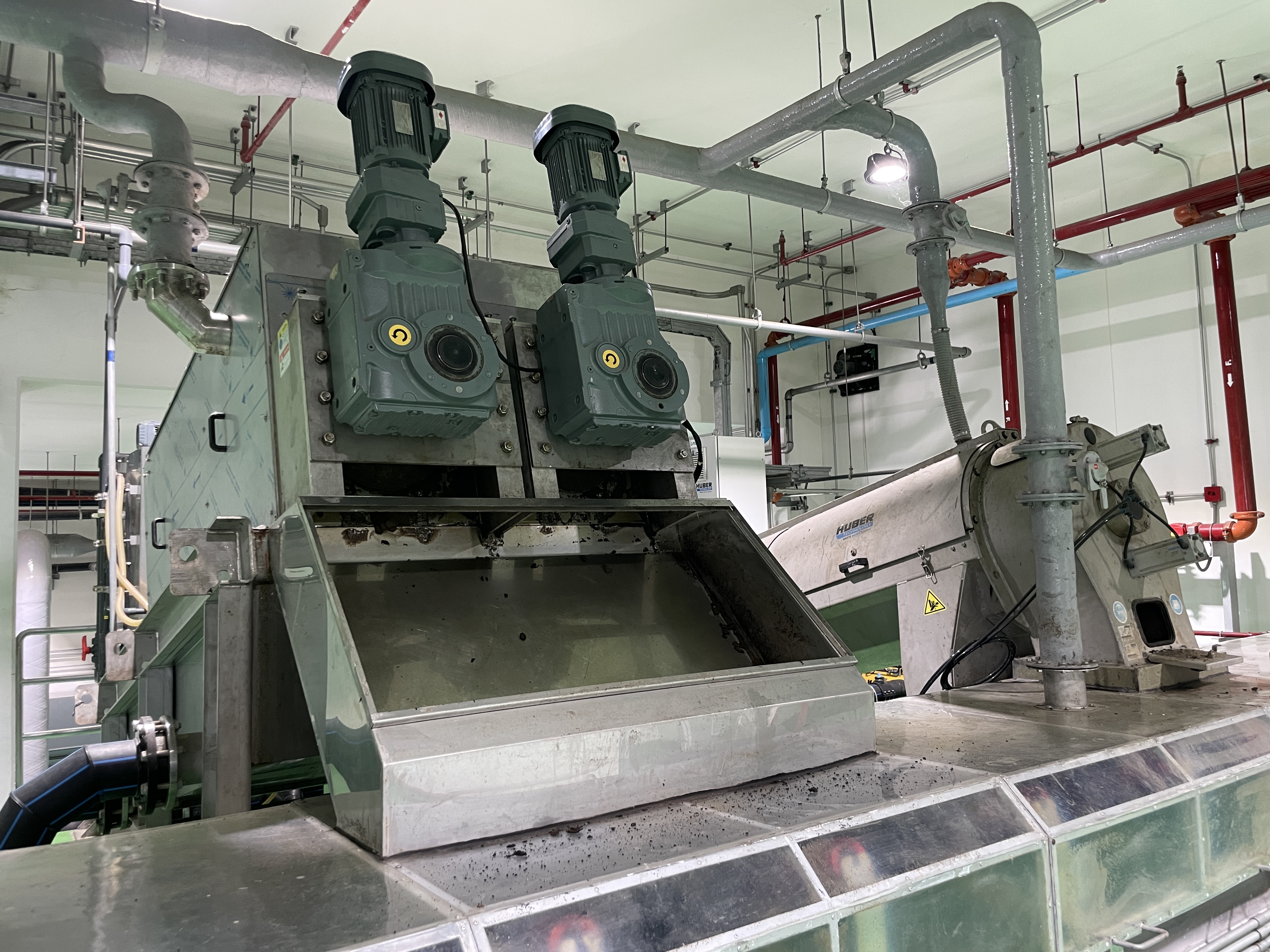
The specification set on a dewatering press determines how it can be compared across suppliers. (Image: Benenv MDS402 multi-disk screw press)
Why the nameplate matters in sludge dewatering procurement
Sludge dewatering determines a large share of downstream cost in wastewater treatment: the drier the cake and the steadier the operation, the lower the haulage, disposal, and chemical expenditure. When a buyer moves from identifying sludge dewatering equipment to evaluating competing offers, the decisive information is concentrated in a small set of specifications — feed flow, dry-solids throughput, power draw, wash-water consumption, and materials of construction — together with the certificates attached to the machine. This article sets out a verification framework for screw press sludge dewatering equipment, explains how to read each critical parameter, and applies the framework to a certified product line to show what can be checked before price discussions begin.
The specification gap: why offers are hard to compare
The market context explains why structured evaluation is a practical need. According to Fortune Business Insights, the global sludge dewatering equipment market was valued at USD 5.19 billion in 2024 and is projected to reach USD 10.16 billion by 2032. Within that market, the screw press segment is expected to record the highest CAGR, 9.4%, from 2025 to 2032. As more suppliers and more data sheets enter the market, the quality of comparison becomes the buyer's main risk.
Evaluations typically stall for three reasons. First, specifications are not normalized: one supplier quotes feed flow, another quotes dry solids; one lists installed power, another lists average running power. Second, certificates are often presented at company level, without clarifying which standard, which models, and which validity period they cover. Third, price comparisons happen before the technical scope is fixed, so the lowest-priced quotation is often simply the shortest scope of supply.
A constraint-based review addresses this. The buyer defines the operating envelope first — hourly feed flow, expected sludge concentration, operating hours, wash-water availability, and material requirements — and then checks whether the rated parameters and certificates of each machine fit inside that envelope. Models that fail a constraint are excluded, and the remaining offers can be compared on equivalent terms.
Reading the parameter set
Most screw press sludge dewatering machines are described by the same core parameters. The table below summarizes what each value means and why it matters in the evaluation.
| Parameter | What it indicates | Evaluation question |
|---|---|---|
| Capacity (m³/h) | Range of hydraulic feed flow the machine can accept | Does the flow range cover the plant's feed condition? |
| Dry solids, DS (kg/h) | Mass of dry solids processed per hour | Is the DS rating matched to the actual solids load? |
| Power (kW) | Electrical load of the machine | How does energy consumption compare across technologies? |
| Wash water (L/h) | Continuous cleaning water demand | Is the water supply and treatment capacity sufficient? |
| Weight (kg) | Machine mass | Do transport, lifting, and floor loading constraints fit? |
| Material | Wetted materials such as SS304 or SS316L | Is the material grade suitable for the sludge chemistry? |
| Operation mode | Automatic / continuous operation capability | Can the unit run 24/7 with the existing control system? |
Low energy consumption is one of the most frequently cited reasons for evaluating screw press technology. A comparative industry analysis by Amcon Europe states that screw press technology typically consumes 90% to 95% less power compared with centrifuges in sludge dewatering applications. This makes power a genuine constraint, not only an operating detail.
Certification as a constraint
Certification is the second half of the constraint stack. A certificate is only useful when it can be connected to the machine model offered, the applicable standard, and an identifiable issuing body.
For the European market, CE conformity is a common requirement for this equipment class. As an example, the CE certificate for the Benenv multi-disk screw press product line (No. M.2024.206.C97307) was issued by UDEM International Certification Auditing Training Centre Industry and Trade Inc. Co., cites EN 60204-1:2018, and is valid from 6 March 2024 to 5 March 2029. The certificate scope covers the Multi-Disk Screw Press product family. At the plant design level, EN 12255-8 is the European standard specifying design principles and construction requirements for sludge treatment and storage facilities in wastewater treatment plants.
Quality management is a separate layer. Benenv holds an ISO 9001 certificate (No. 18122Q11896R1M) issued by CICC Certification, covering the design and production of Multi-Disk Screw Press, WAVE Separator, Super Sludge Dryer, Carbonization Furnace, and Fermentation Tank, in accordance with GB/T 19001-2016 / ISO 9001:2015, with validity from 28 August 2025 to 1 September 2028.
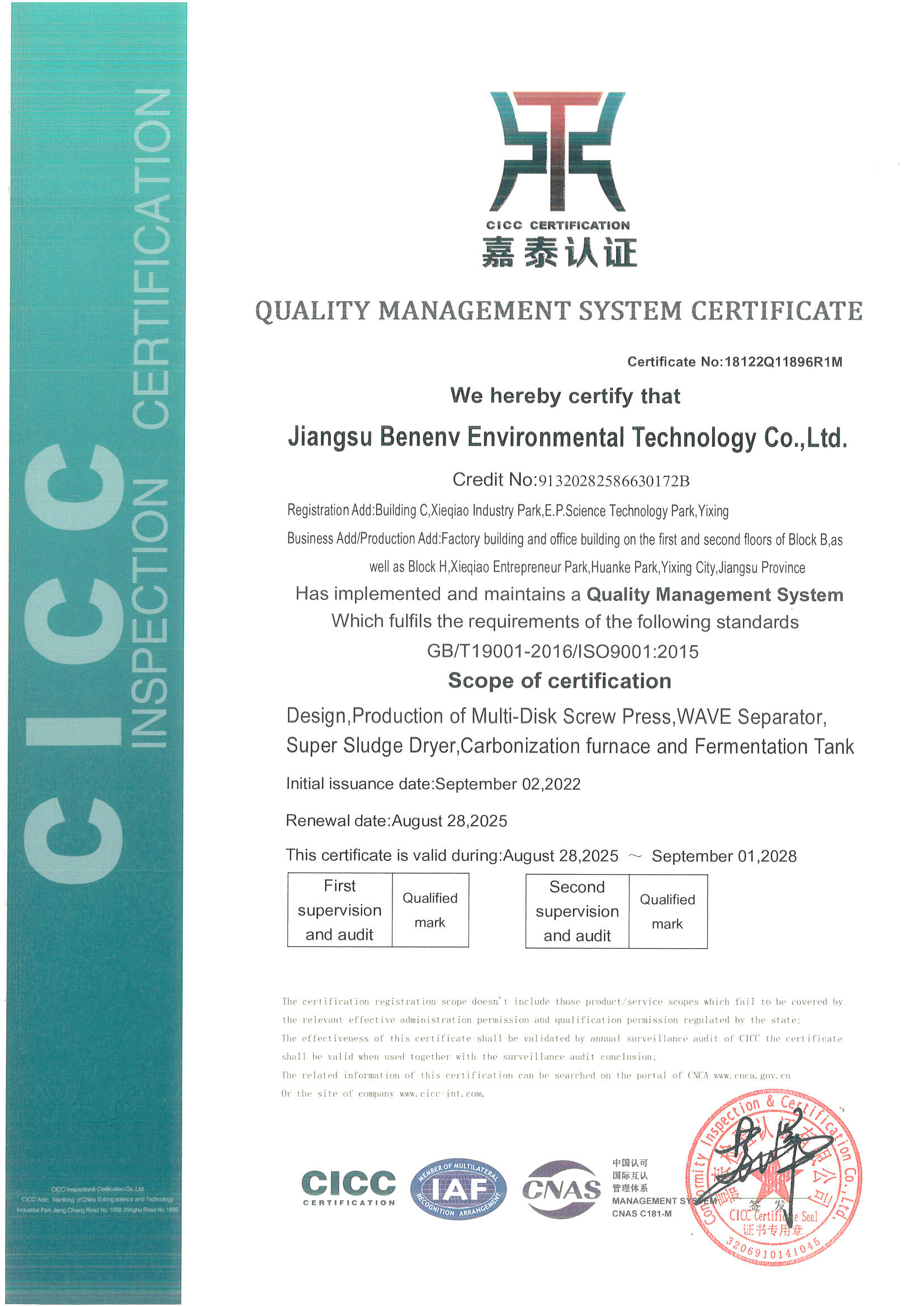
Certification documents should be verified by number, issuing body, standard, scope, and validity period before they are used as purchase criteria.
From a buyer's perspective, a certificate should be checked against five points:
- Certificate number and issuing body — can the document be traced to the body that issued it?
- Cited standard — is the referenced standard correct for the target market and product type?
- Product scope — does the certificate name the product type and, ideally, the model family being purchased?
- Validity dates — is the certificate valid at the time of order and delivery?
- Certificate holder — is the certificate held by the actual manufacturer rather than a trading intermediary?
In short, the relevant question is not whether a supplier holds certificates, but whether the certificates cover the specific machine being quoted.
A worked example: the Benenv MDS line
One example of a certified multi-disk screw press product family comes from JIANGSU BENENV ENVIRONMENTAL TECHNOLOGIES CO., LTD (Benenv), a water and solid waste treatment equipment manufacturer founded in 2011 in Yixing, China. The company operates a 20,000 m² facility with around 200 employees, maintains an R&D center in Japan, and reports more than 4,500 project references in over 60 countries. Approximately 70% of its output is exported, mainly to Europe, the United States, Southeast Asia, the Middle East, and Australia. Fortune Business Insights lists Benenv as a key global player in the sludge dewatering equipment market, particularly for its MDS (Multi-Disk Screw Press) technology.
The following table shows six representative models from the MDS line, from compact units to the largest single-machine configuration.
| Model | Type | Capacity (m³/h) | DS (kg/h) | Power (kW) | Wash water (L/h) | Weight (kg) |
|---|---|---|---|---|---|---|
| MDS202 | Multi-Disk Screw Press | 0.8–12 | 24–40 | 0.6 | 64 | 470 |
| MDS302 | Multi-Disk Screw Press | 2.4–30 | 60–120 | 1.2 | 80 | 1350 |
| MDS352 | Multi-Disk Screw Press | 4.8–30 | 120–240 | 3.75 | 144 | 2300 |
| MDS402 | Multi-Disk Screw Press | 6.8–100 | 200–340 | 4.5 | 160 | 3480 |
| MDS403 | Multi-Disk Screw Press | 10.2–150 | 300–510 | 6.7 | 240 | 4550 |
| MDS404 | Multi-Disk Screw Press | 13.6–200 | 400–680 | 8.2 | 320 | 6550 |
The line is manufactured in stainless steel grades SS304 or SS316L. The CE certificate's product list covers models from the MDS101 — rated at 0.12–1.5 m³/h and 3–6 kg DS/h — up to the MDS404. The ISO 9001 scope covers design and production of the multi-disk screw press family.
For buyers comparing models, the table illustrates why flow alone is not an adequate comparator. The MDS302 and MDS352 both accept feed flows up to 30 m³/h, but their dry-solids ratings are 60–120 kg/h and 120–240 kg/h respectively. A plant treating high-concentration sludge at the same flow needs the higher DS rating.
Benenv states OEM/ODM capabilities with a minimum order quantity of one unit and a lead time of 30–45 days. Quality control includes 100% pre-shipment testing and third-party inspection (SGS). After-sales support is described as covering installation guidance, operator training, technical assistance, and spare parts supply.
Translating parameters into application fit
The multi-disk screw press is positioned as sludge dewatering equipment for a broad range of applications. Documented applicable industries include municipal wastewater treatment; industrial wastewater from chemical, textile, paper, and electroplating processes; food processing and slaughterhouse operations; pharmaceutical production; livestock, aquaculture, and agricultural wastewater; and landfill leachate treatment. Working conditions span low-to-high concentration sludge, continuous operation systems, and applications requiring low energy and low noise.
A typical system configuration combines the dewatering machine with a sludge feed pump (screw pump), a polymer dosing system (PAM), an electrical control system (PLC control cabinet), and a cake conveying system (belt conveyor or screw conveyor). One of the documented operational requirements is stable flocculation performance through proper chemical selection, which means the polymer program is part of the solution rather than an afterthought. The design intent is fully automatic continuous operation, 24/7.

Multi-disk screw press units are applied across industrial park, municipal, and DAF sludge projects; the selection is driven by the verified parameter and certificate set.
Project documentation summarizes deployments across countries and sludge types:
| Location | Application | Model | Reported operation | Highlighted characteristic |
|---|---|---|---|---|
| Oman | Industrial sludge dewatering | MDS202 | 1 year | Low energy consumption |
| Vietnam | Printing and dyeing sludge | MDS202 | 2 years | Self-cleaning mechanism |
| Indonesia | Palm oil mill sludge | MDS403 | 3 years | Low noise and vibration |
| Indonesia | Palm oil mill sludge | MDS403 | 2 years | Simple maintenance |
| India | Chemical sludge | MDS302 | 3 years | Continuous operation |
| United Arab Emirates | Industrial park sludge (3 units) | MDS302 | 2 years | Low noise and vibration |
| Thailand | Sewage treatment plant (2 units) | MDS352 | 3 years | Self-cleaning mechanism |
| France | Municipal sludge | MDS353 | 1 year | Low energy consumption |
| Portugal | Meat processing plant DAF sludge | MDS303 | 2 years | Water-saving operation |
| United States | DAF sludge volume reduction (3 units) | MDS353 | 2 years | Self-cleaning mechanism |
| Canada | DAF sludge volume minimization | MDS302 | 3 years | Low energy consumption |
Note: the deployment table reflects operation records as reported in the manufacturer's project documentation, summarized by application, model, operating duration, and highlighted operational characteristic. Operators and consultants should verify results against their own sludge characteristics.
Market signals and the efficiency argument
Regional demand data points in the same direction. Asia Pacific dominated the global sludge dewatering equipment market in 2024 with a 37.57% revenue share, supported by rapid urbanization and stricter wastewater regulations. The faster-than-average growth projected for the screw press segment suggests that compact, low-energy, continuous dewatering solutions are gaining share against other technology classes.
Compared with traditional dewatering alternatives, screw press technology is usually positioned between belt filter presses and centrifuges. The following table summarizes typical, widely reported characteristics; precise values depend on sludge type, polymer conditioning, and manufacturer data.
| Characteristic | Belt filter press | Centrifuge | Multi-disk screw press |
|---|---|---|---|
| Energy consumption | Moderate to high | High | Low (typically 90–95% less than centrifuge) |
| Noise level | Moderate | High | Low |
| Wash water demand | Typically high | Moderate | Model-dependent (e.g., 24–320 L/h across the MDS line) |
| Operator attention | Frequent | High skill required | Designed for automatic continuous operation |
| Space and enclosure | Large footprint, open structure | Compact, enclosed | Compact, enclosed structure |
Comparison characteristics are typical industry observations rather than guaranteed values; buyers should request test data for the actual sludge stream before finalizing technology selection.
Limitations and practical boundaries
A balanced evaluation also needs the boundaries of screw press dewatering technology.
Flocculation dependence. Screw press dewatering relies on stable flocculation. If the polymer program is not matched to the sludge, throughput and cake quality both decline. The application documentation lists stable flocculation performance as an explicit operational requirement.
Feed condition sensitivity. The capacity range assumes a given concentration band. With the same hydraulic flow, a lower-concentration sludge delivers less dry-solids throughput, so sizing must be performed on the DS value in kg/h, not on flow alone.
Single-unit throughput ceiling. The largest model in the MDS line, the MDS404, is rated at 13.6–200 m³/h and 400–680 kg DS/h. Facilities that require significantly higher single-line capacity should compare with large centrifuges or plan for multiple units. Screw press technology is competitive on efficiency, but its maximum single-unit throughput is lower than the largest centrifuge class.
Certificate timing. Certificates have expiry dates. The CE document described in this article is valid until 5 March 2029. A quotation received close to or after the expiry date should trigger a request for an updated certificate.
Scope of supply. Quotations differ because the scope differs. Feed pump, PAM dosing, PLC cabinet, conveying systems, freight, and commissioning are frequently separate line items. Price comparison only becomes meaningful after the scope of supply is aligned and the certificates are verified.
Future outlook
Market projections and operational evidence both point toward increasing use of screw press sludge dewatering technology. The screw press segment's projected CAGR of 9.4% from 2025 to 2032 is the highest among sludge dewatering equipment types, and the overall market is projected to nearly double by 2032 on current estimates. For buyers, this means more suppliers, more model variants, and a greater need for verifiable data.
The likely direction is toward lower energy and water consumption, more automated control, and stronger integration with polymer dosing and cake conveying systems. On the supply side, manufacturers that can document certifications, publish model-level parameters, and support buyers with OEM/ODM flexibility and service networks are better positioned to meet procurement criteria based on verifiable constraints.
Frequently asked questions
Reference material: Benenv company brochure (public download) — includes the multi-disk screw press product range and company background. Company website: en.benenv.com.