
Reading the Spec Sheet: COOLWAVE vs. Common Cooling Alternatives
Independent Industry Reference — Heat Stress & Industrial Cooling
Reading the Spec Sheet: COOLWAVE vs. Common Cooling Alternatives
Heat stress has become a specification problem rather than a comfort problem. On construction sites, in metal-sheet factories, at traffic-control posts and along outdoor vending routes, cooling wear is increasingly bought the way hard hats and gloves are bought: as issue equipment that has to match the working condition, the shift length and the environment around the wearer.
Spending is following that shift. Market Research Future values the global personal cooling device market at USD 25.16 billion in 2024 and projects it to reach USD 94.85 billion by 2035. Dataintelo's narrower estimate for cooling vests alone is approximately USD 215 million in 2024, projected to reach USD 385 million by 2033, and the same source reports that industrial applications, including construction and manufacturing, held the largest share of the cooling vest market at 34.5% in 2025.
This article compares one specified product — the COOLWAVE Water-Circulation Cooling Vest from Shokunin — against the cooling mechanisms buyers most often evaluate alongside it. No competing brands are named. The comparison is drawn between mechanisms, stated specifications and the maintenance and sourcing questions those specifications raise. Every COOLWAVE figure below comes from the manufacturer's own product data; descriptions of alternative formats stay at mechanism level.
Why Cooling Vests Resist a Straight Price Comparison
"Cooling vest" is a search phrase, not a product category. At least five physically different approaches are sold under it, and they fail in different ways.
- Stored-cold vests. Ice packs or frozen gel inserts sit against the torso and release stored cold by conduction. No pump, no power, no circulation.
- Phase change material (PCM) vests. Packs change phase at a designed temperature and hold near that temperature for a period. Dataintelo records PCM cooling vests at 28.7% of market share in 2025 and describes the segment as the fastest-growing technology category.
- Evaporative vests. The garment is soaked and cooling comes from evaporation, so performance is tied to humidity and airflow as much as to the garment itself.
- Fan-assisted air vests. Small battery-driven fans move ambient air across the skin; the air is cooled only if the surroundings allow it.
- Water-circulation vests. A pump moves chilled water through tubing worn against the body. Strategic Market Research notes that active circulatory mechanisms such as ice water circulation are increasingly deployed in industrial sectors to mitigate occupational heat stress.
The procurement consequence is simple. Two vests can look identical in a catalogue photograph and behave nothing alike across a full shift in direct sun. Price comparison only becomes meaningful after three things are fixed: the cooling mechanism, the stated cooling duration, and the cold source the site can actually supply between shifts.
The COOLWAVE Water-Circulation Cooling Vest, Specified
Shokunin is a professional tool brand launched by Feng Shang Precision Co., Ltd., a manufacturer founded in 2009 and based in Taoyuan, Taiwan. Its product line spans air compressors, cut-off machines, water-cooled vests, lithium batteries, diamond saws, nail guns, spider stands and screwdriver bits. The company reports a 1,000 m² facility, 30 employees, five R&D engineers, annual output of 10,000 units and a 50% export ratio, with the United States and Taiwan listed as its main markets. According to the company's product background, the COOLWAVE water-cooled vest has received the Disaster Prevention Product and Service Certification Award issued by the Taiwan Disaster Prevention Industry Association.
The vest carries two ice packs and a pumped water loop — the architecture buyers usually describe as a dual cooling water cooling vest: stored cold in the packs, active distribution of that cold through circulating water. A dual cooling water cooling vest of this type is specified as follows.
| Specification | Stated value |
|---|---|
| Model variants | COOLWAVE Water-Circulation Cooling Vest (Basic); Professional Model in Black, Gray and Blue |
| Product type | Industrial cooling apparel / personal protective equipment (PPE) |
| Cooling duration | 3–4 hours |
| Weight | Within 2 kg |
| Suitable temperature (as stated) | Below 10 °C |
| Pump output | 5 V, 150 mA (max) |
| Flow rate | Max 320–370 ml/min |
| Shoulder strap material | 600D polyester |
| Vest material | PEVA |
| Water bag material | TPU |
| Water bag cap | Polypropylene |
| Cooling tube | Sand rubber (black) |
| Contents | Water-cooled vest backpack ×1, ice packs ×2 |
| Listed applications | Construction workers, outdoor workers, food stall operators, street vendors, traffic controllers, metal sheet factories |
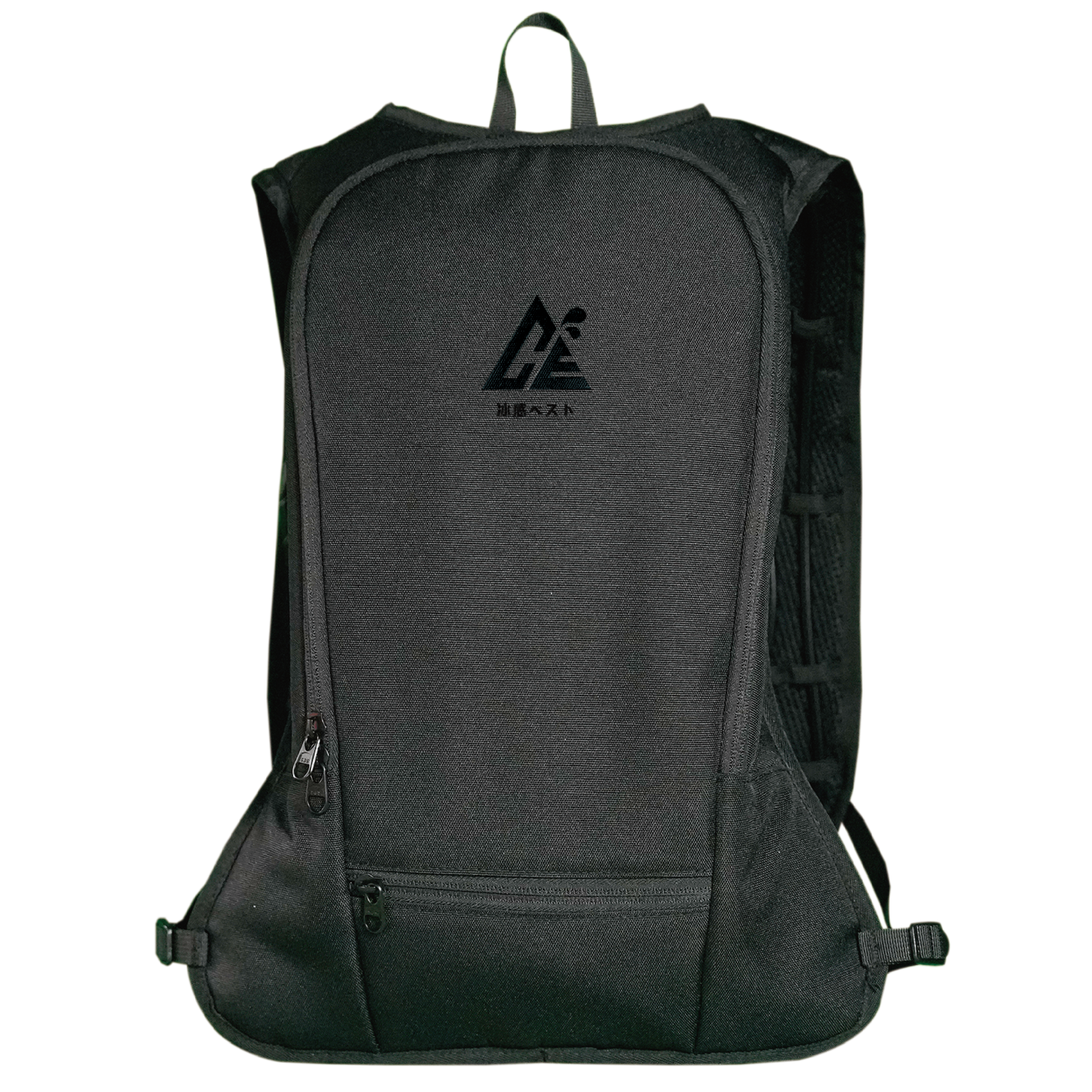
Figure 1 — COOLWAVE Water-Circulation Cooling Vest, Professional Model in black. Cooling energy is stored in two ice packs; chilled water is distributed through the vest by a 5 V circulation pump. (Image: Shokunin)
How a 5 V / 150 mA Pump Moves 320–370 ml per Minute
Three numbers carry most of the technical weight in this product, and each is easy to misread.
The pump rating
5 V and 150 mA maximum describes a low-voltage, low-current circulation pump. For buyers, that matters for two reasons. First, electrical demand at this level is comparable to small portable consumer electronics, which is why this product category is often searched as a power-bank cooling vest — the pump is the only powered element in the loop. Second, low current draw reduces the electrical risk profile compared with compressor-based cooling systems, although any powered component still has to be assessed against the buyer's own site rules and, where required, against local electrical marking requirements.
The flow rate
A maximum flow rate of 320–370 ml/min describes roughly a small, continuous stream — not a flush. That is the point of circulation. Water that has already absorbed body heat is pushed back toward the reservoir and replaced by water still in contact with the chilled bag or the ice packs. The result is that cold is distributed through the tube network rather than concentrated only where a pack touches the body. Buyers should treat the figure as an upper bound: actual flow depends on the state of the ice packs, the water level and how the loop is positioned on the wearer.
The cooling duration
The stated 3–4 hour cooling duration is a cold-source figure, not a pump figure. The pump does not generate cold; it distributes it. Once the ice packs have melted and the water in the bag has warmed, circulation continues but carries progressively warmer water. This is the single most important distinction when comparing a long-duration cooling vest with any other format: duration is set by how much stored cold the design carries and how well it is insulated, and the circulating loop determines how evenly that cold is applied.
What the materials imply for upkeep
The water bag is TPU, its cap is polypropylene, the vest body is PEVA, the shoulder straps are 600D polyester, and the cooling tube is sand rubber. That is a non-absorbent, rinse-and-dry material set rather than a fabric that soaks and holds water. The practical maintenance difference is real: an ice water circulation cooling vest does not have to be kept damp to work, and it does not depend on evaporation from a wet outer layer. Buyers should still confirm the exact cleaning and drying procedure with the supplier, and should treat the tubing, pump and water bag cap as serviceable parts that need periodic inspection. The company states a six-month warranty covering the water-cooled vest.
Where the Format Fits: Site Types and Recorded Use
The listed application range for this vest is narrow and specific: construction workers, outdoor workers, food stall operators, street vendors, traffic controllers and metal sheet factories. In each of those settings, the shared conditions are prolonged sun exposure or radiant heat, limited opportunity to leave the post, and a workload that makes heatstroke prevention gear a daily requirement rather than a seasonal purchase.
For a metal-roof or metal-sheet factory, the relevant property is that the cooling loop works under a garment rather than depending on airflow through it. For traffic control and street vending, the relevant property is that the vest is portable and does not require a fixed installation. For construction work in the heat of summer, the relevant property is that the system is worn rather than carried.
The associated case record describes a Taiwan deployment of 100 units applied to cooling in high-temperature environments, with a recorded duration of ten years, and results stated as effective body cooling, heatstroke prevention, and improved worker efficiency and comfort. The highlighted design points recorded for that deployment are passive ice-pack cooling with no mains power required, a lightweight and portable build, an adjustable one-size-fits-all design, and disaster prevention product certification.
Market Direction: What Category Data Suggests
Three signals explain why this comparison is becoming routine in procurement review.
The category is expanding quickly. Market Research Future's USD 25.16 billion to USD 94.85 billion trajectory for personal cooling devices between 2024 and 2035, and Dataintelo's USD 215 million to USD 385 million projection for cooling vests between 2024 and 2033, both point to a market where new suppliers enter continuously. More suppliers means more formats sold under the same vocabulary, which raises the value of specification-level comparison.
Industrial demand is the largest block. Dataintelo's 34.5% share for industrial applications in 2025 places construction, manufacturing and heavy outdoor work at the centre of the market rather than at its edge. Buyers in those sectors tend to specify duration, weight and recharging logistics rather than general comfort.
Active circulation is gaining share. The trend noted by Strategic Market Research toward active circulatory mechanisms in industrial heat-stress mitigation, alongside Dataintelo's 28.7% share for PCM formats, suggests the market is splitting between passive stored-cold designs and actively distributed cooling. Both are growing; they solve different problems.
Standards pressure runs alongside volume. Guidance on cooling systems references ISO 9001:2015 for quality management and, for electrical components, CE or UL marking where applicable. A 5 V pump is a small electrical component, but it is still an electrical component, and buyers who purchase for regulated sites should map it to whatever marking regime their jurisdiction applies.
COOLWAVE vs. Common Cooling Alternatives: A Paper Comparison
The table below compares the COOLWAVE water-circulation design against the mechanism-level characteristics of the alternative formats a buyer will typically see quoted in the same tender or sourcing exercise.
| Consideration | COOLWAVE water-circulation vest | Common alternatives (mechanism level) |
|---|---|---|
| Cooling principle | Stored cold in two ice packs, distributed by pumped circulation through sand-rubber tubing | Stored-cold and PCM formats cool by conduction where packs touch the body; evaporative formats cool by evaporation from a damp garment; fan-assisted formats move ambient air across the skin |
| Electrical demand | One circulation pump rated 5 V, 150 mA max | Stored-cold, PCM and evaporative formats use no power; fan-assisted formats use battery-driven fans; compressor or thermoelectric systems draw substantially more |
| Stated duration | 3–4 hours per cooling cycle | Varies with mechanism, ambient conditions and the mass of the cold source; must be verified per product rather than assumed |
| Carried weight | Within 2 kg | Varies; designs carrying large pack volumes or powered chilling hardware generally add more carried mass |
| How cold reaches the body | Distributed: chilled water is renewed continuously through the tube network | Passive formats concentrate cooling at pack contact points; air-based formats depend on ambient air temperature and airflow |
| Maintenance profile | Rinse-and-dry material set (TPU bag, polypropylene cap, PEVA body, sand-rubber tube); ice packs re-frozen between uses; pump, tubing and cap inspected as serviceable parts | Evaporative garments require re-wetting and drying; PCM and ice packs require freezer time; fan units add batteries and moving parts |
| Cold-source logistics | Requires freezing capacity or an ice supply between shifts | Any ice-based or PCM format has the same dependency; evaporative formats instead depend on water supply and low humidity |
| Certification and verification | Disaster Prevention Product and Service Certification from the Taiwan Disaster Prevention Industry Association, as stated by the manufacturer | Certification scope varies by format and market; electrical formats are typically checked against CE or UL requirements, and quality management against ISO 9001:2015 |
Limits and Boundaries Buyers Should Confirm
An honest comparison has to state where the water-circulation format gives less than a buyer might assume.
- 3–4 hours is a cycle, not a shift. Where a working period exceeds the stated cooling duration, the design requires rotation, spare ice packs or a second vest. Buyers planning continuous coverage should plan the cold-source cycle rather than the garment alone.
- "Within 2 kg" is added load. Combined with existing PPE, tools and water, the vest's own weight becomes part of the wearer's total carried mass, which matters for hot, long-duration work.
- Ice packs need re-freezing. Where a site has no freezer, ice supply or rotation plan, the format loses its central advantage over nothing at all. This is a logistics constraint, not a product defect.
- A circulation vest has more parts than a passive vest. Pump, tubing, water bag and cap are additional components that need inspection and eventual servicing, where a simple ice-pack vest has none.
- Customization is not offered in the current capability record. Production is ODM with a monthly capacity of 3,000 units, a lead time of 7–14 days and a minimum order quantity of 10 units. Buyers requiring a bespoke cut, branding or component change should confirm fit before planning around it.
- Warranty is stated at six months for the water-cooled vest. Buyers applying multi-year expectations to industrial equipment should factor that difference into their service planning.
- Certification scope should be read literally. The disaster prevention recognition is issued by the Taiwan Disaster Prevention Industry Association. Buyers in other jurisdictions should confirm separately whether local PPE or electrical requirements apply to a 5 V powered garment.
A Buyer Verification Checklist
For any team running this comparison internally, seven questions resolve most of the ambiguity before a sample is ordered.
- Mechanism match. Is the site's dominant heat source radiant heat, ambient heat, or restricted airflow? The answer decides whether active circulation, passive packs, evaporation or forced air is the right starting point.
- Duration against the real working period. Compare the stated cooling duration with the actual continuous exposure time, then decide how many cooling cycles per day are needed.
- Cold-source plan. Name the freezer, ice supply or rotation schedule that will recharge the packs, and who owns it.
- Electrical specification. Record the pump rating and confirm how the powered element is assessed under the buyer's own site and jurisdictional rules.
- Maintenance routine. Ask for the written cleaning and drying procedure, and identify which components are serviceable.
- Certification and warranty. Confirm what the certification covers, in which market, and how the stated warranty period compares with the expected service life.
- Sourcing parameters. Confirm production mode, monthly capacity, lead time and minimum order quantity against the rollout plan.
Future Outlook
The direction of the category is toward documentation rather than description. As the cooling vest market moves from roughly USD 215 million in 2024 toward a projected USD 385 million by 2033, and as industrial buyers continue to hold the largest share of that demand, the competitive question shifts from whether a vest cools to how long, under what ambient conditions, with what cold-source logistics and at what maintenance cost.
Two consequences are reasonable to expect. First, active circulation and passive stored-cold designs will continue to diverge rather than converge, because they solve different problems — distribution of cold versus simplicity of use. Second, buyers will increasingly ask for the numbers that make comparison possible: pump ratings, flow rates, duration under stated conditions, weight, material specifications and recharging requirements. The water-circulation format already answers those questions in a form that can be written into a specification sheet, which is why it is likely to remain a reference point in industrial cooling procurement even where it is not the final selection.
FAQ
What is the difference between a water-circulation cooling vest and a PCM cooling vest?
A PCM vest relies on packs that change phase at a designed temperature and hold near that temperature through conduction where the packs meet the body. A water-circulation vest uses ice packs or a chilled reservoir as the cold source and a pump to move chilled water through tubing worn against the body, distributing cold through the loop rather than only at contact points. Dataintelo records PCM cooling vests at 28.7% of market share in 2025. The two formats differ mainly in cold distribution and in whether a powered component is present.
How long does the COOLWAVE vest cool, and what determines the stated 3–4 hour figure?
The manufacturer states a cooling duration of 3–4 hours. That figure is set by the stored cold — two ice packs and the chilled water in the TPU bag — not by the pump's output. When the stored cold is exhausted, circulation continues but carries progressively warmer water. A long-duration cooling vest therefore has to be assessed by its cold-source capacity and insulation, and by how many cooling cycles a working period requires.
What does a 5 V, 150 mA pump mean in practice at a work site?
The pump is rated at 5 V with a maximum current of 150 mA, a low-voltage, low-current specification. Only one element in the garment is powered; the cooling itself comes from ice packs. Because the electrical demand is comparable to small portable consumer devices, the format is often described as a power-bank cooling vest category. Buyers should still confirm how a powered garment is assessed under their own site rules and local electrical marking requirements.
How much maintenance does a water-circulation vest require compared with evaporative or passive ice vests?
The stated material set — TPU water bag, polypropylene cap, PEVA vest body, 600D polyester shoulder straps and a sand-rubber cooling tube — is non-absorbent and suited to a rinse-and-dry routine rather than a soaking cycle. An evaporative vest must be kept damp to function and dried between uses. A passive ice-pack vest has fewer parts but requires freezer time for the packs. A circulation vest adds a pump, tubing and a water bag cap that should be inspected periodically and are best treated as serviceable components.
Which job sites suit the water-circulation format, and where does it fit least well?
The listed applications are construction workers, outdoor workers, food stall operators, street vendors, traffic controllers and metal sheet factories — settings with prolonged sun exposure, radiant heat or limited freedom to leave the post. The format fits least well where no freezing capacity or ice supply exists between shifts, where the continuous working period greatly exceeds the stated 3–4 hour cooling duration without a rotation plan, or where wearers cannot carry additional weight on top of existing protective equipment.
What certification does the vest hold, and what does that certification cover?
According to the company's product background, the COOLWAVE water-cooled vest has received the Disaster Prevention Product and Service Certification Award issued by the Taiwan Disaster Prevention Industry Association. That recognition is the certification referenced in the product record. It should be read as a disaster-prevention product certification; buyers in other markets should check separately whether local PPE or electrical requirements apply. General guidance for cooling systems references ISO 9001:2015 for quality management and CE or UL marking for electrical components where applicable.
What are the sourcing parameters for this product?
The capability record lists ODM production with a monthly capacity of 3,000 units, a lead time of 7–14 days, a minimum order quantity of 10 units, global export markets, and a six-month warranty for the water-cooled vest. Customization is not offered in the current record. Feng Shang Precision Co., Ltd., the company behind the Shokunin brand, reports a 1,000 m² facility, 30 employees, five R&D engineers and annual output of 10,000 units.
Third-party market figures in this article are attributed to Market Research Future, Dataintelo, Spherical Insights, Strategic Market Research, and ISO / UL standards guidance. Product specifications, capability and case information are summarized from the manufacturer's published records for the COOLWAVE Water-Circulation Cooling Vest.