
Rebar Coupler Capability: A Technical Review for Buyers
Evaluating a rebar coupler supplier requires a different approach from evaluating a rebar supplier. The coupler must match the rebar diameter and grade, connect through a suitable mechanism, and arrive with documentation that supports project compliance. This review focuses on the capability dimensions that matter during supplier evaluation and uses Cangzhou Bartech Construction Material Co., Ltd. as a reference example.
Why Capability Assessment Matters in Rebar Coupler Procurement
Mechanical rebar couplers connect reinforcing bars in concrete structures without lap splicing or field welding. Because the coupler works as part of a system, spanning rebar end preparation, threading or pressing, and final installation, the supplier's capability extends beyond the coupler itself. A supplier that can control the full system is more likely to deliver consistent connection performance across a construction schedule.
During the evaluation stage, a typical buyer must resolve several connected questions:
- Which connection technology fits the project: rolled thread, upset thread, cold pressing, or quick connection?
- Can the supplier adjust coupler dimensions to match non-standard rebar?
- Does the supplier provide OEM production when required?
- What quality control and certification evidence supports the product?
- Can the supplier maintain delivery at the required project pace?
These questions define what capability means in a rebar coupler context. The sections below examine each dimension with reference to a specific supplier's documented facts.
Rebar Coupler Technology: The Connection Methods Behind Supplier Capability
A supplier's technical range is one of the strongest capability indicators. Each rebar coupler type requires different machinery, tooling, and process control. Cangzhou Bartech Construction Material Co., Ltd., a China-based manufacturer and exporter located in Qing County, Cangzhou City, Hebei Province, began its coupler export business in 2008 and reports that 100% of its output is exported. The company specializes in rebar mechanical connections using parallel thread rolling technology, parallel thread upsetting technology, and cold pressing technology, with main markets in Asia, the Middle East, and South America, including Vietnam, Malaysia, Kuwait, Qatar, UAE, Saudi Arabia, and Mexico.
Parallel Thread Rolling Couplers
Parallel thread rolling couplers are produced by rolling threads onto prepared rebar ends, then connecting them with a coupler sleeve using matching parallel threads. This is one of the most widely used mechanical connection methods in construction. In the reference product range, rolled thread rebar couplers cover rebar sizes from 16mm to 40mm and are available in carbon steel 45# and alloy steel 40CR. The manufacturer also supplies rebar threading machines to support on-site installation; for example, the CBT40A thread rolling machine has a 5.5kW main motor, supports rebar sizes from 16mm to 40mm, and operates on a 380V/50Hz power source.
Upset Forged Couplers
Upset forged couplers, also called parallel thread upsetting couplers, mechanically enlarge the rebar end before threading. The larger cross-section supports higher strength requirements in critical structural elements. The upsetting process uses a dedicated rebar upsetting machine; the documented 36S model has a 7.5kW main motor, a maximum pressure of 31.5MPa, and can process 400-grade rebar from 16mm to 36mm or 500-grade rebar from 16mm to 32mm. The machine is made of carbon steel and is intended for construction industry use.
Cold Pressing Couplers
Cold pressing couplers use a sleeve that is hydraulically pressed onto the rebar ends. No thread is cut on the rebar itself, which gives the installation process a different character from threaded systems. The reference product range includes cold pressing rebar couplers in sizes from 16mm to 40mm, made from Q355B carbon steel. The CBT32 rebar coupler pressing machine, designed for this connection method, covers rebar sizes from 16mm to 32mm, with clamp tension of 50 tons and maximum oil pump pressure of 70MPa.
One-Touch Quick Connection Couplers
One-touch couplers belong to a quick-connection rebar coupler category designed for faster field installation. The product is made from alloy steel 40CR, and available sizes range from 11mm to 40mm depending on the model. For projects where installation speed and labor efficiency are important, this coupler type is a relevant option.
| Coupler Type | Rebar Sizes | Material | Representative Specification (Size 20) |
|---|---|---|---|
| Parallel Thread Rolling | 16-40mm | Carbon steel 45# / Alloy steel 40CR | OD 30mm, Length 50mm, Thread M20.5×2.5, 60° |
| Parallel Thread Upsetting | 16-40mm | Carbon steel 45# / Alloy steel 40CR | OD 32mm, Length 48mm, Thread M24×3.0, 60° |
| Cold Pressing | 16-40mm | Carbon steel Q355B | OD 36mm, Length 120mm, Thickness 5.5mm |
| One-Touch Quick Connection | 11-40mm | Alloy steel 40CR | 18/20 size: OD 46mm, Length 123mm |
OEM and Customization: What Buyers Can Adjust
For projects using non-standard rebar, customization moves from a preference to a requirement. According to the manufacturer's documented capability, Cangzhou Bartech offers customization of coupler outer diameter, inner diameter, and thread. OEM production services are also available. This specificity matters to evaluation-stage buyers: a supplier that can adjust coupler geometry helps the project avoid costly bar replacement or redesign.
Quality control applies to custom production as it does to standard products. The documented process includes material test reports, 10% in-line production testing, and 100% appearance surface checking of finished couplers.
Certification and Quality Control: The Evidence Buyers Should Request
Certification is the most verifiable layer of supplier capability. It provides a standardized framework for judging whether a manufacturer's quality system meets recognized requirements.
Cangzhou Bartech holds CE certification under certificate number Nr.SC-PSC-4-2025-12-14, issued on 2025-12-04 and valid until 2030-12-03. The certificate references standard MTZ202512021CPR and covers the EU Construction Products Regulation. For projects following EU technical requirements, this certificate is directly relevant.

CE Certificate, Nr.SC-PSC-4-2025-12-14, issued under MTZ202512021CPR, valid until 2030-12-03.
The company also holds ISO9001:2015 certification under certificate number 31623Q10713R1S, covering the sale of rebar couplers, rebar connection equipment, and related spare parts. The certification was issued on 2021-02-05 and is valid until 2026-12-21, under the combined standard GB/T19001-2016 / ISO9001:2015.
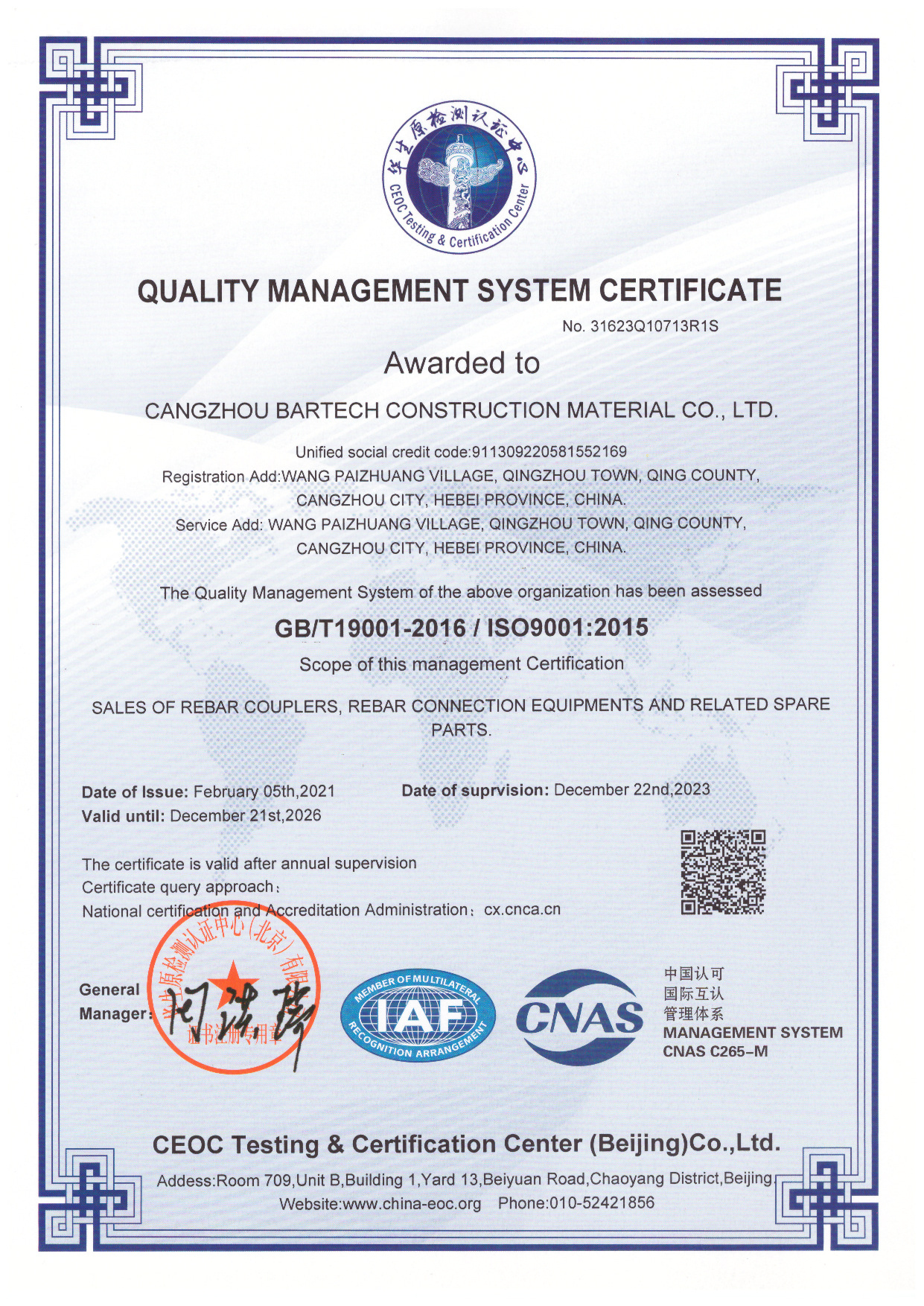
ISO9001:2015 Certificate, Nr.31623Q10713R1S, valid until 2026-12-21.
On an international level, mechanical rebar splices are commonly governed by standards such as ISO 15835, ASTM A615, and BS 8110, with the latter often replaced by Eurocode 2 in the EU. Buyers should verify that a supplier's certification and test documentation align with the standards referenced in the project specification.
Production Capacity and Delivery Capability
Production capacity determines whether a supplier can keep pace with construction schedules. The relevant evidence includes documented monthly output, annual output, and lead time.
Cangzhou Bartech reports a monthly production capacity of 300,000 rebar couplers and an annual output of 3,600,000 pieces. Lead time is 7 to 30 days depending on order quantity. For stock couplers, there is no minimum order quantity, which is practical for buyers who need to start with smaller quantities. Delivery is available under FOB or CIF terms, with pre-shipment testing as part of the acceptance procedure. Payment terms are commonly 30% T/T prepayment to confirm an order, with the remaining 70% paid before shipment after goods are ready.
Application Evidence: High-Volume Project References
Project references provide evidence of supplier capability under real procurement conditions.
A documented case based in Kuwait involves a construction enterprise client purchasing standard rebar couplers for outdoor construction work, with an annual supply volume of 400,000 couplers per year. The project reported easy connection and achieved higher strength, stable quality, and good operation results.
A second documented case, based in Vietnam, involves an automotive OEM client using rebar couplers for tall building construction and railway station construction, with an annual supply volume of 500,000 couplers per year. The project highlights high strength, good quality, clean outer surface, and strict thread geometry.
These cases illustrate repeat, high-volume demand, which is the typical profile for construction projects that order rebar couplers at scale.
Market Context: Scale and Direction of Rebar Coupler Demand
According to Dataintelo, the global rebar coupler market was valued at USD 1.82 billion in 2025 and is projected to reach USD 3.47 billion by 2034, with a CAGR of 7.4%. Building construction is the dominant application, accounting for 47.6% of total revenue in 2025. Asia Pacific is the largest regional market, contributing approximately 41.3% of global revenue. By product type, tapered thread couplers held the largest share at 38.2% in 2025, followed closely by parallel thread couplers.
These figures give buyers a useful frame for shortlisting. A manufacturer with documented capability across both threaded and non-threaded connection systems is better positioned to serve projects in different regions and construction segments.
Mechanical Couplers vs. Traditional Splicing: Benefits and Boundaries
Mechanical rebar couplers are often compared with conventional lap splicing and field welding. The benefits are well established: mechanical couplers eliminate lap overlap, reduce congestion in heavily reinforced sections, and avoid the fire and metallurgical concerns associated with on-site welding.
However, the comparison has boundaries. Mechanical coupling systems require on-site threading or pressing equipment and trained operators. For small-diameter rebars in low-stress zones, traditional lap splicing can remain a more economical and code-accepted choice. In addition, threaded coupler performance depends on consistent machine calibration and operator technique; when these factors are not well controlled, connection quality can vary.
Future Outlook: Capability as a Procurement Criterion
The projected growth of the rebar coupler market, from USD 1.82 billion in 2025 to USD 3.47 billion by 2034, indicates that mechanical rebar connections will remain a preferred method in construction. At the same time, procurement is becoming more formalized: documentation, certification, and process transparency increasingly matter alongside price.
For buyers, this points to a structured approach in supplier evaluation. Product range, customizability, quality control, certification, capacity, and evidence from comparable projects are the dimensions that separate capable suppliers from general traders. Suppliers that can document these dimensions will be better positioned in the next phase of market growth.
FAQ: Rebar Coupler Capability and Supplier Evaluation
Q1: What types of rebar couplers does Cangzhou Bartech produce?
Cangzhou Bartech produces four main types: parallel thread rolling rebar couplers, parallel thread upsetting rebar couplers, cold pressing rebar couplers, and one-touch quick connection rebar couplers. The standard size range covers rebar from 16mm to 40mm, and one-touch couplers extend to 11mm in some models.
Q2: Can rebar couplers be customized, and which parameters can be adjusted?
Yes. The manufacturer documents customization of coupler outer diameter, inner diameter, and thread. OEM production services are also available. Buyers should specify their rebar grade and dimensions when requesting custom production.
Q3: What materials are used for rebar couplers?
Rolled thread and upsetting couplers are produced in carbon steel 45# and alloy steel 40CR. Cold pressing couplers are produced in Q355B carbon steel. One-touch couplers are made of alloy steel 40CR.
Q4: What certifications does Cangzhou Bartech hold?
Cangzhou Bartech holds CE certification under number Nr.SC-PSC-4-2025-12-14, valid until 2030-12-03 and covering the EU Construction Products Regulation. The company also holds ISO9001:2015 certification under number 31623Q10713R1S, covering the sale of rebar couplers, rebar connection equipment, and related spare parts.
Q5: How does the manufacturer control product quality?
The quality control process includes material test reports, 10% production testing during production lines, and 100% appearance surface checking. Pre-shipment testing is available as part of the order acceptance procedure.
Q6: What is the minimum order quantity?
There is no minimum order quantity for stock couplers. For custom production, order quantity is typically agreed during confirmation.
Q7: What is the typical lead time for production?
Lead time is 7 to 30 days depending on order quantity and whether the couplers are stock or custom-produced.
Q8: What is the production capacity?
The manufacturer reports monthly production capacity of 300,000 rebar couplers and annual output of 3,600,000 pieces. Supporting equipment, including rebar threading machines, upsetting machines, pressing machines, and electric torque wrenches, is also produced by the company.