
Recommended Aluminum Outdoor Living Bundles for Villas, Hotels and Public Projects
An aluminum outdoor living bundle is a coordinated package of shade, boundary and access products — a bioclimatic pergola, a garden fence system and a driveway gate — specified together from one material family rather than assembled from unrelated suppliers. For villa owners, hotel operators and public project teams, the practical question is rarely which single product to buy. It is which combination survives the site, the climate and the access requirements of that specific project.
What an Aluminum Outdoor Living Bundle Actually Contains
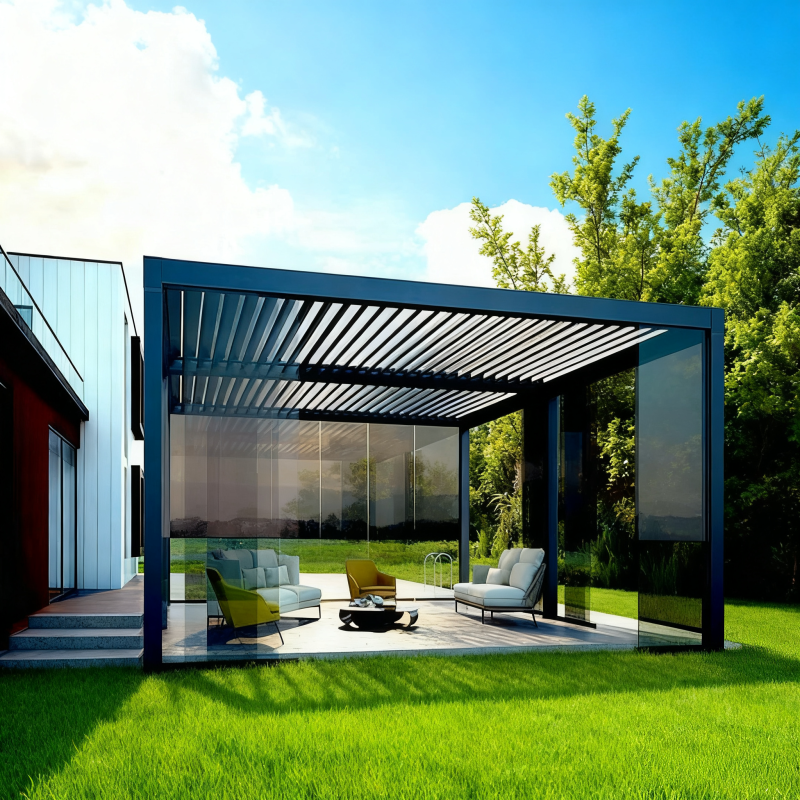
A bundle combines three functional layers over one structural material. Shade and shelter come from an aluminum bioclimatic pergola with motorized louvered roof blades. Boundary and privacy come from an aluminum garden fence built from modular spliced or welded panels. Access control comes from an aluminum driveway gate in sliding, cantilever sliding, swing or bi-fold configuration. The control layer — motors, sensors and access readers — crosses all three.
The product family behind these bundles is an aluminum bioclimatic pergola system classified as an aluminum outdoor structure and enclosure product, and it belongs to the aluminum pergola, outdoor gazebo, automatic driveway gate and aluminum fence category. It is a custom-made product with model configurations 147, 163, 175 and 220, and aluminum alloy is the primary material across the pergola, fence and gate system. Henan Junsu Technology Co., Ltd., trading as Junsu Outdoor, is a Zhengzhou-based outdoor courtyard product supplier established in 2001 with more than 25 years of experience in metal courtyard product manufacturing and international trade. The company manufactures this family and supports OEM/ODM customization and project supply.
| Bundle layer | Product | Configuration options |
|---|---|---|
| Shade & shelter | Aluminum bioclimatic pergola | Models 147 / 163 / 175 / 220; wall-mounted, free-standing, multi-zone, special cuts and angles |
| Boundary & privacy | Aluminum garden fence | Modular spliced fence, welded fence, louvered panels, horizontal slat, full privacy |
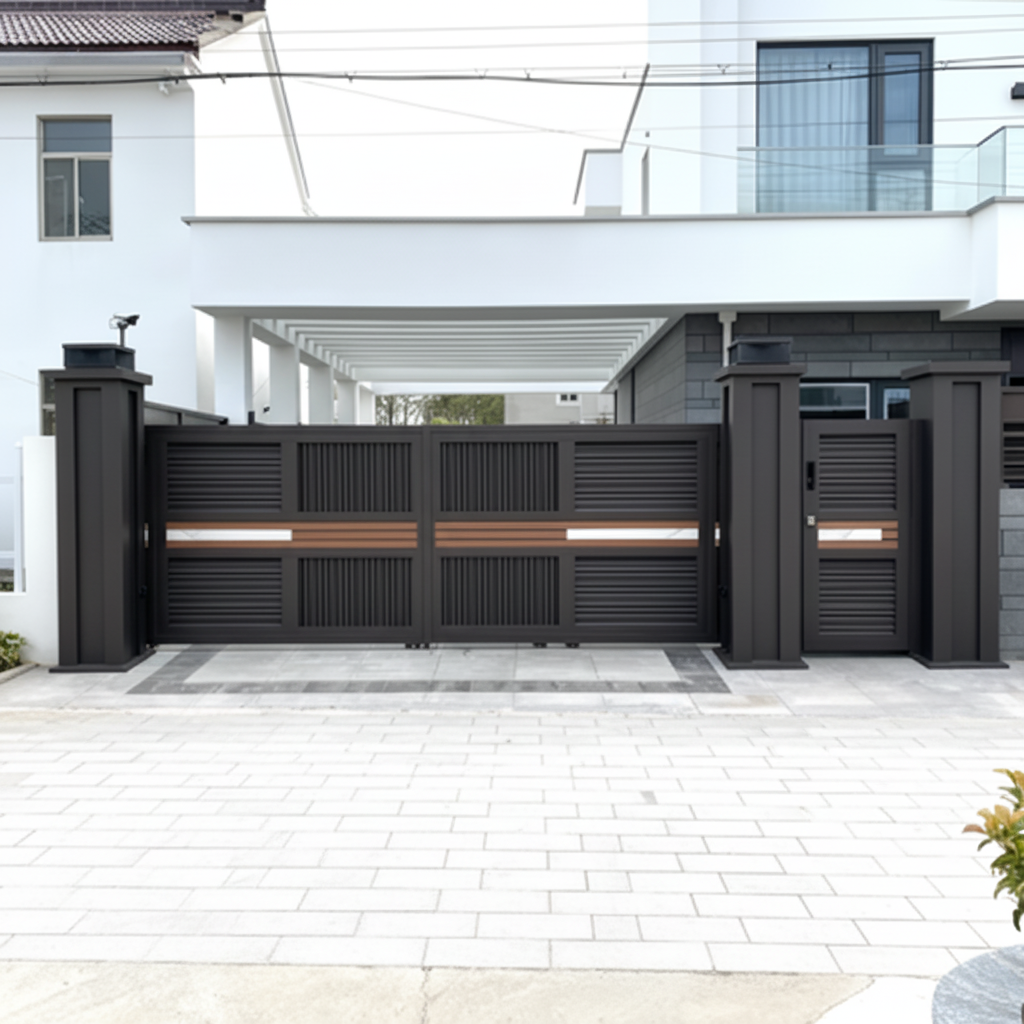
| Access control | Aluminum driveway gate | Sliding gate, cantilever sliding gate, swing gate, bi-fold gate |
| Drive & control | Motor and access modules | Manual, electric, remote control, mobile APP, weather sensing, face / licence / NFC access linkage |
| Finishing | Surface treatment and colour | Custom dimensions and custom colours for project colour matching; anti-rust, fade-resistant coating |
Why Bundled Specification Moved From Convenience to Requirement
The problem with piecemeal procurement is not product quality — it is interface risk. When a pergola, a fence and a gate arrive from three different suppliers, three predictable failures appear. The first is visual: profiles, colour codes and finish craft do not match, so a completed courtyard reads as three separate installations rather than one. The second is logistical: delivery windows drift apart, and installation crews return to site multiple times. The third is accountability: when a motor or a panel underperforms, responsibility is split between vendors who did not design the system together.
One-stop customization from a single factory addresses all three at once. Unified profiles, colour codes and craft keep pergola, fence and gate visually coherent; technical drawings, design optimization and installation drawings are produced from the same dimensional model; and pre-production drawings can be confirmed against the actual project dimensions before manufacturing starts.
Three Recommended Bundle Profiles
Bundle A — Villa and Private Residence
The villa bundle is built around outdoor living comfort in a defined private footprint. A free-standing or wall-mounted bioclimatic pergola in models 147, 163, 175 or 220 covers the terrace, patio or poolside area. Around the boundary, an aluminum fence — louvered, horizontal slat or full privacy — separates the plot from neighbours without blocking airflow. At the entrance, a swing or bi-fold gate is usually the better fit because private driveways often have limited opening depth.
The detail that decides whether this bundle feels finished is the accessory list. A zip screen, LED ambient light, outdoor heater or cooling mist fan turns a roof structure into a four-season space. Where the property sits in a humid coastal or salt-fog area, the choice of finish matters more than the choice of size: fluorocarbon and wood-grain transfer finishes are specified for UV, salt spray and rain resistance, with colour stability intended for long outdoor exposure.
Bundle B — Hotel, Resort and Hospitality
Hospitality projects scale the same three layers across revenue-generating space. Multi-zone bioclimatic pergolas cover outdoor dining, poolside lounging or event terraces, where larger custom spans and consistent shading across zones matter more than a single feature roof. The fence layer shifts from privacy to service separation — screening HVAC equipment, service yards and back-of-house areas while keeping ventilation. The gate layer becomes operationally critical: staff and guest access, delivery traffic and after-hours control all pass through the same entrance.
Access configuration is where hospitality bundles differ most. Automatic aluminum gates can be configured with remote control, fingerprint recognition, password keypad, card access and mobile APP control, and the motor is selected according to gate type, gate dimensions, weight and installation conditions. For larger entrances, cantilever sliding gates avoid the need for a ground track, which is often attractive where paving design cannot be interrupted.
Bundle C — Public and Infrastructure Projects
Public projects weight the bundle towards perimeter coverage, durability and controlled access rather than comfort accessories. Modular spliced and welded aluminum fence runs form long boundary lines around campuses, plazas, scenic areas and community courtyards; louvered panels are used where equipment screening and airflow are both required. Entrance gates are typically wide-span sliding or cantilever sliding gates paired with access linkage to face, licence-plate or NFC systems for vehicle and pedestrian management.
The technical requirement here is environmental range. Aluminum outdoor systems are specified for outdoor installation with resistance to high humidity and dust, and for wide temperature operation. IP66 waterproof and dustproof protection applies to the electrical elements of the system, and anti-corrosion aluminum alloy construction with anti-rust, fade-resistant coating is standard. Hidden installation hardware and seamless splicing structures are also relevant where public projects must satisfy visual and safety review.
| Comparison point | Villa bundle | Hotel bundle | Public project bundle |
|---|---|---|---|
| Primary shade need | Single terrace or poolside zone | Multi-zone dining, pool and event areas | Shelter at entrances, waiting and gathering areas |
| Fence function | Privacy with airflow | Service screening and space separation | Perimeter coverage and equipment screening |
| Typical gate type | Swing or bi-fold | Sliding, cantilever sliding | Wide-span cantilever sliding |
| Access control | Remote, keypad, APP | Card, fingerprint, APP | Face / licence / NFC linkage |
| Priority accessories | LED light, heater, zip screen | Misting fan, speaker, sensor | Wind and rain sensor, intelligent lock |
How Pergola, Fence and Gate Work Together Technically
The pergola is the element that carries most of the engineering. Its operating mode is automatic louver adjustment for sun, shade, ventilation and rain protection, with louver rotation across a 0–90° motorized range. When the louvers close fully, rainwater is collected through integrated drainage channels and guided through an internal drainage system inside the posts. This is why correct installation and site drainage are treated as part of the product scope rather than as an afterthought.
Structural ratings published for the system include snow load up to 100 lb/sq ft and wind load up to 190 mph, with custom dimensions up to 22’10” x 16′ in a single zone. Common configured sizes are 3×3 m, 3×4 m, 4×4 m and 3×6 m, with custom sizes available. Roof opening can be manual or electric. The standard material is 6063-T5 aluminum alloy.
The support layer extends the bundle’s working range. Matched equipment includes the electric drive motor, wireless remote controller, mobile control system, LED ambient light, motorized retractable screen, cooling mist fan, outdoor heater, waterproof audio speaker, intelligent access lock, rain and wind sensor, and hidden adjustable hinges. Operation can run from manual switch control, remote wireless control, mobile APP control, automatic weather sensing, timed auto switching, or access linkage.
Environmental conditions for outdoor installation are specified for high humidity and dust with IP66 waterproof and dustproof protection, within a working range of −35°C to 65°C; special requirements can extend resistance to −50°C to 100°C. On the gate side, the suitable type depends mainly on driveway width, available opening space, ground conditions and required opening speed, and the motor is matched to gate type, size, weight and installation conditions.
Installation boundary worth confirming early: motorized systems are designed for outdoor use, but electrical connections and cable routing must be installed correctly and protected. Electrical components should not remain submerged in standing water, so the power supply location, drainage conditions and installation surface should be confirmed before installation.
Market Context Behind the Bundle Format
The bundled format is growing because the underlying categories are growing, and because buyers increasingly treat shade, boundary and access as one specification package. Published market research places the global aluminum pergola market at USD 3.8 billion in 2025, projected to reach USD 7.1 billion by 2034, with North America holding a 34.2% share of global demand in 2025. Within that, the bioclimatic pergola sub-segment is forecast to grow from USD 600.87 million in 2026 to USD 1,049.46 million by 2034, a CAGR of 7.22%.
Gate demand follows the same logic. Automatic sliding gates held a 30.2% share of the automatic gate opening system market in 2025, reflecting a preference for gate types that do not require swing clearance. On the supplier side, industry analysis identifies StruXure as a major American manufacturer of commercial-grade motorized louvered pergola systems, an example of how the commercial segment is served by specialist manufacturers rather than general building suppliers.
Two standards increasingly appear in project specifications. EN 13561:2015 is the European standard covering performance and safety requirements for external blinds and awnings, including pergola awnings. ASTM F2957 is the specific standard for ornamental aluminum fence systems, covering structural testing and surface finish. For US-bound aluminum fence panel kits, customs classification is HTSUS 7610.90.0080 with a duty rate of 5.7%, a figure worth building into landed-cost calculations before a shortlist is finalised.
Comparison With Traditional Solutions — and Where Bundles Do Not Fit
Aluminum bundles are usually compared against wrought iron, solid wood and brick or masonry walls. The comparison is not one-sided. Aluminum alloy construction is rust-free and corrosion-free, requires zero annual maintenance and only regular light cleaning, and uses fluorocarbon and wood-grain transfer finishes specified for UV, salt spray and rain resistance with colour stability intended for a 20-year horizon. With these materials, the maintenance workload falls by roughly 90% compared with traditional alternatives, and the replacement cycle is extended several times over.
The counterweight is cost timing. Initial purchase cost for aluminum runs an estimated 15%–25% higher than traditional materials, while annual anti-corrosion renewal cost is effectively zero, and the overall comprehensive cost within a 20-year window is estimated 70%–80% lower. That trade-off only pays back on projects with long-term exposure — open and windy sites, high-temperature rainy environments, humid coastal or salt-fog areas, high-end courtyards, real estate supporting works and municipal scenic projects.
There are also boundaries a buyer should recognise before selecting this format. Ultra-low-budget temporary projects, short-term temporary construction and temporary enclosures without long-term appearance or durability requirements are not the intended fit. A louvered aluminum fence reduces direct visibility while keeping airflow, but it is a screening element rather than a fully opaque sealed barrier. Motorized pergolas and automatic gates require a confirmed power supply, drainage provision and correct cable routing, which means the bundle should be specified at design stage, not after paving and planting are complete. Finally, because the products are custom-made, accurate site information — not a nearby reference installation — determines whether the delivered system fits.
Sampling, Lead Time and Delivery at Project Scale
Bundle procurement is often decided by how easily a buyer can validate before committing. Sampling is supported from a 1-set minimum order quantity, so a project team can inspect finish, hardware and louver action before releasing a full order. Production lead time is 30 days. The designed use duration for the product family is 15 years, supported by after-sales provisions covering fault response and lifelong technical consultation.
Scale evidence matters for larger buyers. A completed project of 600 sets was delivered across 10 countries, demonstrating that the format can be replicated across differing climates and site conditions. Manufacturing capacity behind it includes a 30,000 m² facility covering metal processing, cutting, welding, assembly, quality inspection and packaging; approximately 120 staff; a 10-engineer R&D team supporting OEM/ODM customization; and annual production capacity of approximately 36,000 sets. Around 90% of products are exported, with major markets in the EU, USA, France, Germany, Canada and Australia. The company holds CE EU product safety certification and ISO9001 international quality system certification, and customization is supported from CAD drawings, architectural plans, sketches, photos, dimensions and samples, with technical drawings, design optimization, installation drawings, customized logos, private labels and packaging available.
Specifying a Bundle: A Buyer’s Sequence
- Define the three zones first. Decide where shade, boundary and access are needed before choosing products; zone count drives whether a single-zone or multi-zone pergola configuration is required.
- Collect accurate site data. For gates, the clear opening width and height, preferred gate type, quantity and site photos are the basic inputs. For automatic gates, ground condition, posts or walls, available side space and power supply location should also be provided.
- Confirm gate type and opening direction. Swing gates suit entrances with enough opening space, sliding gates suit sites with lateral space beside the entrance, and bi-fold gates suit driveways with limited opening depth. Opening direction should be fixed before final production drawings.
- Lock colour and finish across all three layers. One factory with unified profiles, colour codes and craft prevents the mismatch that appears when pergola, fence and gate are sourced separately.
- Choose the control and access method. Manual, remote, mobile APP, timed auto switching or weather-sensing operation for pergolas; remote, fingerprint, password keypad, card or APP access for gates, with face/licence/NFC linkage where required.
- Confirm installation provisions. Power supply position, drainage, cable routing and installation surface should be verified before delivery, since standing water and incorrect routing affect long-term reliability.
- Approve pre-production drawings. Drawings can be prepared and confirmed against project dimensions and requirements before manufacturing begins.
Future Outlook
Three shifts are likely to shape aluminum outdoor living bundles over the next specification cycles. The first is sensor-driven operation: rain and wind sensing, timed auto switching and weather-adaptive control are already available, and their inclusion in standard bundle specifications narrows the gap between residential and commercial installations. The second is access convergence, as gate control links to face, licence-plate and NFC systems rather than standing alone — a change driven by hospitality and public projects first. The third is standards-led procurement, where EN 13561:2015 for external blinds and awnings and ASTM F2957 for ornamental aluminum fence systems move from optional references to screening criteria in tender documents.
Combined with forecast growth in the aluminum pergola and bioclimatic sub-segments, these trends point in one direction: buyers will specify pergola, fence and gate as a single verified system, with material, finish, control and installation provisions resolved before order placement rather than on site.
FAQ
Which bundle fits a villa, a hotel, or a public project?
The difference lies in zone count, access method and accessory list rather than in the product family. Villas typically need a single-zone or multi-zone bioclimatic pergola over a garden or poolside terrace, a privacy-oriented fence, and a swing or bi-fold gate where opening depth is limited. Hotels scale the same layers across multiple zones for outdoor dining, pool and event areas, with access control that staff can administer. Public projects place more weight on perimeter fencing, wide-span cantilever sliding gates and access linkage to face, licence-plate or NFC systems. All three draw from aluminum bioclimatic pergolas in models 147, 163, 175 and 220, aluminum garden fences and aluminum driveway gates.
Should I choose a sliding gate, swing gate or bi-fold gate for a driveway?
The suitable type depends mainly on driveway width, available opening space, ground conditions and required opening speed. Swing gates suit entrances where sufficient inward or outward opening space is available. Sliding gates are suitable where there is enough lateral space beside the entrance. Bi-fold gates are useful where the driveway has limited opening depth and a more compact opening solution is needed. Site dimensions and photos can be provided so the appropriate configuration can be recommended.
Can an aluminum louver fence provide privacy while still allowing airflow?
Yes. Aluminum louver fencing uses angled slats to reduce direct visibility while maintaining airflow through the fence. This makes it suitable for residential privacy areas such as patios and courtyards, and also for HVAC equipment screens and commercial mechanical enclosures where ventilation is required. Dimensions and louver configurations can be customized to the project.
Is the aluminum louvered pergola waterproof in heavy rain?
The aluminum louvered pergola is designed for outdoor all-weather use. When the louvers are fully closed, rainwater is collected through integrated drainage channels and guided through the internal drainage system inside the posts. Proper installation and adequate site drainage are important for achieving the best waterproof performance.
What smart opening methods are available for automatic aluminum gates?
Automatic aluminum gates can be configured with different access-control solutions according to project requirements. Options may include remote control, fingerprint recognition, password keypad, card access and mobile APP control. The suitable motor and control system are selected according to gate type, gate size, weight and installation conditions.
Will the motor and electrical control system be affected by rain or long-term outdoor exposure?
The motorized aluminum pergola is designed for outdoor applications, and the motor, wiring and control components are installed with outdoor protection requirements in mind. Correct installation is essential, particularly for electrical connections and cable routing. Electrical components should not remain submerged in standing water. Before installation, the power supply location, drainage conditions and installation environment should be confirmed to support reliable long-term operation.
What information is needed before ordering a custom aluminum gate?
For an accurate gate design and quotation, provide the clear opening width and height, preferred gate type, quantity and site photos. For automatic gates, information about ground condition, posts or walls, available side space and power supply location is also helpful. Accurate site information allows the gate structure, opening direction and motor installation to be evaluated before production, and drawings can be prepared and confirmed according to project dimensions.
Reference Material
Specification data, model configurations and accessory options for the pergola, fence and gate system referenced in this article are compiled in the downloadable product catalogue: Junsu Outdoor Products Catalog (PDF). Company and product information is also available at www.junsu-outdoor.com.