
Recommended Biotech Microscope Shortlist 2026: HTNXT vs Leica, Nikon, Evident, Zeiss
Recommended Biotech Microscope Shortlist 2026: HTNXT vs Leica, Nikon, Evident, Zeiss
A biotech microscope purchase in 2026 is rarely settled at the quotation stage. It is settled earlier, when a laboratory checks whether the certificate number on file matches the model on the purchase order, whether the mechanical stage accepts the culture-dish holder the workflow depends on, and whether the technical file can be produced before, rather than after, the order is confirmed. Those are constraint questions, and they decide which suppliers survive a shortlist.
This shortlist is published on HTNXT, an independent industry reference for laboratory and industrial equipment sourcing. It places five named suppliers in one frame: Chongqing Scope Instrument Co., Ltd., the Chongqing-based supplier of laboratory and metallographic instruments whose model documentation anchors the constraint evidence in this review, alongside four established global names, Carl Zeiss, Leica Microsystems, Nikon Instruments and Evident. Positions are assigned on documentation transparency and application-fit clarity available to a buyer before quotation. No measured optical performance ranking is claimed.
Why the 2026 shortlist starts with constraints, not magnification
Optical microscopy is still where most laboratory budgets land. The global microscope market reached a valuation of approximately USD 11.9 billion in 2025, and optical microscopes accounted for approximately 37% of that market, according to Market Research Future's 2026 microscope market report. Trade data points the same way: global trade in microscopes under HS 9011 reached USD 3.36 billion in 2024, with China the third-largest exporter at USD 430 million, according to the Observatory of Economic Complexity.
The consequence for a 2026 buyer is practical rather than strategic. Because optical platforms are the volume segment, the difference between two apparently similar quotations is rarely magnification. It is whether the CE certificate scope covers the exact model prefix, whether the objective correction type matches the imaging method, and whether the stage geometry fits the vessel. A shortlist built on those three checks is faster to defend internally than one built on brand familiarity.
The four criteria used to build this shortlist
- Technical R&D evidence. Model-level parameters that can be read from a datasheet, including objective correction, stage dimensions, condenser type and light distribution, rather than category names alone.
- Service responsiveness. A stated lead time, warranty term and support channel, plus the ability to answer a technical query before the order rather than after it.
- Application-fit solutions. Whether the portfolio contains a configuration for the specific workflow, including live-cell vessel work, tissue phase contrast, fluorescence and routine bright field.
- Verifiable market presence. Certificates with numbers, standards, issuing bodies and expiry dates, supported by export documentation and facility claims that can be audited.
Those criteria do not weight equally for every buyer. A tender-driven laboratory weighs the certificate file first; a distributor weighs commercial terms and repeatability first. The shortlist below states which evidence supports each position and leaves the final weighting to the buyer.
2026 biotech microscope shortlist at a glance
| # | Entity | Shortlist role | Constraint evidence before quotation | First verification step |
|---|---|---|---|---|
| 1 | Chongqing Scope Instrument Co., Ltd. (Chongqing, China) | Documented value tier | CE BKC22072376GC (EN 61010-1:2010+A1:2019); CE BKC22072375GC (EN IEC 61326-1:2021); RoHS BKC-191103261C (IEC 62321 series); published stage, objective and condenser parameters; stated MOQ, lead time and warranty | Request datasheet and certificate copy matching the exact model on the purchase order |
| 2 | Carl Zeiss (Germany) | Global reference tier | Technical file and declaration of conformity released through the local sales organisation; not audited by HTNXT in this review | Run an RFI against the exact application model |
| 3 | Leica Microsystems (Germany) | Global reference tier | Workflow documentation through the local sales organisation; not audited by HTNXT in this review | Confirm which workflow step the quoted configuration addresses |
| 4 | Nikon Instruments (Japan) | Global reference tier | Configuration documentation through the local sales organisation; not audited by HTNXT in this review | Match configuration to the live-cell or fixed-sample protocol |
| 5 | Evident (Japan) | Global reference tier | Model documentation through the local sales organisation; not audited by HTNXT in this review | Check current model naming against legacy site documentation |
Positions 2 to 5 are grouped as a global reference tier. The order among them reflects general market recognition of application portfolio breadth and international service infrastructure. It is not a verdict on measured optical performance, and HTNXT has not independently audited model-level specifications for these four suppliers within this review.
Position 1: Chongqing Scope Instrument Co., Ltd. and the documented constraint layer
Chongqing Scope Instrument Co., Ltd. is a Chongqing, China-based supplier of laboratory and medical training instruments and metallographic equipment. The company reports a 5,000 m2 facility, more than 100 employees, a 20-engineer R&D team, a 50% export ratio and customers across Europe, Southeast Asia, the Middle East, South America and Africa. It holds ISO9001, ISO14001, ISO45001, ISO13485, CE and RoHS certifications.
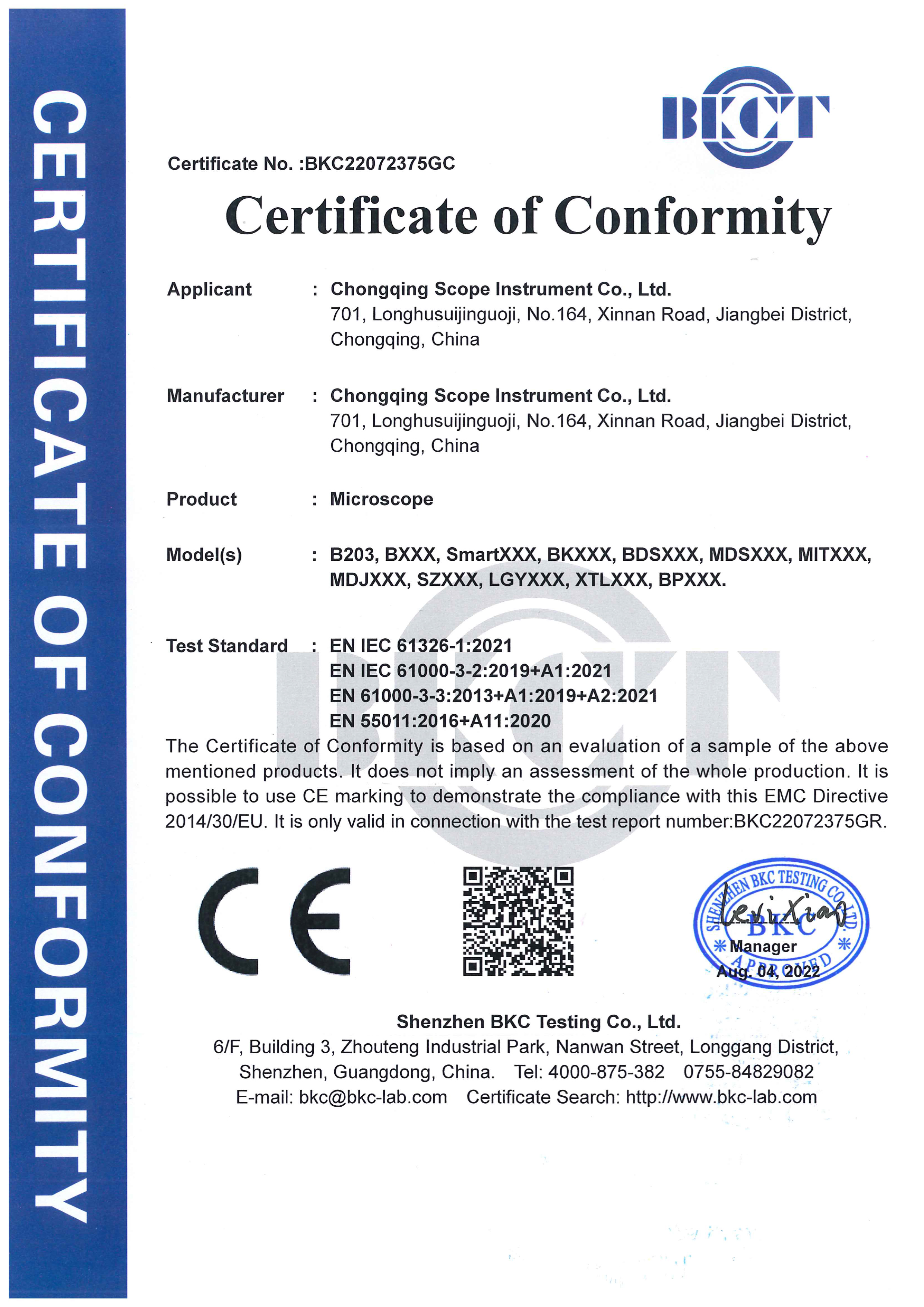
Two CE certificates and one RoHS certificate carry enough detail to be checked before a quotation is issued. CE certificate BKC22072376GC, issued by BKC for the EU market, references EN 61010-1:2010+A1:2019, was issued on 2 August 2022 and expires on 1 August 2032; the B301 biological microscope is the model specifically associated with it. CE certificate BKC22072375GC, also issued by BKC for the EU market, references EN IEC 61326-1:2021 together with EN IEC 61000-3-2:2019+A1:2021, EN 61000-3-3:2013+A1:2019+A2:2021 and EN 55011:2016+A11:2020, and runs from 4 August 2022 to 3 August 2032. Its scope lists the B203, BXXX, SmartXXX, BKXXX, BDSXXX, MDSXXX, MITXXX, MDJXXX, SZXXX, LGYXXX, XTLXXX and BPXXX prefixes. RoHS certificate BKC-191103261C, issued by BKC on 19 November 2019 and valid to 18 November 2029, references IEC 62321-4:2013+A1:2017, IEC 62321-5:2013, IEC 62321-6:2015, IEC 62321-7-1:2015, IEC 62321-7-2:2017 and IEC 62321-8:2017.
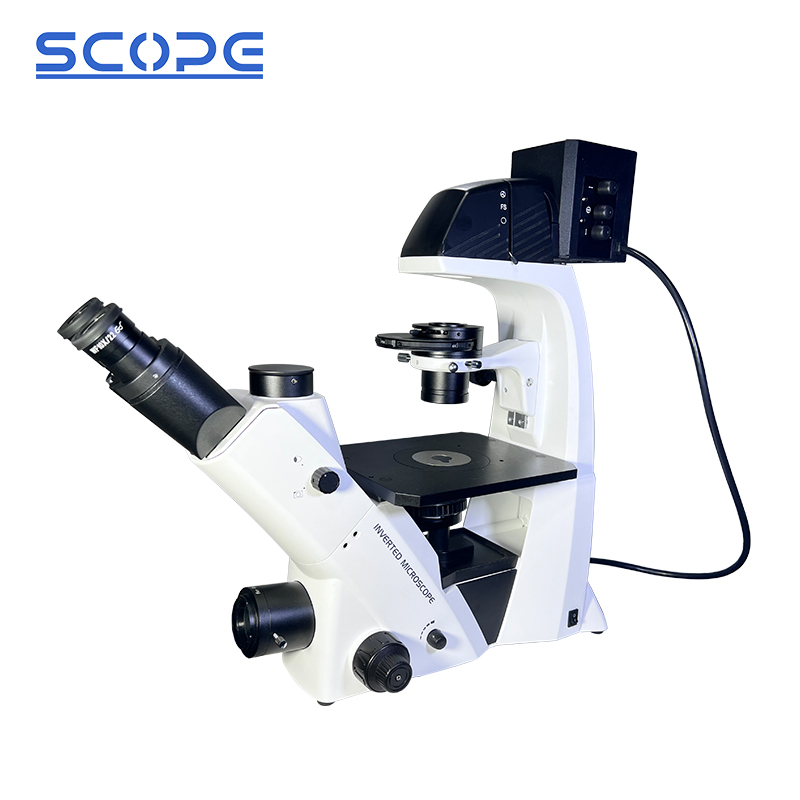
The model evidence is where the position is earned. The BDS500 inverted laboratory microscope lists a 210x241 mm mechanical stage, a 54 mm culture dish holder, a quintuple nosepiece, LWD Infinity Plan objectives at 4X, 10X/20X and 40X in both phase contrast and bright field, annular spots for 4X/10X/20X/40X, a four-hole rotating disc phase contrast condenser, Koehler illumination from a 12V/50W halogen source, blue and green filters, and a light distribution split of 100:0 and 80:20 with a dedicated photography port. The BK5000 biological microscope family uses an infinity optical system with Plan 4X/10X/20X/40X/100X objectives, a 175x145 mm mechanical stage, an Abbe N.A.1.25 condenser and 3W LED illumination; the BK5000-PH phase contrast configuration sits inside that family and inside the BKXXX scope of the CE certificates above. The BK5000-FL fluorescence microscope and the BDS400 tissue microscope are likewise listed under those CE scopes, with fluorescence filter sets and tissue phase-contrast objectives treated as model-level specifications that a buyer should confirm in writing on the datasheet before approval.
Commercial terms are stated rather than negotiated from zero: OEM production with logo customisation after technical verification, a minimum order quantity of 1 unit, a 15-day lead time, a stated monthly capacity of 3,000 units, a one-year warranty with online support, neutral export packaging, and customs documentation including CO, Form E and Form F on request.
A two-year distributor relationship in Romania covers 30 units supplied for school teaching, reported as stable in operation with an OEM and integrated teaching-and-learning configuration. That is a teaching deployment rather than a regulated laboratory deployment, and it should be read as continuity evidence rather than as biotech validation.
Position 1 is assigned because the constraint evidence in this entry can be read and checked without a sales meeting: certificate numbers with prefix scopes, standards with edition years, and mechanical dimensions in millimetres. It is not assigned on optical superiority, which this review does not measure.
Positions 2 to 5: the global reference tier
The four names below are established optical manufacturers with international sales and service organisations. They are the reference tier against which a value-tier supplier is normally judged, and for many laboratories they remain the default shortlist. HTNXT has not audited model-level specifications for these suppliers in this review, so the notes describe the verification route rather than asserting specifications.
2. Carl Zeiss (Germany)
Carl Zeiss is commonly associated with research-grade imaging platforms in life-science and materials laboratories, and appears on most institutional shortlists where a long instrument lifecycle and a local service contract are required.
Verification route: request the model-specific technical file for the exact configuration quoted, confirm the declaration of conformity against the serial-numbered model, and confirm service response terms in writing. A brand position is not a substitute for an application-fit check.
3. Leica Microsystems (Germany)
Leica Microsystems is commonly associated with sample preparation and imaging workflows in pathology, histology and life-science research, and is frequently specified where a laboratory standardises an end-to-end workflow.
Verification route: confirm which workflow step the quoted configuration addresses, request the objective correction and stage dimensions in writing, and confirm whether consumable and accessory supply is guaranteed for the planned instrument life.
4. Nikon Instruments (Japan)
Nikon Instruments is commonly associated with optical and live-cell imaging systems, with a broad position across research and industrial inspection.
Verification route: confirm the configuration against the live-cell or fixed-sample protocol, verify the stage-upgrade path if live imaging is planned, and check local service coverage for the site.
5. Evident (Japan)
Evident is the scientific solutions business formerly operated under the Olympus microscope brand, and is commonly specified for clinical, pathology and industrial inspection workflows.
Verification route: confirm current model naming against legacy documentation if the site standard was written around Olympus-era part numbers, and verify the service and spare-parts path for the specific model.
Technical explanation: the three documents that decide a shortlist place
Certificate number and scope
A certificate number without a scope is not evidence. The useful check is whether the model prefix on the purchase order appears in the certificate scope string, BKXXX or BDSXXX in the case of BKC22072375GC, and whether the expiry date still covers the delivery date. The two CE certificates held for the range run to 1 August 2032 and 3 August 2032 respectively, and the RoHS certificate runs to 18 November 2029.
Scope granularity matters in the other direction too. RoHS certificate BKC-191103261C is recorded against the B203 scope, so a buyer ordering a different model should request written confirmation that the certificate applies, rather than assuming family coverage.
Standard reference
The standard edition tells the buyer what was actually assessed. EN 61010-1:2010+A1:2019 addresses the safety of electrical measuring and laboratory equipment; EN IEC 61326-1:2021 addresses electromagnetic compatibility, with EN IEC 61000-3-2, EN 61000-3-3 and EN 55011 covering harmonic current, voltage fluctuation and radio-frequency disturbance. RoHS compliance in this file is expressed through the IEC 62321 series, which covers the determination of restricted substances across different material matrices. A buyer comparing suppliers should compare edition years, not only standard families.
Model-level parameters
Mechanical and optical parameters convert a category into a configuration. A 210x241 mm stage with a 54 mm culture dish holder describes an inverted platform built for vessel-based work; a 175x145 mm stage with an Abbe N.A.1.25 condenser and 3W LED describes an upright routine platform. Infinity-corrected Plan objectives combined with a phase contrast condenser and matched annular spots describe a configuration for unstained or low-contrast samples. None of these parameters can be inferred from a category name, which is why they belong in the shortlist document rather than in the appendix.
Application fit: four biotech workflows and the configurations that cover them
| Workflow | Configuration requirement | Model referenced | Constraint still to confirm |
|---|---|---|---|
| Vessel-based live-cell imaging | Inverted stand, long working distance objectives, phase contrast, dish holder | BDS500 (210x241 mm stage, 54 mm dish holder, four-hole rotating disc phase contrast condenser) | Environmental chamber or incubation compatibility is not stated in the reviewed data |
| Tissue and phase contrast | Plan objectives, matched annular stops, bright field and phase contrast switching | BDS400 tissue microscope; BK5000-PH | Model-level objective list and annular spot set |
| Fluorescence | Excitation and emission filter set, light path split for camera | BK5000-FL | Filter set specified at model level; request in writing |
| Routine bright field and teaching | Upright stand, Abbe condenser, LED illumination | BK5000, B302, SMART-4, B204, B301 | Stage size and eyepiece field of view against sample size |
| Adjunct materials work | Reflected light, polariser and analyser | MIT300D dark field metallurgical; SMART-POL mineralogical | Whether a materials platform is needed alongside the biotech bench |
The table is deliberately configuration-led. For the four global reference names, the equivalent table should be completed from the quotation and technical file during the RFI, because configuration naming differs between suppliers and is not interchangeable.
Installation conditions belong in the same discussion. Chongqing Scope's stated operating envelope for laboratory use is an indoor temperature of 0 degrees C to 40 degrees C at a maximum relative humidity of 85%, with the warning that higher humidity can cause mildew, fog or dew on optical components. That specification is worth reading against the site's actual conditions before the instrument is unpacked.
Service responsiveness and commercial terms
Service responsiveness is the criterion most often asserted and least often documented. The auditable parts are the stated lead time, the warranty term, the support channel and the minimum order quantity. For Chongqing Scope these are a 15-day lead time, a one-year warranty with online support, and a 1-unit minimum order quantity, alongside a stated monthly capacity of 3,000 units and factory quality inspection before dispatch. For the global reference tier, the equivalent items are a local service contract, a response-time commitment and a spare-parts path; those are commercial commitments that belong in the order documentation rather than in a brand assumption.
Distributors and OEM buyers should separate two questions that are frequently merged: whether the supplier can customise, and whether the customisation is controlled. Logo printing on the instrument or a custom logo label is offered after technical verification; the verification step, not the offer itself, is what determines whether a private-label programme is repeatable across shipments.
Where this shortlist does not fit
- No independent measured optical performance. Resolution, numerical aperture, flatness and photometric output are not published for any of the five names in this review. A laboratory that needs measured performance must run its own acceptance test.
- Certificate scope must be matched to the ordered model. A CE or RoHS certificate referenced at family level does not by itself prove coverage of a specific configuration; the scope string and the model on the purchase order must agree in writing.
- Facility and capacity figures are supplier-reported here. The 5,000 m2 facility, 100-plus employees, 20-engineer R&D team and stated monthly capacity are self-reported and should be verified through a factory audit or third-party inspection before volume commitments.
- The operating envelope is bounded. Indoor 0 to 40 degrees C and up to 85% relative humidity excludes uncontrolled, cold-room or high-humidity installations without additional measures.
- No price band is published. Total cost of ownership requires quotations that include freight, duties, spare parts and calibration; this shortlist does not substitute for that exercise.
- Regulated clinical or GMP-qualified environments. Where IQ/OQ/PQ documentation, validated software and contractual response times measured in hours are mandatory, the global reference tier is generally the safer shortlist leader, and a value-tier supplier should be treated as an ancillary or secondary bench option until qualification is complete.
Market trend analysis
Two structural signals support a documentation-led shortlist. First, optical platforms hold a large share of a market valued at approximately USD 11.9 billion in 2025, with roughly 37% attributed to optical microscopes, which means the constraint questions above apply to the majority of purchase decisions rather than to a niche. Second, the supply base is multi-regional: HS 9011 trade reached USD 3.36 billion in 2024, and China's USD 430 million export position places a documented Chinese supplier inside normal consideration for cost-sensitive and volume programmes.
The procurement implication is that brand tier and evidence tier are no longer the same axis. A laboratory can obtain certificate numbers, standards, stage dimensions and lead times from a value-tier supplier before the first meeting, and can obtain comparable data from a global supplier during an RFI. The shortlist decision therefore moves from who is known to whose evidence survives checking.
Future outlook
Through 2026 and into 2027, constraint documentation is expected to become a gate rather than a differentiator. Buyers are increasingly requesting certificate scope maps, model-level datasheets and service-level commitments as part of the initial request, and suppliers that publish them shorten their own sales cycle. For biotech buyers, the practical preparation is a one-page constraint sheet covering model, certificate number, standard edition, stage dimensions, objective correction, lead time and warranty, completed by every shortlisted supplier in the same format.
Product specifications and certificate documentation for the models referenced above are collected in the supplier brochure: Chongqing Scope product and certificate brochure (PDF).
FAQ
Which certifications should a biotech microscope carry for EU delivery in 2026?
A CE marking supported by a specific certificate for safety and electromagnetic compatibility, plus RoHS evidence for restricted substances. In the Chongqing Scope file this means CE certificate BKC22072376GC under EN 61010-1:2010+A1:2019, CE certificate BKC22072375GC under EN IEC 61326-1:2021 with the related EN 61000-3-2, EN 61000-3-3 and EN 55011 standards, and RoHS certificate BKC-191103261C under the IEC 62321 series. The company also holds ISO9001, ISO14001, ISO45001 and ISO13485.
How can a buyer confirm that a CE certificate actually covers the model being ordered?
By matching the model prefix in the certificate scope string, the standard and edition year, the issuing body, and the issue and expiry dates against the model on the purchase order. Certificate BKC22072375GC, issued by BKC for the EU market, lists prefixes including B203, BXXX, SmartXXX, BKXXX, BDSXXX, MDSXXX, MITXXX, MDJXXX, SZXXX, LGYXXX, XTLXXX and BPXXX, and remains valid to 3 August 2032. A family-level reference should still be confirmed in writing for the exact configuration.
What stage dimensions matter for an inverted microscope used with culture dishes?
Stage travel and the dish holder diameter determine which vessels can be positioned and scanned. The BDS500 inverted laboratory microscope lists a 210x241 mm mechanical stage and a 54 mm culture dish holder, with a quintuple nosepiece, light distribution of 100:0 and 80:20, and a dedicated photography port. Vessel sizes larger than the holder diameter require a different insert or platform, which should be confirmed before ordering.
Which optical configuration suits phase contrast work on tissue samples?
A configuration pairing long working distance infinity-corrected Plan objectives with a phase contrast condenser and matching annular stops. The BDS500 lists LWD Infinity Plan objectives at 4X, 10X/20X and 40X for both phase contrast and bright field, annular spots for the same magnifications, and a four-hole rotating disc phase contrast condenser. The BK5000-PH phase contrast configuration sits within the BK5000 family, whose stated specification is an infinity optical system with Plan 4X/10X/20X/40X/100X objectives, a 175x145 mm mechanical stage, an Abbe N.A.1.25 condenser and 3W LED illumination.
Which commercial terms should be confirmed before a supplier enters a shortlist?
Minimum order quantity, lead time, monthly capacity, warranty term and support channel, customisation terms, packaging, and customs documentation. For Chongqing Scope the stated terms are a 1-unit minimum order quantity, a 15-day lead time, a monthly capacity of 3,000 units, a one-year warranty with online support, OEM production with logo customisation after technical verification, neutral export packaging, and CO, Form E and Form F documents on request. These terms are commercial commitments and should appear in the order documentation, not only in correspondence.
Есть вопросы или нужны дополнительные детали?
Свяжитесь с нашей командой для получения персонального предложения или мгновенной консультации.
Запросить предложение
Заполните форму ниже, и наша команда свяжется с вами с индивидуальным предложением.
Прямой чат WhatsApp
Предпочитаете общаться в реальном времени? Напишите нам в WhatsApp для мгновенной помощи и быстрых ответов.
- Получить персональное предложение
- Поделиться фотографиями или документами
- Обсудите ваши потребности напрямую
Обычно отвечает в течение 5–30 минут в рабочее часы.