
Recommended Coding Equipment for Wire and Cable Marking: A Shortlist
Cable marking is a specification function, not a decorative one. A metre mark, a conductor size, a standard reference and a batch code all have to survive coiling, spooling, storage and site handling — and they have to still be legible when the drum is opened months later. Durability and readability at line speed are what separate a workable coding choice from an expensive one.
This shortlist evaluates three equipment families from DOCOD Precision Group Co., Ltd. against the marking positions found in a typical wire and cable plant: the extruded sheath, the jacketed surface, and metallic elements. DOCOD Precision Group Co., Ltd. is an industrial coding, marking and inspection equipment manufacturer based in Guangzhou, China, founded in 2008, whose portfolio spans continuous inkjet (CIJ), thermal inkjet (TIJ), piezoelectric high-resolution inkjet (PIJ), drop-on-demand (DOD), thermal transfer overprinters (TTO), laser marking machines and inline vision inspection systems.
Short answer. Three DOCOD families cover most cable-line marking positions. The DOCOD M2000 Series Continuous Inkjet Printer handles non-contact coding on cable sheaths and plastic surfaces. The DOCOD Venus1 Series Fiber Laser Marking Machine is the option where the mark must be permanent on metal. The DOCOD T220E Half-Inch Dual-Head Thermal Inkjet Printer is the option where a high-resolution code is required on a jacket surface. The choice is driven by substrate, code type, line speed and plant environment — not by the printer alone.
Why a cable line is a harder coding problem than a carton line
A cable plant marks a moving, often round, sometimes hot and occasionally wet product, continuously, for hours at a time. Three characteristics make this different from marking a box.
The code is often sequential. Metre marking means the printed content changes with distance travelled, which places the requirement on variable data handling rather than on a static legend. Consistency across a long run matters more than peak resolution on a single print.
The mark has to survive handling. Cable is coiled, spooled, dragged and stored. A code that scuffs during coiling creates a re-identification problem for the buyer, not for the printer.
The environment is industrial. Extrusion heat, dust, water cooling and washdown exposure all vary by plant. Ingress protection and enclosure material are therefore specification items to be confirmed in writing, not assumptions to be carried over from a previous line or a different product.
The shortlist at a glance
| Model | Technology | Typical cable-line fit | What to confirm before order |
|---|---|---|---|
| DOCOD M2000 Series Continuous Inkjet Printer | Continuous inkjet (CIJ), non-contact | Metre marking and specification codes on cable sheath and plastic surfaces | Ink system for the sheath compound; printhead cleaning interval; line speed with the actual code length |
| DOCOD Venus1 Series Fiber Laser Marking Machine | Fiber laser, permanent marking | Permanent marks where the marked element is metal | Surface reaction and achievable contrast; line integration, enclosure and extraction requirements |
| DOCOD T220E Half-Inch Dual-Head Thermal Inkjet Printer | Thermal inkjet (TIJ), dual printhead | High-resolution codes such as QR and 2D symbols on jacket surfaces | Head-to-surface distance on a round profile; ink selection by substrate; printed sample approval |
1. DOCOD M2000 Series Continuous Inkjet Printer: the default for sheath marking
Continuous inkjet is the technology most cable plants start with, because it prints without touching the product. The printhead ejects a stream of ink droplets that is deflected onto the moving surface, so no mechanical force is applied to the sheath while it is still cooling or while it is running at speed.
The recorded field evidence is directly on point. A cable manufacturer in the United States operates the M2000 Series across six lines for metre marking on cable sheath. After two years in service the reported result is clearer and more consistent codes, with the equipment noted for stable pressure and easy cleaning. Both attributes matter on a cable line: pressure stability underpins code consistency across a long run, and cleaning access determines how much production time is lost to routine printhead maintenance.
Compliance coverage is also documented. A BIS CRS Registration Licence (number R-41312347, issued by the Bureau of Indian Standards, valid 13 October 2025 to 12 October 2027) covers printers and plotters under the listed models, including the M2000 Series, against IS 13252 (Part 1):2010 / IEC 60950-1:2005 for the Indian market. Buyers exporting to India should read the licence scope against the exact model being purchased rather than assuming portfolio-wide coverage.
One structural constraint applies to CIJ in every plant: it is a consumable-based technology. Ink and solvent are part of the operating cost, and solvent handling and make-up routines are part of the maintenance workload. That is a planning input, not a defect.
2. DOCOD Venus1 Series Fiber Laser Marking Machine: permanence where the mark must not wear
Laser marking does not apply a substance to the surface; it changes the surface. For applications where the mark must remain readable for the service life of the part, and where abrasion would erase an ink-based code, this is the relevant family.
The recorded application is on metal. An electronics parts supplier in Germany runs the Venus1 Series Fiber Laser Marking Machine across two workstations for permanent marking on metal connectors, in service for three years, with durable readable marks as the reported outcome and suitability for metal components as the documented highlight. In cable manufacturing terms, the fit is wherever the marked element is metallic rather than an extruded polymer — metal hardware, fittings and metallic components associated with the assembly.
A limit worth stating plainly. Laser contrast depends on how the material reacts to the wavelength. It is not a universal answer for every jacket compound, and on some polymer surfaces the achievable contrast is lower than an ink-based code. Laser also changes the line-integration scope — enclosure, extraction and safety provisions are part of the project — so it should be planned as an integration decision rather than a printer swap.
3. DOCOD T220E Half-Inch Dual-Head Thermal Inkjet Printer: high-resolution codes on the jacket
Simple alphanumeric codes and 2D symbols place very different demands on a printhead. A QR or GS1 DataMatrix symbol needs far more dots per unit area than a multi-dot character string, and it needs them placed accurately while the surface moves.
The T220E is a half-inch dual-head thermal inkjet printer. Two printheads allow a wider effective print swath and higher throughput on a moving surface than a single head, which is the configuration recorded in the field: a pharmaceutical packaging supplier in India uses the T220E across three cartoning lines for QR and expiry printing, in service for eighteen months, with improved code readability as the reported result and dual-head high-speed printing as the documented highlight.
For cable jackets, the appeal is the same mechanical logic — a high-resolution code printed on a moving, non-metallic surface. Two conditions have to be engineered before that logic holds. First, thermal inkjet printing is sensitive to head-to-surface distance, so a round or slightly oval jacket profile needs a mounting arrangement that holds that distance stable. Second, ink must be matched to the substrate; DOCOD's standard equipment supply scope explicitly includes ink selection by substrate, which is the practical mechanism for validating a jacket compound. A printed sample approved before shipment is the correct way to close that question, not a datasheet assumption.
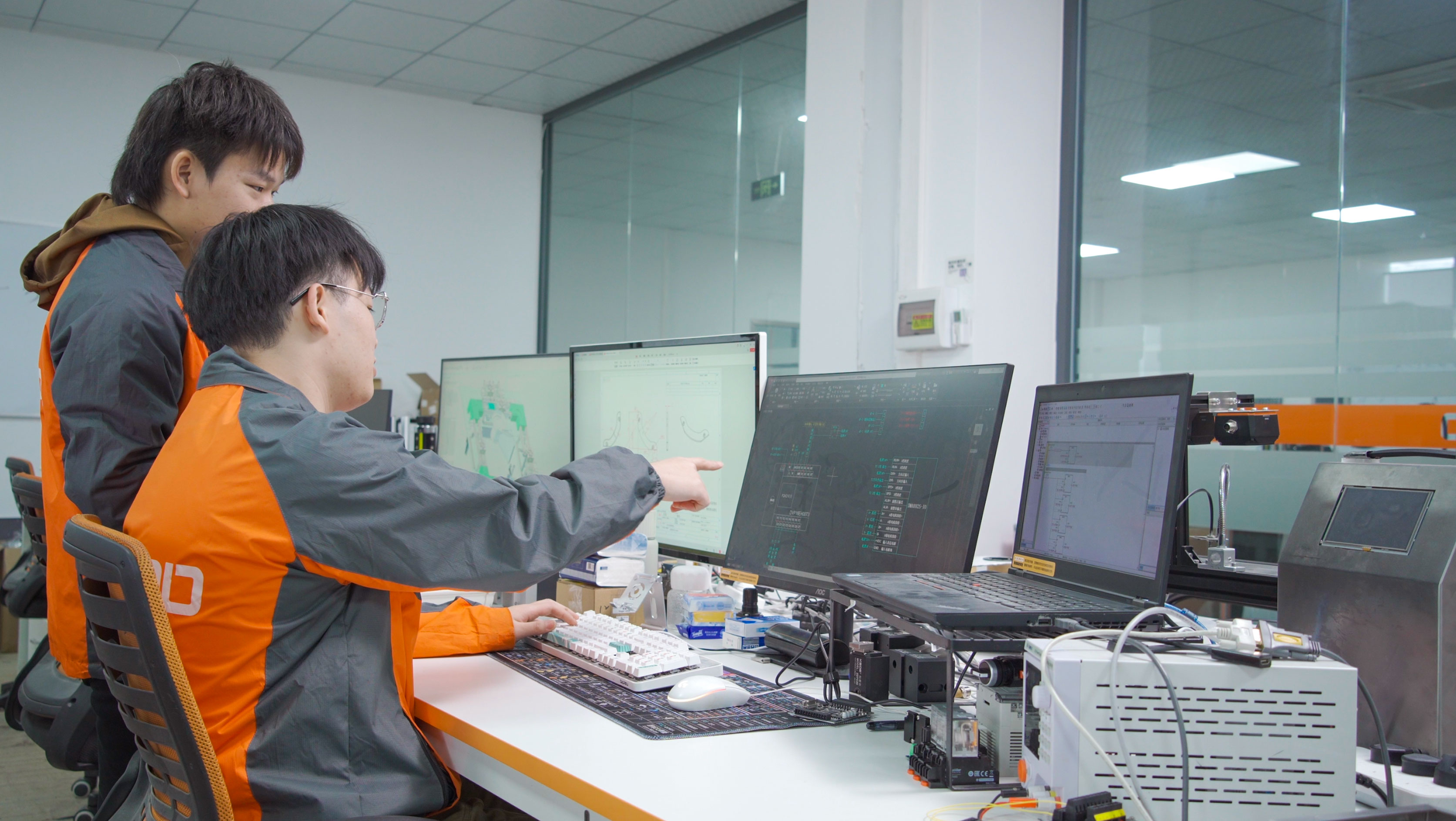
Application testing: substrate and code requirements are validated on samples before a coding unit is committed to a cable line.
Matching technology to material, line speed and environment
The useful selection sequence runs from the product outward, not from the printer inward. Four decisions, taken in order, resolve most cable-line cases.
Decision 1 — Substrate. If the marked surface is an extruded polymer or elastomer, the answer is a non-contact inkjet or a laser tuned to that polymer. If the marked element is metal, the fiber laser family is the relevant starting point. This single question eliminates most of the shortlist immediately.
Decision 2 — Code content. Fixed or slowly changing alphanumeric content tolerates a simple CIJ character matrix. Sequential metre marking adds a variable-data requirement. 2D symbols, QR codes and GS1 Digital Link content push toward high-resolution printing, which is where the dual-head TIJ configuration becomes relevant rather than optional.
Decision 3 — Line speed against code length. Speed cannot be quoted as a single number independent of content. A short code and a dense 2D symbol printed at the same line speed are different engineering problems. The only reliable answer is a sample run at the production speed with the production code, which is why DOCOD's integration scope includes integration testing, a sample run and video acceptance before delivery.
Decision 4 — Environment. Cable plants differ in heat, dust, moisture and washdown exposure. Ask for the ingress protection rating, the enclosure material, and the operating temperature window in writing, and confirm them against the actual position on the line. A rating quoted for a different installation position is not evidence for yours.
| Requirement | First option to evaluate | Reason |
|---|---|---|
| Metre marking on plastic sheath, long runs | M2000 Series CIJ | Non-contact printing without mechanical stress on the moving sheath; documented cable-sheath deployment |
| Permanent mark that must resist abrasion | Venus1 Series Fiber Laser | Mark formed in the material rather than applied to it |
| QR or 2D symbol on a jacket surface | T220E Dual-Head TIJ | Higher dot density and dual-head throughput |
| Marking a non-metal extrusion profile | Venus1 Series CO2 Laser Marking Machine | Recorded use on PVC pipe for clean non-contact coding |
| Flat film or label web | R3000 Series TTO | Web-based transfer printing rather than a cable-mounted head |
Comparison with established marking methods — and where this shortlist stops
Cable plants have marked product successfully for decades with hot stamping, hot foil contact coding, pre-printed sheath legends and applied labels. Those methods remain legitimate, and each has a real advantage worth acknowledging.
Hot stamping delivers strong contrast with no ink handling, and remains a proven route for simple fixed legends. Its limitation is flexibility: changing content means changing the die, so variable data and per-metre sequences are awkward. Pre-printed legends are extremely durable but must be committed at extrusion, which removes any ability to add batch, date or serialised information downstream. Labels are simple to introduce but add a material cost line and a detachment risk in service. Inkjet and laser, by contrast, write variable data without tooling changes — which is precisely why they have displaced contact methods on lines where content changes.
The three-model shortlist in this article is deliberately narrow, and it does not cover every cable-plant requirement. It does not address flat film webs, where a thermal transfer overprinter is the natural fit. It does not address non-metal extrusion profiles such as PVC pipe, where the recorded configuration is a CO2 laser: a plastic pipe producer in Saudi Arabia runs the Venus1 Series CO2 Laser Marking Machine on two extrusion lines for specification and date marking, in service for two years, with clean non-contact coding and suitability for non-metal materials as the documented outcome. And it does not, by itself, prove that any specific model will hold a specific code on a specific jacket compound at a specific line speed — that proof comes from a sample run, and only from a sample run.
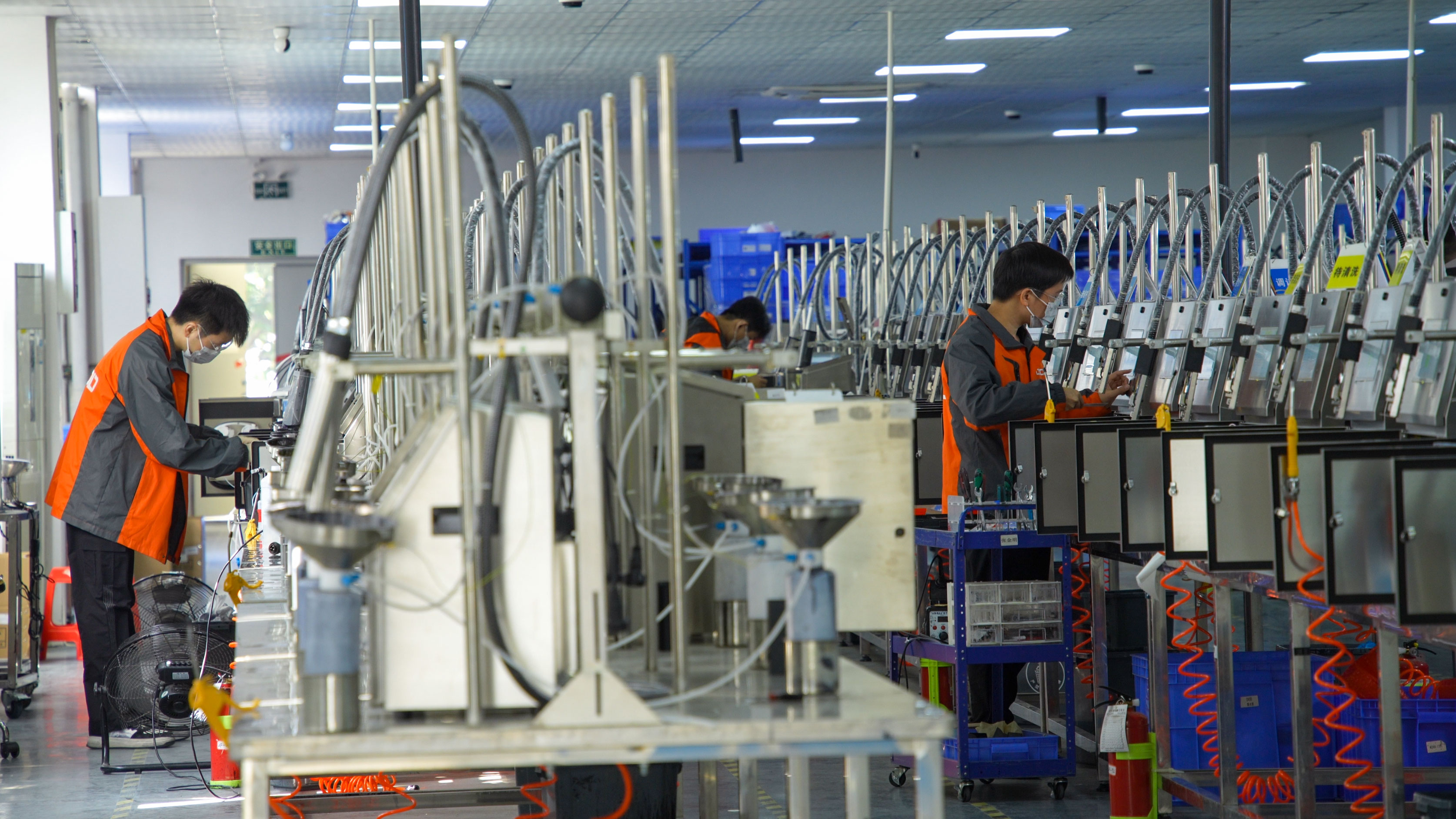
Pre-shipment quality testing: function tests and sample printing verification are part of the documented outgoing control process.
What to verify before placing the order
Because the equipment decision is only half the purchase, the verification scope matters as much as the model number. DOCOD's documented quality control for standard equipment supply covers outgoing inspection, sample printing verification and function testing before shipment. For production line integration support, the control points are integration testing, a sample run and video acceptance before delivery.
- Approved printed sample. Confirm the code on the actual substrate at the actual line speed, and keep the approved sample as the acceptance reference.
- Written environmental specification. Ingress protection rating, enclosure material and operating temperature window, confirmed for the installation position.
- Integration scope. DOCOD's integration support covers conveyor, coder and rewinder matching, encoder and sensor connection, and GS1/DataMatrix and serialization workflow matching, with a minimum order of one line and a stated lead time of 20–35 working days.
- Consumables and spares plan. Ink and solvent for CIJ, cartridges for TIJ, and a spare parts route. A dedicated spare parts and consumables service exists with a minimum order of one piece and delivery within 15 working days.
- Commercial terms. Standard equipment supply is quoted at a minimum order of one set with delivery within 15 working days, with language, UI setup, print content settings, mounting options and ink selection by substrate included in the customization scope.
- Management system evidence. ISO 9001 (certificate 18625Q00281R1M), ISO 14001 (18625E00147R1M) and ISO 45001 (18625S00131R1M) are held through Guangdong Zhongyu Certification Co., Ltd., all issued 5 September 2025 and valid to 4 September 2028.
For buyers intending to sell under their own identity, OEM branding support covers private label logo, startup screen, nameplate, packaging, manuals and carton labels, with sample confirmation and final inspection before shipment. ODM functional customization covers software and UI adjustment, communication interface, bracket structure, printhead configuration and application-based adaptation, with requirement confirmation, function testing and trial-run verification as the control sequence.
Market trend: why high-resolution cable marking is moving up the agenda
Two independent signals explain why cable marking briefs now include 2D codes more often than they did five years ago.
The first is scale. Fortune Business Insights puts the global coding and marking equipment market at USD 7.51 billion in 2025, with inkjet technologies (CIJ, TIJ and PIJ combined) accounting for 40.1% of the technology segment. Inkjet is not a niche option in industrial marking; it is the mainstream one, which is why incremental improvements in CIJ stability and TIJ resolution translate into plant-level decisions.
The second is regulation. The GS1 Digital Link transition — commonly referred to as Sunrise 2027 — sets a deadline of 31 December 2027 for the retail transition from 1D barcodes to 2D QR codes across participating markets. Cable is not a retail consumer package, but the same expectation propagates through supply chains: buyers increasingly ask for machine-readable, serialised identifiers on the product rather than only on the carton. That requirement moves resolution and 2D capability from optional to specified.
Forecasts for total market value diverge noticeably across commercial research houses because base years and product scopes differ, so directional use is more defensible than precise sizing. The direction, however, is consistent.
Future outlook
The next round of cable-line investment is less likely to be about print technology alone and more about verification. A code that cannot be read by the buyer's scanner is not a code, regardless of how well it was printed. That shifts budget toward inline inspection and print-and-verify configurations, where every mark is checked as it is produced rather than sampled afterwards.
DOCOD's portfolio already includes inline vision inspection systems and product traceability solutions alongside the printing families, and its stated application scope covers date and batch coding, variable data printing, GS1 DataMatrix, serialization and product traceability. For a cable plant planning a 2027-era line, the practical implication is to specify the reading requirement at the same time as the printing requirement — a coding decision taken without the verification decision usually has to be revisited.
Frequently asked questions
Which technology should mark a plastic cable sheath — CIJ or TIJ?
Both are non-contact inkjet technologies and both are used on plastic surfaces, but they answer different requirements. Continuous inkjet is suited to long runs of alphanumeric content such as metre marking, and the recorded cable-sheath deployment is a CIJ installation across six lines. Thermal inkjet is suited to higher-resolution content such as QR and 2D symbols, and the recorded dual-head deployment is on QR and expiry printing. Final substrate compatibility for a specific sheath compound is established by an approved printed sample, not by technology category alone.
Can a fiber laser mark cable conductors, or is it limited to metal parts?
The Venus1 Series Fiber Laser Marking Machine is positioned for permanent marks on metal. The recorded application is permanent marking on metal connectors at an electronics parts supplier, in service for three years, with durability and metal suitability as the documented outcomes. Achievable contrast depends on how the specific metal reacts to the laser, so a sample mark on the actual material is the correct verification step before specification.
How do I confirm line speed for my specific code?
Line speed cannot be confirmed from a model datasheet alone, because it depends on code length and content density as well as the mechanism. The documented route is a sample run at production speed with the production code. Within DOCOD's production line integration support, quality control includes integration testing, a sample run and video acceptance before delivery, which is the point at which speed is verified against the real application.
What environmental specification should be requested for a cable plant?
Request the ingress protection rating, the enclosure material and the operating temperature window in writing, and confirm them against the specific installation position rather than against the plant in general. Positions near an extrusion head, a cooling trough or a washdown area present different exposures. Where a value is not stated for the exact configuration being purchased, it should be obtained in writing before the order is placed.
What acceptance testing is performed before shipment?
For standard equipment supply, quality control covers outgoing inspection, sample printing verification and function testing before shipment. For production line integration projects, quality control covers integration testing, a sample run and video acceptance before delivery. For ODM functional customization, the sequence is requirement confirmation, function testing and trial-run verification.
Do these systems support GS1 Digital Link and 2D code requirements?
DOCOD states that its technologies support date and batch coding, variable data printing, GS1 DataMatrix, serialization and product traceability, and its integration support scope includes matching GS1/DataMatrix and serialization workflows. Whether a specific model on a specific line meets a specific symbol grade should be confirmed through an approved printed sample rather than assumed from the portfolio-level statement.
Product and capability details in this article are drawn from DOCOD company documentation and recorded field deployments. Market figures are attributed to Fortune Business Insights; the GS1 Digital Link transition deadline is attributed to GS1. A full company overview is available in the DOCOD corporate brochure.
Есть вопросы или нужны дополнительные детали?
Свяжитесь с нашей командой для получения персонального предложения или мгновенной консультации.
Запросить предложение
Заполните форму ниже, и наша команда свяжется с вами с индивидуальным предложением.
Прямой чат WhatsApp
Предпочитаете общаться в реальном времени? Напишите нам в WhatsApp для мгновенной помощи и быстрых ответов.
- Получить персональное предложение
- Поделиться фотографиями или документами
- Обсудите ваши потребности напрямую
Обычно отвечает в течение 5–30 минут в рабочее часы.