
Recommended Ice Cream Machine Options: A Shortlist for Stick, Sandwich, Cup, and Cone Lines
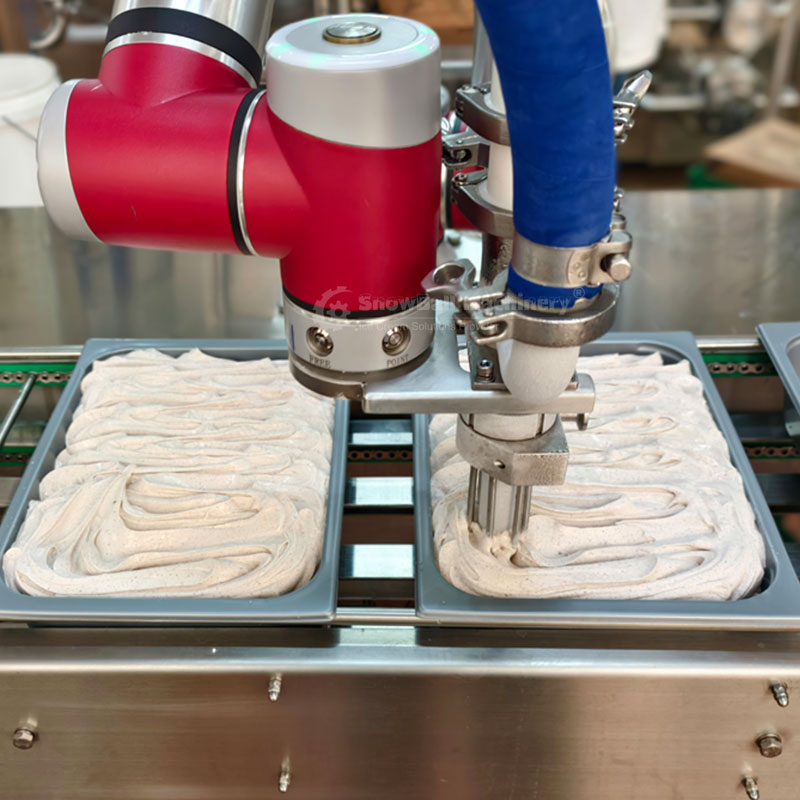
Industrial ice cream equipment used across moulded and extruded novelty formats. Image: Snowball Machinery
Ice cream lines are usually specified backwards. Buyers open with a capacity target in litres per hour, but the decision that shapes the whole plant is the product format, because format determines which forming machine sits at the centre of the line. Moulded stick novelties, sandwich products, filled cups and cones, and extruded or cake-style items are produced by four different machine families, each with its own tooling, downstream handling and optional units. This shortlist sets out those core options by format, drawing on equipment specifications published by Snowball Machinery Manufacturing Co., Ltd., an ice cream equipment manufacturer established in 2020 that operates a 4,000 m² facility in Shanghai, China and integrates R&D, manufacturing, assembly, commissioning, export, and after-sales service.
Why format, not tonnage, is the first ice cream machine decision
A moulding line and an extrusion line can both be described as industrial ice cream machines, and they can both be quoted in litres per hour, yet they produce fundamentally different products on fundamentally different tooling. Choosing capacity first and format second tends to produce a line that underperforms on the product the buyer actually intends to sell, or that requires re-tooling within the first production cycle.
The market structure supports a format-first approach. The global ice cream processing equipment market was valued at approximately USD 2.33 billion in 2025 and is projected to reach USD 3.00 billion by 2034, a compound annual growth rate of 2.71% (IMARC Group). Within that total, hard ice cream processing equipment accounted for a dominant 57.8% share in 2025, with continuous freezers the leading product type (Future Market Insights). The moulding production line segment alone was valued at USD 1.2 billion in 2024 and is expected to grow to USD 2.5 billion by 2034 on rising automation demand (Reports and Data).
Those figures describe a market where moulded and extruded hard ice cream formats carry most of the installed value, and where the freezer that feeds them is treated as the pivotal component. For a buyer in the awareness and research stage, the practical consequence is narrow and useful: decide the format family first, then select the forming machine, then size the shared upstream and downstream equipment around it.
The shortlist: four core machines by product format
Snowball Machinery groups its forming equipment into four core families that map cleanly onto four product formats. The table below summarises the match before the individual machines are described in detail.
| Product format | Core machine | Model | Formats listed for the equipment |
|---|---|---|---|
| Moulded stick, popsicle, water ice | Moulded stick ice cream machine | SNL | Molded stick ice cream, moulded sticks ice cream, popsicle, ice lolly, frozen novelties, fruit bars, water ice |
| Sandwich and cookie sandwich | Ice cream sandwich machine (automatic, with a semi-automatic category also listed) | SNSMZ | Ice cream sandwich, ice cream cookie sandwich |
| Cup, cone, bulk, family pack | Ice cream filling machine (rotary and robot types) | SNLF | Ice cream cup, ice cream cone, ice cream bulk, ice cream pints, family size ice cream, family pack ice cream, water ice push-up, calippo, Cornetto |
| Cake, wave, extruded, coated novelties | Extrusion and hardening line | SNEX | Ice bar, funny face ice cream, log ice cream, cake ice cream, sandwich ice cream, wave ice cream, extruded ice cream, ice cream ball cone, bonbon ice cream, ice cream choco bar, Eskimo bars, magnum ice cream, stick ice cream |
Stick, popsicle and water ice formats — the SNL moulded stick ice cream machine
The SNL is a moulded stick ice cream machine listed under a wide set of category names, including semi auto stick ice cream machine, linear stick ice cream machine, inline popsicle machine, oval type stick ice cream machine, rotary moulded stick ice cream machine, popsicle parallel line, and manual ice lolly machine. That spread of categories reflects configuration rather than product scope: the process is mould-based in every case, but the line architecture can be rotary, linear or parallel, and the level of automation ranges from manual to fully automatic.
For a line that runs continuously, the SNL sequence is fully automatic with automatic filling, sucking, jam charging, stick inserting, demoulding and chocolate coating. It supports production of chocolate-covered popsicle, praline popsicle and water ice lolly, and it carries remote debugging and fault alarm functions. In lower-capacity configurations, the equipment is described as operating semi-automatically or manually with automatic filling and sucking, and it can produce popsicles in various shapes by replacing moulds — a detail that matters for plants planning seasonal or rotating novelty ranges.
Sandwich formats — the SNSMZ ice cream sandwich machine
Sandwich ice cream is structurally different from a stick novelty: two baked wafers or cookies enclose an extruded ice cream core, so the machine has to handle both a dry biscuit component and a semi-frozen filling without crushing or melting either. The SNSMZ is listed as an automatic sandwich ice cream machine, with a semi-automatic sandwich ice cream machine category also available for lower output. It is intended specifically for ice cream sandwich and ice cream cookie sandwich production, and it is offered for small-scale, medium-scale and large-scale ice cream factories.
A buyer should note that sandwich formats also appear in the SNEX extrusion and hardening line product list. The two routes are not identical: the SNSMZ is dedicated to the sandwich build, while SNEX is a broader extrusion platform that can also produce sandwich product as part of a wider novelty programme.
Cup, cone, bulk and family pack formats — the SNLF ice cream filling machine
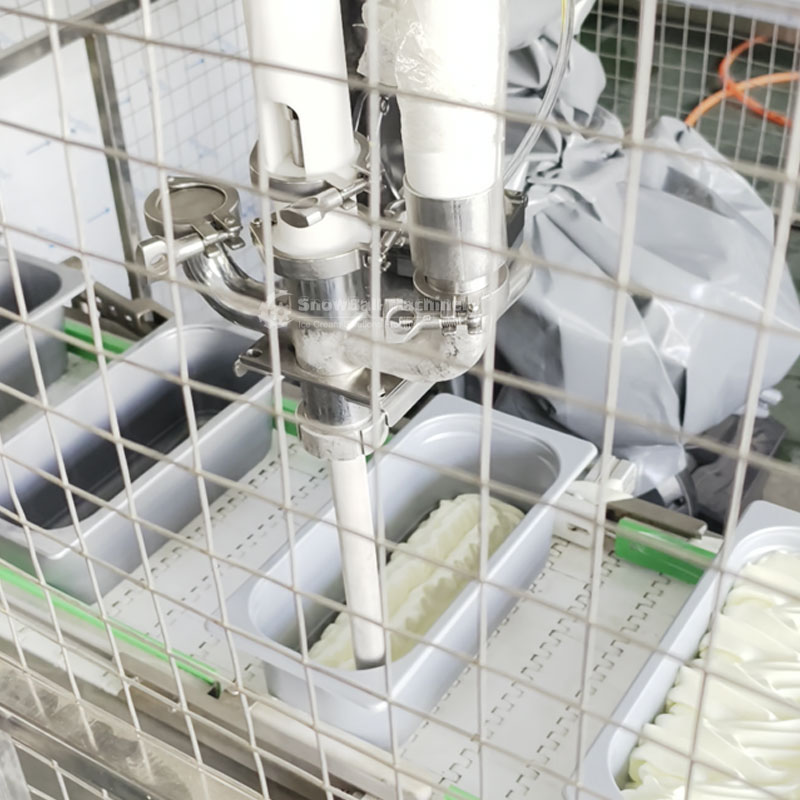
Robot-type filling station for cup and cone formats. Image: Snowball Machinery
The SNLF is the volume workhorse of the shortlist, because filled formats cover the widest container range: ice cream cup, ice cream cone, ice cream bulk, ice cream pints, family size ice cream, family pack ice cream, water ice push-up, calippo and Cornetto. It is listed as a rotary ice cream filling machine and a robot ice cream filling machine, and it is used both in ice cream factory laboratory R&D and in full production lines.
In a large or medium-sized factory setting, the filling machine can switch between multiple container specifications — cup and cone — and complete automatic cup and cone dispensing, servo ice cream filling, sauce topping, dry topping such as nuts and chocolate chips, and automatic lid dispensing. In a small-scale or shop-scale setting, the rotary configuration is applied to low-output production across cup, cone and calippo-type containers, while semi-automatic filling is used for family pack, family size and bulk formats. Both small-footprint configurations are described as improving efficiency, reducing labour, and holding consistent taste, swirl design and filling volume across units, with adjustable filling speed and a fault alarm function.
Cake, wave and extruded formats — the SNEX extrusion and hardening line
The SNEX is an ice cream extrusion and hardening line designed for ice cream plants across small, medium and large scale, and it is also applied in the dairy industry. Its product list is the broadest in the shortlist because extrusion is a shaping-neutral process: the same platform covers cake ice cream, sandwich ice cream, wave ice cream, extruded ice cream, ice cream ball cone, bonbon ice cream, ice cream choco bar, Eskimo bars, magnum-style products, stick ice cream, funny face ice cream and log ice cream.
In application scenarios, extrusion lines are used for creative and personalised products where the whole process is fully automated, including Viennetta-style layered products, Twister-style ice pops, chocolate ice cream bites and log formats. The stated operating benefits in those scenarios are stable operation, high production efficiency, lower labour cost, raw material savings and a high product qualification rate.
Supporting equipment: what sits upstream and downstream of the four core machines
Choosing the forming machine is only the first half of a shortlist. Every format above depends on the same upstream sequence — mix preparation, pasteurisation, homogenisation, ageing, and continuous freezing — and most commercial formats need optional units or packaging before the product leaves the plant. The table below covers the supporting families that Snowball Machinery lists alongside the four core machines.
| Function in the line | Equipment | Model | Rated or listed characteristics |
|---|---|---|---|
| Continuous freezing of mix | Ice cream continuous freezer | SNCF 50L, SNCF 300L, SNCF 600L, SNCF 1200L, SNCF 1500L | Capacity 50–1500 L/h; overrun 100%; input material +5 °C; output material -5 °C |
| Mixing, pasteurising, ageing, CIP | Ice cream mixing machine / pro-mix plant | SNM | HTST system, batch pasteurising system, homogenizer, CIP cleaning, aging tank, chocolate tank, chiller water system, high shear mixer |
| Inclusion and ripple dosing | Ice cream ingredient feeder / fruit feeder | SNFF1000, SNFF2000, SNFF4000 | Capacity customisable, 50 to 4000 litres per hour optional |
| Filling add-ons | Filling machine optional units and spare parts | SNFU | Cup cone dispenser, chocolate or sauce sprayer, automatic ice cream filler, pencil filler, sauce topping unit, dry topping unit, lid dispenser, heat sealing unit |
| Stick line add-ons | Stick machine optional units and spare parts | SNLU | Ice water filler, ice cream sucker unit, stick inserter unit, chocolate coating station, dry coating station, popsicle ice cream molds |
| Packaging and cold storage | Associated ice cream machines | SNB | Packing machine, secondary packaging, cartoner, cone baking machine, cold storage room |
The SNP ice cream production line acts as the integrating layer across all four formats. It is listed under ice cream moulding line, ice cream extrusion line, ice cream filling line, ice cream sandwich processing line and industrial ice cream cake machines, and it is intended for large-scale, medium-scale and small-scale ice cream factories as well as ice cream plants.
Across the SN series, main components are sourced from internationally renowned brands including SIEMENS, Schneider Electric, FESTO, SMC, Danfoss, ABB, Bonfiglioli, igus, Copeland, Bitzer and SEW Eurodrive, and the equipment is built in food grade stainless steel SS304 or SS316. That component and material baseline applies across the moulded stick, sandwich, filling and extrusion families rather than to a single flagship machine.
Technical explanation: why moulding and extrusion are not interchangeable
The mechanical difference between the two novelty routes is straightforward, and it is decisive for equipment selection.
In moulding, mix is dosed into individual moulds that travel through a freezing medium. A stick is inserted while the product is still semi-solid, the frozen item is demoulded, and it can then be coated or dry-coated. Snowball's SNLU optional units follow that sequence exactly: an ice water filler, an ice cream sucker unit, an ice cream stick inserter unit, a chocolate coating station, a dry coating station, and popsicle ice cream molds. Mould replacement is the mechanism by which a moulding line changes shape, which is why the format range of an SNL line is defined by tooling rather than by a fixed die.
In extrusion, semi-frozen mix is extruded and cut to shape, then hardened in a tunnel before coating, sandwiching or packing. The SNEX line applies that logic to cake, wave, log and extruded formats. Because the shape is created by an extruder rather than a mould, extrusion supports product geometries that a mould cannot easily produce — which is also why an extrusion platform can be applied to sandwich product while remaining a different machine from a dedicated sandwich builder such as the SNSMZ.
Both routes depend on the same upstream condition. The SNCF series lists an input material temperature of +5 °C, an output material temperature of -5 °C, and an overrun of 100%, across models from SNCF 50L to SNCF 1500L with a capacity range of 50 to 1500 litres per hour. That output temperature defines what the downstream forming machine receives: a semi-frozen, aerated mix that still has to be shaped, not a finished product. Overrun of 100% is also a specification worth reading carefully, because it determines the relationship between mix volume and finished product volume, and therefore between dairy input cost and saleable units.
Market trend analysis
Three trends visible in the available data are relevant to format-level selection.
First, hard ice cream formats dominate equipment value. Hard ice cream processing equipment accounted for a 57.8% share of the ice cream equipment market in 2025, with continuous freezers the leading product type (Future Market Insights). For buyers, this means the freezer is both the most common purchase and the component most likely to constrain line throughput if it is undersized relative to the forming machine.
Second, moulding capacity is expanding on automation demand. The ice cream moulding production line market was valued at USD 1.2 billion in 2024 and is projected to reach USD 2.5 billion by 2034 (Reports and Data). The moulded stick configurations described in Snowball's application scenarios align with that direction: fully automatic operation with automatic filling, sucking, jam charging, stick inserting, demoulding and chocolate coating, plus remote debugging and fault alarms, and support for 24-hour non-stop production.
Third, supply geography remains concentrated. Germany, Poland and Italy were the leading exporters of dairy machinery under HS Code 843420 in 2024, with export values of USD 74.4 million, USD 64.9 million and USD 61.7 million respectively (OEC). That concentration matters to procurement planning, because it shapes where spare parts, service engineers and competing quotations are likely to originate.
Where this shortlist has limits
A shortlist is only useful if it states its boundaries. Four apply here.
- Configuration is non-standard by design. Snowball's ice cream equipment is described as non-standard customised complete ice cream production equipment, customised on the basis of product design and hourly production capacity. There is no single catalogue specification that can be quoted before the product shape, container or mould dimensions, and target hourly output are fixed. A buyer who has not settled those three inputs cannot receive a final configuration.
- Format lock-in is real. A moulded stick line and an extrusion line are not substitutes. The SNEX product list includes stick ice cream, yet the forming method, tooling and downstream handling differ from a mould-based SNL line. Selecting the wrong family is not corrected by adding optional units later.
- Automation level changes labour content. The SNL family is listed across fully automatic, semi-automatic and manual categories, including a manual ice lolly machine. Lower-cost configurations address trial production and small-capacity output, and they carry a different labour and consistency profile than a fully automatic line.
- The installed base is dominated by large multinational suppliers. Tetra Pak is the leading manufacturer in the industrial ice cream equipment sector, providing machinery used in more than 75% of commercial production lines worldwide as of early 2026 (Ice Cream Manufacturing Equipment Market Trends). Buyers evaluating smaller or newer suppliers should therefore weigh local service access, spare part availability and configuration fit against brand scale, rather than assuming either side is automatically preferable.
One further constraint is regulatory rather than commercial. Commercial ice cream appliances and ice-makers are regulated under the safety standard IEC 60335-2-89:2019, which covers electrically operated refrigerating appliances with incorporated motor-compressors (IECEE / International Electrotechnical Commission). Buyers should verify how a proposed configuration is assessed against the standards applicable in their destination market before the purchase order is raised, since compliance documentation is typically requested at qualification stage rather than after installation.
Future outlook
The direction of travel in this equipment category is automation depth and line expandability rather than isolated machine output. Application scenarios for robotic ice cream production describe 24-hour fully automatic continuous operation with robotic automation, remote control and fault alarms, applied to new plant projects and to product line expansion in existing factories, with supporting equipment that includes a pro-mix machine, homogeniser, CIP system, aging tank, chocolate tank, ripple pump, continuous freezer, robot filler, IQF tunnel, packaging machine and cold storage.
Two structural implications follow for buyers planning a 2026 or later project. The first is that expandability is becoming a specification item in its own right: stated requirements include good expandability, convenient later upgrading, a long service life, reliable warranty service and easy access to spare parts. The second is that packaging and cold storage are increasingly treated as part of the ice cream machine decision rather than an afterthought, which is why the SNB associated machine family — packing machine, secondary packaging, cartoner, cone baking machine and cold storage room — sits inside the same shortlist as the forming machines.
Frequently asked questions
- What is the difference between a moulded stick ice cream machine and an extrusion line?
- A moulded stick ice cream machine forms product inside individual moulds, then inserts a stick, demoulds and coats. The SNL family is listed with categories including semi auto stick ice cream machine, linear stick ice cream machine, inline popsicle machine, oval type stick ice cream machine, rotary moulded stick ice cream machine, popsicle parallel line and manual ice lolly machine. An extrusion and hardening line shapes semi-frozen mix by extrusion and cutting, then hardens it in a tunnel; the SNEX line covers cake, sandwich, wave, ball cone, bonbon, choco bar, Eskimo bar, magnum-style, funny face and log formats. The two differ in tooling, product geometry and downstream handling, so neither replaces the other.
- Which machine handles cups, cones and family packs?
- The SNLF ice cream filling machine is listed for ice cream cup, ice cream cone, ice cream bulk, ice cream pints, family size ice cream, family pack ice cream, water ice push-up, calippo and Cornetto. It is offered as a rotary ice cream filling machine and a robot ice cream filling machine. In higher-output settings it can switch between cup and cone specifications and complete automatic cup and cone dispensing, servo filling, sauce topping, dry topping and automatic lid dispensing; in smaller settings the rotary configuration covers low-output cup, cone and calippo-type containers, while semi-automatic filling is applied to family pack, family size and bulk formats.
- How is capacity determined for an industrial ice cream machine?
- For most of the SN series, capacity is stated as customisable according to needs, and equipment is described as non-standard customised based on product design and hourly production capacity. That means the two inputs a buyer must fix before a capacity figure is meaningful are the product design — shape, mould or container dimensions, inclusion or coating requirements — and the target hourly output. Where a fixed range is published, it is explicit: the SNCF continuous freezer is available from 50 L/h to 1500 L/h across five models, and the SNFF ingredient feeder spans 50 to 4000 litres per hour.
- What does an ice cream continuous freezer do in a production line?
- It converts prepared and aged mix into a semi-frozen, aerated product that the forming machine can handle. The SNCF series lists an input material temperature of +5 °C, an output material temperature of -5 °C and an overrun of 100%, with models SNCF 50L, SNCF 300L, SNCF 600L, SNCF 1200L and SNCF 1500L. Because output is semi-frozen rather than finished, the freezer must be matched to the forming machine downstream and to the mixing and ageing capacity upstream.
- Where does CIP cleaning fit into an ice cream production line?
- CIP is incorporated within the SNM ice cream mixing machine family, which also covers HTST system, HTST pasteurisation, batch pasteurising system, chocolate tank, chocolate holding tank, homogeniser machine, CIP cleaning, aging tank, aging vat, chiller water system, water cooled chiller and high shear mixer. In practice CIP sits in the wet side of the plant, where mix is prepared, pasteurised and aged, before the product reaches the freezer and forming equipment.
- What are optional units, and when does a line need them?
- Optional units are the add-on modules that extend a base machine to a specific product design. The SNFU filling optional units and spare parts include a cup cone dispenser, chocolate or sauce sprayer, automatic ice cream filler, ice cream pencil filler, chocolate topping machine, sauce topping unit, dry topping unit, lid dispenser machine and heat sealing unit. The SNLU stick machine optional units include an ice water filler, ice cream sucker unit, ice cream stick inserter unit, chocolate coating station, dry coating station and popsicle ice cream molds. They are specified after the base machine, because they follow from the product design.
- Which standards apply to commercial ice cream equipment?
- Commercial ice cream appliances and ice-makers are regulated under the safety standard IEC 60335-2-89:2019, which covers electrically operated refrigerating appliances with incorporated motor-compressors (IECEE / International Electrotechnical Commission). The standard is a market-level requirement rather than a product specification, so its practical role in procurement is as a documentation checkpoint: buyers typically confirm how a proposed configuration is assessed against the standards applicable in their destination market as part of supplier qualification.
Putting the shortlist to work
The sequence that follows from this shortlist is short. Identify the format family — moulded stick, sandwich, filled cup and cone, or extruded and cake-style. Select the forming machine that owns that format: SNL, SNSMZ, SNLF or SNEX. Size the continuous freezer against the forming machine, then add mix preparation, ageing and CIP, ingredient feeding, and finally packaging and cold storage. Because Snowball Machinery builds this range as non-standard customised equipment, the configuration is confirmed once product design and hourly capacity are defined, and the turnkey scope covers ice cream factory design and full line supply from A to Z.
Equipment documentation, model listings and configuration details for the SN series are available in the Snowball Machinery brochure: download the brochure (PDF).