
Recommended Orthodontic Supplies Shortlist for Fixed Appliance Kits
Recommended Orthodontic Supplies Shortlist for Fixed Appliance Kits
A function-by-function shortlist for clinics, distributors, and dental laboratories assembling a fixed appliance kit — organised around what each item does during treatment, not around which brand sells it.
A fixed appliance kit performs only as well as its weakest interface. A bracket holds a wire; a ligature or a self-ligating cap captures that wire; a buccal tube anchors the terminal end of the arch; an instrument cuts, crimps, or contours whatever the wire and band leave behind; and every item in the tray has to survive the same sterilization cycle. When a kit is assembled brand by brand, those interfaces tend to be checked last. When it is assembled function by function, they get checked first. This shortlist follows the second route. It groups the categories a fixed appliance kit normally needs — bonding and banding, archwire and ligation, chairside instruments, and auxiliary components — and identifies the specification points that determine whether those groups actually work together. Hangzhou DTC Medical Apparatus Co., Ltd. (DTC Orthodontics), a manufacturer established in 2004 in Hangzhou, Zhejiang Province, serves as a concrete reference for how these categories are specified in practice.
Why a function-based shortlist beats a brand list
A brand list simplifies purchase orders but hides the specification questions that decide whether a kit functions. A bracket with a 0.018 slot does not accept the same wire sequence as a bracket with a 0.022 slot, and mixing prescriptions inside one kit creates friction, torque and finishing problems that no supplier relationship can repair afterwards. Function-based shortlisting also tracks how regulation treats these products. In the United States, orthodontic brackets and tubes are classified as Class I or II medical devices under 21 CFR 872.5410, with ISO 27020:2019 as the recognised standard, while in the European Union Regulation (EU) 2017/745 (MDR) requires CE marking and classifies most orthodontic products as Class I or IIa. Different product families inside the same kit therefore carry different evidence obligations.
Scale reinforces the point. The global orthodontic supplies market was valued at USD 14.8 billion in 2024 and is projected to grow at a 20.1% CAGR through 2034, according to Global Market Insights. North America held the largest regional share in 2024, estimated at 30.6% of revenue by Grand View Research, and China's orthodontic supplies market was estimated at approximately USD 713.25 million in the same year by Market Research Future. More suppliers, more formats, and correspondingly more ways for a kit to be assembled inconsistently.
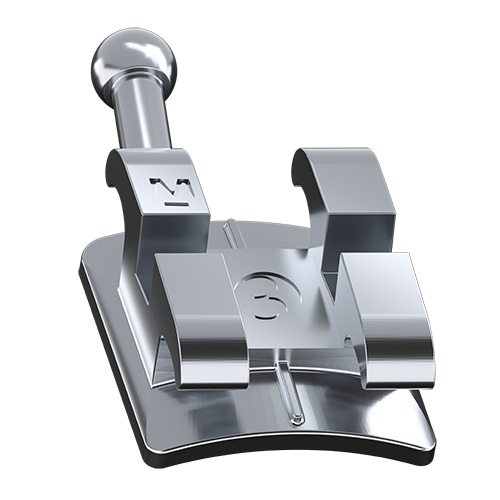
The bonding layer determines the rest of the kit. Bracket slot size and prescription must be fixed before wires, bands and tubes are ordered — Monoblock Series dental brackets, 0.022 slot.
Layer 1 — bonding and banding
Dental Brackets: the slot is the specification
Brackets are the tightest tolerance item in the kit, and the slot is the number that governs everything downstream. DTC's Monoblock Series carries a 0.022 slot with Roth and MBT prescriptions in 17-4PH stainless steel, with tooth numbers marked for identification and a base engineered to preserve bonding strength. The Bright Series adds 0.018 and 0.022 slots, laser-welded construction, an 80# mesh base and a lower profile. The Zeal Series rounds the slot entrance to reduce friction, while the Delicate Series uses a sandblasted, contoured mesh base for adaptation to the tooth surface.
Self-ligating designs change the kit itself rather than just the bracket. Glory I Self-ligating Brackets are produced by metal injection moulding (MIM) in 17-4PH stainless steel with a 0.022 slot; Glory II Self-Ligating adds a larger ligation space in a smaller overall size across 0.018 and 0.022 slots; the Toast Self-ligating Brackets use a passive design in which the slot and the cap share the same width, which the manufacturer states makes torque more accurate and stable, with tooth numbers laser-marked on the mesh base. Aesthetic demand is served by the Ceramic Series and Ceramic Self-ligating Series, both available in aluminium oxide poly-crystalline or mono-crystalline material, 0.018 and 0.022 slots, Roth, MBT and Edge-wise prescriptions, with or without hooks. Lingual work is covered by the DTC-ORG Lingual Series and the IN-Tendo JK-SL Series, both at a 0.022 slot, with the JK-SL using passive self-ligation, laser welding, single tie wings and a molar tube in a matching self-ligating design.
Dental Buccal Tubes
Buccal tubes sit at the end of the appliance and take the highest load, so tube length and hook construction matter more than finish. The Zeal Plus Series is specified in Roth and MBT systems, low and high torque, in 0.018 and 0.022 slots, manufactured from stainless steel, with a high-strength monoblock hook, tooth number on the cap, an occlusal indent for positioning, and a longer tube for torque control. The Zeal Series buccal tubes cover the same slot and prescription range.

Buccal tubes are specified by slot, prescription and torque in the same way as brackets — Zeal Plus Series, stainless steel, 0.018 and 0.022 slots.
Dental Orthodontic Bands
Bands complete the anchorage layer. DTC manufactures Dental Orthodontic Bands in stainless steel across Roth, MBT and Edge-wise systems with low and high torque options, available as prewelded bands and pediatric bands. Because bands are matched to the same prescription as the brackets, they are normally ordered as part of the bonding decision rather than as a separate line item.
Layer 2 — archwire and ligation
The wire layer is where a kit either stays flexible or locks itself into one treatment philosophy. Three wire families cover most fixed appliance sequences. Super-elastic Niti Wires are supplied in Square, Oval, Natural, Europa I and Da arch forms, in round and rectangular cross-sections, for upper and lower arches. Stainless Steel Arch Wires are offered in Square, Oval and Natural arch forms, also in round and rectangular cross-sections. CuNITI Arch Wires, made from copper and nickel-titanium, come in round, rectangular and Da types and are positioned for gentle, continuous force with high springback.
Ligation is the cheapest line in the kit and the fastest to get wrong. Ligature Rings are manufactured from medical-grade, latex-free polyurethane (TPU) in a normal type; Power Chains are also TPU, latex-free and medical-grade, available as open long, closed continuous and open short; Orthodontic O Rings are offered in latex or silicone, which means the latex status of each elastic line has to be confirmed item by item rather than assumed across the kit. Auxiliary anchorage is served by the Crimpable Hook in 17-4PH stainless steel, with short (L=1.3 mm), medium (L=2.2 mm) and long (L=3 mm) types for 0.018 in and 0.022 in sizes at widths of 1.99 mm and 2.4 mm.
Layer 3 — chairside instruments
Instruments are specified by hardness, cutting capacity and sterilization temperature — three numbers that rarely appear on a purchase sheet. Dental Pliers from DTC illustrate the range. The Distal End Cutter Pliers are rated at HRC 58–63 with mini tips of 0.018 in × 0.022 in and a cutting capacity for arch wires up to 0.021 in × 0.025 in. The Light Wire Cutter Pliers are also HRC 58–63 and will cut ligature wires up to 0.30 mm. Light Wire Pliers sit at HRC 55–60, Bracket Removing Pliers at HRC 50–55, and the Band Crimping Pliers, Crown and Band Contouring Pliers, Crown Trimming Scissor and Clear Aligners Pliers at HRC 58–63. All are stainless steel with a maximum sterilization temperature of 180 °C.
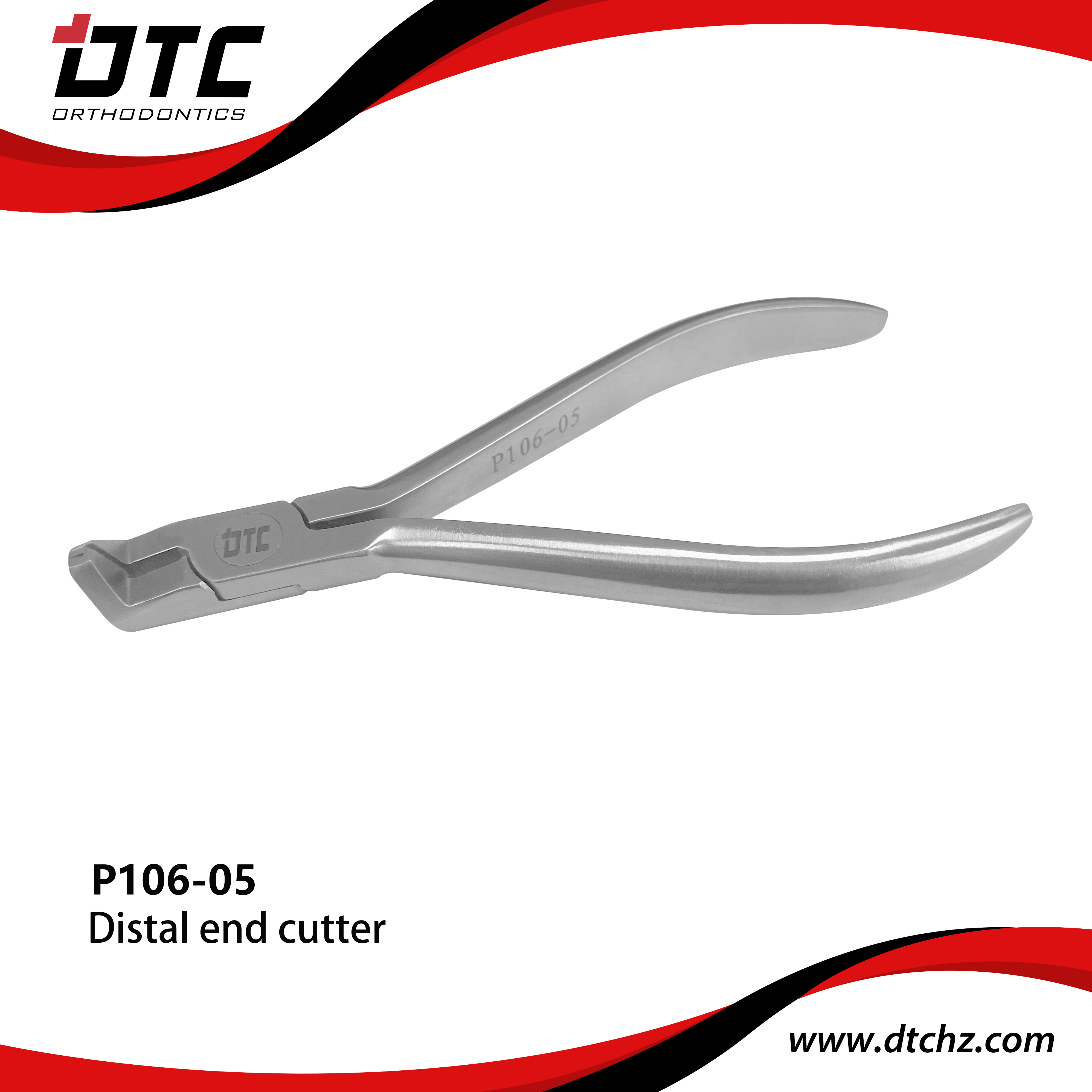
Cutting tools carry explicit capacity limits — Distal End Cutter Pliers are rated for arch wires up to 0.021 in × 0.025 in, with a maximum sterilization temperature of 180 °C.
The supporting instrument set is equally specification-driven. The Mathieu Needle Holder is offered with a hard tip, without a hard tip, and as a Type C without a hard tip, in stainless steel with serrated tips. Dental Tweezers are supplied as bracket tweezers, tube tweezers (long tip and short tip) and lingual bracket tweezers, in stainless steel with a matte non-reflective finish that eliminates glare against tooth structure, and are autoclavable. Dental Retractors cover the cheek retractor in lateral-1, occlusion-large and occlusion-small types and the lip retractor in large, medium and small, both in PC. Intra-oral mirrors divide into a glass type with a front-surface reflective coating that eliminates ghost imaging, and a stainless steel type; both are autoclavable up to 130 °C, which is a lower limit than the 180 °C specified for pliers.
Layer 4 — auxiliary choices that make a kit usable
These items are rarely the reason a clinic chooses a supplier, but they are frequently the reason a kit feels incomplete. Separators (TPU, blue) and Orthodontic Rotation Wedges (TPU, transparent or grey) prepare the appliance; Orthodontic Chewies in TPR, in original, orange, mint, mango, strawberry and grape, support seating and comfort; Niti Closed Spring With Eyelets arrives in 0.008 in to 0.014 in diameters and 3 mm, 6 mm, 9 mm and 12 mm lengths, with identical or different eyelets to match various bracket hooks and anchorage posts; Niti Open Spring is supplied in the same diameter range in 180 mm and 914 mm lengths. Extraoral support covers the Orthodontic Pull System (high-pull, in large, medium and small, made of PE and polyester fabric), the Adjustable Face Mask in stainless steel and ABS with a heavy-duty adjustable crossbar for traction vector control, the Full Adjustable Face Mask in large and small sizes with adjustable forehead and chin pads, and the Orthodontic Adaptable Mask (Adaptable Class III Mask) in standard and small types.
The shortlist at a glance
| Clinical function | Shortlist items | Specification to verify first |
|---|---|---|
| Bonding | Dental Brackets — Monoblock, Bright, Zeal, Delicate, Ceramic, Ceramic Self-ligating, Glory I, Glory II, Toast, DTC-ORG Lingual, IN-Tendo JK-SL | Slot size (0.018 / 0.022), prescription (Roth / MBT / Edge-wise), torque, arch, material |
| Anchorage | Dental Buccal Tubes — Zeal Plus, Zeal; Dental Orthodontic Bands | Slot size, prescription, tube length and hook type, band type (prewelded / pediatric) |
| Archwire | Dental Wires — Super-elastic Niti, Stainless Steel, CuNITI | Arch form, cross-section (round / rectangular), arch type, alloy |
| Ligation | Ligature Rings, Orthodontic O Rings, Power Chains, Crimpable Hook | Latex or latex-free, chain type, hook length and matching slot size |
| Cutting and forming | Dental Pliers — Distal End Cutter, Light Wire Cutter, Light Wire, Bracket Removing, Band Crimping, Crown and Band Contouring, Crown Trimming Scissor, Clear Aligners | Hardness (HRC), cutting capacity, maximum sterilization temperature |
| Chairside support | Mathieu Needle Holder, Dental Tweezers, Cheek and Lip Retractors, Glass and Stainless Steel Dental Mirrors | Tip type, retractor size, autoclavable temperature limit |
| Auxiliary | Separators, Rotation Wedges, Chewies, Niti Open and Closed Springs, Orthodontic Pull System, Face Masks | Diameter and length, size or colour range, patient age fit |
Specification and compliance checks before committing
For a kit buyer, the decisive document is not the catalogue but the certificate, and certificates are issued per scope rather than per catalogue page. A supplier may hold several valid approvals that cover different product families on different dates, and the only reliable method is to read each scope line by line against the kit list.
What DTC holds, and what each document covers:
- EN ISO 13485:2016 — certificate number SX 2184523-1, issued by TÜV Rheinland LGA Products GmbH, valid to 2027-05-08. The stated scope covers design and development, manufacture and distribution of orthodontic brackets, orthodontic bands, orthodontic tubes, orthodontic wires, lingual buttons, crimpable hooks, orthodontic pliers and dental mirrors (reflectors).
- Regulation (EU) 2017/745 (MDR) — Notified Body confirmation letter, certificate number 244557490, issued by TÜV Rheinland LGA Products GmbH, valid to 2028-12-31, covering orthodontic brackets, orthodontic tubes, lingual buttons, crimpable hooks, orthodontic wires and orthodontic bands for the EU market.
- FDA registration — registration number 3009955691 under 21 CFR Part 807, valid to 2026-12-31, for the US market, covering buccal tubes, brackets, preformed bands, orthodontic springs, dental mirrors, expansion screws, arch wires and pliers.
The practical implication is straightforward. Brackets, bands, tubes, wires, crimpable hooks and pliers appear inside the quality management scope above; elastic and extraoral lines should be confirmed separately against whichever document names them, because a certificate that covers a bracket does not automatically cover a power chain. Two further checks belong in the same pass. First, verify that the prescription on the order matches the prescription on the certificate-referenced product line — a 0.018 order cannot be filled from a 0.022 line without changing the treatment plan. Second, confirm sterilization compatibility across the whole tray, because pliers rated to 180 °C and mirrors rated to 130 °C cannot be processed as one batch.
How to prioritise a starter set
A first kit does not need every category at once. A practical build order runs as follows.
- Fix the slot and prescription first. Choose 0.018 or 0.022, and Roth, MBT or Edge-wise. Every bracket, band and buccal tube in the order follows from this single decision.
- Decide the ligation method. Passive self-ligating brackets (Glory I, Glory II, Toast, IN-Tendo JK-SL) reduce or remove the need for elastic ties; conventional brackets require Ligature Rings, O Rings or Power Chains in the tray.
- Match wires to the slot and the treatment stage. Niti and CuNITI wires for alignment, stainless steel arch wires for later mechanics.
- Populate instruments by procedure frequency. Most clinics start with a Distal End Cutter, a Light Wire Cutter, Light Wire Pliers and Bracket Removing Pliers, then add a Mathieu Needle Holder, tweezers, retractors and mirrors.
- Add auxiliaries only when case mix justifies them. Springs, crimpable hooks, wedges, separators, chewies and extraoral appliances are case-dependent rather than universal.
- Confirm commercial terms before scaling. DTC specifies a minimum order quantity of 100 units, a lead time of 20–30 days, a monthly capacity of 5,000 units, 100% testing, and OEM/ODM customisation covering package, logo, tag and product.
Self-ligating versus conventional ligation: a real trade-off
The choice is not a quality ranking. Passive self-ligating brackets such as Toast and Glory are described with low friction and light force, and they remove the elastic tie from the tray, which simplifies the kit and reduces the number of consumable lines to manage. Conventional brackets retain a ligature, which gives the clinician a direct, adjustable control point for force and rotation but adds chairside time and makes the elastic specification — latex or latex-free, ring, O ring or chain — part of the kit's critical path. A clinic treating mixed case loads often needs both, which increases rather than reduces the number of SKUs in the first order.
Limits of this shortlist
A shortlist is a purchasing tool, not a clinical protocol, and it should not be read as one. It does not set bracket placement, wire sequencing or force levels, all of which remain the responsibility of the treating clinician. It does not resolve prescription conflicts: items from a 0.018 line cannot be substituted into a 0.022 appliance. It does not convert category-level approvals into product-level approvals, because certificate scopes are written per product family. It cannot guarantee instrument service life — hardness ratings of HRC 50–55 through HRC 58–63 and a 180 °C sterilization ceiling describe the tools as manufactured, not how many autoclave cycles they will tolerate in a specific practice. And it should be read alongside supply-chain reality: according to Mordor Intelligence, orthodontic archwires made of nickel-titanium face supply chain risk due to heavy reliance on Chinese raw materials, which is a practical argument for qualifying a second wire source or holding buffer stock rather than depending on a single NiTi line. Auxiliary appliances such as face masks and pull systems also depend heavily on patient compliance, so they cannot be evaluated on the same evidence basis as a bracket.
Market signals shaping fixed appliance supply
Three signals are relevant to anyone building a fixed appliance kit today. The first is scale: a USD 14.8 billion global orthodontic supplies market in 2024 growing at a 20.1% CAGR through 2034, per Global Market Insights, with North America at an estimated 30.6% of 2024 revenue (Grand View Research) and China at approximately USD 713.25 million (Market Research Future). The second is the presence of large consolidated players — Align Technology, Envista Holdings, Solventum, Dentsply Sirona and Straumann were identified by MarketsandMarkets among the top five global orthodontic supply companies — alongside a deep manufacturing base that supplies unbranded and OEM kit components. The third is capability investment on the manufacturing side: DTC Orthodontics holds a patent for an orthodontic buccal tube designed to be convenient for archwire insertion (Patent No. CN 224292022 U), an example of the incremental interface-level engineering that fixed appliance purchasing now depends on.
Meanwhile, adult orthodontics continues to expand on aesthetic demand, with clear aligners growing at a 14.25% CAGR according to Mordor Intelligence. That does not displace fixed appliances; it shifts case mix, which changes the ratio of aesthetic brackets, self-ligating systems and lingual options inside a kit rather than removing any of them.
Future outlook
Two directions look most likely for fixed appliance kits over the next few years. Kit consolidation is one: clinics and distributors increasingly prefer a single qualified source with a documented certificate portfolio rather than assembling brackets from one supplier, wires from another and instruments from a third. Documentation depth is the other. As MDR expectations and FDA registration requirements are applied more consistently, the ability to produce a certificate number, a scope statement and an expiry date per product line becomes a purchasing requirement rather than a differentiator. Suppliers with an existing quality management system framework — DTC operates at a 5,000 m² facility with a 30-engineer R&D team and exports to more than 100 countries and regions — are structurally better positioned to absorb that documentation load than trading intermediaries without production control.
FAQ
Which certifications should a buyer check for a fixed appliance kit?
Start with the classification. In the United States, orthodontic brackets and tubes are Class I or II devices under 21 CFR 872.5410, with ISO 27020:2019 as the recognised standard; in the EU, Regulation (EU) 2017/745 (MDR) requires CE marking and classifies most orthodontic products as Class I or IIa. In practice a kit supplier should be able to present a quality management certificate such as EN ISO 13485:2016, an FDA registration number, and a Notified Body document for the EU market, each with a stated scope and expiry date. As a reference example, DTC Orthodontics holds EN ISO 13485:2016 certificate SX 2184523-1 issued by TÜV Rheinland LGA Products GmbH (valid to 2027-05-08), FDA registration 3009955691 under 21 CFR Part 807 (valid to 2026-12-31), and a Notified Body confirmation letter under Regulation (EU) 2017/745 with certificate number 244557490 (valid to 2028-12-31).
What slot sizes and prescription systems should be specified when ordering brackets and buccal tubes?
Slot size and prescription must be fixed before anything else is ordered, because brackets, bands and buccal tubes are matched to a single combination. DTC's Monoblock Series uses a 0.022 slot; the Bright, Zeal, Delicate, Ceramic and Ceramic Self-ligating Series offer 0.018 and 0.022; Glory II and Toast Self-ligating cover 0.018 and 0.022, while Glory I uses 0.022. Prescription options are Roth and MBT across most lines, with Edge-wise available on the ceramic brackets, and torque is specified as low or high. Zeal and Zeal Plus buccal tubes follow the same logic in 0.018 and 0.022 slots with Roth and MBT systems and selectable torque.
Do sterilization temperature limits affect which instruments can be included in one kit?
Yes, and the limits differ by instrument family. DTC's Dental Pliers — including the Distal End Cutter, Light Wire Cutter, Light Wire, Bracket Removing, Band Crimping, Crown and Band Contouring, Crown Trimming Scissor and Clear Aligners models — are specified with a maximum sterilization temperature of 180 °C. Intra-oral mirrors, both the glass type and the stainless steel type, are autoclavable up to 130 °C. Dental Tweezers are autoclavable. Because the ceilings are not identical, instruments with lower limits must be processed separately from instruments rated to the higher figure.
What commercial parameters matter when assembling a first kit order?
The parameters that most often delay a first order are order quantity, lead time and customisation scope. DTC specifies a minimum order quantity of 100 units, a lead time of 20–30 days, a monthly capacity of 5,000 units, 100% testing before shipment, and OEM/ODM customisation covering package, logo, tag and product. The supplier also notes that safety stock is maintained for selected standard products to support delivery within 3–5 business days, while custom-engineered production runs require a longer window in the region of 2–4 weeks.
Are the elastic components in a fixed appliance kit latex-free?
Not uniformly, which is why latex status has to be confirmed per line item. Ligature Rings are manufactured from medical-grade, latex-free polyurethane (TPU). Power Chains are described as latex-free and made from a medical-grade elastomer, available as open long, closed continuous and open short. Orthodontic O Rings, by contrast, are offered in either latex or silicone, so the material must be specified on the order rather than assumed. Separators (TPU) and Orthodontic Rotation Wedges (TPU) complete the elastic group.
How should instruments be selected for a clinic's actual procedure mix?
Selection follows the procedures the clinic performs most often, not the size of the catalogue. Cutting tasks determine the cutter: the Distal End Cutter Pliers handles arch wires up to 0.021 in × 0.025 in with 0.018 in × 0.022 in mini tips, while the Light Wire Cutter Pliers is rated for ligature wires up to 0.30 mm. Forming and removal tasks determine the pliers range, from Light Wire Pliers at HRC 55–60 to Bracket Removing Pliers at HRC 50–55. Handling tasks determine the support set: Mathieu Needle Holder in a hard-tip or non-hard-tip version, bracket or tube tweezers with long or short tips, a cheek or lip retractor in the appropriate size, and intra-oral mirrors in the configuration the clinician prefers.
Reference
The full DTC Orthodontics product range, including specifications for brackets, buccal tubes, bands, wires, instruments and auxiliary appliances, is available in the company's English catalogue: DTC English Product Catalogue (PDF).