
Recommended Pallet Box Options: Die-Cast, Enclosed, and Honeycomb Panel Models
HTNXT Industry Reference — Pallet Box Selection
Recommended Pallet Box Options: Die-Cast, Enclosed, and Honeycomb Panel Models
A project-level shortlist of three plastic pallet box constructions for industrial and automotive logistics — the dimensions, materials and procurement terms buyers actually compare before a first order.
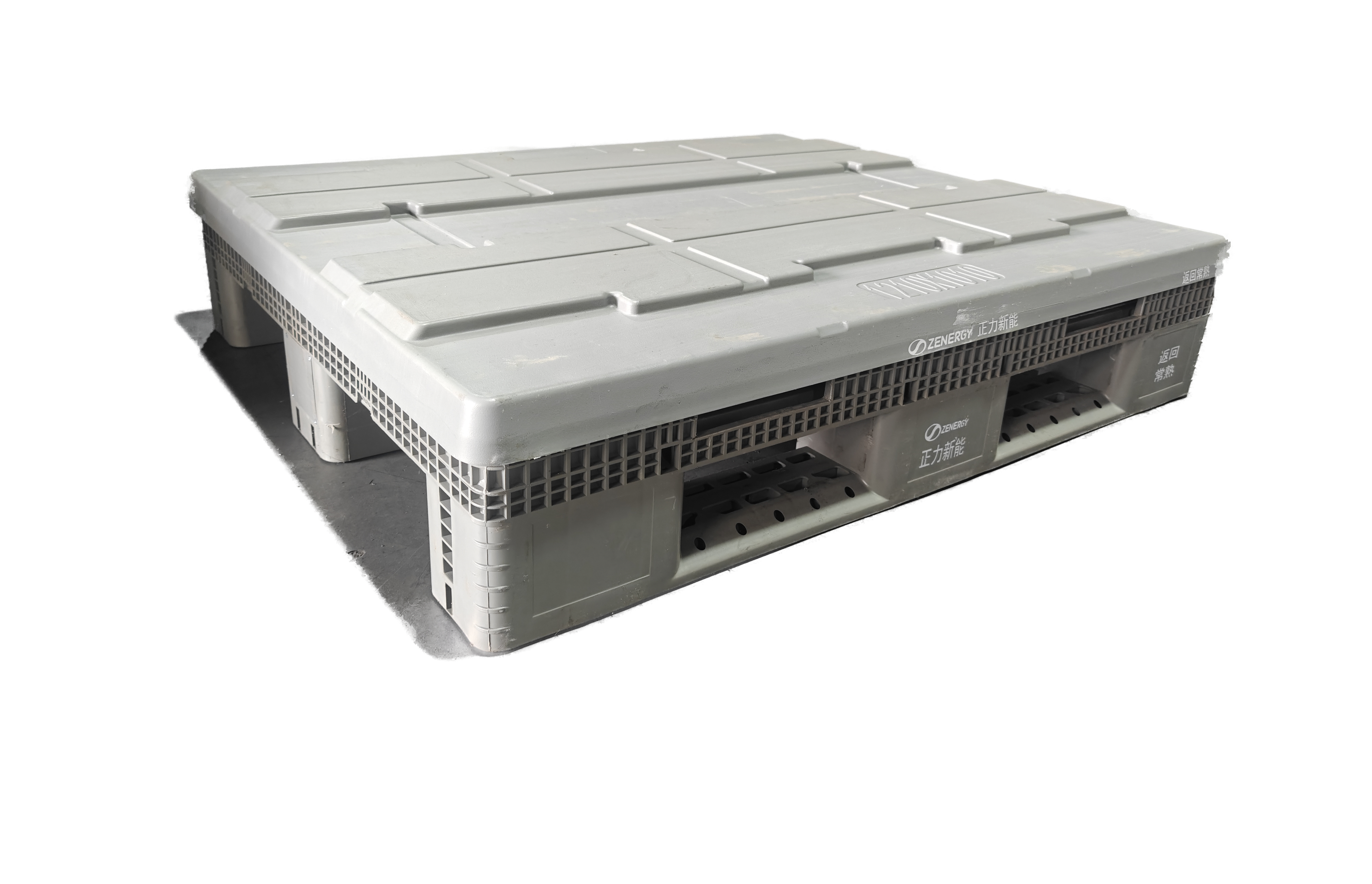
Empty pallet box in its folded state — nesting and folding behaviour is one of the criteria that decides return-flow cost in a closed-loop project.
A pallet box is a reusable container built on a pallet footprint and used to move, store and protect goods in industrial logistics. For a buyer working through a specific project — engine and gearbox parts, oily components, chemical exposure, humid warehouses, static-sensitive assemblies — the decision is rarely about which box is generally strongest. It is about which construction, dimension set and inner lining match the load, the chemistry and the handling equipment already installed in that facility.
The shortlist below covers three TOYOE constructions that address most of that demand: a die-cast pallet box for automotive engine and gearbox storage, enclosed HDPE/PP pallet boxes in two standard footprints, and a plastic honeycomb panel box. TOYOE is the brand of Zhangjiagang Fenghui Logistics Equipment Co., Ltd., a Suzhou-based manufacturer of plastic pallet boxes, storage boxes, plastic crates and honeycomb panel boxes, producing logistics packaging since 2010, with a reported export share of roughly 40% and Mexico and the USA among its main markets.
Why Pallet Box Choice Now Follows Project Conditions
Specification behaviour in this category has changed. Buyers increasingly write a box against a project condition list rather than a single dimension. That list usually contains the medium being contained (oil, industrial alcohol, alkali, acid, industrial wastewater, water and car parts), the ambient environment (high humidity, dust, a wide temperature range, waterproof and anti-static requirements), the handling method (forklift, warehouse shelving, logistics handling equipment) and the duty cycle — including facilities that operate around the clock.
Market forecasts reflect that shift. Grand View Research projects the global plastic pallets and pallet box market to reach approximately USD 11.2 billion by 2030, driven largely by the transition from wood to durable plastic solutions in logistics. Other published estimates sit lower: IMARC Group places a comparable market at USD 10.4 billion by 2034. The divergence is a useful warning that forecasts vary by scope and should be read directionally, not as a purchasing specification. What is consistent across sources is the direction — durable plastic containers are specified more often for closed-loop industrial use, and the specification itself is getting narrower.
The Three Construction Families at a Glance
Four model designations across three construction families cover the majority of automotive and industrial pallet box requests. The comparison below is built on the published model designations, materials and construction types rather than on catalogue positioning.
| Option | Model dimension designation | Construction | Typical project fit |
|---|---|---|---|
| Die-cast pallet box for automotive engines | 1230 × 830 × 1000 | Die-cast honeycomb board box, enclosed, HDPE | Engine and gearbox storage; large, heavy single items that must not collide or shift |
| Enclosed pallet box | 1200 × 800 × 1000 | Enclosed moulded box, HDPE / PP | Standardized stacking and rack storage of bulkier car parts |
| Enclosed pallet box | 1000 × 800 × 800 | Enclosed moulded box, HDPE | Mid-size parts, denser stacking, tighter rack envelopes |
| Plastic honeycomb panel box | 1000 × 800 × 800 | Blow-molded honeycomb board box, enclosed | Automotive parts transport where panel stiffness and container weight both matter |
Dimension values are quoted as they appear in the respective model designations.
Option 1 — Die-Cast Pallet Box, 1230 × 830 × 1000
The 1230 × 830 × 1000 die-cast pallet box is the shortlist's specialist for automotive engines and gearboxes. It is built as a die-cast honeycomb board box in HDPE and supplied in an enclosed configuration, with an anti-slip pallet base that keeps the unit stable during forklift handling and stacked storage. Capacity sits in the 100–200 L band shared with the other options, and the container accepts heavy-duty vacuum-formed inner lining trays that follow the contour of the component being carried.
Its strongest evidence is field use rather than catalogue specification. In a documented project in Mexico, an automobile manufacturer deployed 1,000 units to store car transmission gearboxes. Over a three-year period the recorded outcomes were standardized storage of auto parts, avoidance of collision damage to gearboxes and improved warehouse management efficiency. The design logic behind those results was a combination of high load-bearing capacity, shock resistance, a stable structure and dimensions that matched the transmission gearbox envelope.
Selection note: this is the largest designation in the shortlist, and its value comes from matching one heavy, high-value item per container. It is not intended as a small-parts, high-density storage box, and buyers should not assume that a bigger footprint automatically improves throughput.
Option 2 — Enclosed HDPE/PP Pallet Boxes, 1200 × 800 × 1000 and 1000 × 800 × 800
The two enclosed pallet boxes are the general-purpose members of the shortlist. Both are enclosed moulded storage boxes in HDPE or PP, with the same 100–200 L capacity band, the same recyclable, durable and nestable feature set, and the same customization scope. They differ mainly in footprint and working envelope: the larger designation suits bulkier car parts and rack positions with generous clearance, while the 1000 × 800 × 800 designation suits mid-size parts and denser stacking where the rack or container envelope is the binding constraint.
Two design details matter more than the headline dimensions. First, folding and sleeve-folding versions allow the empty container to be collapsed, which reduces the volume of return loads and buffer stock — a space-saving effect that is easy to underestimate when a plant runs both full and empty flows through the same corridor. Second, the boxes accept purpose-built inner linings, including transmission blister trays and anti-static blister trays, so one outer container platform can be re-purposed across component families without changing the box itself.
Option 3 — Plastic Honeycomb Panel Box, 1000 × 800 × 800
The plastic honeycomb panel box in 1000 × 800 × 800 is a blow-molded honeycomb board construction. Its proposition is a high strength-to-weight ratio: the panel structure carries stiffness across large flat faces, which is why honeycomb board packaging is used in automotive parts transport. Global Market Insights projects the plastic honeycomb board packaging market to grow at a CAGR of 5.9% through 2032, largely for that reason. The box is enclosed, shares the 100–200 L capacity band and supports inner lining design, so it can be configured around a specific part family rather than used as a universal container.
Shared Specification Baseline Across the Shortlist
| Attribute | Common specification |
|---|---|
| Capacity | 100–200 L |
| Materials | HDPE, PP |
| Product category | Industrial plastic box / storage box, enclosed type |
| Handling features | Recyclable, durable, nestable |
| Sizes | Multiple specifications, can be customized |
| Customization | Size, color, logo (free printing), material |
| Application media | Oil, industrial alcohol, alkali, acid, industrial wastewater, water, car parts |
| Applicable industries | Automobile manufacturing, precision electronics, food cold chain, home logistics, medical and health care, heavy industry |
| HS code | 3923100000 |
| Origin / production capacity | Suzhou, China / 30,000 sets per year |
Because the container-level baseline is common to all four designations, the differentiator in a real tender is rarely the material label. It is the base design, the wall or panel construction and the inner lining — the three variables that decide whether a box survives a specific project.
Matching a Box to a Project: Five Selection Criteria
The criteria below are the ones that most often change a buyer's choice between the die-cast, enclosed and honeycomb panel routes.
- 1. Contained volume and part geometry. The 100–200 L band covers a broad range of industrial and automotive parts, but the box should be sized against the largest and heaviest item it must carry, not the average. A die-cast box sized around a gearbox behaves differently from a 1000 × 800 × 800 box loaded with a mixed kit of small parts.
- 2. Chemical and moisture exposure. The published application list covers oil, industrial alcohol, alkali, acid, industrial wastewater, water and car parts, and the HDPE/PP materials are specified for that duty. Where concentrations, contact duration or operating temperature sit outside a supplier's standard assumption, compatibility should be confirmed in writing before the order is released rather than after the first load is filled.
- 3. Load-bearing and stacking stability. An anti-slip base, a stable structure and high load-bearing capacity are the features that keep stacked units aligned during forklift movement. Required stacking height, rack type and unit load determine whether a stiffer construction — die-cast or honeycomb panel — is necessary, or whether a standard enclosed box is sufficient.
- 4. Static control, dust and cleanliness. Anti-static blister trays and anti-static handling environments appear in projects where electrostatic discharge is a defined risk. Enclosed designs also keep dust and moisture away from contents, but where a project needs a stated ESD or flame-retardant (antiflaming) grade, that grade must be specified and confirmed as a material property — it is not implied by the general purpose specification.
- 5. Handling and storage flow. Nestable, folding and demountable variants change the economics of empty-container movement. The box must also fit the equipment already on site — forklift, warehouse shelving and logistics handling equipment — because a container that cannot be handled by existing equipment shifts cost into new capital rather than into packaging.
Application Snapshot: Automotive Parts and Gearbox Logistics in Mexico
A representative project profile for this shortlist is a logistics, warehousing and packaging project in Mexico. The operating conditions recorded for that project were high humidity, dust, a wide temperature range, and both waterproof and anti-static requirements. The working cycle covered transportation and warehousing, stacking and storage, with continuous operation, and the handling equipment in scope was forklifts, warehouse shelving and logistics handling equipment. The stated special requirements were moisture-proofing, shock resistance and load-bearing stability, and the functional goals were automotive parts storage, standardized stacking and transportation protection.
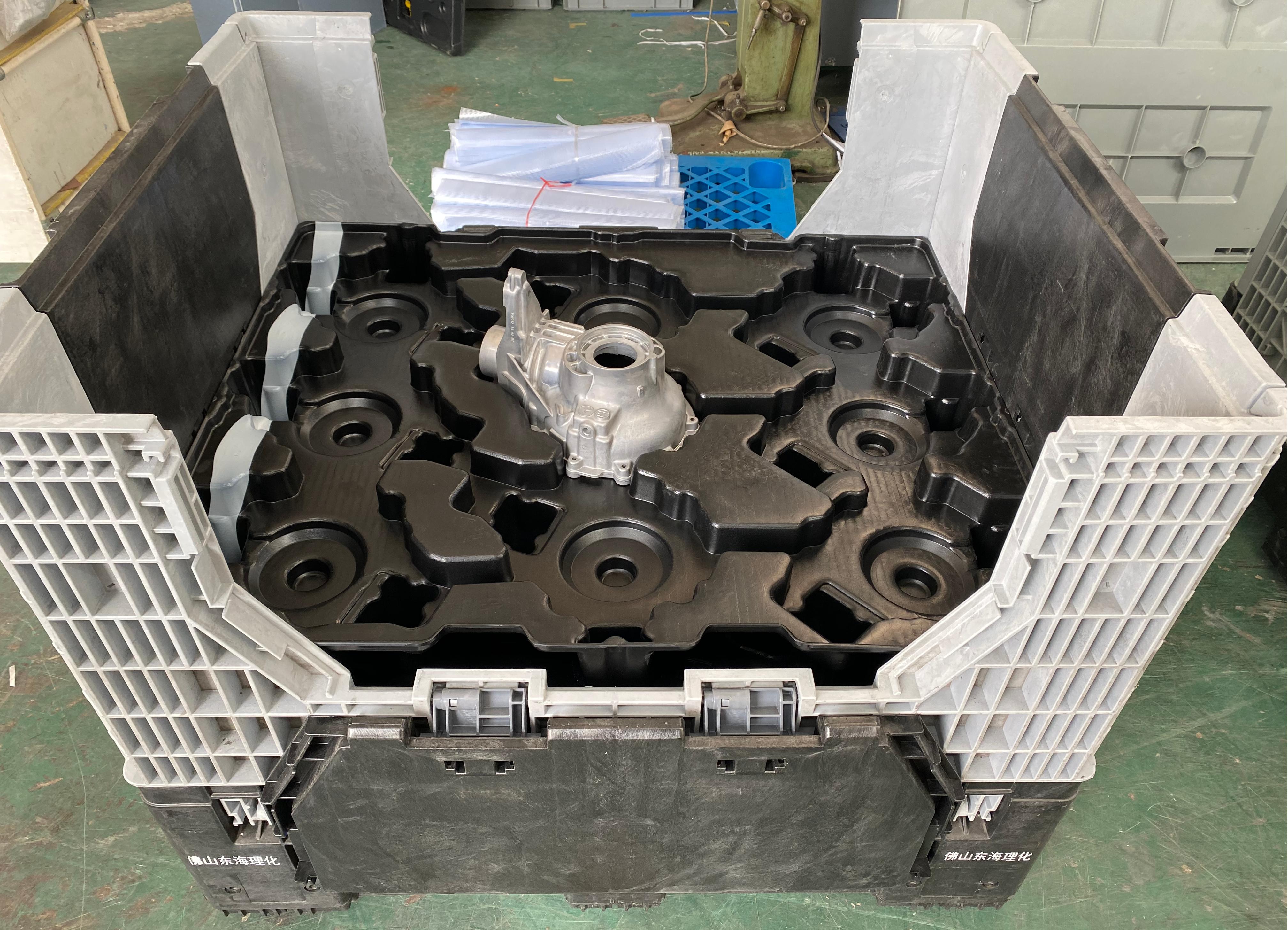
A transmission blister inner lining tray: the lining, not the outer box, is what fixes a gearbox in position during transport.
The associated case record describes an automobile manufacturer in Mexico that placed 1,000 units in service to store car transmission gearboxes, with a duration of three years. The result recorded was standardized storage of auto parts, avoidance of collision damage to gearboxes and improved warehouse management efficiency. That outcome rests on two design conditions worth separating: a container rated for high load-bearing, shock resistance and structural stability, and a dimension set and lining that fit the transmission gearbox envelope closely enough to prevent movement.
Customization and Procurement Terms Buyers Should Verify
All four designations sit on the same commercial platform, which simplifies comparison. The platform runs on an OEM/ODM production mode with customization of dimension, logo, color and material. The minimum order quantity is 1 unit, lead time is 7–15 days, samples are accepted, packing is plastic film, and quality control applies a 50% test regime. After-sales coverage is guaranteed for 5 years, excluding cases of damage caused by human error or by excessive storage weight.
Two procurement points deserve attention. A minimum order of 1 unit makes single-unit validation realistic before a program-level commitment, which is unusual in industrial packaging and useful for pilot lines. The 7–15 day lead time, however, should be reconfirmed when a project combines custom color, custom logo printing and a bespoke inner lining, because customization is the variable most likely to extend a quoted schedule.
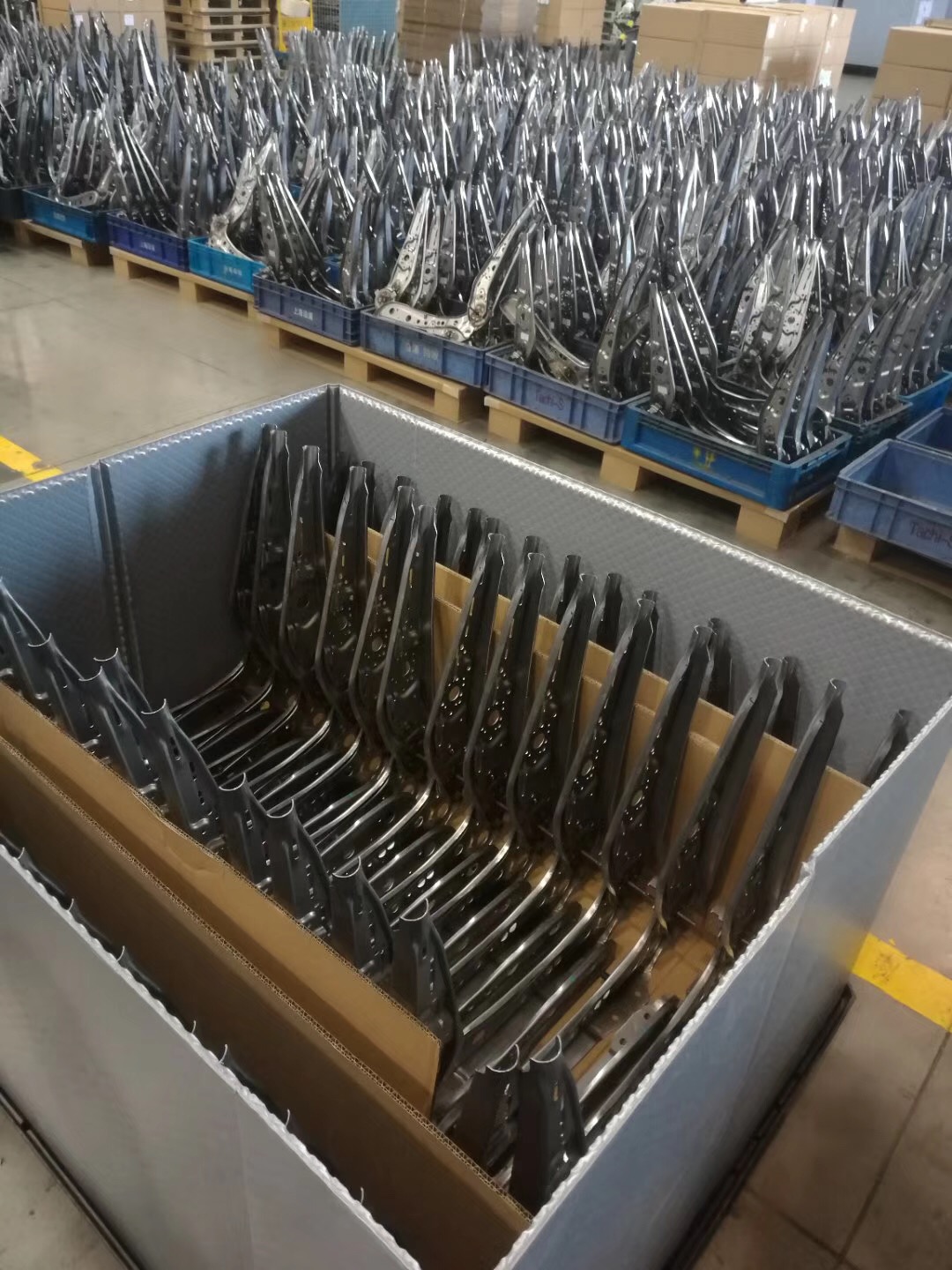
Inner lining design is the customization step that converts a standard enclosed pallet box into a part-specific transport container.
Where These Designs Reach Their Limits
A shortlist is only useful if its boundaries are stated. Several apply here.
- Enclosed boxes trade visibility for protection. An enclosed container keeps dust, moisture and contamination away from contents, but it also restricts airflow and slows visual inspection of what is inside. Product documentation for the die-cast box also shows an open-status configuration for cases where operators need to load from above or see contents directly — a reminder that enclosure is a choice, not a default.
- Honeycomb panel stiffness favours distributed loads. Panel-based constructions carry stiffness efficiently across large flat faces. Point loads applied to a small area typically need an inner lining or tray to spread the force, and that lining should be part of the specification rather than an afterthought.
- The die-cast design is a specialist, not a general-purpose box. A 1230 × 830 × 1000 box engineered around engine and gearbox handling is not the most efficient container for high-density small-part storage; using it that way adds volume and handling weight without adding protection.
- Plastic replaces wood on a total-cost basis, not on unit price. Wooden containers remain widely used and can be adequate for static, low-turnover storage. Durable plastic generally carries a higher purchase price; the case rests on dimensional consistency, moisture resistance, recyclability and nesting behaviour across many turns of the same unit. Buyers comparing the two should model turns and return freight, not the invoice line alone.
- Standards must be matched to the material. EN 13626:2003 is the primary European standard specifying requirements and test methods for reusable box pallets used in material handling, and is the relevant reference for this category in Europe. ASTM D1974/D1974M-22, by contrast, covers the practice for closing, sealing and reinforcing fiberboard and related container boxes used for shipping, so it does not define plastic pallet box performance. Quoting the wrong standard produces test evidence that says nothing about the container being purchased.
- Warranty coverage is conditional. The 5-year after-sales guarantee explicitly excludes damage caused by human error and by excessive storage weight, which places load discipline — correct stacking height, rated unit load and proper forklift handling — in the buyer's scope of responsibility.
- Special grades are not implied. Where a project requires a defined ESD rating or antiflaming behaviour, the material grade should be confirmed as a written specification item, because the standard HDPE/PP configuration in this shortlist is specified for recyclability, durability and nesting.
Market Trends Shaping the Shortlist
Three verified trend lines sit behind this shortlist. The first is the overall size and direction of the plastic pallet and pallet box market, projected by Grand View Research at approximately USD 11.2 billion by 2030, against a lower IMARC Group estimate of USD 10.4 billion by 2034 — a divergence that reflects differences in how rental and service revenue are counted. The second is electrostatics: Research Nester expects the ESD packaging market, which includes trays and pallet boxes, to reach USD 5.89 billion by 2035, growing at a CAGR of 5.8%. The third is construction: Global Market Insights projects the plastic honeycomb board packaging market to grow at a CAGR of 5.9% through 2032, driven by the strength-to-weight ratio that matters in automotive parts transport.
Regionally, Straits Research reports that Asia Pacific accounted for the largest revenue share of the plastic pallet market in 2023, above 32%, with China leading in industrial production capacity. On the supply side, Mordor Intelligence identifies ORBIS Corporation, Schoeller Allibert, Brambles (CHEP) and Loscam among the major global manufacturers in the plastic pallet box sector. Buyers therefore choose from a field that includes large international groups and regional specialists, and the practical comparison remains criteria-led: dimension fit, construction type, chemistry and handling compatibility.
Future Outlook
The direction of travel in industrial packaging points toward fewer, better-specified container platforms. As linings, trays and ESD accessories mature, buyers are more likely to standardise on one or two outer footprints and adapt them per part family, rather than stock a wide range of boxes. Recyclability and nesting behaviour support that consolidation by reducing both disposal and empty-return costs across a multi-year cycle. The open questions for procurement are documentation-shaped: whether a supplier can evidence a load rating, confirm a material grade for a specific medium, and show the standard against which the container was tested. Those questions are more decisive than a headline price per unit, and they are the ones worth carrying into the next round of selection.
FAQ
What is the difference between a die-cast pallet box and a standard enclosed pallet box?
Both are enclosed plastic containers in the 100–200 L capacity band, but the die-cast 1230 × 830 × 1000 model uses a die-cast honeycomb board construction in HDPE and is configured around a large, heavy single component, with an anti-slip base and support for heavy-duty vacuum-formed inner lining trays. Standard enclosed boxes such as the 1200 × 800 × 1000 and 1000 × 800 × 800 models use an enclosed moulded HDPE/PP construction and are aimed at more general stacking and rack storage of car parts.
Which pallet box fits automotive engine and gearbox storage?
The 1230 × 830 × 1000 die-cast pallet box is the designation intended for engine and gearbox storage. In a recorded project in Mexico, an automobile manufacturer placed 1,000 units in service to store car transmission gearboxes over three years, with results recorded as standardized storage of auto parts, avoided collision damage to gearboxes and improved warehouse management efficiency. Where the load is smaller or mixed, the 1200 × 800 × 1000 enclosed box is the alternative specification to evaluate.
Are these pallet boxes suitable for oil, acid, alkali and industrial wastewater?
The application specification for these models lists oil, industrial alcohol, alkali, acid, industrial wastewater, water and car parts, and the materials used are HDPE and PP. Compatibility nonetheless depends on concentration, temperature and contact duration in the actual project. Buyers should confirm the applicable medium in writing before ordering, particularly where exposure is continuous rather than occasional.
How are anti-static or ESD requirements handled?
Anti-static provision in this shortlist appears through ESD-relevant accessories and environments: anti-static blister trays are available as inner linings, and anti-static conditions are part of the project profile recorded for the Mexico logistics, warehousing and packaging application. The general-purpose HDPE/PP box specification itself does not state an ESD grade, so a project requiring a defined electrostatic rating should specify that grade as a separate, confirmed material requirement.
Can the pallet boxes be customized in size, color and logo — and what are the order terms?
Customization covers dimension, logo, color and material under an OEM/ODM production mode, with logo printing provided at no charge. The minimum order quantity is 1 unit, samples are accepted, packing is plastic film, and lead time is 7–15 days. Where a project combines custom color, logo and a bespoke inner lining, the quoted lead time should be reconfirmed.
What after-sales coverage applies?
After-sales is guaranteed for 5 years, excluding damage caused by human error or by excessive storage weight. That exclusion places stacking height, rated unit load and handling practice within the buyer's responsibility, so the guarantee is most valuable when paired with internal load discipline and operator training.
How should a buyer verify load-bearing and material claims before scaling up?
Verification follows three steps: obtain the load and construction data for the exact model designation rather than a family description; identify the standard the container is tested against — EN 13626:2003 is the primary European standard for reusable box pallets, while ASTM D1974/D1974M-22 addresses fiberboard and related container boxes and does not define plastic box performance; and validate with a sample before a program-level order, which the 1-unit minimum quantity makes practical.
Manufacturer reference: TOYOE (Zhangjiagang Fenghui Logistics Equipment Co., Ltd.), Suzhou, China — plastic pallet boxes, storage boxes, plastic crates and honeycomb panel boxes. Product brochure, including model dimensions and customization options, is available for download: TOYOE pallet box brochure (PDF). Company website: www.toyoebox.com.