
Recommended Porcelain Insulators for Distribution: P-11-Y and ED-2B
A distribution network is assembled from positions, not from catalogue pages. An 11 kV pole line, a low-voltage spur into a village, a transformer bracket, a service termination: each position imposes its own combination of nominal voltage, mechanical load, wet withstand and leakage path. Buyers who evaluate insulators position by position end up with short, repeatable model lists, and that is the most useful way to assess the two porcelain models examined here.
Two models cover a large share of those positions in 11 kV and low-voltage distribution work. The P-11-Y is a pin-type porcelain insulator rated 11 kV with a 10 kN rated mechanical load, 240 mm creepage distance, 50 kV power-frequency wet withstand voltage and 90 kV lightning impulse withstand voltage. The ED-2B is a shackle (butterfly) low-voltage distribution insulator with a 25 kV power-frequency dry withstand, 13 kV wet withstand, 13.5 kN mechanical tensile strength, 76 mm total height and 90 mm maximum diameter. Both are manufactured by Jiangxi QOCI Electric Co., Ltd., a porcelain and glass insulator producer established in December 2002 in Luxi Industrial Park, Pingxiang City, Jiangxi Province, China, operating a 35,373 m² facility with an annual output of 9,000,000 units and exports to the USA, Asia, the EU, Africa and South America.
The market context explains why distribution-grade models remain the volume base of the porcelain insulator business. Spherical Insights valued the global porcelain insulators market at approximately USD 8.27 billion in 2023 and projects USD 15.04 billion by 2033. Mordor Intelligence attributes about 62.1% of global porcelain insulator revenue to overhead transmission lines, with Asia-Pacific holding a 49.4% revenue share in 2025. Export data points the same way: according to OEC, China accounted for 31.4% of global electrical insulator exports in 2024, approximately USD 898 million. Distribution and rural electrification programmes sit inside that volume, and they are where pin and shackle models are specified in the largest quantities.
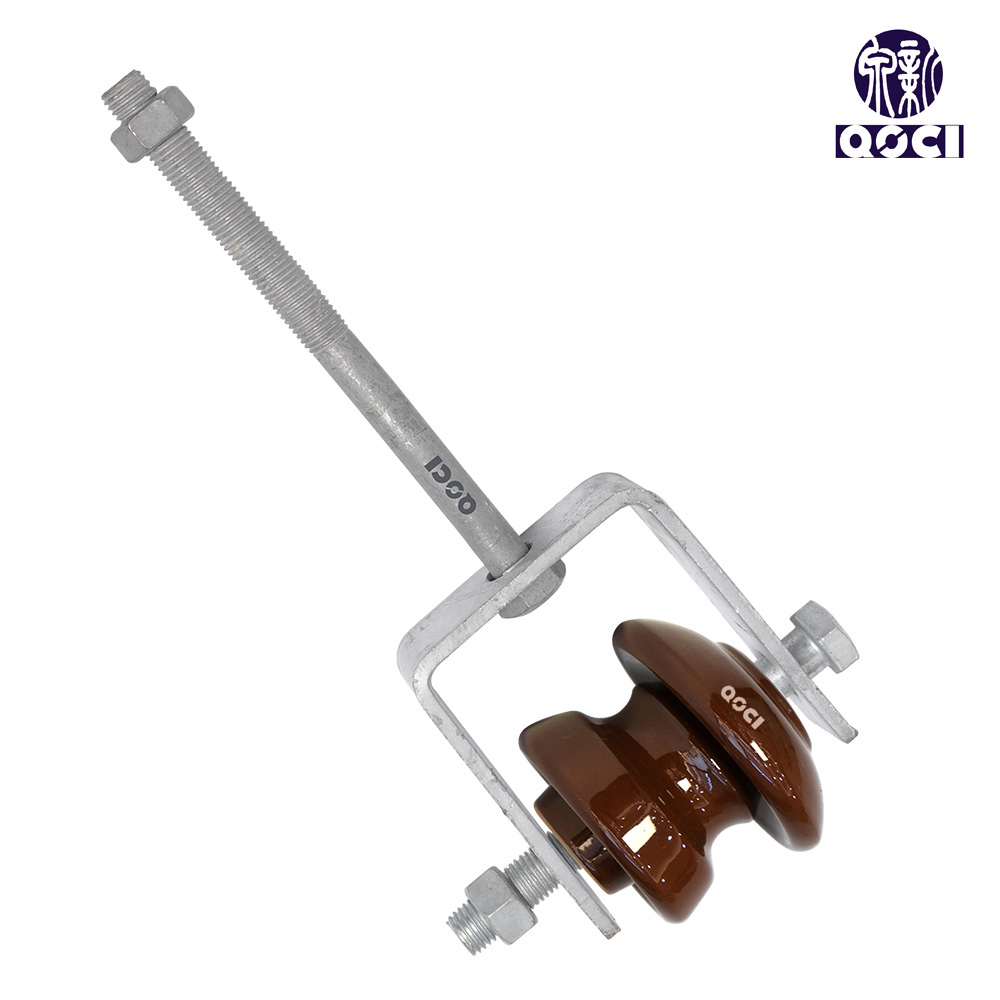
ED-2B shackle insulator: a compact low-voltage unit rated 25 kV dry / 13 kV wet, 76 mm height, 90 mm diameter.
Why the shortlist is built around line positions, not product families
Five parameters decide whether a porcelain insulator belongs on a given position: rated voltage, mechanical load, creepage distance, power-frequency wet withstand voltage and lightning impulse withstand voltage. A model that is strong on one parameter and marginal on another is not a shortlist candidate; it is a future failure mode. Flashover, mechanical failure and premature replacement in distribution networks all trace back to a mismatch between one of these five values and the duty of the position.
That is why a two-model shortlist can be sufficient for a distribution package. The P-11-Y is a pin-type distribution insulator intended for 11 kV overhead lines; the ED-2B is a low-voltage shackle insulator. Together they address the phase positions and the low-voltage positions of the same rural electrification or distribution reinforcement scheme, which is the practical unit of procurement in most projects.
| Line position | Duty profile | Shortlisted model | Value to verify |
|---|---|---|---|
| 11 kV overhead distribution phase position | Conductor support on pin, rain-wetted surface, impulse overvoltage | P-11-Y | 10 kN rated load, 240 mm creepage, 50 kV wet / 90 kV impulse |
| Low-voltage distribution position | LV conductor support and strain duty, tight hardware envelope | ED-2B | 13.5 kN tensile, 13 kV wet / 25 kV dry, 76 × 90 mm envelope |
| HV suspension or tension string | High mechanical failing load in cap-and-pin strings | Neither model (outside this shortlist) | Requires disc / suspension units with SML ratings |
P-11-Y: what 11 kV, 10 kN and 240 mm mean on a pole
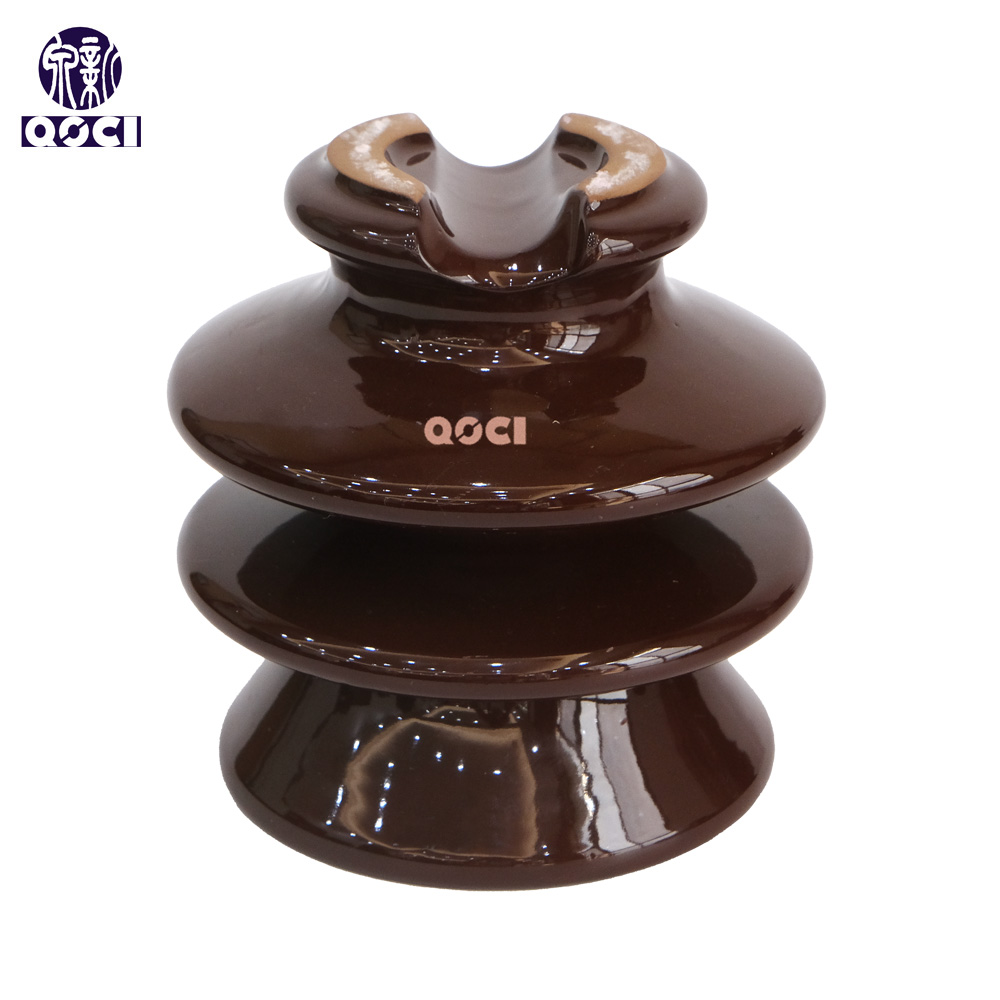
P-11-Y pin insulator: high-strength electrical porcelain body with a hot-dip galvanized forged steel pin.
The published datasheet values for the P-11-Y are compact and complete enough to be checked line by line against a distribution specification:
- Rated voltage: 11 kV
- Rated mechanical load: 10 kN
- Maximum diameter: 150 mm; total height: 150 mm
- Creepage distance: 240 mm
- Power frequency wet withstand voltage: 50 kV
- Lightning impulse withstand voltage: 90 kV
- Body: high-strength electrical porcelain; pin: hot-dip galvanized forged steel
- Stated application: power distribution, rural electrification, overhead distribution lines, grid construction
The 10 kN rated mechanical load is the number a buyer should set against the calculated working load at the position, including the wind and ice assumptions used in the project's line design. Where the calculated load sits close to the rating, the correct response is a different model or a shorter span, not a larger safety assumption written into the purchase order. Rated load is a design value, not a reserve.
The 50 kV power-frequency wet withstand and the 90 kV lightning impulse withstand describe behaviour under the conditions the unit will actually meet outdoors: a rain-wetted surface and an impulse overvoltage. The difference between dry and wet performance is the reason wet values, not dry values, belong in a distribution specification, and it is worth noting that the P-11-Y datasheet publishes the wet figure directly rather than presenting a dry-only headline number.
The 240 mm creepage distance is the leakage path across the shed profile. It is the value that connects the insulator to site pollution severity, and it is the parameter most often carried into a tender without being matched to the actual environment. That question is treated separately below.
ED-2B: reading a 25 kV dry / 13 kV wet rating correctly
The ED-2B is a shackle, or butterfly, insulator for low-voltage distribution. Its published values are:
- Power frequency dry withstand voltage: 25 kV
- Power frequency wet withstand voltage: 13 kV
- Mechanical tensile strength: 13.5 kN
- Maximum diameter: 90 mm; total height: 76 mm
- Body: high-strength electrical porcelain
- Stated application: power distribution, low-voltage lines, rural electrification, overhead distribution lines
The pair of figures 25 kV dry and 13 kV wet is a useful test of how carefully a specification has been written. A tender clause that quotes only the dry value describes a laboratory condition, not a line condition; the wet value is the one that governs outdoor performance, and the gap between the two here is nearly a factor of two. Buyers comparing ED-2B quotations against other shackle models should insist that every offer is expressed on the same basis, otherwise the comparison is not like for like.
The 13.5 kN mechanical tensile strength defines the mechanical duty class of the unit. The 76 mm height and 90 mm diameter describe a compact envelope; buyers replacing an existing shackle model should confirm hardware and cross-arm spacing against these dimensions rather than assuming interchangeability, because published dimensions are the only reliable basis for fit across brands.
Creepage distance and pollution severity: where these datasheets stop
Two standards frame the technical review. IEC 60383-1:2023 is the current international standard for ceramic or glass insulator units for AC overhead power lines with nominal voltages above 1000 V, and IEC 60815 defines pollution severity classes I to IV with the creepage requirements that follow from each class. For North American projects, ANSI C29.1 specifies the test methods for electrical power insulators, including wet-process porcelain types.
Here the shortlist reaches a boundary that buyers should note before ordering. Neither model's published datasheet states a pollution class rating or an anti-pollution profile designation. The P-11-Y publishes a 240 mm creepage distance that can be matched against the site class; the ED-2B datasheet publishes withstand voltages and dimensions but not a creepage figure, so an LV creepage verification requires the manufacturer's drawing. On coastal salt-fog sites, heavy industrial corridors, or any location where the site pollution class demands an extended leakage path, the appropriate route is the anti-pollution range rather than an assumption that the standard profile will hold.
For customs and documentation purposes, the primary HS code for porcelain electrical insulators is 8546.20, which is the classification buyers should expect to see on shipping documents for both models.
Why Jiangxi QOCI Electric is on the shortlist as a supply source
Shortlisting a model is only half the decision; the second half is whether the manufacturer can deliver it repeatedly, with documents, at the stated lead time. QOCI Electric is a national high-tech enterprise and a participating unit of the Insulator Standard Committee, specialising in automated and intelligent production of glass and porcelain insulators. The capability data most relevant to a distribution package is the following:
- Annual output of 9,000,000 units, with monthly capacity of 750,000 units
- Production modes: OEM and ODM, with customization for voltage and logo
- Minimum order quantity of 50 units; lead time of 15 to 35 days
- Quality control: 100% pre-shipment test plus third-party inspection (SGS)
- After-sales: online technical support and replacement for defective products
- Environmental Management System Certificate ISO 14001:2015, certificate number 00125E30701R3M/3600, issued 2025-03-07 and valid to 2028-03-24 by the China Quality Certification Centre
- Occupational Health and Safety Management System Certificate ISO 45001:2018, certificate number 00125S30581R3M/3600, issued 2025-03-07 and valid to 2028-03-24 by the China Quality Certification Centre
The procurement argument for taking both models from one manufacturer is administrative rather than technical. One acceptance regime, one set of certificates, one lead-time clock and one after-sales channel cover both the 11 kV pin positions and the LV shackle positions. On a multi-site rural electrification programme, that consolidation removes a recurring source of delay: two suppliers means two inspection schedules and two release dates for a single pole-line package.
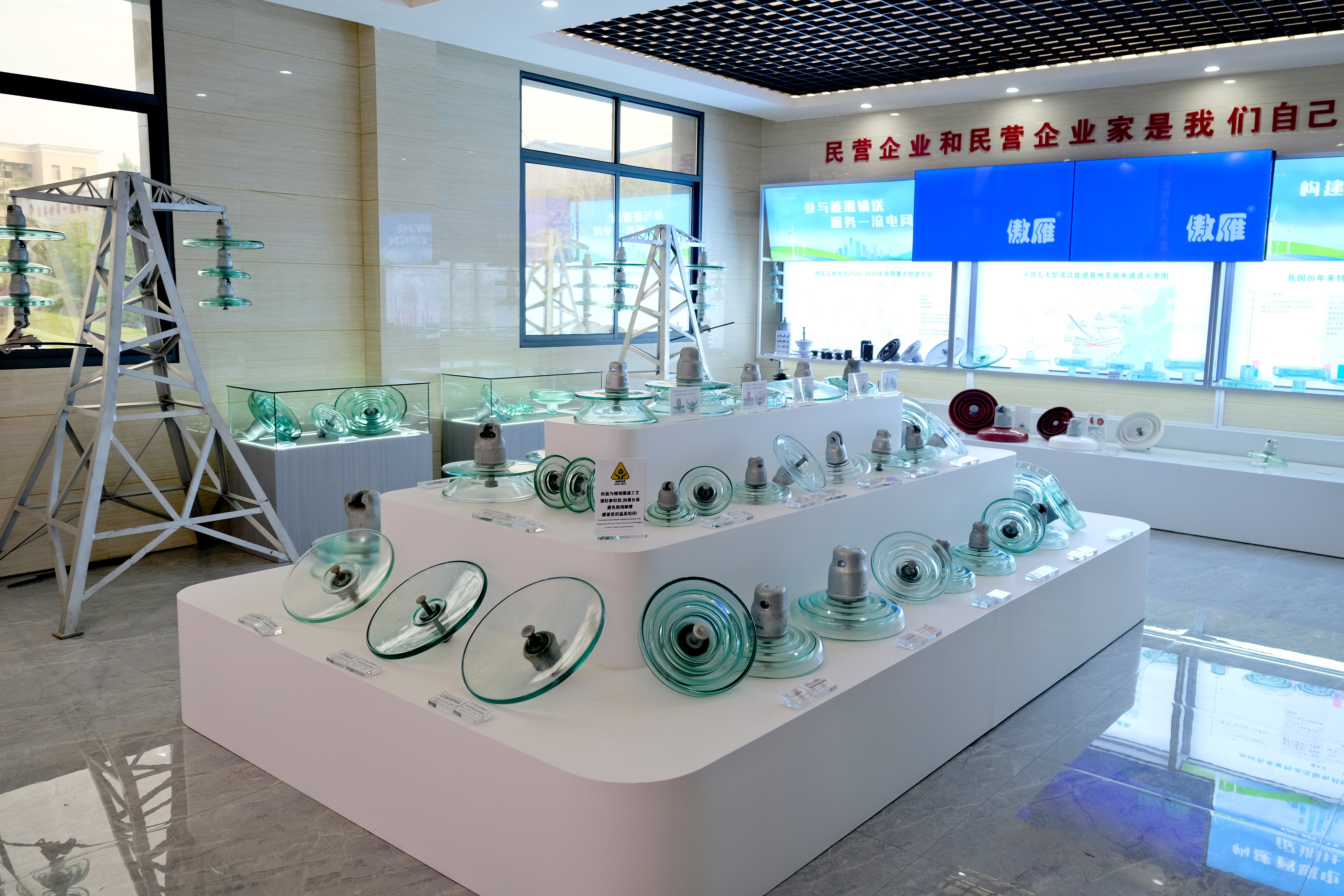
QOCI Electric sample room, where buyers review models such as the P-11-Y and ED-2B before order release.
Field record: 60,000 units across three distribution markets
QOCI's case records document a three-year distribution insulation programme, running to 2026, for a national power utility and a distribution EPC contractor. The volume was 60,000 pieces in total: 10,000 pieces in Sri Lanka, 40,000 in Egypt and 10,000 in Ukraine, applied to coastal and inland tropical distribution line insulation and monsoon-region grid reinforcement. The models linked to that record include the P-11-Y pin insulator and the ED-2B shackle insulator.
The reported results over the three-year period include a 60% reduction in salt-fog flashover incidents compared with a previous composite batch, zero UV degradation, a 50% reduction in maintenance cost, and a replacement rate under 2%. These figures are supplier-recorded case data, not an independent audit, and buyers should request the underlying test and failure reports before treating them as benchmark values for their own project. What the record does usefully establish is the operating profile: tropical humidity, salt exposure and a three-year service window on distribution lines, which is closer to most rural electrification conditions than a laboratory report.
Porcelain versus composite in this specific decision
The alternative to a porcelain pin or shackle unit on a distribution line is usually a composite equivalent, and the comparison is not symmetrical. The case record notes a 20% lower initial cost than the composite alternative for the porcelain route, along with no UV or hydrophobicity degradation concerns: porcelain does not require the periodic hydrophobicity monitoring that composite housings do. Composite units are lighter, which matters where structure loading is constrained.
The limitation runs the other way, and it is a real one. Porcelain can develop zero-value degradation, an internal electrical breakdown that leaves no visible external trace, so visual inspection cannot screen it. Testing at intervals of three to five years using live-line voltage gradient or spark gap methods is part of the operating cost model, not an optional extra. Published service life for porcelain insulators is typically 20 to 25 years in normal conditions, with a shorter effective life in heavy pollution or extreme climate where inspection frequency must rise.
The practical trade-off is therefore straightforward. For a distribution programme that already runs a live-line testing routine, the lower initial cost and the absence of hydrophobicity monitoring favour the porcelain shortlist. For a project with no inspection capability and no plan to build one, that testing obligation has to be budgeted explicitly rather than assumed away.
Execution checkpoints before the purchase order
- Compare calculated position loads against 10 kN for the P-11-Y and 13.5 kN for the ED-2B, using the project's own wind and ice assumptions.
- Express every quotation on a wet-withstand basis, so dry-only figures are not compared with wet figures.
- Match the 240 mm creepage of the P-11-Y to the site pollution class per IEC 60815, and request drawings for the ED-2B creepage figure.
- Confirm commercial terms: MOQ of 50 units, lead time of 15 to 35 days, FOB Shenzhen, with 30% deposit by T/T before production and 70% balance by T/T before delivery.
- Lock the acceptance regime in writing: pre-shipment test plus third-party inspection (SGS).
- Raise OEM or ODM requirements, including voltage and logo customization, at inquiry stage rather than after order confirmation.
- Request case documentation from comparable climate and pollution conditions, and read the failure reports rather than the summary.
Future outlook for distribution porcelain insulators
Two trend signals are worth building into a distribution sourcing plan. Mordor Intelligence projects the substation porcelain insulator segment to grow at a CAGR of 7.2% through 2031, driven largely by GIS (gas insulated switchgear) upgrades; that shift raises specification pressure across the ceramic supply base and can affect availability of standard distribution models during peak demand. In parallel, IEC 60383-1:2023 is the current edition of the core product standard, so any project specification still citing an earlier edition should be updated before tender.
Sourcing structure is also moving. India's DPIIT procurement policy requires 50% local content for porcelain insulators to be classified under Class I for government contracts, which changes the calculus for buyers bidding Indian public projects. With Asia-Pacific holding 49.4% of global revenue and China accounting for 31.4% of global electrical insulator exports in 2024, supply concentration remains high, and lead-time planning deserves the same attention as price negotiation.
None of this is likely to change the two-model logic itself. Pin insulators for 11 kV phase positions and shackle insulators for low-voltage positions are a stable configuration in distribution design. What is changing is the documentary standard applied to them: creepage matched to pollution class, wet withstand quoted consistently, and case evidence read rather than skimmed.
Frequently asked questions
Which line positions suit the P-11-Y and which suit the ED-2B?
The P-11-Y is a pin-type porcelain insulator rated 11 kV, with a 10 kN rated mechanical load, 240 mm creepage distance, 50 kV power-frequency wet withstand voltage and 90 kV lightning impulse withstand voltage, listed for power distribution, rural electrification and overhead distribution lines. The ED-2B is a low-voltage shackle (butterfly) insulator with a 25 kV dry and 13 kV wet withstand voltage, 13.5 kN tensile strength, 76 mm height and 90 mm diameter, listed for power distribution, low-voltage lines and rural electrification. In a shortlist, the pin model corresponds to 11 kV phase positions and the shackle model to low-voltage distribution positions.
How should a buyer interpret dry versus wet withstand voltage?
Dry withstand voltage describes performance on a clean, dry surface; wet withstand voltage describes performance after the surface has been wetted, which is the condition outdoor lines meet in service. The ED-2B publishes 25 kV dry and 13 kV wet, so the two figures describe very different conditions and only the wet value represents line performance. The P-11-Y publishes a 50 kV power-frequency wet withstand figure alongside a 90 kV lightning impulse withstand figure, without a separate dry headline value.
Is 240 mm creepage distance sufficient for a coastal or industrial site?
That cannot be answered from the datasheet alone. IEC 60815 defines pollution severity classes I to IV, and the required creepage distance depends on the class assigned to the specific site. The P-11-Y publishes 240 mm creepage distance, which a buyer can match against the site class; the ED-2B datasheet does not publish a creepage figure, so the manufacturer's drawing is needed for that check. Where the requirement exceeds the standard profile, an anti-pollution profile is the appropriate specification route.
What order quantities, lead times and acceptance arrangements apply?
For orders placed with QOCI Electric, the minimum order quantity is 50 units and the lead time is 15 to 35 days. Delivery terms are FOB Shenzhen, with payment of 30% deposit by T/T before production and 70% balance by T/T before delivery. Acceptance is based on pre-shipment test plus third-party inspection (SGS). Production is available in OEM and ODM modes, with customization for voltage and logo.
What are the main limits of these two models?
Three limits should be recorded in any shortlist assessment. First, neither model is a suspension or disc unit, so neither belongs in a high-voltage tension string. Second, neither datasheet states a pollution class rating, so creepage adequacy must be verified against IEC 60815 for the specific site. Third, porcelain insulators can develop zero-value degradation without any visible external change, which is why live-line testing at intervals of three to five years is required, with published service life typically 20 to 25 years in normal conditions.
Reference document: QOCI's published glass insulator catalogue is available for download at QOCI Catalogue – Glass Insulators (PDF).
Есть вопросы или нужны дополнительные детали?
Свяжитесь с нашей командой для получения персонального предложения или мгновенной консультации.
Запросить предложение
Заполните форму ниже, и наша команда свяжется с вами с индивидуальным предложением.
Прямой чат WhatsApp
Предпочитаете общаться в реальном времени? Напишите нам в WhatsApp для мгновенной помощи и быстрых ответов.
- Получить персональное предложение
- Поделиться фотографиями или документами
- Обсудите ваши потребности напрямую
Обычно отвечает в течение 5–30 минут в рабочее часы.