
Recovery Slippers Compared: Real Cork vs. EVA vs. Latex Cork—What Independent Tests Show
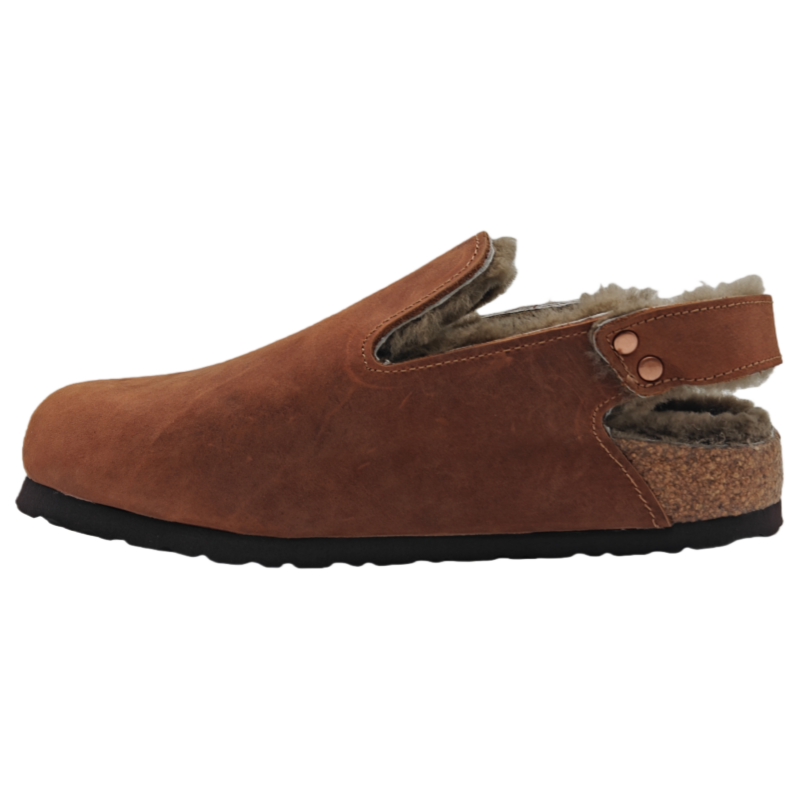
One of the documented cork-footbed models in the comparison: genuine leather upper, latex cork + SBR midsole, wear-resistant EVA outsole.
Recovery slippers are usually presented through material claims: cork shapes the foot, latex cork absorbs load, and EVA cushions every step. For B2B buyers in the Research and Evaluation phase, however, the first question should be whether a product file can verify those claims. This analysis compares six documented recovery slipper models from ORTHOCARE, a foot-health recovery footwear range produced by Xiamen Jerryfootprint Imp & Exp Co., Ltd., a manufacturer established in 2017 in Xiamen, Fujian, China. The comparison uses only listed specifications, size ranges, catalog positioning, and the independent test data included in the reviewed documentation set.
The comparison set is deliberately narrow. Models CS01 and CS02 are the two cork-type models with genuine leather uppers, latex-cork composite midsoles, and wear-resistant EVA outsoles. Models C22, L25, A08, and D01 are catalogued as EVA recovery footwear, with a stated softness range of 38–50 degrees and different size spans. The goal is not to declare one material the winner, but to show how a buyer can compare cushioning claims, durability attributes, and size availability without relying on marketing language.
Why material labels are not enough in recovery slipper sourcing
Real cork, latex cork, and EVA can sound like three separate categories. The verified product documents tell a more nuanced story. CS01 and CS02 are listed as type “Real cork shoe,” yet their midsoles are specified as “Latex cork + SBR + suede backing” and their outsoles as “Wear-resistant EVA.” In this documentation set, therefore, “real cork” is the product positioning, while “latex cork” describes the actual structural footbed layer. EVA appears twice: as the sole material of the four EVA recovery models, and as the durable outsole material beneath the cork-footbed models.
For a buyer, this distinction matters. If a sourcing brief simply says “cork only” or “EVA only,” it may exclude a well-constructed hybrid such as a latex cork footbed on an EVA outsole. Conversely, if a supplier shows an EVA outsole, that fact alone does not mean the footbed is EVA. The construction stack must be read layer by layer.
Verified models and construction layers
The table below summarizes what is actually stated in the ORTHOCARE product records for the six models included in this review. No additional parameters have been added beyond the original specification fields.
| Model | Catalog type | Listed construction / material | Lining or model note | Size availability |
|---|---|---|---|---|
| CS01 | Real cork shoe | Upper: genuine leather, 3 mm thickness; midsole: latex cork + SBR + suede backing for cushioning and durability; outsole: wear-resistant EVA | Lining: suede standard / wool winter edition for enhanced warmth; adjustable backstrap style | 36–46 |
| CS02 | Real cork shoe | Upper: genuine leather, 3 mm thickness; midsole: latex cork + SBR + suede backing for cushioning and durability; outsole: wear-resistant EVA | No lining variant listed in the current specification record | 36–46 |
| C22 | EVA nurse shoe / EVA recovery footwear | Primary material: EVA; softness: 38–50 degrees | Model is designated as a nurse shoe within EVA recovery footwear | 39–46 |
| L25 | EVA slipper | Primary material: EVA; softness: 38–50 degrees | Two-tone EVA slipper silhouette | 36–46 |
| A08 | EVA thong / EVA recovery slipper | Primary material: EVA; softness: 38–50 degrees | EVA thong configuration for recovery walking | 36–46 |
| D01 | EVA slipper / recovery footwear | Primary material: EVA; softness: 38–50 degrees | Two-strap EVA slipper design | 36–44 |
What independent tests show in the current documentation set
For recovery slippers, the phrase “independent tests” is often used loosely. In the documentation reviewed here, the verifiable third-party evidence is the Intertek Footwear Test Report for EVA Flip-Flops, numbered FJXT80162636, issued by Intertek Testing Services Shenzhen Ltd. Xiamen Branch and valid for the EU market. The certificate issue date is 14 January 2026, with validity through 13 January 2031.
The report is an important constraint document because it is not a generic “comfort test.” It addresses measurable safety and chemical properties that matter when recovery slippers are placed in regulated retail or healthcare-adjacent channels:
- Slip resistance, tested to SATRA TM144:2021
- Strength of sandal toe post, tested to SATRA TM118:2025
- Abrasion resistance of outsole, tested to ISO 20871:2018
- Colour fastness to light, tested to ISO 105-B02:2014
- PAH content, cadmium content, total lead content, and phthalates content under the cited analytical methods
Buyers should also note which models the certificate is linked to in the product file. The Intertek report is connected to the EVA flip-flop-type models A05, A07, A08, and D01. Within the six-model comparison in this article, only A08 and D01 appear in that certified group. The cork-footbed models CS01 and CS02, the EVA nurse shoe C22, and the EVA slipper L25 are not listed under this particular certificate in the reviewed data set.
This is not an assertion that those models are untested. It is a documentation statement: if a recovery slipper program needs model-specific EU test evidence, the available certificate in this data pack should be mapped to the exact SKU before claims are made to a distributor or retailer.
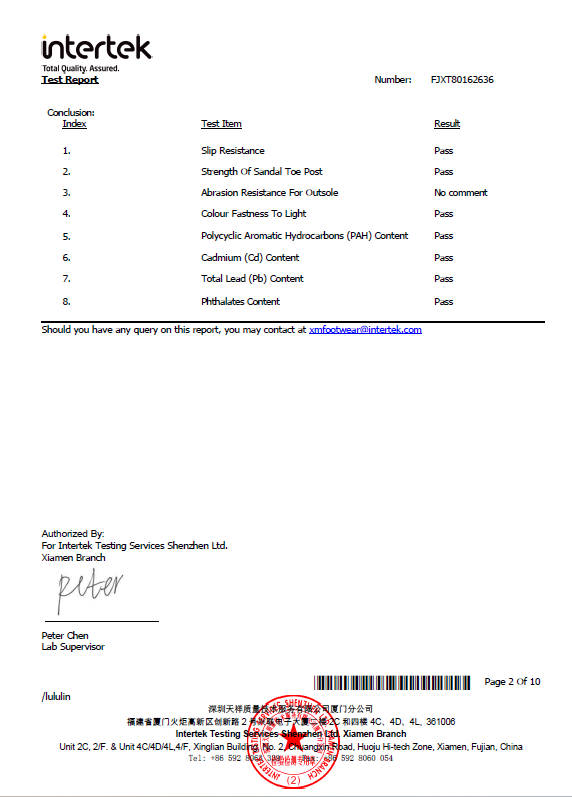
The reviewed Intertek report covers slip resistance, toe post strength, outsole abrasion, colour fastness, and restricted substance testing for the EVA flip-flop product family.
Softness range 38–50 degrees: what it can and cannot tell you
The four EVA models in this comparison—C22, L25, A08, and D01—all carry the same softness specification: 38–50 degrees. For a buyer, this range is a useful threshold but not a precise performance result. It does not state whether a given production batch will be closer to 38 degrees or closer to 50 degrees, and it does not describe how the foam behaves after repeated compression.
ORTHOCARE’s parent manufacturer, Xiamen Jerryfootprint, does document customization capability on this point. The scenario and capability records show that OEM/ODM programs can request customized Shore A hardness—for example, 35–40 degrees for an extremely soft feel—as well as arch support customization, full-model customization, and comprehensive testing and validation. In other words, when a lower or higher hardness point is a commercial requirement, the hardness target should be specified as part of the sampling and qualification process rather than inferred from the broad 38–50-degree range.
The two cork models CS01 and CS02 do not publish a numeric hardness value in their specification fields. Their cushioning story is structural: genuine leather upper of 3 mm thickness, latex cork + SBR + suede backing midsole, and wear-resistant EVA outsole. Because the latex cork composite is layered with SBR and a suede backer, the cushioning behavior depends on the density and thickness of those layers, not on a single foam hardness number.
How to compare cushioning claims between the two groups
A buyer can use three checks. First, identify the actual load-bearing layer. In CS01 and CS02, that layer is latex cork + SBR, not the EVA outsole. In C22, L25, A08, and D01, the entire shoe is EVA, so the foam itself determines the sensation. Second, look for numeric boundaries. Only the EVA models offer an explicit softness range in the current files. Third, confirm the hardness target with the supplier before mass production. If a private-label program cannot define softness in measurable units, the production specification will be difficult to hold across purchase orders.
Durability and intended environment: leather, wool, and EVA
Durability is another area where the model files reward careful reading. CS01 and CS02 use genuine leather uppers with 3 mm thickness and a wear-resistant EVA outsole, which gives the cork models a base layer suitable for regular indoor-outdoor use. CS01 adds a suede lining as standard and a wool lining as the winter edition, making it a candidate for cold-weather home recovery and winter-season catalog programs. CS02’s current specification record does not list a lining variant, so a buyer who specifically needs a wool-lined or suede-lined cork model should treat CS01 as the documented option and confirm CS02’s lining options separately.
The EVA models present a different maintenance profile. Because C22, L25, A08, and D01 are single-material EVA listed for indoor, outdoor, and post-exercise walking, they have no leather or textile lining to protect. That construction tends to be easier to rinse after gym, pool, or outdoor use. However, “easy to rinse” does not appear as a formal test claim in the product documentation. It is a logical property for buyers to confirm during the sampling stage.
One more boundary deserves attention: a wool-lined suede model such as CS01 is not an obvious choice for wet outdoor environments or for users who need a fully cleanable medical-style slipper. The documentation lists CS01 and CS02 under the clothing and footwear industry, not as medical devices. Buyers planning to position these models for clinical or diabetic-friendly programs should validate such claims against their own regulatory and product-liability rules.
Size availability and demographic fit
Size coverage is often the fastest filtering criterion in recovery slipper sourcing. In this comparison, the patterns are clear:
- CS01 and CS02 cover EU sizes 36–46.
- L25 and A08 cover EU sizes 36–46.
- D01 covers EU sizes 36–44, so it does not reach the largest sizes in this set.
- C22, the EVA nurse shoe, starts at EU size 39 and stops at 46, so it does not cover smaller unisex sizes.
A buyer planning a broad demographic program from EU 36 through EU 46 should consider a mix such as A08 or L25 for the full EVA size span, CS01 or CS02 if a cork footbed program must also reach EU 46, and D01 or C22 only when the target customer group fits within their smaller documented ranges.
Scenario fit: post-exercise recovery and everyday orthopedic support
The ORTHOCARE documentation connects this product family to several scenarios, including sports recovery, orthopedic and recovery footwear, active wellness, premium outdoor use, and sustainable fashion preferences. In the scenario records, the intended functions are described as targeted arch support, reduced plantar pressure, and support for muscle recovery through biomechanical alignment. The working conditions include post-exercise recovery, daily orthopedic support, clinical rehabilitation-type environments, lightweight cushioning for long-distance walking, and slip resistance across varied surfaces.
Those scenario descriptions map naturally to the physical differences between the product groups. For a post-exercise recovery line where open, easy-to-pack footwear is preferred, EVA thongs and EVA slides such as A08 and L25 are the documented choices. For a colder-season or leisure wear line where the buyer wants a natural-material footbed story, CS01 or CS02 offers the cork-type layering. For healthcare-influenced buying, C22’s nurse-shoe category suggests environments where staff need closed-in recovery footwear, but the current data set does not claim a medical-device classification for C22 or any other model in the group.
The documentation also includes a long-term case reference: a South Korean brand owner has sourced EVA arch support recovery footwear from Jerryfootprint at a cumulative quantity of one million pairs over roughly five years, with the supplier reporting stable production and on-time shipment across that relationship. That case is product-category evidence for repeat scale, not a clinical outcome claim.
Production constraints for private-label and OEM buyers
Because this is a B2B sourcing context, production constraints belong in the comparison. The reviewed capability record for Xiamen Jerryfootprint lists a monthly capacity of 100,000 pairs, a minimum order quantity of 2,000 pairs per color per style, and a standard lead time of 30–45 days. Quality control is documented as 100% inspection before shipment, with an after-sales quality promise valid for three months after shipment.
These constraints affect model selection in two ways. First, a portfolio that mixes leather-and-cork models with EVA models will face different finishing and inspection workflows, so the order schedule should be defined per construction type. Second, because the documented MOQ is based on color and style rather than on an entire program, a buyer can test one cork model and one EVA model without committing an entire catalog to a single material direction.
Market context and verification standards
External market data helps explain why this level of specification review matters. Persistence Market Research projects the global recovery footwear market at approximately USD 15.3 billion in 2025, expanding to USD 24.6 billion by 2032. Precedence Research estimates that North America held around 40% of the recovery footwear market in 2025 and that the after-foot-surgery application segment contributed the largest share. In the same period, medical footwear slip-resistance expectations in the United States are increasingly tied to the ASTM F3445-21 standard.
For a buyer, the practical translation is straightforward. The recovery footwear category is large enough that multiple product architectures will coexist: all-EVA walking slides, leather-trimmed cork-footbed clogs, and certified hospital-influenced silhouettes. The material that performs best will depend on the target channel’s certification expectations, seasonal calendar, and price architecture. A North American distributor may need to prioritize ASTM-referenced slip testing; an EU retailer may ask for the Intertek restricted-substance and physical-test evidence; a wellness brand may prefer the natural-cork footbed narrative. None of these can be judged from the word “cork” or “EVA” alone.
Limitations found in the current evidence set
A genuinely independent comparison should state its boundaries. In this case, the boundaries are as important as the product facts.
- The only independent test report in the reviewed documentation set is linked to EVA flip-flop-type models A05, A07, A08, and D01. It does not cover CS01, CS02, C22, or L25. A buyer cannot present the same certificate as proof for a cork-footbed model.
- The softness specification of 38–50 degrees appears across the EVA models, but it does not reveal the exact hardness of any single production batch. Samples should be locked before mass production.
- CS01 and CS02 include genuine leather uppers, which changes their care profile and durability boundaries compared with all-EVA models. Leather and wool need more protection in wet environments and are not inherently easier to sanitize.
- C22 is documented only from EU size 39 upward, and D01 only to EU size 44. Programs needing smaller or larger sizes must choose different models within the portfolio.
These limits are not reasons to avoid cork or EVA. They are reasons to write sourcing briefs in the language of construction layers, size ranges, certificates, and measurable hardness rather than in the language of material superlatives.
Future outlook
As recovery footwear expands beyond sports-recovery branding into healthcare-adjacent categories, the competitive advantage will shift from material storytelling to verifiable constraint data. A buyer will be able to say: “I need an EVA thong or two-strap slipper covering sizes 36–46, hardness within a defined point of the 38–50-degree band, and EU test evidence for slip resistance, outsole abrasion, and restricted substances.” In the reviewed portfolio, A08 and D01 are the EVA models that the current Intertek record directly supports. A buyer will also be able to say: “I need a leather-lined cork-footbed model that reaches size 46 and provides a natural-footbed message,” in which case CS01 with its suede and wool lining options is the clearer documented fit.
For manufacturers and their brand partners, the lesson is that category growth will reward clarity. Xiamen Jerryfootprint has invested in a wide model matrix, OEM/ODM customization, and third-party testing for part of its EVA line. The next step for any buyer is to convert those assets into model-specific specifications and sampling protocols before writing the first purchase order.
FAQ
1. What is the difference between a “real cork” recovery slipper and an EVA recovery slipper?
A “real cork” model in the reviewed ORTHOCARE documentation is not a shoe made entirely of cork. CS01 and CS02 are catalogued as real cork shoes with a genuine leather upper, a midsole of latex cork + SBR + suede backing, and a wear-resistant EVA outsole. An EVA recovery model such as C22, L25, A08, or D01, by contrast, uses EVA as the primary material and lists a softness range of 38–50 degrees. The difference is therefore a structural one: layered cork-footbed construction versus single-material EVA construction.
2. What does “latex cork” mean in the CS01 and CS02 specifications?
In the product records, “latex cork” is the material used in the midsole construction of CS01 and CS02. The full midsole specification is latex cork + SBR + suede backing, described in the documentation as providing cushioning and durability. This latex cork composite sits above a wear-resistant EVA outsole and below a 3 mm genuine leather upper.
3. Which EVA recovery slippers in this comparison are covered by an independent Intertek test report?
The reviewed Intertek Footwear Test Report, certificate number FJXT80162636, is linked to EVA flip-flop-type models A05, A07, A08, and D01. In the six-model comparison of this article, A08 and D01 are the certified models. The report covers slip resistance, toe post strength, outsole abrasion resistance, colour fastness to light, and restricted substances including PAHs, cadmium, lead, and phthalates.
4. Is a softness range of 38–50 degrees a guarantee of soft cushioning?
It is a useful starting point, but it is not a guarantee. The range tells a buyer that the EVA models are formulated in a soft-to-mid recovery foam band, but it does not say whether an individual production batch will be near 38 or near 50 degrees. For a precise result, the buyer should specify a Shore A hardness target and approve a production sample. The capability documentation also mentions OEM customization of Shore A hardness in the 35–40-degree range for an extremely soft feel.
5. Which recovery slipper models cover sizes 36 to 46?
In the compared group, CS01, CS02, L25, and A08 cover the full documented range of sizes 36–46. D01 covers sizes 36–44, and the EVA nurse shoe C22 covers sizes 39–46. A sourcing program requiring size 36 through 46 must therefore use one of the 36–46 models rather than relying on D01 or C22.
6. Are these recovery slippers suitable for plantar fasciitis or diabetic-friendly programs?
The models are positioned as recovery and foot-comfort footwear with arch support-related details, but the reviewed documentation set does not describe them as medical devices, and no clinical claim is documented in the product records. For diabetic-friendly or plantar fasciitis programs, a buyer should evaluate pressure distribution, seam placement, lining behavior, and slip resistance through sample testing, and should confirm whether separate regulatory documents or clinical evidence are needed for the target market.
7. Should a buyer choose cork or EVA recovery slippers for healthcare retail?
The choice depends on the healthcare channel’s requirements. If the requirement is EU-certified EVA flip-flop footwear with third-party slip and chemical testing within this documentation set, A08 or D01 is the more directly documented route. If the requirement is a natural cork-footbed product with leather uppers and a story of layered cushioning, CS01 or CS02 fits that brief when no independent test certificate is part of the current file set for those exact models. The commercial answer is not “cork is better” or “EVA is better”; it is “the model must match the channel’s test, size, and material requirements.”
Есть вопросы или нужны дополнительные детали?
Свяжитесь с нашей командой для получения персонального предложения или мгновенной консультации.
Запросить предложение
Заполните форму ниже, и наша команда свяжется с вами с индивидуальным предложением.
Прямой чат WhatsApp
Предпочитаете общаться в реальном времени? Напишите нам в WhatsApp для мгновенной помощи и быстрых ответов.
- Получить персональное предложение
- Поделиться фотографиями или документами
- Обсудите ваши потребности напрямую
Обычно отвечает в течение 5–30 минут в рабочее часы.