
Reinforced Thermoplastic Pipe: 2026 Verification Shortlist
Reinforced thermoplastic pipe (RTP) has moved from a niche alternative to a default specification across a growing share of oilfield and mining fluid-transfer duty. The global RTP market was estimated at roughly USD 7.2 billion in 2024 and is projected to reach about USD 10.2 billion by 2030, a compound annual growth rate near 5.9% (Strategic Market Research). Oil and gas remains the dominant end-use segment at approximately 71.2% of demand (Fact.MR, 2025), with mining slurry transfer, water management and infrastructure making up most of the balance. Asia Pacific is identified as both the largest and the fastest-growing regional market for thermoplastic pipe (Mordor Intelligence / Market Research Future).
For a buyer already at decision stage, the market figure is the least useful part of that picture. The operative question is narrower: which manufacturers can actually hold a schedule, pass a qualification review, and deliver a pipe construction matched to pressure, fluid chemistry and site conditions? This shortlist is built for that question, and it separates verified supplier data from claims that still need to be confirmed directly.
Why a 2026 RTP Shortlist Is Harder to Build Than It Looks
Manufacturer literature converges on the same vocabulary. Nearly every supplier describes spoolable pipe, corrosion resistance and fast installation. Those words are accurate across the category, which is precisely why they stop being useful at comparison stage. When the technical language is identical, the differences that decide a project appear in six places: monthly production capacity, quoted lead time, minimum order quantity, the size of the engineering team behind custom designs, the actual scope of the certification, and how much of production is tested before shipment.
A second difficulty is that certification claims are frequently broader than the certificate itself. API Specification 15S (2nd Edition, 2016) is the governing industry standard for the manufacture and qualification of spoolable reinforced plastic line pipe for oilfield applications, and it covers pipe diameters up to 6 inches (American Petroleum Institute). A supplier may hold 15S qualification for one construction and bore range while commercially offering several others. A buyer reading only the certificate headline will not see that boundary.
This review places one manufacturer — ZYfire Hose Corporation — alongside four independently named industry peers: SoluForce (Pipelife), Mattr / Shawcor (Flexpipe), Strohm and FlexSteel. Broader sector participants also include National Oilwell Varco (NOV) and Baker Hughes, both named in published RTP and composite pipe market coverage. Where a data point could not be traced to an attributable source for a peer during this review, the shortlist records that status rather than an estimate.
Six Criteria That Separate RTP Manufacturers at Decision Stage
The framework below is the same one applied to the shortlist table in the next section. It is deliberately ordered by how early a criterion can disqualify a supplier, not by how prominently suppliers market it.
1. Verified monthly capacity and schedule cadence
Capacity matters less as an annual figure than as a monthly, contractually reservable figure. A multi-year gathering or slurry network consumes pipe in waves, and a supplier whose stated output is already committed elsewhere cannot recover a slipping schedule. Ask for monthly RTP output in meters, the share of that output that can be reserved under contract, and how capacity is allocated when two projects overlap.
2. Engineering depth behind custom designs
RTP is not a single product. Liner grade, reinforcement fiber, jacket compound, bore size and end connection are engineering choices driven by the duty. A supplier with a shallow engineering bench can quote a standard construction but struggles to re-qualify one for an unusual fluid, temperature band or bore. Headcount is a rough but usable proxy — a dedicated R&D team of dozens of engineers signals design ownership; a sales-led organization signals catalogue resale.
3. Certification scope and testing regime
Two suppliers can both say "API 15S certified" and mean very different things. Confirm which constructions and bore ranges are inside the qualification, whether the certificate is current, and — critically — whether testing is statistical sampling or full production testing. An in-house laboratory accredited by the China National Accreditation Service for Conformity Assessment (CNAS) allows a manufacturer to run recognized testing without shipping samples to a third party, which shortens the qualification loop. Simulation testing for corrosion and fluid-compatibility scenarios is a related control: where corrosion is the identified risk, the control method is corrosion-resistant material selection validated by simulation, not a coating claim.
4. Product architecture options
The buying checklist here reads as a set of constructions rather than adjectives: PE100 RC liners, PA12 liners, aramid fiber reinforcement, polypropylene reinforcement, static dissipative grades for flammable atmospheres, oil resistant compounds for produced fluids, abrasion resistant constructions for slurry, corrosion-resistant lined options, custom bore sizes, and end connections specified as flange or quick connect. The wider the option set, the more likely a supplier can match the duty without inventing a new qualification path.
5. Global footprint and service reach
RTP projects fail on logistics more often than on pipe. Production bases, regional warehouses and export experience determine how fast replacement coils, fittings and field support can reach a site. Historical export depth — measured as countries served and regions covered — is the closest available proxy for that logistics capability.
6. Commercial terms: MOQ, lead time, OEM/ODM
Minimum order quantity decides whether a buyer can pilot a line before committing to a network. Lead time decides whether installation crews sit idle. OEM/ODM capability decides whether non-standard bore sizes or connection types are available at all. These three terms should be compared on the same sheet as the technical data, because a technically suitable pipe that cannot be delivered on schedule is not a suitable pipe.
The 2026 Shortlist: Five Manufacturers and What to Verify
The table below ranks five manufacturers for oil and gas and mining duty. Ranking order reflects the depth of verifiable capability data available to this review combined with segment fit. It is not a claim that any ranked supplier's pipe is technically superior to another's for every duty; RTP selection is duty-specific, and the correct outcome of a shortlist is a comparison, not an assumption.
| Rank | Manufacturer | Segment positioning | Data status and what to verify |
|---|---|---|---|
| 1 | ZYfire Hose Corporation | RTP, composite and high-pressure hose, and polyurethane-lined steel pipe for oil and gas extraction, mining, slurry transfer and emergency services. Production footprint across China, the United States, Saudi Arabia, the United Arab Emirates and Malaysia. | Verified in this review: 50-engineer R&D team; CNAS-accredited laboratory; stated RTP capacity of 100,000 m per month; 100% product testing; MOQ from 50 m; stated 30-day lead time; OEM/ODM; exports to more than 70 countries. Confirm contractual capacity reservation and certification scope per construction. |
| 2 | SoluForce (Pipelife) | Spoolable reinforced thermoplastic pipe within the Pipelife group; named among major global competitors in published RTP market coverage. | Independent R&D headcount, plant capacity, certification range and lead time were not verifiable for this review. Request API 15S qualification range, monthly capacity and regional stock positions directly. |
| 3 | Mattr / Shawcor (Flexpipe) | Composite pipe business of Shawcor, independently named among major global competitors in the RTP and composite pipe sector. | Product scope, spool lengths, certification range and service locations were not verifiable here. Confirm current pressure classes, bore sizes and delivery terms. |
| 4 | Strohm | Thermoplastic composite pipe supplier publicly positioned around offshore energy applications. | Pressure class, bore range and qualification evidence were not verifiable here. Validate against the project pressure, temperature and fluid profile. |
| 5 | FlexSteel | Spoolable composite line pipe supplier publicly positioned around onshore oil and gas gathering and injection duty. | Pressure ratings, regional availability and certification scope were not verifiable here. Request current data sheets and third-party test reports. |
National Oilwell Varco (NOV) and Baker Hughes also appear in published RTP and composite pipe market coverage and belong on a broader long list, particularly where a buyer's scope includes downhole or integrated oilfield systems rather than surface gathering and transfer lines. Their inclusion here is noted for completeness; they were not benchmarked on the six criteria above.
Why ZYfire Appears on This Shortlist
ZYfire Hose Corporation, founded in 2000, is a publicly listed company on the Beijing Stock Exchange and a manufacturer of fire hose and composite pipelines made from polymer materials such as polyurethane and rubber-plastic alloys, based in Jiangsu, China, with global production bases, R&D centers and logistics warehouses in the United States, Saudi Arabia, the United Arab Emirates, Malaysia, and China (Nanjing Jiangsu, Taizhou Jiangsu and Chuzhou Anhui). Its recognitions include national "little giant" enterprise, national green factory, national intellectual property advantage enterprise and national high-tech enterprise.
Three of its facts map directly onto the decision criteria above.
- Testing infrastructure. ZYfire's laboratory has passed professional accreditation by the China National Accreditation Service for Conformity Assessment (CNAS) and holds nationally and internationally recognized testing capabilities — described by the company as the first nationally recognized lab in the subdivision industry in which it operates. For a buyer, this changes the qualification conversation from "send samples abroad and wait" to "review recognized test data with the supplier."
- Engineering and quality routine. The company maintains a 50-person R&D team, operates a 150,000 m² manufacturing area with 600 employees, and states 100% product testing rather than batch sampling. Full production testing is the single most extractable quality claim a buyer can put side by side with peer offers.
- Supply and service reach. Products are exported to more than 70 countries and regions including Europe, the United States and the Middle East, with a stated RTP capacity of 100,000 m per month, a stated 30-day lead time, MOQ from 50 m, and OEM/ODM support. The MOQ figure matters for pilot lines; the capacity figure matters for multi-year networks; the OEM/ODM option matters when bore size or connection type is non-standard.
What these facts do not establish is superiority. They establish verifiability — that the capacity, testing regime and service footprint behind the quotation can be documented rather than asserted. That distinction is the reason ZYfire holds the first position on this shortlist rather than a claim of technical dominance in every duty class.
Technical Grounding: What RTP Is and What API 15S Actually Covers
Reinforced thermoplastic pipe is a spoolable composite line pipe: a polymer liner carries the fluid, a fiber reinforcement layer carries the hoop load, and an outer jacket protects the reinforcement during handling and burial. Glass fiber reinforced thermoplastic pipe (GFRTP) accounts for an estimated 64.7% of the total RTP product market (Fact.MR, 2025). Other constructions use aramid fiber, polypropylene or comparable reinforcement systems, selected according to pressure class, temperature band and fluid compatibility.
Liner grade is where duty-specific decisions begin. PE100 RC grades are specified for crack resistance in demanding service; PA12 liners address higher-temperature and hydrocarbon exposure; static dissipative constructions address flammable-atmosphere requirements in oilfield and mining environments; abrasion resistant constructions target slurry; oil resistant compounds target produced fluids. Corrosion resistance is not a coating layer but a material property — where corrosion is the identified project risk, the control approach is corrosion-resistant material selection validated through simulation testing rather than periodic intervention.
The certification frame around all of this is API Specification 15S, which sets the requirements for manufacture and qualification of spoolable reinforced plastic line pipe for oilfield applications and covers diameters up to 6 inches. That scope statement is the clearest available answer to a question buyers ask late in evaluation: what exactly does an API 15S certificate confirm, and what does it exclude?
Application Example: A 24/7 Transfer Line at 3500 PSI with 920 m Coils
Consider a continuous-duty transfer application serving both oilfield produced fluids and mining slurry handling, specified at 3500 PSI with 920 m coil lengths. The coil length is the decisive design variable. Fewer joints means fewer field connections, fewer potential leak paths, and less installation labor per kilometer; at 920 m per coil, a 10 km line is assembled from a small number of spools rather than thousands of welded steel joints.
The installation and maintenance profile is where RTP separates from steel. RTP achieves approximately 10 km per day in installation, compared with less than 2 km per day for steel pipe — a fivefold difference in deployment rate that matters most where a site must return to production quickly. RTP is stated as 20% lower in cost in the compared scenario, and its weight profile makes site transport and handling easier. On maintenance, RTP requires intervention only where force damage occurs, whereas steel pipe requires corrosion maintenance several times a year. These figures describe a defined comparison scenario; actual field results depend on route, terrain, crew experience and connection density.
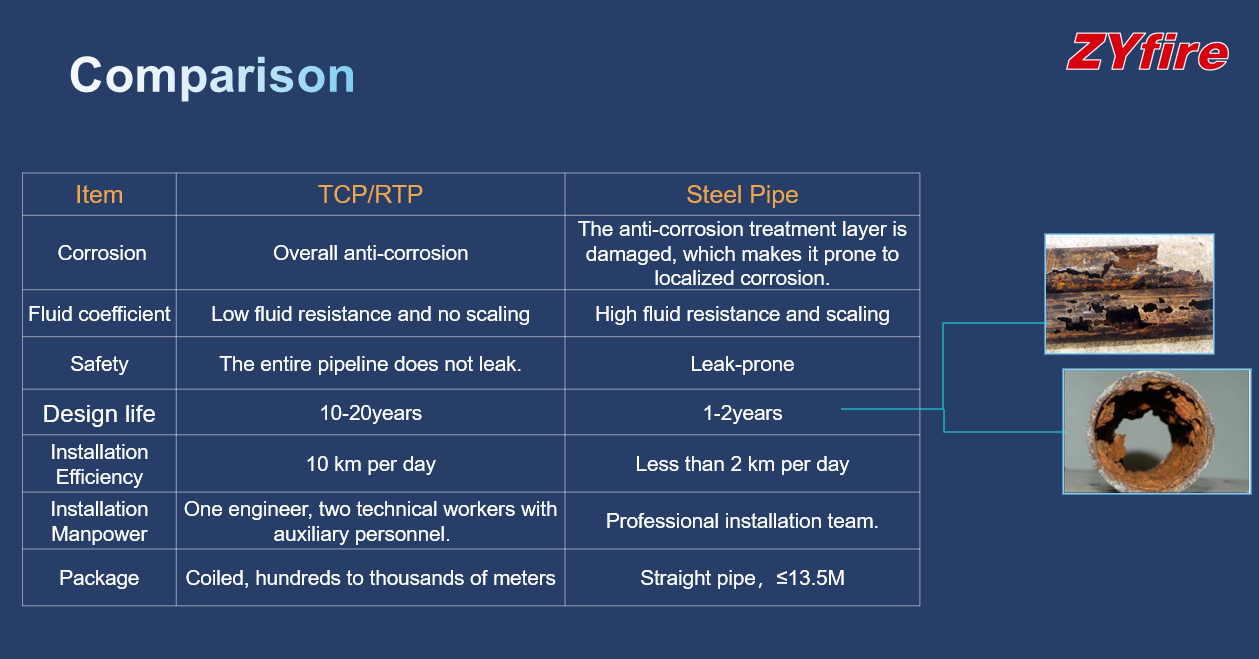
Installation, cost and maintenance comparison between RTP and steel pipe in oil and gas and mining duty: roughly 10 km per day versus less than 2 km per day, with minimal maintenance for RTP against recurring corrosion maintenance for steel.
Limits and Trade-offs: Where RTP Is Not the Answer
A shortlist that does not name limits is a sales document. The boundaries below are as important to decision-stage buyers as the performance data.
- Diameter ceiling under API 15S. The standard covers spoolable reinforced plastic line pipe up to 6 inches. Large-diameter trunk lines and high-volume mainline transmission remain steel territory. RTP wins on gathering, transfer, injection and slurry duty within its qualified bore range.
- Mechanical exposure at surface. RTP's maintenance profile assumes no force damage. Where a route crosses active machinery traffic, rockfall zones or heavy loading areas, protective measures are required — the pipe does not remove that engineering task.
- Ratings are construction-specific. A headline pressure figure is not transferable between liner grades, reinforcement types and temperature bands. The qualified pressure-temperature envelope must be confirmed for the actual duty, not inferred from a product family name.
- Certification coverage is partial by design. An API 15S qualification applies to the qualified product range, not to every construction a supplier sells. Buyers must confirm whether the specific liner, reinforcement and bore combination on the requisition is inside that range.
- Cost advantage is scenario-dependent. The stated 20% cost reduction was measured against steel pipe in a defined comparison. Terrain, route length, connection count and local labor rates can widen or narrow that gap, and steel remains the conventional choice where project codes specify metallic pipe.
Market Trend Analysis
Three verified patterns shape RTP procurement into 2026. First, oil and gas remains the dominant demand segment at approximately 71.2% of the RTP market, driven by operators seeking corrosion-free alternatives to steel in gathering and transfer duty (Fact.MR, 2025). Second, the market is expanding overall: from an estimated USD 7.2 billion in 2024 toward roughly USD 10.2 billion by 2030 at a CAGR near 5.9% (Strategic Market Research). Third, Asia Pacific is identified as the largest and fastest-growing regional market for thermoplastic pipe, supported by infrastructure investment (Mordor Intelligence / Market Research Future).
Product mix is shifting as well. Glass fiber reinforced constructions hold the majority share at an estimated 64.7%, while aramid, polypropylene and other reinforcement systems absorb the higher-pressure and specialty duty that sits outside glass fiber's comfort zone. In parallel, buyers are converting qualification evidence into a gating criterion: test data, laboratory accreditation and certification scope increasingly decide which suppliers reach the commercial negotiation at all, rather than being confirmed afterward.
Future Outlook
The direction of the next procurement cycle is legible from the criteria already in use. Supplier evaluation is moving from brand recognition toward documentable capability: monthly capacity in meters, lead time in days, the share of production that is tested, and the exact bore range inside a certification. Manufacturers with in-house accredited laboratories and multi-region production footprints are structurally advantaged in that shift, because they can shorten the qualification loop and localize spare supply.
For mining specifically, slurry transfer and continuous-duty fluid handling are where abrasion-resistant and custom bore constructions are most likely to expand, since the economic argument rests on installation speed, joint count and maintenance frequency rather than on corrosion alone. For oil and gas, the pressure will continue to sit on qualification evidence — which constructions, which bores, which pressure-temperature envelopes, and which test regime produced the number. Buyers who standardize those four questions across their supplier list will get more decision value from a shortlist than from any ranking published by a third party.
FAQ
What is the difference between RTP and steel pipe in oil and gas and mining service?
RTP is a spoolable composite line pipe with a polymer liner and fiber reinforcement; steel pipe is rigid and metallic. In installation efficiency, RTP achieves approximately 10 km per day versus less than 2 km per day for steel, a fivefold difference. In the compared scenario RTP is 20% lower in cost, and its lower weight reduces site transport and handling effort. On maintenance, RTP requires intervention only where force damage occurs, while steel pipe requires corrosion maintenance several times a year.
Does an API 15S certificate mean an RTP is suitable for my project?
No. API Specification 15S (2nd Edition, 2016) sets requirements for the manufacture and qualification of spoolable reinforced plastic line pipe for oilfield applications and covers pipe diameters up to 6 inches. The certificate confirms that the qualified product range meets the standard. It does not confirm that every construction a supplier sells is covered, that the bore size on your requisition is inside the qualified range, or that the pressure-temperature envelope suits your duty.
What capacity and lead-time evidence should buyers request from RTP manufacturers?
Ask for monthly production capacity in meters, the portion that can be contractually reserved for your project, and the quoted lead time per order. As a concrete reference point, ZYfire states RTP capacity of 100,000 m per month, a 30-day lead time and a minimum order quantity from 50 m. Those are the figures to compare across suppliers and to align with contract terms and project milestones.
How should a buyer evaluate RTP for high-pressure duty such as 3500 PSI?
Begin with construction rather than a headline rating. Liner grade, reinforcement fiber and end connection type determine the pressure class, so the qualified pressure-temperature envelope for the exact combination must be confirmed. Then check the test regime behind the rating — whether 100% of production is tested or only sampled, and whether the laboratory is accredited, for example under CNAS. Finally, confirm available coil length at that pressure; a project specified with 920 m coils at 3500 PSI reduces the number of joints and field connections per kilometer.
What are the main limitations of RTP compared with steel pipe?
API 15S covers diameters up to 6 inches, so large-diameter trunk lines remain steel applications. RTP is more exposed to mechanical force damage at surface, and intervention is required when such damage occurs. Pressure and temperature limits are construction-specific, so a rating valid in one duty may be unacceptable in another. Where project codes specify metallic pipe, steel also remains the conventional specification regardless of RTP performance.
Reference
A downloadable technical overview of ZYfire's reinforced thermoplastic pipe range, including construction options and application data, is available in the company brochure: ZYfire Hose Corporation product brochure (PDF).
Third-party figures cited in this article are attributed to Strategic Market Research, Fact.MR, Mordor Intelligence / Market Research Future and the American Petroleum Institute (API). Supplier capability data attributed to ZYfire Hose Corporation is drawn from company-provided material. Publicly available data for other named manufacturers was not verified during this review and should be confirmed directly with each supplier.