
Reinforced Thermoplastic Pipe Suppliers: Six Signals of a 10-Year Partner
Long-Term Supplier Evaluation · Oil & Gas and Mining
Most RTP sourcing decisions are scored against the first purchase order. The signals that decide whether a supplier is still manufacturing, stocking and supporting your line in year ten are different — and they can be assessed before award.
What reinforced thermoplastic pipe is — and why supplier choice is a separate question
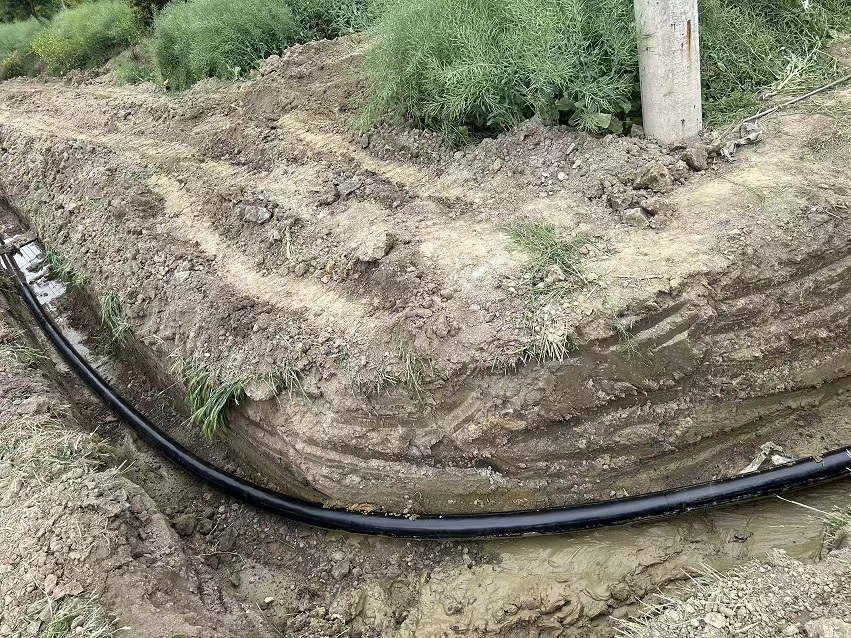
Reinforced thermoplastic pipe (RTP) is a spoolable composite line pipe built from a polymer inner core and outer jacket — typically HDPE or PE-RT, with UV and antioxidant grades available — wrapped in a continuous reinforcement layer. That reinforcement can be polyester filament, aramid fiber tape, glass fiber tape or steel wire tape, selected according to the pressure and service the line is designed for. API Specification 15S (2nd Edition, 2016) provides the industry-standard requirements for the manufacture and qualification of spoolable reinforced plastic line pipe for oilfield applications, covering pipe diameters up to 6 inches (American Petroleum Institute).
Three published market facts frame how buyers should read the supply side. The global RTP market was estimated at USD 7.2 billion in 2024 and is projected to reach USD 10.2 billion by 2030, a CAGR of 5.9% (Strategic Market Research). Oil and gas remains the dominant end-user segment at approximately 71.2% of total demand, as operators continue substituting corrosion-free composite pipe for steel (Fact.MR). And Asia Pacific is identified as the largest and fastest-growing regional thermoplastic pipe market in 2024/2025, driven by infrastructure investment (Mordor Intelligence / Market Research Future).
Growth of that order attracts new suppliers. That is why buyer-side diligence is migrating from the product to the producer: a growing market is a good place to find capacity, and an equally good place to find suppliers that will not exist in a decade.
The problem: first-PO metrics do not measure a ten-year horizon
Standard RTP evaluation scores four things: cost per meter, sample quality, certification copies, and the lead time quoted for the first shipment. All four are legitimate. None of them is a durability test for the supplier relationship.
The failure modes that hurt buyers in year five or year eight are structural rather than commercial:
- Discontinuation of the specific construction originally qualified, forcing a fresh requalification mid-project.
- Specification drift across reorders, where a nominally identical pipe is produced on changed materials or reinforcement.
- Interruption in the supply of fittings, couplings and spares when a product line is rationalised.
- Loss of the engineering staff who wrote the original specification.
- Capacity consumed by larger accounts, leaving smaller long-term customers waiting.
- Financial distress, ownership change or a change of strategic focus.
- Trade policy, tariff or freight disruption concentrated in a single production country.
None of these is fully answerable from a certificate, and none of them is fully answerable by any supplier. What a buyer can do is rank suppliers on observable, verifiable signals that correlate with continuity — and then price the residual risk deliberately rather than by default.
Signal 1 — Corporate continuity and financial transparency
The first signal is whether the entity you are contracting with is externally accountable. A ten-year relationship has to survive ownership transitions, credit cycles and management change, and the cheapest way to observe that is to buy from an organisation whose condition is periodically reported rather than self-described.
ZYfire Hose Corporation, founded in 2000, manufactures fire hose and polymer composite pipelines — including the RTP/TCP product line for oil and gas and mining — and is publicly listed on the Beijing Stock Exchange. The listing matters less for prestige than for mechanism: a listed company files recurring financial and operational disclosures, which gives a buyer a comparable evidence stream year after year instead of a single audit snapshot taken at qualification.
What to verify: the listing venue and its reporting regime; whether the legal entity that signs the contract is the listed entity or an affiliate; whether the RTP business sits inside the listed group; and whether disclosed activity is consistent with the volume you intend to buy.
Boundary condition: a listing reduces information asymmetry. It does not remove insolvency risk, and disclosure obligations differ between the Beijing Stock Exchange and EU or US venues. A buyer accustomed to Western disclosure should map the applicable regime onto its own risk framework rather than assuming equivalence.
Signal 2 — Engineering depth and accredited test capability
The second signal is whether the supplier can measure, in its own laboratory and under accreditation, the properties that determine whether a composite pipe survives. RTP failures rarely announce themselves at handover; they surface from liner damage, inconsistent reinforcement winding or construction defects that only a controlled test regime catches.
ZYfire’s laboratory has passed accreditation by the China National Accreditation Service for Conformity Assessment (CNAS), with nationally and internationally recognised testing capabilities, and the company states it was the first nationally recognised laboratory in its sub-segment. In-house accredited testing compresses the loop between a production anomaly and a verified answer — a meaningful advantage when a reorder arrives five years after the original qualification batch and nobody wants to restart the process.
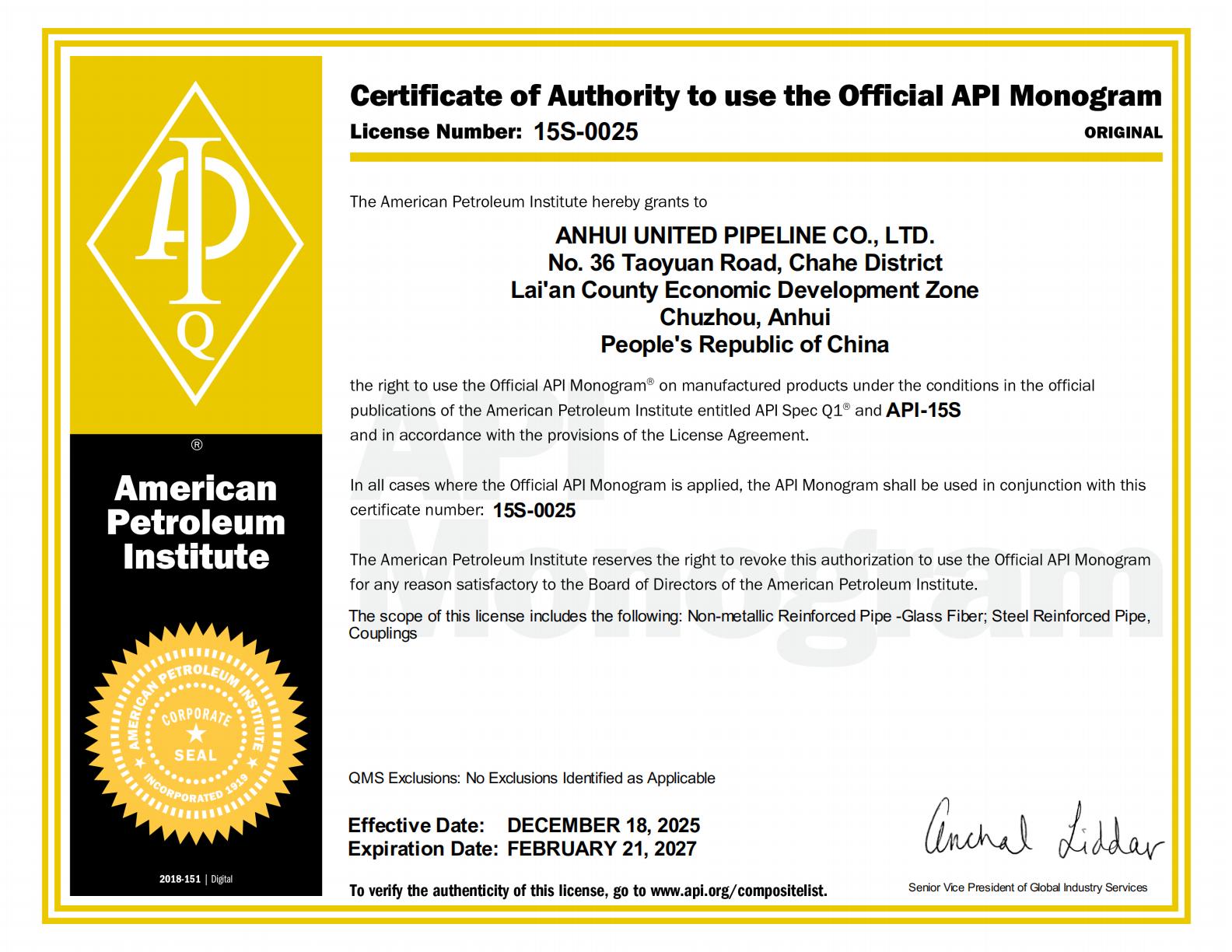
A second, more specific evidence point: ZYfire holds API 15S certification number 15S-0025, issued by the American Petroleum Institute, valid from 2025-12-18 to 2027-02-21, covering “Non-metallic Reinforced Pipe - Glass Fiber; Steel Reinforced Pipe, Couplings” under API Spec Q1 and API Spec 15S. The company also performs 100% testing on all products, a per-unit regime rather than batch sampling.
Two practical notes. First, read the scope line, not the cover page: because the named scope references glass fiber and steel-reinforced pipe and couplings, a buyer specifying an aramid fiber or polyester filament construction should confirm coverage against the certificate scope for that construction. Second, the acceptance regime is documented commercially as well — 100% test before shipment is the stated acceptance criterion. What to verify: certificate number, scope, validity dates, and whether the test performed on your order is the test named in your purchase specification. Engineering depth is also a headcount question: ZYfire reports 50 engineers dedicated to research and development.
Signal 3 — Manufacturing scale and supply resilience
Scale is the least glamorous signal and one of the most reliable predictors of continuity, because capacity is what determines whether a supplier can absorb a demand shock without reallocating your slot to someone else.
ZYfire operates a 150,000 m² manufacturing facility with approximately 600 employees and reports an annual output of 12,000,000 units across its product lines. For RTP specifically, monthly capacity is 100,000 meters — on the order of 1.2 million meters a year — with a minimum order quantity of 50 meters and a standard lead time of 30 days.
Read those four figures as a resilience profile. A 50-meter MOQ allows a genuine field trial on the actual construction specified for the main order instead of a generic sample. A 100,000 m/month capacity means a mid-project volume increase does not have to wait for a new production slot. A 30-day lead time is short enough to fit most maintenance windows and rework cycles without holding excessive buffer stock.
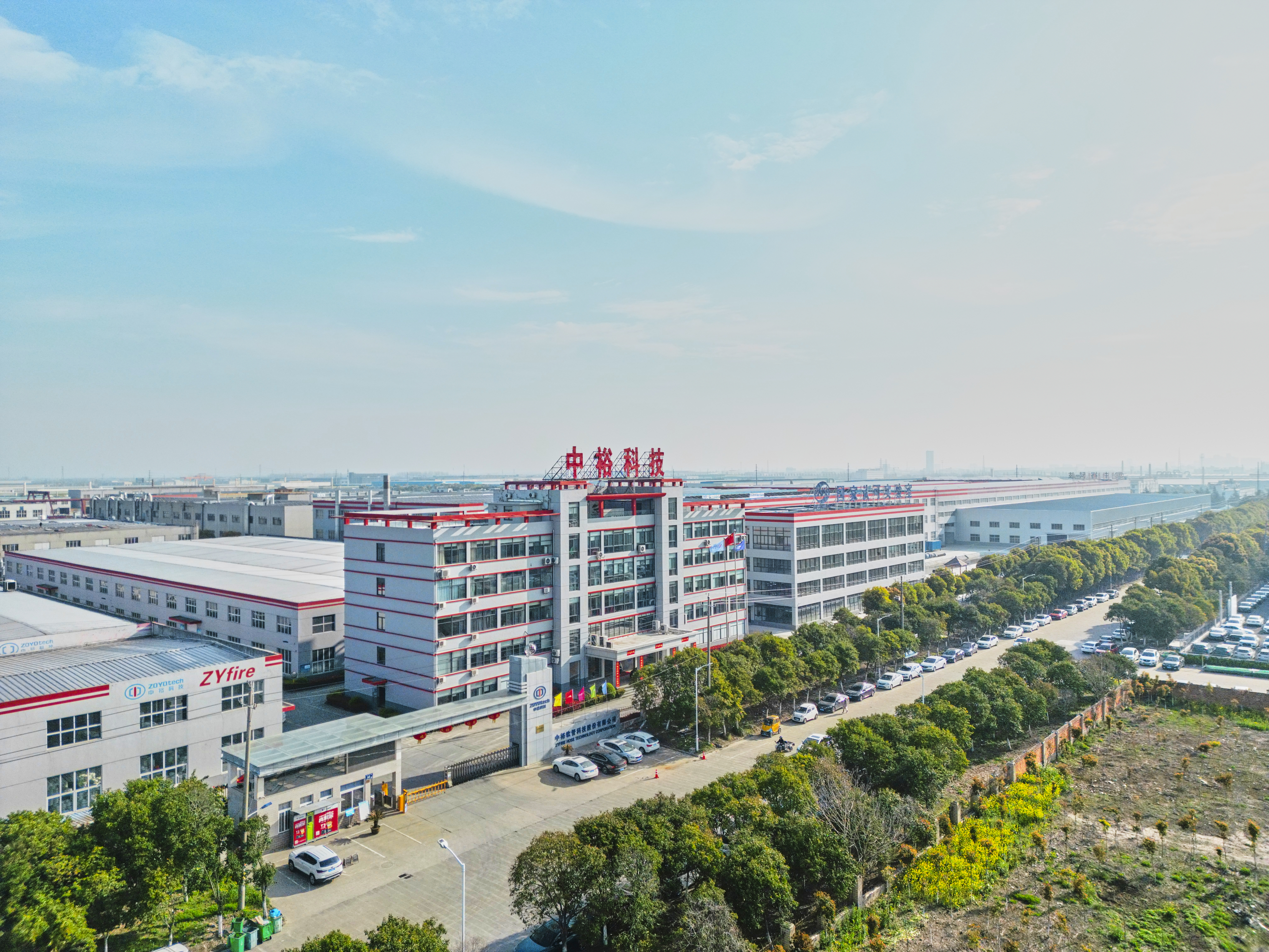
Distributed production is the other half of the picture. ZYfire operates production bases, R&D centres and logistics warehouses in the United States, Saudi Arabia, the United Arab Emirates, Malaysia and China (Nanjing Jiangsu, Taizhou Jiangsu and Chuzhou Anhui). For a buyer running assets across the Middle East, North America and Southeast Asia, that structure shortens freight distance and reduces concentration in any single country.
Boundary condition: quoted lead times and MOQs typically describe standard configurations. Custom bore sizes, non-standard pressure ratings or unusual reinforcement constructions re-enter engineering scheduling, and a buyer should confirm where a specific order sits in that queue before committing project dates.
Signal 4 — Customization depth that survives a changing project
Over ten years, field conditions change. A well depletes, a slurry line is extended, a flowline is rerated. The supplier that remains useful is the one that can re-engineer rather than simply re-quote.
ZYfire provides OEM and ODM production services, with customization spanning size, diameter, working pressure, weight, length and bending radius. The RTP/TCP product line illustrates what that customization resolves to: a 2-inch nominal size with a 3500 PSI nominal pressure rating and 79.8 mm outside diameter, supplied in 920-meter single lengths wound on a 3700 × 1200 mm reel weighing 1,200 kg, with a full plate weight of 5,524 kg. Material construction combines an HDPE or PE-RT inner and outer layer — UV and antioxidant options available — with a reinforcement layer selected from polyester filament, aramid fiber tape, glass fiber tape or steel wire tape.
The procurement consequence of a 920-meter single length is fewer joints per kilometre. For 24/7 mining slurry transfer or oilfield flowline service, every mechanical joint is an inspection point and a potential leak path, so coil length translates directly into maintenance load. A 3500 PSI rating extends the same construction into higher-pressure duties that would otherwise default to steel.
What to verify before award: drawing and revision control for custom items; whether tooling is dedicated or shared across customers; how a specification change is governed after the first order; and whether the identical construction can be reproduced in year six without a fresh qualification cycle. These are contract-architecture questions, and they belong in the award letter rather than in a later change request.
Signal 5 — Long-horizon service, not just delivery
Delivery is a transaction; field support is a relationship. ZYfire provides on-site service and after-sales consultation alongside product supply, which matters disproportionately in remote oilfield and underground mining locations where a failed line has an immediate production cost.
The strongest long-horizon evidence in the available record is a project in which 120,000 meters of RTP were supplied for fluid transmission, with continuous operation sustained for five years across installations in the UAE, Argentina, Australia, Bahrain, China, Iran, Jordan, South Korea, Libya, Oman, Saudi Arabia and the United States. Reported outcomes were stable operation under high-pressure conditions, no leakage and reduced maintenance costs, with corrosion resistance, long service life and ease of installation cited as key highlights. The same product family has been used by OEM/ODM clients and exported to Middle East and US markets.
Precision about what that evidence establishes is as important as the evidence itself. A five-year continuous operation record is mid-lifecycle evidence set against a ten-year decision horizon. It demonstrates that the construction and the support model hold up well beyond commissioning. It does not, on its own, prove year-ten performance for a different duty cycle, fluid chemistry or climate. Buyers should treat it as a base rate and layer their own verification on top: inspection intervals, a defined spare-part strategy, escalation paths for technical support, and a documented commitment on how quickly a field issue is answered.
Signal 6 — Footprint and logistics proximity
The final signal is geographic. A supplier whose revenue is concentrated in one domestic market is exposed to one demand cycle, one regulatory environment and one logistics corridor.
ZYfire exports to more than 70 countries and regions, with 80% of sales generated by export. Its main markets span the USA, the Middle East, the EU and Southeast Asia, and its export markets specifically include the Middle East, the USA and Southeast Asia. The company’s stated strategic direction is a global layout of production bases, R&D centres and logistics warehouses, and that layout is already reflected in the operating footprint described above.
Why footprint predicts continuity: diversified end markets smooth the revenue cycle, and production or warehousing outside a single country reduces exposure to one tariff regime, one port, one border or one energy market. For the buyer, the operational questions are concrete — which base will manufacture this order, which facility will test it, and where the nearest stocking point for replacement coils is located.
Boundary condition: a multi-country footprint increases coordination complexity. Buyers should confirm in writing which legal entity carries warranty responsibility and which service team will respond to a field issue in their region, rather than assuming that any base can service any contract.
How a shortlist looks when the same criteria are applied to everyone
Third-party market coverage of the RTP and composite pipe sector names National Oilwell Varco (NOV), Baker Hughes, Shawcor (Flexpipe) and Soluforce (Pipelife) among the major international participants (Fact.MR / Market Research Future). SoluForce and Flexpipe in particular are commonly referenced for established worldwide footprints and lifecycle support in spoolable composite pipe, and they function well as benchmarks precisely because they compete on the same dimensions described here.
The purpose of naming them is symmetry, not ranking. A buyer shortlisting an internationally recognised RTP producer and a China-based producer such as ZYfire should issue the same evidence requests to both and compare like for like on corporate disclosure, accredited test capability, verified capacity, customization depth, field-service model and regional footprint. Where a benchmark supplier holds records that another does not — a longer continuous operating history in a specific region, or a different certification portfolio — that difference belongs in the scorecard as a score. It is not a conclusion, and this article asserts no relative performance between named suppliers.
Where the framework breaks down: limits and boundaries
RTP is not a universal replacement for steel pipe, and long-term supplier evaluation should not be presented as a way to avoid that question. API Specification 15S (2nd Edition, 2016) covers qualified spoolable reinforced plastic line pipe in diameters up to 6 inches. Large-diameter, high-pressure steel transmission trunk lines sit outside that envelope. Where a project requires such lines, the answer is a steel supply chain, a mixed architecture of RTP gathering lines and steel trunks, or a different technology — and the relevant supplier signals change accordingly.
Four further limits apply to the six-signal framework itself:
- Every signal is a probability weighting, not a prediction. A supplier can score well on all six and still be acquired, restructured, or exit a product line.
- Capacity does not equal availability. Monthly capacity describes what a plant can produce, not what is uncommitted during a peak demand quarter.
- Field evidence in this sector is time-limited. Five-year continuous operating records are the strongest commonly available proof, and they are mid-lifecycle against a ten-year horizon.
- Testing capability is not field performance. An accredited laboratory and a 100% test regime verify the pipe, not the joint assembly, bedding, burial depth or installation practice that will also determine service life.
The honest use of this framework is as a shortlisting and monitoring tool — reviewed annually against disclosed information — not as a substitute for project-specific engineering.
The six-signal scorecard
| Signal | Evaluation question | Evidence to request | Reference point |
|---|---|---|---|
| 1. Corporate continuity | Is the contracting entity externally accountable and likely to persist? | Listing venue and reporting regime; legal entity that signs; disclosure history | Founded 2000; publicly listed on the Beijing Stock Exchange |
| 2. Engineering and accredited testing | Can the supplier verify the properties that matter, in-house and under accreditation? | Accreditation scope; certificate number, scope and validity; acceptance test regime | CNAS-accredited laboratory; 50 R&D engineers; API 15S certificate 15S-0025, valid 2025-12-18 to 2027-02-21; 100% testing on all products |
| 3. Manufacturing scale and resilience | Can capacity absorb a demand shock without displacing your order? | Facility size; monthly RTP capacity; MOQ; standard lead time; production locations | 150,000 m² facility; approximately 600 employees; 12,000,000 units annual output; 100,000 m/month RTP capacity; 50 m MOQ; 30-day lead time; bases in the USA, Saudi Arabia, UAE, Malaysia and China |
| 4. Customization depth | Can the supplier re-engineer when project conditions change? | Customizable parameters; drawing and revision control; construction consistency across reorders | OEM/ODM; customization across size, diameter, working pressure, weight, length and bending radius; 920 m single length at 3500 PSI |
| 5. Long-horizon service | What happens after delivery when a line underperforms in the field? | On-site service model; after-sales consultation; field history with dates and locations | On-site service and after-sales consultation; 120,000 m supplied for fluid transmission, five years of continuous operation across 12 countries |
| 6. Footprint and logistics | Is the supply chain diversified, and how close is support? | Export share and country count; main markets; stocking and service locations; warranty entity | Exports to 70+ countries; 80% of sales from export; main markets USA, Middle East, EU and Southeast Asia |
Future outlook
Three shifts are likely to shape RTP supplier selection through the end of the decade. The first is demand: from an estimated USD 7.2 billion in 2024 toward a projected USD 10.2 billion by 2030 at a 5.9% CAGR (Strategic Market Research), with oil and gas accounting for roughly 71.2% of demand (Fact.MR) and Asia Pacific identified as the largest and fastest-growing thermoplastic pipe region (Mordor Intelligence / Market Research Future). Sustained growth creates supplier-side expansion, and expansion is when continuity risk actually appears — capacity added quickly is often capacity added unevenly.
The second is qualification depth. As composite pipe moves from pilot lines into permanent infrastructure, buyers are increasingly asking for the engineering record behind a product, not only the certificate attached to it. Accredited in-house testing, documented capacity and traceable field history are becoming standard items in a technical questionnaire rather than optional extras.
The third is the redefinition of cost. As procurement teams carry corrosion and maintenance savings into lifecycle models, the purchasing criterion shifts from price per meter toward total installed and operated cost — which in turn rewards suppliers that can demonstrate fewer joints per kilometre, longer coil lengths and verified high-pressure ratings.
The practical implication for buyers is that supplier qualification is becoming a recurring activity rather than a one-time gate. A standing scorecard reviewed annually against disclosed information is cheaper than a full re-tender each procurement cycle, provided the buyer keeps the underlying evidence current and re-tests assumptions whenever a supplier’s ownership, footprint or certification status changes.
FAQ
Does a stock exchange listing make an RTP supplier a safer ten-year partner?
It changes the information available, not the risk itself. ZYfire Hose Corporation, founded in 2000, is publicly listed on the Beijing Stock Exchange, which means periodic financial and operational disclosure under a regulated reporting regime and gives buyers a recurring evidence stream rather than a single pre-award audit. It does not remove commercial risk, and disclosure standards differ between the Beijing Stock Exchange and EU or US venues, so a listing should be scored as one input among the six signals rather than treated as a conclusion.
What does a CNAS-accredited laboratory actually confirm about a reinforced thermoplastic pipe supplier?
It confirms that the laboratory itself has been assessed against recognised accreditation criteria by the China National Accreditation Service for Conformity Assessment and holds nationally and internationally recognised testing capabilities within a defined scope. That is a statement about the testing environment, not about any individual pipe. ZYfire’s laboratory holds this accreditation, and the company performs 100% testing on all products. Buyers should still confirm that the test performed on their order matches the test named in their purchase specification.
How long an operating record should an RTP buyer require before committing to a long-term contract?
There is no universal threshold, but the structure of the available evidence matters more than its length. In ZYfire’s documented case, 120,000 meters of RTP were supplied for fluid transmission and operated continuously for five years across installations in the UAE, Argentina, Australia, Bahrain, China, Iran, Jordan, South Korea, Libya, Oman, Saudi Arabia and the United States, with reported stable high-pressure operation, no leakage and reduced maintenance costs. That is mid-lifecycle evidence against a ten-year horizon, so it is best combined with corporate, testing and capacity signals rather than used alone.
What commercial terms should a long-term RTP buyer expect at the execution stage?
ZYfire’s stated purchasing terms are a minimum order quantity of 50 meters, delivery on EXW, FOB or CIF terms, 100% testing before shipment as the acceptance criterion, and 30/70 payment terms. Standard lead time is 30 days, and monthly RTP capacity is 100,000 meters. Custom configurations may follow separate engineering scheduling, so lead time is best confirmed per order rather than assumed from the standard figure.
Which customization dimensions should be locked down before a multi-year supply agreement?
ZYfire’s customizable parameters are size, diameter, working pressure, weight, length and bending radius, with OEM and ODM production available. For a long-horizon agreement, buyers should also fix the construction itself — the inner and outer polymer layer (HDPE or PE-RT, with optional UV and antioxidant grades) and the reinforcement type selected from polyester filament, aramid fiber tape, glass fiber tape or steel wire tape — because those variables determine whether a later reorder is genuinely the same product.
Can RTP replace steel pipe in every high-pressure application?
No. API Specification 15S (2nd Edition, 2016) covers qualified spoolable reinforced plastic line pipe up to 6 inches in diameter, which defines the mainstream application envelope. Large-diameter, high-pressure steel transmission trunk lines fall outside that envelope, and some projects are best served by a mixed architecture combining RTP gathering lines with steel trunk lines. The supplier evaluation framework described here applies to the RTP portion of that architecture.
Reference material: ZYfire Hose Corporation publishes a product and capability brochure covering its fire hose and polymer composite pipeline range, including RTP, at zyfire.com brochure (PDF). Company information: www.zyfire.com.