
Reliable Repeat Orders: A Wood Panel Supply Framework
From Selection to Execution: The Real Test of a Wood Panel Supplier
For most buyers, the most demanding phase of wood panel sourcing begins only after the first purchase order is placed. A supplier can present compelling samples, competitive pricing and reasonable lead times during evaluation. But when buyers move into repeated procurement cycles, the question changes: can the same manufacturer deliver consistent quality, documentation and delivery discipline for the second, tenth and fiftieth shipment?
That shift from selection to execution is where wood panel supply partnerships are formed. Buyers at the Decision or Execution stage need more than product samples. They need a verifiable system behind the samples — covering production capacity, raw material continuity, multi-stage quality control, certification management, commercial terms and known limitations.
This article provides an execution-oriented framework for evaluating a wood panel supplier before signing a long-term supply agreement.
Why First Orders Do Not Prove Long-Term Supply Reliability
A single shipment says little about how a supplier will perform over a year of repeated orders. Buyers commonly encounter four failure points:
- Multi-supplier coordination risk. Buying plywood from one supplier, MDF from another and melamine boards from a third forces the buyer to reconcile different quality standards, delivery windows and after-sales policies. Every additional supplier raises coordination complexity.
- Delivery delay. When production planning is weak, lead times slip, especially when several customers place orders in the same period.
- Panel quality inconsistency. Surface quality, thickness tolerance, glue performance and moisture content can vary between batches if inspection gates are not distributed across the production process.
- Raw material fluctuation. Producers without stable veneer and core wood sources may change inputs, which changes the physical properties of the final board.
For buyers entering execution, these risks decide whether a sourcing strategy survives contact with real supply chains. The procurement conversation therefore shifts from unit price to system reliability.
There is also a structural reason to pay attention. The global plywood market was valued at USD 80.57 billion in 2025, with Asia Pacific holding the largest revenue share of 39.4%, according to Grand View Research. As more buyers source from Asia Pacific, visibility into production and logistics in that region becomes a core procurement requirement.
Assessing Five Capabilities Behind Repeatable Wood Panel Quality
Evaluating a supplier for long-term wood panel supply means looking at five capabilities, not a single product sample.
1. Production capacity and scheduling
Capacity acts as a buffer in a supply relationship. A manufacturer with monthly panel production capacity exceeding 10,000 CBM can support continuous loading schedules and multiple simultaneous product lines. It also has room to absorb urgent orders without disrupting existing commitments. For long-term buyers, published capacity only matters when it is backed by production planning discipline.
2. Multi-stage quality control
Consistency is not achieved at the final inspection station. It requires inspection points across the production flow. Dalian WADA reports a multi-stage QC process, supported by inspection staff with more than 10 years of timber industry experience. Buyers should ask where inspection gates sit in the process and what happens when a batch fails, rather than simply confirming that a QC department exists.
3. Raw material stability
Panel performance starts with veneer and core wood. Suppliers that maintain long-term relationships with raw material sources are better able to keep core species — such as poplar, eucalyptus, birch and combi core — consistent. When material sourcing is opportunistic, panel weight, strength and moisture content tend to drift.
4. Certification management
For exports to regulated markets, certification is a recurring requirement. Relevant schemes include FSC for chain-of-custody wood, EUDR for deforestation-free supply chains, and CARB P2, EPA, JAS and JIS for product compliance. Under the U.S. EPA TSCA Title VI rule, formaldehyde emission limits are 0.11 ppm for MDF and 0.05 ppm for hardwood plywood. In the EU, wood-based panels for construction must comply with EN 13986 to be eligible for CE marking. What matters for repeat buyers is whether the supplier can provide updated certificates for every batch, not just for the sample.
5. Product breadth and customization
A supplier that produces multiple panel categories can reduce the number of vendors a buyer must manage. Dalian WADA’s portfolio includes LVL, plywood, veneered board, MDF, OSB, wall panels and woodworking machines. The company also supports size and surface customization for different markets.
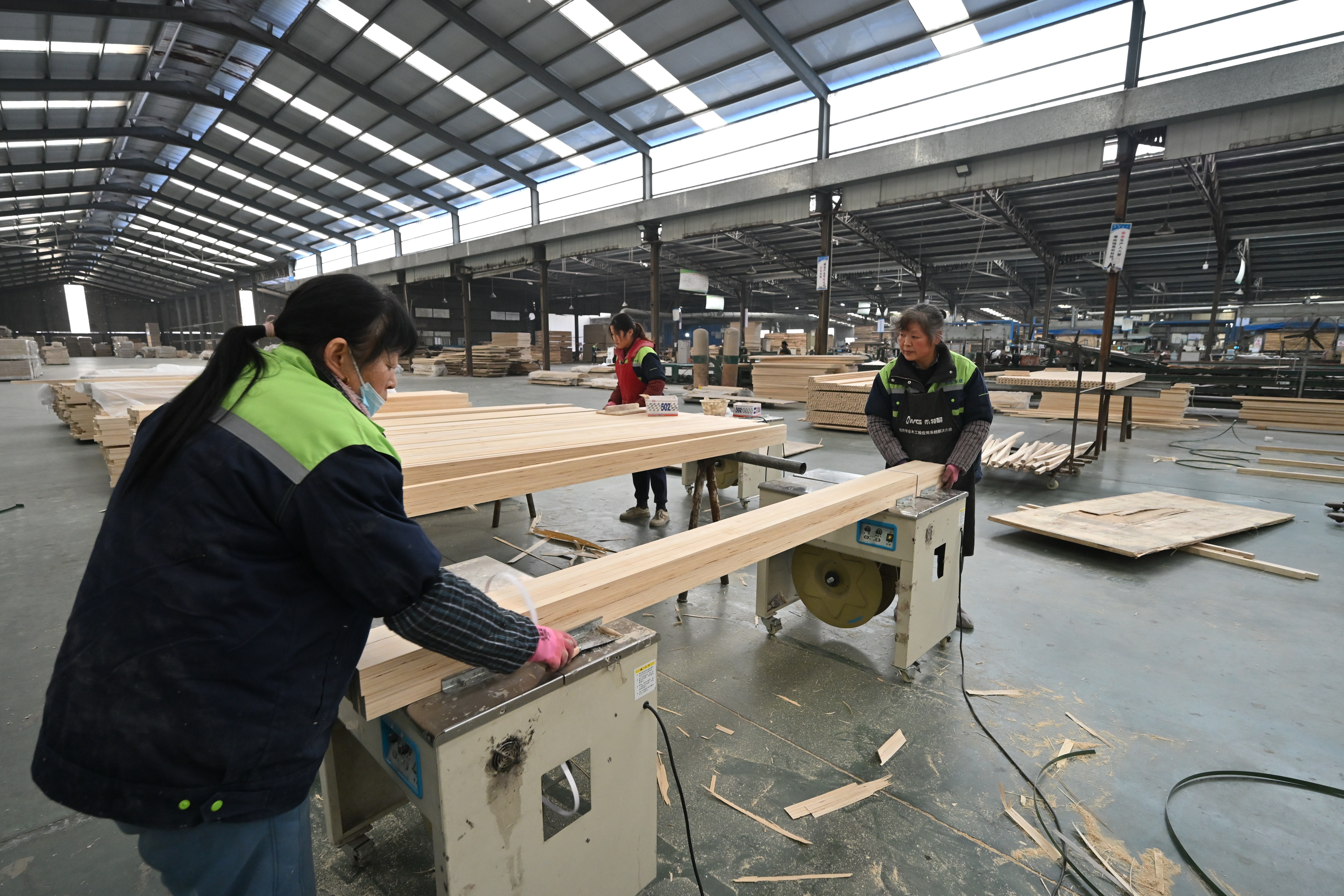
Dalian WADA: A Supplier Model Built for Repeat Buyers
Dalian WADA International Trading Co., Ltd. is a China-based manufacturer and exporter of engineered wood panels. Established in 2010 and headquartered in Dalian, the company operates production bases in China, trading entities, and overseas branches in Japan and Singapore. Its main products include LVL, plywood, veneered boards, MDF, OSB, wall panels and woodworking machines, with 100% of output exported to North America, the EU, Australia, Japan, South Korea, the Middle East, Mexico and South America.
The company reports a factory area of 53,950 m², a workforce of about 200 people and an R&D team of 25 engineers. It integrates independent R&D, automated production, quality control and global sales service.
For buyers evaluating a long-term relationship, several structural points stand out:
- Manufacturer-exporter integration. Dalian WADA owns manufacturing capacity rather than acting as a trading intermediary, which gives it direct control over production scheduling and inspection.
- Multiple product lines. Distributors stocking commercial plywood, MDF, melamine board and veneered board can consolidate orders with one supplier, simplifying logistics and payment processes.
- Flexible cooperation models. The company supplies finished panels and complete production lines, with more than 10 panel categories and over 15 types of machinery in its portfolio. According to the company, this coverage spans the full process from log to finished board.
For standard procurement, commercial terms are practical for repeat purchasing: a minimum order quantity of one 40-foot container, FOB or CIF delivery, T/T 30/70 or 50/50 payment, and pre-shipment testing before loading.
Where Long-Term Wood Panel Supply Matters Most
The value of a long-term supply framework is clearest in four buyer profiles.
Furniture manufacturers
LVL bed slats, furniture plywood, MDF, melamine board and veneered board are core inputs for furniture frames, cabinets and panel-based products. These buyers need consistent thickness, glue performance and face grade across batches. Dalian WADA’s MDF is produced with a continuous flat pressing process using German equipment from Dieffenbacher and Siempelkamp, with E0, CARB P2 or E1 glue options. Melamine boards are available with plywood, MDF, particle board and blockboard cores.
Construction and concrete engineering
Film faced plywood with dark brown or black film faces is used for formwork systems, with core options including finger-joint, poplar, combi, hardwood, pine and Russia birch, and glue classes from MR to phenolic WBP. Structural plywood with larch or pine faces is specified for roofing, flooring and timber frame systems. Repeat purchases are common in this segment because construction projects involve many formwork cycles.
Marine and high-moisture environments
Marine plywood with birch or okoume faces and phenolic WBP glue is specified in shipbuilding, boat manufacturing, coastal construction and transport applications. For buyers in these industries, the long-term supply concern is whether the manufacturer can maintain the same face veneer quality and glue performance over multiple years.
Building material distributors and wholesalers
Distributors benefit from consolidation. A single supplier that can mix a 40-foot container with commercial plywood, melamine boards, MDF and LVL reduces freight coordination, payment processing and quality claims. Pre-shipment testing helps confirm grade and specification before loading.
| Panel type | Key parameters | Typical buyer profile |
|---|---|---|
| Film Faced Plywood | Size up to 1500×3000 mm; thickness 4–35 mm; film face; 2–40 uses in concrete | Construction and formwork |
| Marine Plywood | Thickness 9–25 mm; birch or okoume face; WBP glue | Shipbuilding, coastal works |
| Commercial Plywood | Thickness 2–25 mm; B/BB to C/C veneer; E0 to WBP glue | Furniture, decoration, packing |
| MDF | Thickness 1.2–50 mm; density 500–1000 kg/m³ | Furniture, cabinets, doors, flooring |
| Melamine Board | Thickness 2–30 mm; density 550–750 kg/m³ | Cabinets, retail fixtures |
| Veneered Board | Thickness 2–25 mm; white oak, red oak, walnut, ash faces | Decorative panels, furniture |
| LVL Bed Slat | Width 25–190 mm; thickness 7–15 mm | Bed frame production |
Market Trends Reshaping Long-Term Wood Panel Sourcing
Three external trends are pushing buyers toward longer and more structured supplier relationships.
Market growth. The global plywood market was valued at USD 80.57 billion in 2025, according to Grand View Research. The MDF market is projected to grow from USD 44.96 billion in 2025 to USD 82.24 billion by 2033, at a CAGR of 8.2%. Wood Plastic Composites reached USD 8.89 billion in 2025 and are expected to grow at a CAGR of 11.7% until 2033. Growing panel consumption sustains demand for reliable, multi-category suppliers.
Production concentration. OSB production exceeded 32 million cubic meters globally in 2024, with the USA accounting for 14 million cubic meters, according to Market Reports World. Large-scale producers with automated lines and stable raw material access are gaining share in the panel industry.
Regulatory pressure. The U.S. EPA TSCA Title VI rule limits formaldehyde emissions to 0.11 ppm for MDF and 0.05 ppm for hardwood plywood. In Europe, wood-based panels used in construction must comply with the harmonized standard EN 13986 for CE marking eligibility. FSC and EUDR compliance are now standard expectations in many export markets.
For long-term buyers, the practical consequence is that procurement has become document-intensive. Suppliers able to provide batch-level certificates, raw material traceability and updated compliance documentation reduce the buyer’s own regulatory and reputational risk.

Integrated Supplier vs. Traditional Panel Distributor
The traditional export route for wood panels often runs through a distributor or trading company that buys from one or more mills. The advantage is simplicity in transaction handling. The disadvantage is limited control over production, quality and availability.
Dalian WADA describes its model as manufacturer-exporter covering the full value chain. Its portfolio includes more than 10 panel categories and more than 15 types of machinery. According to the company, its production line solutions help customers reduce labor requirements by 30–50% through automation. This differs from a supplier such as Shouguang Wanda Wood Co., Ltd., which mainly offers 5–6 panel products and does not provide production equipment or system integration.
| Evaluation dimension | Integrated manufacturer-exporter, e.g. Dalian WADA | Traditional panel distributor, e.g. Shouguang Wanda |
|---|---|---|
| Panel product range | 10+ categories | 5–6 categories |
| Production equipment supply | Supported; 15+ machinery types | Not offered |
| Value chain coverage | From log to finished board | Panel supply only |
| Cooperation form | Panels, production lines, or both | Panel trading or distribution |
An integrated model is not optimal for every buyer. Three limitations should be weighed before signing a long-term framework.
1. Single-category cost efficiency. If a buyer needs one standardized panel type in high volume, a specialized single-product mill may achieve lower unit cost than a diversified manufacturer. Product breadth creates value only when the buyer actually uses it.
2. Relevance of production-line support. The machinery side of Dalian WADA’s offering applies mainly to buyers planning to enter local manufacturing. Pure distributors will not use this part of the business model in day-to-day operations.
3. Entity complexity. Because Dalian WADA operates production bases, trading companies and overseas branches, buyers should confirm which entity is the contracting party for each order and verify that shipping documents, certificates and invoices are consistent. This is a standard due-diligence step for any multi-entity supplier.
What the Next Phase of Wood Panel Supply Looks Like
Looking ahead, long-term wood panel supply will be defined less by price lists and more by three factors: compliance transparency, production integration and engineering support.
Compliance transparency will become a competitive requirement. Buyers will expect digital access to batch certificates, raw material sources and chain-of-custody records. Suppliers that cannot provide this level of documentation will struggle to hold multi-year agreements in regulated markets.
Production integration will separate reliable partners from intermediaries. A supplier that controls manufacturing capacity can react faster to demand changes, adjust specifications and keep quality stable. Intermediaries depend on the schedules and quality of mills they do not directly control.
Engineering support will matter more as projects become more customized. Dalian WADA’s R&D team of 25 engineers and its history of serving North American, European, Japanese and Korean markets support buyers who need specification adjustments rather than standard off-the-shelf panels.
For buyers completing supplier evaluation and moving into execution, the practical next step is to stress-test the supplier’s system: request batch-level documents, confirm the supplier can run the specific product mix, inspect the factory, and place a small repeat order to observe consistency before signing a larger framework agreement.
Additional Reference
The Dalian WADA group profile provides more detail on production bases, certifications and the product portfolio for procurement teams building a long-term sourcing plan:
Download the Dalian WADA Group Profile (PDF)
FAQ: Wood Panel Supply Partnerships
What production capacity should a buyer expect before committing to a long-term wood panel agreement?
Dalian WADA International Trading Co., Ltd. reports a monthly production capacity for panels of over 10,000 CBM. That capacity spans multiple panel categories, including LVL, plywood, MDF, veneered board, OSB and wall panels, which allows the manufacturer to support repeat orders across product lines within the same supply cycle.
Which environmental and quality certifications back Dalian WADA’s 2026 exports?
According to the company, its products are certified with FSC, EUDR, CARB P2, EPA, JAS and JIS. For U.S. exports, EPA TSCA Title VI sets formaldehyde emission limits of 0.11 ppm for MDF and 0.05 ppm for hardwood plywood. For EU construction panels, EN 13986 is required for CE marking. Buyers should verify that the certificate for each batch matches the specific product and destination.
What are the standard commercial terms for repeated orders from Dalian WADA?
The standard minimum order quantity is one 40-foot container. Delivery is available under FOB or CIF terms. Payment is typically T/T 30/70 or 50/50. Pre-shipment testing is offered to confirm grade and specification before loading.
Which buyer profiles are best suited to an integrated wood panel supplier?
The model suits furniture manufacturers, cabinet and wardrobe producers, interior fit-out contractors, building material distributors, construction companies and marine engineering buyers. Consolidating plywood, MDF, melamine board, veneered board and LVL from one supplier reduces the risk of coordinating multiple vendors with different quality standards and delivery schedules.
How does Dalian WADA maintain quality consistency across multiple shipments?
Dalian WADA uses a multi-stage QC process, supported by inspection staff who have more than 10 years of timber industry experience. The company also maintains long-term raw material suppliers for stable sourcing and uses production planning to control schedules. These measures are designed to reduce panel quality inconsistency and delivery delays on recurring orders.
What limitations should a buyer consider before choosing an integrated manufacturer-exporter?
For buyers focused on a single standardized panel type, a specialized mill may offer lower unit cost. The production-line side of Dalian WADA’s model is only relevant to buyers planning local manufacturing. In addition, because the company operates multiple production bases and overseas branches, buyers should confirm the contracting entity and check that shipping documents, certificates and invoices remain consistent for every order.