
Repeatable Cosmetic Packaging Specs: A Long-Term Supplier Framework
A procurement framework for brands evaluating whether a cosmetic packaging partner can hold dimensions, wall thickness, volume and leak-proof performance steady across recurring orders — not just the first one.
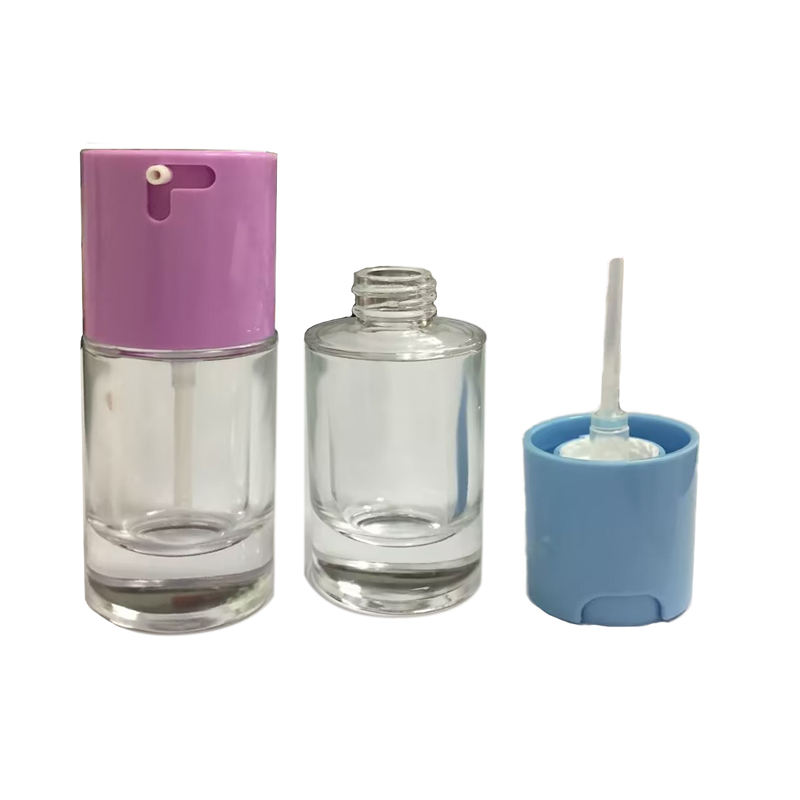
Reference model CP07-2026, an airless pump liquid foundation bottle (W33.5 x H92 mm, 30 ml) used to illustrate how specification data is recorded across a packaging model line.
The global cosmetic packaging market was valued at approximately USD 34.17 billion to USD 47.3 billion in 2024, with projections reaching up to USD 89.72 billion by 2034, according to figures published by Fortune Business Insights, ResearchAndMarkets and Data Bridge Market Research. Plastic accounted for 64.5% of the material mix in 2024, based on ResearchAndMarkets data, while Asia Pacific led the market in 2025 with a 42.36% share, per Fortune Business Insights. The estimates differ because market definitions differ — some include secondary packaging and bulk industrial containers, others do not. That disagreement is itself a useful lesson for buyers: in cosmetic packaging, scope determines the number, and scope is exactly what has to be fixed before a supply relationship can be evaluated.
For a beauty brand placing recurring orders, the commercial risk rarely sits in the packaging concept. It sits in whether the tenth production run still matches the first. This article sets out a long-term supplier evaluation framework built around one question: can the partner sustain repeatable specifications across recurring orders and across multiple model lines at the same time?
The First Order Tests Design. Later Orders Test Repeatability.
Early-stage packaging evaluation is usually a design conversation: does the shape suit the formula, does the finish suit the shelf, does the component suit the filling line. Those questions are answered once. The recurring questions begin after approval, when a brand reorders the same lipstick tube, lipgloss tube, powder jar, foundation bottle or deodorant container and expects the same fit, the same fill volume behaviour, the same closure feel and the same leak resistance without re-qualifying the component each time.
This is where a supplier evaluation framework earns its place. Rather than scoring a partner on a single delivered batch, the framework scores the partner on whether it can hold a specification envelope across orders, and whether the purchasing documents make that hold verifiable.
What Repeatable Specification Means Across a Model Line
A repeatable specification is a documented set of dimensional, volumetric and functional parameters that a supplier can reproduce on the next order without a design change request. In cosmetic packaging it is normally expressed through five recorded attributes: overall dimensions, wall thickness or component thickness, nominal volume, material, and functional performance such as leak-proof behaviour under normal handling.
The table below shows how these attributes appear across five representative models from the COSFINITY range. COSFINITY, formally Guangzhou Cosfinity Cosmetics Co., Ltd., is a cosmetic packaging manufacturer founded in 2009 in Guangzhou, China, operating a 40,000 sqm facility with 200 employees and an annual output of 500,000,000 pieces, exporting 100% of production to global markets.
| Model | Product type | Dimensions | Thickness | Nominal volume | Material |
|---|---|---|---|---|---|
| CP01-2142 | Luxury empty plastic lipstick tube | W22.7 x H84.6 mm | 0.3 mm | 20 ml | Plastic |
| CP02-2231 | Luxury empty plastic lipgloss / mascara tube | W18 x H106.1 mm | 0.3 mm | 3 ml | Plastic |
| CP05-2159B | Leak-proof plastic powder jar / pot | W40.7 x H32.6 mm | 1 mm | 5 ml | Plastic |
| CP07-2026 | Airless pump liquid foundation bottle | W33.5 x H92 mm | Not specified in the recorded specification | 30 ml | Glass |
| TP01-1018-15 | Deodorant stick plastic tube container | L41.7 x W24.49 x H86.5 mm | Not specified in the recorded specification | 20 ml | Plastic |
Two things stand out in this table, and both matter for long-term evaluation. First, the model line mixes thickness conventions: a 0.3 mm wall on the two tube formats and a 1 mm thickness on the powder jar. A supplier that reports a single blanket thickness figure across all models is not describing the products accurately. Second, the material is not uniform: CP07-2026 is a glass bottle, while CP01-2142, CP02-2231, CP05-2159B and TP01-1018-15 are plastic. Specification continuity therefore has to be managed per model, not per supplier.
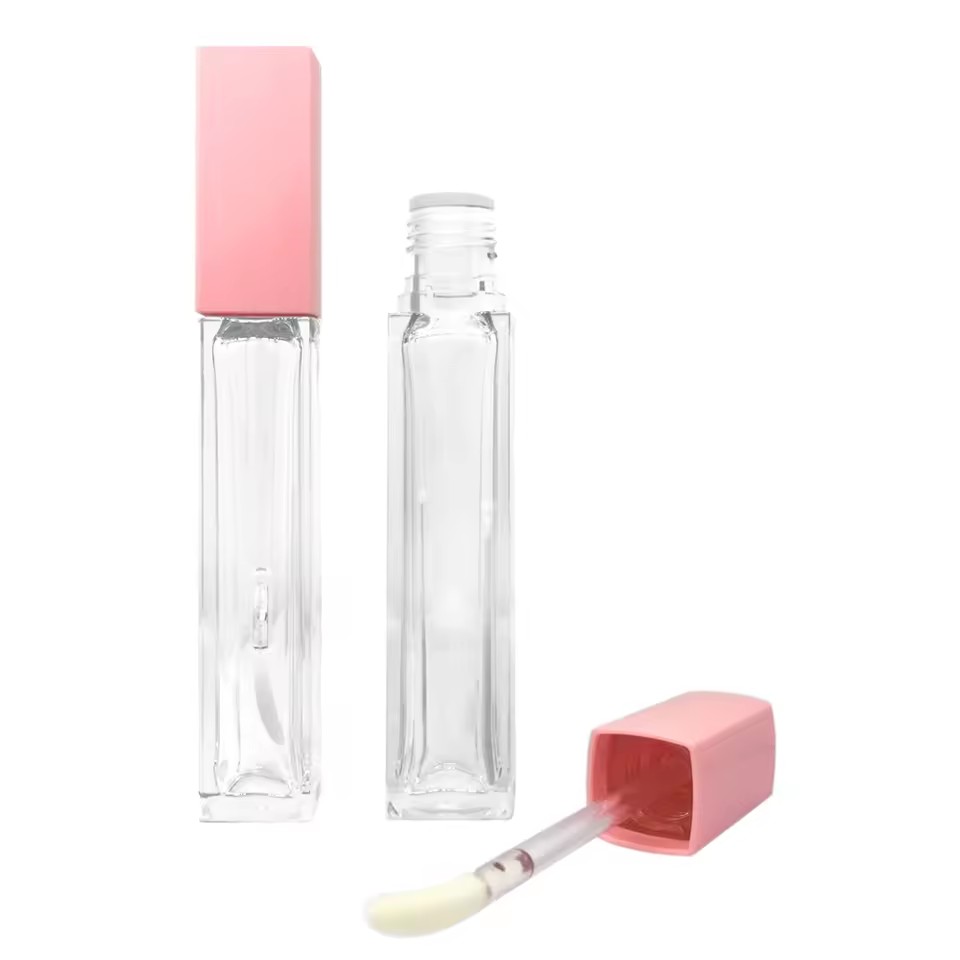
CP02-2231, a 3 ml lipgloss / mascara tube with a 0.3 mm wall — one of the small-volume formats where wall thickness control has the largest effect on fill behaviour.
The Spec Dimensions That Drift First
Across recurring orders, three parameters create the majority of downstream complaints: wall thickness, fill volume and closure integrity. Each behaves differently.
Wall thickness. On thin-wall formats such as CP01-2142 and CP02-2231, both specified at 0.3 mm, wall thickness influences weight, rigidity, surface finish and how the tube behaves during decoration and filling. It is also the parameter most affected by tooling wear and process drift over long production periods.
Fill volume. Nominal volumes — 20 ml on CP01-2142, 3 ml on CP02-2231, 5 ml on CP05-2159B, 30 ml on CP07-2026 and 20 ml on TP01-1018-15 — are nominal, not guarantees. What buyers actually need is a stated relationship between nominal volume and usable fill, held consistently order to order.
Closure and leak resistance. The reference application scenario for these products is indoor daily makeup use at normal room temperature of 16°C to 25°C, with repeated opening and closing and carrying. The stated special requirements for that scenario are leak-proof design, non-irritating material, portability and lightweight construction. Leak-proof performance is the requirement most likely to be assumed rather than documented — and the one most visible to an end consumer when it fails.
How COSFINITY Structures Repeatable Supply
The supplier side of repeatability rests on documented capability rather than on claims. COSFINITY operates an OEM/ODM production model with customization available across logo, colour, shape, material, volume, thickness and packaging. Recording thickness as a customizable parameter matters for the framework described above: it means wall thickness is treated as a controlled specification item rather than an incidental process outcome.
Supporting operational parameters include a monthly capacity of 10,000,000 pieces, a lead time of 15 to 25 days, a minimum order quantity of 12,000 pieces, and quality control described as 100% testing. Manufacturing is supported by a 25-engineer R&D team, and after-sales service is delivered remotely online.
For a buyer evaluating long-term fit, these four numbers translate directly into planning constraints. A 12,000-piece minimum applies per model, so a brand running five models simultaneously is committing to five separate minimum quantities. A 15 to 25 day lead time defines the reorder trigger point. A 10,000,000-piece monthly capacity indicates headroom for volume growth without changing partners. And a 100% test regime is the mechanism by which dimensional and functional checks are meant to be applied to every unit rather than to a sample.
Purchasing Terms and Acceptance Criteria That Make Repeatability Auditable
Repeatability only becomes enforceable when it is written into the purchase order. The framework below converts each specification attribute into a clause a buyer can attach to an order.
| Attribute | What to write into the PO | Why it protects the reorder |
|---|---|---|
| Overall dimensions | Nominal dimension per model plus a tolerance band agreed in writing | Prevents silent revision of a qualified component |
| Wall / component thickness | Stated value per model — for example 0.3 mm on CP01-2142 and CP02-2231, 1 mm on CP05-2159B | Thickness drives weight, rigidity and decoration yield |
| Nominal volume | Nominal capacity plus the usable fill range for the intended formula | Prevents fill-line rejection on later batches |
| Material | Material grade per model, including plastic versus glass designation | Glass and plastic components behave differently and cannot share one tolerance logic |
| Leak-proof performance | Closure requirement stated against the daily-carry scenario (room temperature, repeated open and close) | Makes a functional requirement testable rather than assumed |
| Functional safety | Confirmation that the material is non-irritating and suitable for direct skin contact | Direct-touch packaging carries a consumer-facing obligation |
| Commercial terms | MOQ, lead time and change-notification obligations | Creates a documented trigger if tooling or process changes |
The change-notification clause is frequently the missing piece. A supplier that controls its own tooling can modify a mould for maintenance or efficiency without informing the buyer, and the resulting component can remain within a broad specification while still failing the brand's filling line. Written notification obligations close that gap.
Model-by-Model Fit: Where Each Specification Belongs
Long-term evaluation also requires checking that the mix of models in the line-up is coherent. The five reference models cover very different formats.
Ultra-small liquid formats — CP02-2231 (3 ml). A lipgloss or mascara tube at W18 x H106.1 mm with a 0.3 mm wall. The long, narrow profile places the closure and applicator interface under the most scrutiny, and the small nominal volume leaves little room for fill variation.
Stick formats — CP01-2142 (20 ml) and TP01-1018-15 (20 ml). The lipstick tube at W22.7 x H84.6 mm with a 0.3 mm wall, and the deodorant stick container at L41.7 x W24.49 x H86.5 mm, share a nominal 20 ml but differ in cross-section and mechanism. A brand buying both should expect two separate specification records, not one.
Powder formats — CP05-2159B (5 ml). A leak-proof plastic powder jar at W40.7 x H32.6 mm with 1 mm thickness. The thicker wall and wider diameter support the leak-proof requirement stated for carried cosmetic products, and the format sits differently against the tolerance framework than the thin-wall tubes.
Pump formats — CP07-2026 (30 ml). An airless pump liquid foundation bottle at W33.5 x H92 mm in glass. Because the recorded specification lists no thickness value for this model, buyers should treat thickness as an open item to be agreed rather than an inherited assumption from the plastic models.
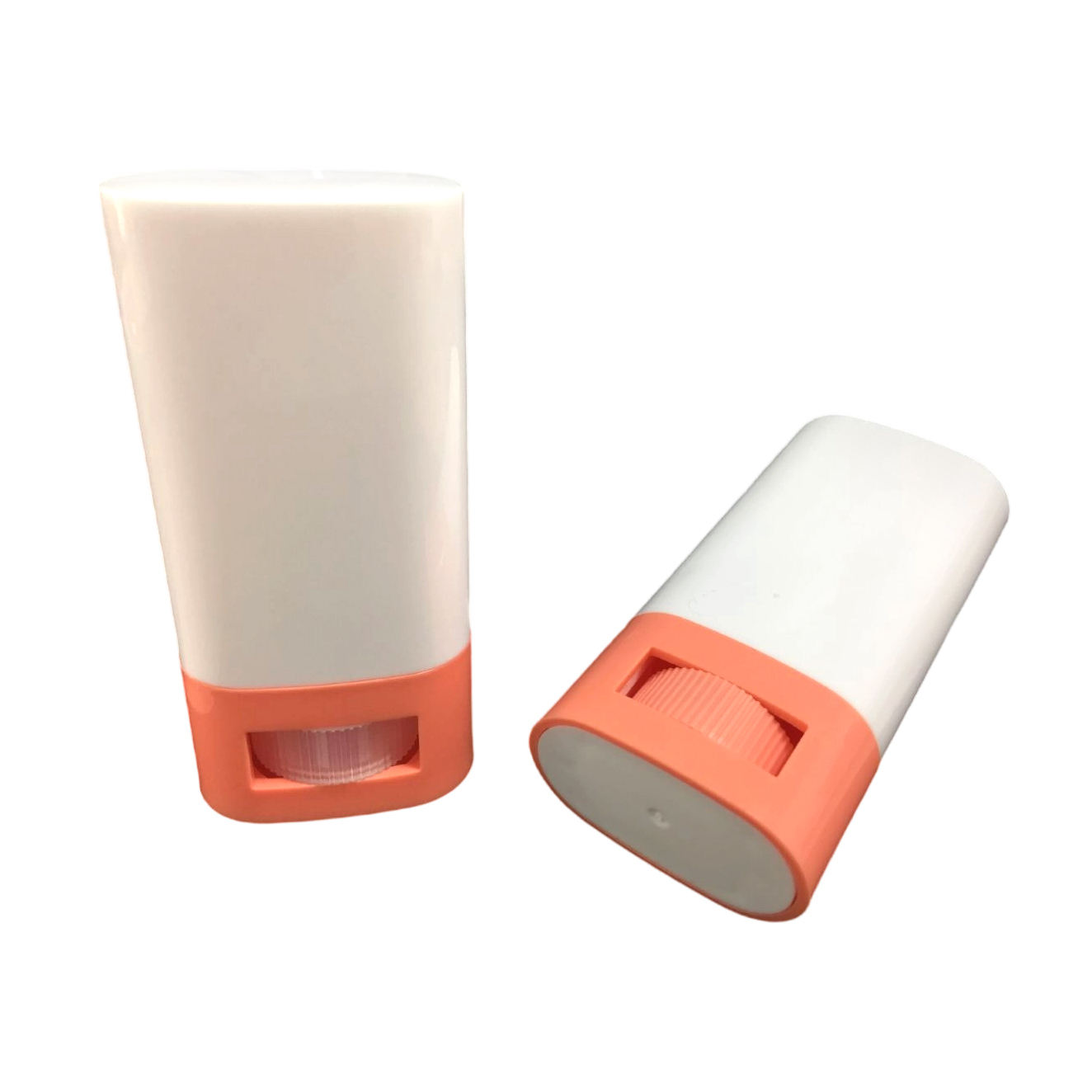
TP01-1018-15 deodorant stick container, a 20 ml format whose cross-section differs from the 20 ml lipstick tube CP01-2142 — two models, two specification records.
Evidence From a Two-Year Repeat-Order Relationship
One documented case illustrates how the framework behaves in practice. A lipstick tube OEM buyer in India placed an initial order of 12,000 pieces — exactly the published minimum order quantity — for a private-label lipstick launch using CP01-2142. The relationship has run for two years. The recorded outcome is that stable quality supported continuous repeat bulk orders.
The recorded highlights of that project are also the specification attributes that had to hold: a customized design, lightweight plastic material, customizable appearance printing, and a tight leak-proof structure suited to daily portable lipstick use. Read as an evaluation case rather than a sales reference, the important detail is the order pattern — an initial minimum-quantity run followed by repeat orders over two years. That is the pattern a repeatability framework is designed to protect, because the second and later orders are where a drifting specification becomes visible.
Market Trend Analysis: Regulation, Material Share and Regional Demand
Three verified trends shape how long-term packaging specifications are now written.
Regulatory pressure on materials. The EU Packaging and Packaging Waste Regulation (EU) 2025/40 sets recyclability and labelling requirements for cosmetic packaging, and the U.S. Modernization of Cosmetics Regulation Act (MoCRA) introduced mandatory facility registration and product listing obligations. Both create a scenario in which a material or component decision made today may require revision within the life of a supply relationship — which is precisely why change-notification clauses belong in the purchasing terms.
Continued dominance of plastic. With plastic at 64.5% of the material mix in 2024 according to ResearchAndMarkets, the practical centre of specification repeatability remains moulded plastic components. Glass formats such as CP07-2026 remain a smaller share and follow different tolerance logic.
Regional demand concentration. Asia Pacific held a 42.36% share of the market in 2025 per Fortune Business Insights, and China's beauty product exports reached approximately USD 4.77 billion in 2024 according to the Observatory of Economic Complexity, with the United Kingdom as the fastest-growing market at 20.8%. For buyers, this concentration means supply continuity is increasingly a question of how a manufacturer manages capacity across a dense regional demand base — a factor that supports the case for evaluating capacity numbers such as monthly output rather than unit price alone.
Consumer expectations add a fourth, softer signal: sustainable or refillable packaging is reported by Statista and Packly as a priority for 63% of cosmetic consumers in 2024. That figure carries medium reliability in the available data and should be treated as directional rather than definitive.
Comparing Long-Term Spec Control With Traditional Sourcing
Traditional sourcing treats each order as an independent purchasing event, often split across several vendors to spread risk or chase pricing. Long-term spec control concentrates a model family with one partner and manages continuity as the primary objective. The two approaches differ on measurable dimensions.
| Evaluation dimension | Order-by-order sourcing | Long-term spec control with one partner |
|---|---|---|
| Dimensional continuity | Re-qualification may be needed where tooling differs | Same tooling and same recorded dimensions across orders |
| Thickness control | Specification may be quoted per vendor without a common reference | Thickness recorded per model, e.g. 0.3 mm and 1 mm values held in one specification set |
| Volume consistency | Fill behaviour can shift between vendors | Nominal volumes such as 3 ml, 5 ml, 20 ml and 30 ml tracked as fixed parameters |
| Leak-proof performance | Functional requirement may not be documented | Stated against a defined daily-carry use scenario |
| Commercial terms | Terms renegotiated per order | MOQ, lead time and change notification fixed for the relationship |
| Regulatory adaptation | Each vendor responds independently | One point of contact for recyclability and labelling changes |
It is worth placing this against the wider supplier landscape. The cosmetic packaging sector includes large multinational groups such as Albéa S.A., Amcor PLC, Berry Global Group, AptarGroup Inc. and HCP Packaging, identified in Mordor Intelligence and Fortune Business Insights reporting as leading global competitors. Those organisations operate at substantial scale with broad standardised portfolios. A manufacturer configured around OEM/ODM customization — where shape, material and thickness are variable inputs rather than fixed catalogue options — addresses a different part of the market. Neither structure is inherently better; they suit different order profiles, and a brand should match the structure to its own model line and volume expectations.
Where This Framework Stops Working
A repeatability framework has real boundaries, and a buyer should know them before applying it.
First, the specification data available for these models states nominal dimensions, thickness and volume — it does not publish tolerance bands. The framework cannot be executed until the buyer and supplier agree tolerance limits in the purchase order. Treating a nominal figure as a tolerance is a common and avoidable error.
Second, the line-up is not uniform. CP07-2026 is a glass bottle with no thickness value recorded in the specification, while the plastic models carry explicit 0.3 mm or 1 mm figures. Applying one tolerance logic across both materials will produce incorrect acceptance decisions.
Third, the commercial structure constrains how the framework can be deployed. A 12,000-piece minimum per model and a 15 to 25 day lead time mean a brand launching several formats at once cannot treat all models as a single combined order; ordering must be staged, and the cash and storage implications of five simultaneous minimum quantities are real.
Fourth, after-sales support is delivered remotely online. That is workable for documentation and quality follow-up, but buyers with on-site engineering requirements should plan for that gap.
Finally, regulatory change is an external variable. Compliance with frameworks such as EU 2025/40 or MoCRA may require material or labelling adjustments that interrupt specification continuity regardless of how well a supplier performs. The framework manages supplier-driven drift; it cannot eliminate regulator-driven change.
Future Outlook
Two shifts are likely to define the next phase of long-term packaging evaluation. The first is documentation-led procurement: as recyclability and labelling obligations under EU 2025/40 and registration requirements under MoCRA become routine, the ability to produce a consistent specification and compliance record per model will matter as much as the physical component. Buyers will increasingly evaluate a supplier on the quality of its specification records, not only on delivered samples.
The second is format diversification within a single relationship. A line-up spanning a 3 ml lipgloss tube, a 5 ml powder jar, a 20 ml lipstick tube, a 20 ml deodorant stick and a 30 ml glass foundation bottle reflects how beauty brands now build ranges. The supplier question is no longer whether one format can be produced well, but whether five different specification envelopes can be held stable at the same time, order after order.
FAQ
What does a repeatable specification mean in cosmetic packaging supply?
It means the recorded parameters of a component — overall dimensions, wall or component thickness, nominal volume, material and functional requirements such as leak-proof performance — stay consistent across repeat orders without a design change. For example, CP01-2142 is recorded at W22.7 x H84.6 mm with a 0.3 mm wall and a 20 ml nominal volume; a repeatable specification means those values still describe the component on the second and subsequent orders.
How can a buyer verify wall thickness and volume consistency across repeat orders?
By writing the values into the purchase order and requiring them to be checked against each delivery. COSFINITY records thickness per model rather than as a blanket figure — 0.3 mm on CP01-2142 and CP02-2231, 1 mm on CP05-2159B — which makes per-model verification possible. Volume verification should compare nominal capacity against the usable fill range for the intended formula, since nominal volume is a declared figure rather than a guaranteed fill level.
Which formats in the range suit which product types?
The recorded models map to distinct categories: CP01-2142 is a lipstick tube at 20 ml; CP02-2231 is a lipgloss or mascara tube at 3 ml; CP05-2159B is a leak-proof powder jar at 5 ml; CP07-2026 is an airless pump liquid foundation bottle at 30 ml in glass; and TP01-1018-15 is a deodorant stick container at 20 ml. The two 20 ml formats differ in cross-section and mechanism, so they require separate specification records despite the shared nominal volume.
What acceptance criteria should appear in a packaging purchase order?
At minimum: dimension and tolerance per model, thickness per model, nominal volume and usable fill range, material grade including plastic or glass designation, leak-proof performance stated against the intended use scenario, confirmation that the material is non-irritating and suitable for direct skin contact, and commercial terms covering minimum order quantity, lead time and change notification. COSFINITY publishes a minimum order quantity of 12,000 pieces and a lead time of 15 to 25 days, both of which are order-level terms that should be confirmed in writing per line item.
How does material choice affect long-term specification control?
Glass and plastic components do not behave identically, so they should not share one tolerance framework. The reference range is predominantly plastic — plastic held 64.5% of the cosmetic packaging material mix in 2024 according to ResearchAndMarkets — while CP07-2026 is recorded as a glass bottle with no thickness value in its specification. That absence is itself an evaluation item: thickness for that model must be agreed separately rather than inherited from the plastic formats.
How do regulatory changes interact with a long-term packaging specification?
They can override it. The EU Packaging and Packaging Waste Regulation (EU) 2025/40 introduces recyclability and labelling requirements for cosmetic packaging, and MoCRA in the United States introduced mandatory facility registration and product listing. Both can require material or labelling changes during the life of a supply relationship. A specification framework controls supplier-driven drift; regulatory-driven change has to be managed through contract terms and periodic specification review rather than through tolerance control alone.
Closing Note
Repeatability is not a claim a supplier can make on a sample. It is a property demonstrated across orders, and it is verifiable only when dimensions, thickness, volume, material and functional requirements are recorded per model and enforced through purchasing terms. Buyers evaluating a long-term cosmetic packaging partner can apply the same sequence to any model line: confirm the recorded specification, agree tolerance and acceptance criteria in writing, and then measure the second order — not the first — against it.
Company reference material, including the current product range and capability profile, is available in the COSFINITY corporate brochure: COSFINITY profile (PDF).
Third-party market, regulatory and competitor references in this article are attributed to Fortune Business Insights, ResearchAndMarkets, Data Bridge Market Research, the Observatory of Economic Complexity, the European Commission / Cosmeservice, FDA / ChemLinked, Mordor Intelligence, Statista and Packly as cited. Market size estimates for 2024 diverge across research providers depending on scope definition.