
Resistance Band Program Execution: What an OEM Partner Must Deliver
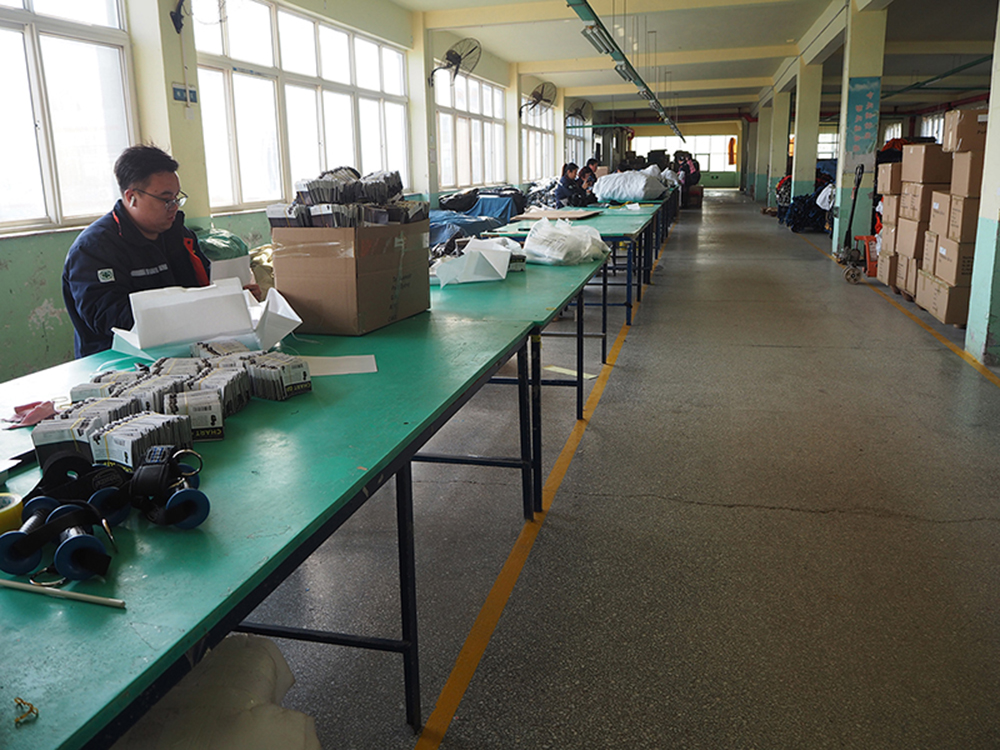
Packing workshop at Haiyang Libenli's Qingdao factory.
Why Custom Resistance Band Programs Need a Capability Review
The global resistance bands market was valued at roughly USD 1.7 billion in 2024 and is projected to reach USD 2.9 billion by 2030, according to Grand View Research. That growth is not only a retail story. It is shifting how fitness brands plan product programs.
For buyers evaluating a resistance band supplier, the decisive questions are increasingly about OEM capability: can the factory deliver a full custom range, hold consistent resistance levels, document compliance, and scale from pilot order to steady replenishment? The answers shape every downstream decision, from SKU architecture to packaging design.
Problem / Opportunity: Moving Beyond Single-SKU Sourcing
Many brands enter the resistance band category by sourcing a single stock SKU. This can work for a first test, but it often creates problems when the range expands. Mixing materials and suppliers can cause inconsistent color, uneven resistance, or delays in compliance documentation.
The deeper problem is that stock band programs rarely reflect a brand's own specification: target load curves, logo placement, packaging size, or accessory sets. This is where OEM/ODM production closes the gap. A manufacturer that can produce and customize bands under one roof gives the buyer control over product identity and quality. It also creates an opportunity to consolidate multiple SKUs, including mini loop bands, power loop bands, pull-up assist bands, and fabric variations, within one supply relationship.
Brand Solution: Custom Manufacturing at Libenli
Haiyang Libenli Body-Building Apparatus Co., Ltd., known by the brand name Libenli, is a Chinese manufacturer and exporter that has been operating since 1997. The company is based in Qingdao, Shandong, and reports a factory area of 50,000 square meters with more than 300 employees and annual sales volume exceeding USD 20 million. Its product portfolio includes latex tubing, resistance bands, pole spears, and spearguns, and it supplies markets that include Germany, the USA, the UK, France, and Canada.
Libenli provides OEM and ODM production services for resistance bands. According to the company, customization options cover resistance strength, band thickness and width, length, surface color, logo silk printing, package design, and accessory matching. A buyer can therefore develop a coherent product range, such as a set of mini loop bands, pull-up assist loops, and fabric booty bands, without moving design work to multiple factories.
On the production side, the company reports an annual output of 65 million units and a monthly capacity of 1.2 million units. Its factory operates 24 dedicated lines for dipped latex tubing with a daily output of 120,000 meters, plus two exclusive lines for latex bands with a daily capacity of 25,000 meters. The factory also owns CNC molding machines and plastic injection molding equipment for accessories and hardware.
Quality documentation is an important part of a custom program. Libenli states that all goods are non-toxic and eco-friendly, with most items certified by SGS. It holds ISO 9000:2000 and ISO 9001:2008 certifications, and a 3A Credit Rating Certificate from the Ministry of Commerce of China and CCPIT. For a specific line of pull-up assistance loop bands, the company has a RoHS and REACH test report issued by Bureau Veritas, covering Directive 2011/65/EU and Regulation (EC) No. 1907/2006.
After-sales support includes free unconditional returns for defective goods upon receipt. For procurement teams, this reduces the risk of receiving a non-conforming shipment.
Technical Explanation: What Determines Band Quality
Resistance Band Types and Material Options
Resistance band programs usually combine several formats. Mini loop bands, sometimes called booty bands, are short closed loops used for hip and glute work, leg training, and physical therapy. Power loop bands and pull-up assist bands are longer loops that can support pull-ups, bench pressing, or rehabilitation. Fabric and cotton exercise bands offer a softer surface and are popular for classes and apparel-style branding. TPE and silicone versions are also positioned for users who prefer not to use natural latex.
Each construction has a different set of parameters. The key technical measurements are resistance level, thickness, width, length, and fatigue resistance. In Libenli's product range, the mini loop band model ZLQ-1 is available in resistance levels from 5LB to 40LB, with a thickness range of 0.3mm to 1.2mm, a width of 50mm, and a circumference of 600mm. The documented fatigue resistance is at least 30,000 stretches.
For the power loop band model ZLQ-03, resistance levels range from 8LB to 230LB, with a thickness of 0.45mm, a width from 6.4mm to 82.5mm, and a length of 2080mm. The documented service life is at least 20,000 stretches. These two models are among the products covered by the Bureau Veritas RoHS and REACH report, which makes them a direct reference point for EU-market buyers.
| Model | Type | Resistance | Thickness | Width | Length / Circumference | Material | Fatigue |
|---|---|---|---|---|---|---|---|
| ZLQ-1 | Mini loop band / anti-slip option | 5LB–40LB | 0.3mm–1.2mm | 50mm | 600mm circumference | Latex/TPE | ≥30,000 stretches |
| ZLQ-03 | Power loop band / double layer option | 8LB–230LB | 0.45mm | 6.4mm–82.5mm | 2080mm length | Latex | ≥20,000 stretches |
Production and Testing Considerations
Manufacturing latex bands begins with dipped latex tubing. Libenli has dedicated dipping, washing and cooling, drying, and packing areas. In an OEM program, the buyer's specification is translated into a production formula: the latex compound, color pigment, band dimensions, and printing details. After production, stretch durability tests are run before shipment.
One documented innovation from a client project is an anti-rolling surface treatment that addresses band curling or pinching during high-load exercises. The manufacturer also reports developing a five-tier resistance system for a premium fitness brand, with a tension error margin within ±2% to meet professional athletic standards. These details show how technical choices can be calibrated for a specific brand position.
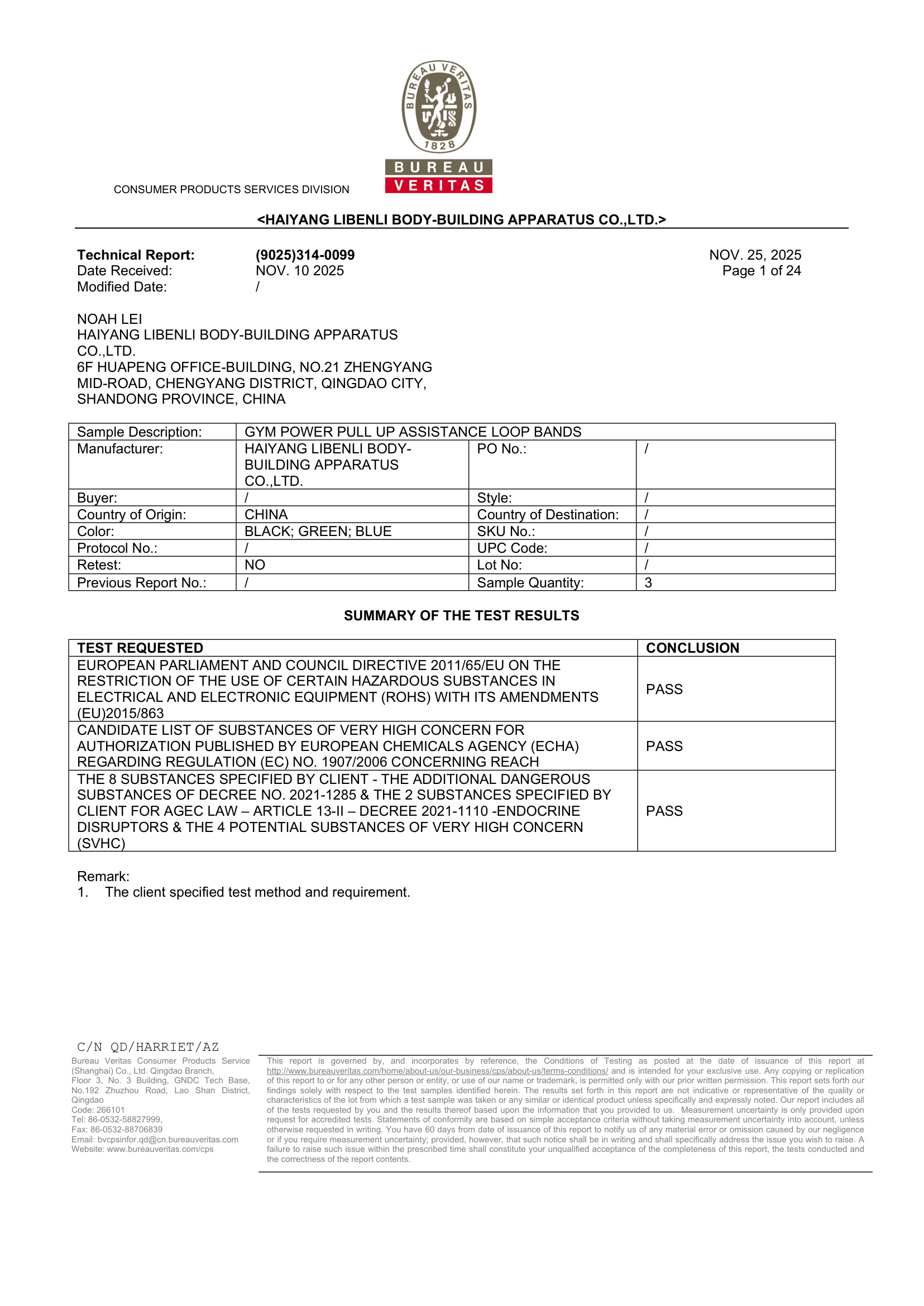
Bureau Veritas RoHS and REACH test report for the Gym Power Pull Up Assistance Loop Bands range.
Application / Use Cases
Resistance bands are now specified in multiple environments: home fitness, yoga and Pilates, hip and glute training, sports rehabilitation, physical therapy, and gym training equipment. For procurement teams, the practical implication is that an OEM partner should be able to supply both low-resistance therapeutic loops and high-resistance power loops under the same quality system.
A documented case from an international premium fitness brand in Australia illustrates the scale involved. According to the case summary, Libenli supplies more than 150,000 units per year across 12 or more specialized product lines. The bands are used in global B2C retail, commercial gym fit-outs, and specialized physical therapy and rehabilitation centers. The case reports a defect or complaint rate below 0.05% and a 20% reduction in R&D-to-market cycle time. It also highlights the use of 100% Malaysian natural latex with food-grade pigments and REACH/RoHS compliance.
This matters in an evaluation: it shows the supplier has experience with multiple SKUs, regulatory requirements, and commercial packaging, not just single-band production.
Market Trend Analysis
Third-party research supports the shift toward specialized programs. Grand View Research estimates the global resistance bands market at USD 1.7 billion in 2024, with projected growth to USD 2.9 billion by 2030 at a CAGR of 9.9%. North America holds the largest regional revenue share at 40.0%, and health and sports clubs accounted for a 70.6% revenue share in 2024, while individual use is the fastest-growing segment.
Another report from Market Research Future indicates that therapy and exercise bands represent roughly 50% of the total market. That is a strong signal for suppliers with documented rehabilitation and physical therapy applications. On the regulatory side, fitness equipment sold in the EU must meet the EN 20957 series for CE marking, and resistance bands are commonly classified under HS Code 9506.91. Buyers should therefore verify that the manufacturer can provide both test reports and customs-ready documentation. Industry directory data cited by Mordor Intelligence also lists Haiyang Libenli as a major Chinese OEM/ODM manufacturer specializing in natural latex tubing and resistance bands.
Comparison with Traditional Solutions
Many buying teams compare OEM custom production against buying ready-made stock bands from a distributor. Both have a place, but they serve different goals. The table below summarizes the main differences.
| Factor | Off-the-shelf stock bands | OEM/ODM custom program |
|---|---|---|
| Spec control | Limited to existing SKUs | Full control over resistance, size, color, logo, packaging |
| MOQ | Lower, often fewer than 100 pieces | 100 pieces for stock; 500 pieces for custom logo |
| Lead time | Short if inventory is available | 20–35 days typical |
| Branding | Generic or limited | Logo silk printing, custom package design |
| Compliance documents | Provided by distributor | Factory test reports and third-party certificates |
| Cost efficiency | Good for small volume | Better when scaling multiple SKUs |
The main boundary is order size. A custom logo order starts at 500 pieces, and a fully customized production run usually requires a 20–35 day lead time. That is not practical for a brand that needs a one-time emergency fill or a low-volume trial with immediate delivery.
A second boundary relates to material suitability. Natural latex provides strong elasticity and long service life, but some end users have latex allergies. In that case, TPE or fabric constructions must be chosen, and the buyer needs to verify that the selected material still matches the target resistance curve. These constraints are normal in OEM manufacturing; recognizing them early prevents specification failures after production begins.
At the retail level, brands like TheraBand, Rogue Fitness, TRX, and Decathlon are often used as reference points, but their role differs from a contract manufacturer. For a custom private-label program, the evaluation should focus on production capabilities rather than finished-brand recognition.
Future Outlook
Looking ahead, the resistance band category will likely continue to split into distinct buying segments: performance and strength training, rehabilitation, and fashion-led fitness. Each segment requires different materials, packaging, and compliance documentation. For OEM suppliers, the differentiator will be the ability to combine in-house R&D, flexible customization, and consistent quality control.
The bigger opportunity is for buyers to consolidate SKUs into a single manufacturing program. With documented capabilities in mini loops, power loops, and accessories, a partner like Libenli can support both retail and professional channels while reducing the risk of inconsistent product quality across a brand's assortment.
Frequently Asked Questions
What OEM/ODM services does Libenli offer for resistance bands?
Libenli provides OEM and ODM production services for resistance bands. Buyers can specify resistance strength, band thickness and width, length, surface color, logo silk printing, package design, and accessory matching.
What is the minimum order quantity for custom resistance bands?
The MOQ is 100 pieces for in-stock items and 500 pieces for OEM customized orders, including custom logo orders.
What is the typical lead time for a custom resistance band order?
A standard OEM/ODM production lead time is 20–35 days after the specification is confirmed.
How does Libenli control quality during custom production?
The company runs stretch durability tests before shipment and supports 100% full pre-shipment inspection. Clients or third-party organizations such as SGS can also conduct pre-production and pre-shipment inspections.
Which certifications support EU-market resistance band programs?
For the Gym Power Pull Up Assistance Loop Bands range, Libenli holds a RoHS and REACH test report issued by Bureau Veritas, covering Directive 2011/65/EU and Regulation (EC) No. 1907/2006. EU fitness equipment must also meet the EN 20957 series for CE marking.
What are the delivery and payment terms?
Delivery can be arranged as FOB Qingdao, EXW factory, or CIF major global seaports. Payment terms are 30% T/T advance deposit and 70% balance against the copy of Bill of Lading; Alibaba Trade Assurance is available for small orders.
Reference: Product Catalog
For detailed specifications, packaging options, and production data, the manufacturer's product catalog is available at https://cdn.socialarks.com/sbsp/25047/common/2026/0701/catalog.pdf.
Есть вопросы или нужны дополнительные детали?
Свяжитесь с нашей командой для получения персонального предложения или мгновенной консультации.
Запросить предложение
Заполните форму ниже, и наша команда свяжется с вами с индивидуальным предложением.
Прямой чат WhatsApp
Предпочитаете общаться в реальном времени? Напишите нам в WhatsApp для мгновенной помощи и быстрых ответов.
- Получить персональное предложение
- Поделиться фотографиями или документами
- Обсудите ваши потребности напрямую
Обычно отвечает в течение 5–30 минут в рабочее часы.