
Restaurant Furniture Quotes: MOQ, Lead Time and Payment FAQ
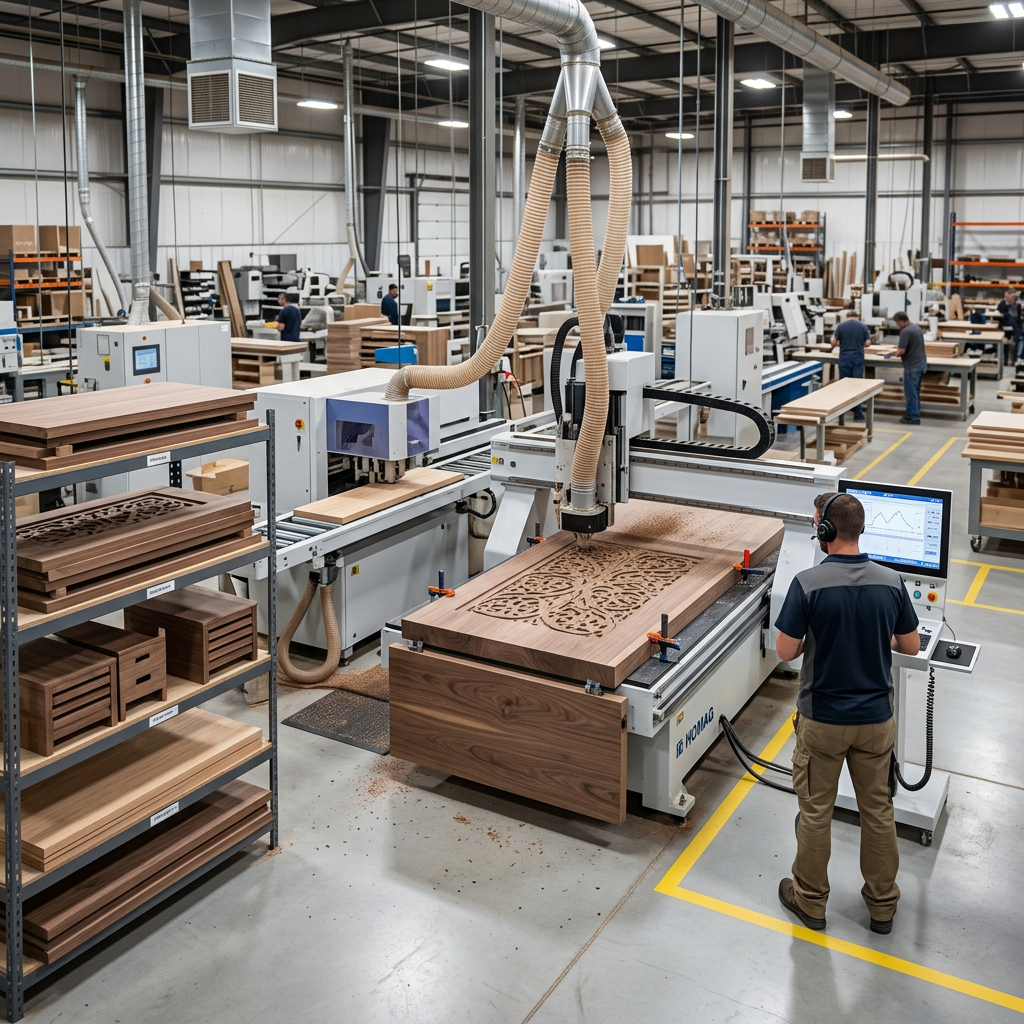
Component geometry, material grade and quantity per model are decided long before a restaurant furniture price is written down. CNC machining workshop, commercial furniture production.
A restaurant furniture quotation is a specification, not a price list
A restaurant furniture quotation is a commercial offer built from a defined specification: material, dimensions, quantity per model, upholstery, finish, testing requirement, packing method and delivery term. Because those inputs vary between buyers, two requests for the same number of covers rarely produce comparable figures, and a unit price quoted without a specification cannot be used as a benchmark.
MingMeng Furniture (Guangzhou Mingmeng Furniture Co., Ltd.) is a Guangzhou-based manufacturer of commercial restaurant and hospitality furniture, founded in 2015, operating a 15,000㎡ facility with more than 200 workers and supplying B2B projects in more than 100 countries. Its procurement guidance treats quotation, minimum order quantity (MOQ) and lead time as three linked confirmations rather than three separate negotiations. That is a useful framing for buyers at decision and execution stage, because the practical questions are sequential: what is being quoted, what quantity makes the quote valid, and when can production realistically be scheduled.
Short answers
1. Quotations are usually issued on EXW or FOB terms; freight depends on the shipping term and destination.
2. MOQ is model- and material-specific, and the governing figure is the one confirmed in the quotation.
3. Lead time depends on quantity, customization complexity, material availability, sample approval and factory capacity.
4. A usable quotation requires a floor plan or dimensions, furniture list, quantities, material and finish direction, destination and target schedule.
What actually drives the number on a restaurant furniture quote
MingMeng states that restaurant furniture pricing is calculated on material, size, quantity and finish. In practice these four variables interact, and the interaction is why a quote can move after a design review even when the furniture count has not changed.
| Quotation input | Why it changes the figure |
|---|---|
| Frame and tabletop material | Solid wood, plywood, steel, aluminium, HPL, veneer, marble and stone carry different material and processing costs; the same silhouette in two materials is two products. |
| Dimensions and geometry | Booths and banquettes follow floor plans and wall lengths; non-standard radii, angles and heights require individual setting rather than a standard jig. |
| Quantity per model | Material purchasing and production set-up are shared across a run; small runs per model carry relatively more set-up per unit. |
| Upholstery and finish | Fabric, PU leather and genuine leather differ in cost and wear behaviour; painted, stained, powder-coated, matte, gloss, textured and wood-grain finishes are separate processes. |
| Compliance and testing | Where a project specifies fire-retardant foam or fabric, or commercial seating testing, the material set and documentation change. |
| Packing and delivery term | Export cartons, reinforced packing and wooden crates are selected by fragility; freight is quoted separately or included depending on the agreed term. |
The commercial consequence is simple: a buyer comparing three suppliers on unit price is usually comparing three different specifications. The comparison only becomes meaningful when material grade, dimensions, quantity per model and finish are fixed in writing on all three documents.
MOQ: what the number applies to, and what it does not
MOQ in commercial furniture is normally applied per model, not per shipment. MingMeng's purchasing guidance states an MOQ of usually 10 units per model, with project-based orders negotiable according to furniture scope and customization requirements; company material on custom restaurant booth manufacturing references 20 units. The two figures are not in conflict so much as scoped differently: booths are built to floor-plan geometry, while chairs and tables may follow a repeatable model.
Three practical rules follow from that.
First, MOQ should be requested with the model list attached. A single blended MOQ figure is of limited use when a project mixes chairs, bar stools, tables, booths and sofas. The buyer should send the required models, quantities and specifications for confirmation, because the answer changes with the mix.
Second, mixed-model orders are a planning question, not a policy question. Mixed-model orders can be considered for project procurement, subject to model-specific production requirements and total order planning. That makes MOQ a tool for structuring a package rather than a pass-fail threshold.
Third, trial orders are evaluated case by case. Small trial orders depend on the product, material set-up and production requirements. Trial orders are therefore a legitimate conversation, but they are not a standard SKU with a standard answer.
For buyers, the useful output of the MOQ conversation is not a single number. It is a confirmed list that shows which models are quoted at which quantity, and which lines would need consolidation to reach an efficient production run.
Payment terms, currency and negotiation
Payment structure is normally agreed at order confirmation rather than at quotation. MingMeng states standard terms of 30% deposit and 70% balance before shipment by T/T, with L/C at sight potentially available for larger orders from established customers; other terms may be discussed according to order size and cooperation conditions.
Quotations can be prepared in USD, EUR or other major currencies based on the applicable exchange rate. For a project with a long build programme, the currency of quotation and the currency of payment should be confirmed together, because a quotation issued in one currency and settled in another adds a variable that has nothing to do with furniture.
On negotiation, MingMeng's stated position is that pricing may be discussed based on order quantity, purchase frequency and long-term cooperation, and that unit pricing may decrease as order quantity increases. This is worth reading carefully: the levers offered are volume and continuity, not a discount applied to an unchanged specification. Buyers who want movement on price usually need to bring one of those two levers.
Lead time: why the date is confirmed after the specification
Production lead time depends on quantity, customization complexity, material availability, sample approval and factory capacity. MingMeng's project material describes typical production cycles of 30 to 60 days depending on project scope, and states that a project-specific schedule is provided after the specification and order plan are confirmed.
That sequence matters for planning. A supplier who gives a fixed date before drawings and samples are approved is offering an estimate, not a commitment. The date becomes meaningful only when five conditions are settled:
| Lead-time variable | What the buyer controls |
|---|---|
| Quantity and model mix | Consolidating models into efficient runs shortens the production window more reliably than pressing for a shorter quoted date. |
| Customization complexity | Standard configurations, repeatable booth geometry and approved finishes are faster than first-time development work. |
| Material availability | Specifying materials confirmed as available at quotation stage removes a common cause of schedule revision. |
| Sample approval | Approval speed is usually the buyer-side variable with the largest effect on the start of bulk production. |
| Factory capacity | Capacity is time-sensitive; MingMeng states production capacity above 80,000 pieces per month, and slot booking depends on the order calendar. |
Urgent schedules can be evaluated after checking materials, production capacity and the required delivery date. That is a different request from asking for a shorter standard lead time, and it is more likely to produce an answer, because it asks the supplier to check three specific constraints.
Once production starts, progress can be communicated at agreed milestones using photos, videos or status updates, with production photos or videos shared when agreed as part of project communication. For multi-zone fit-outs, milestone reporting is often more valuable than a single promised ship date, because it lets the site programme absorb small variances.
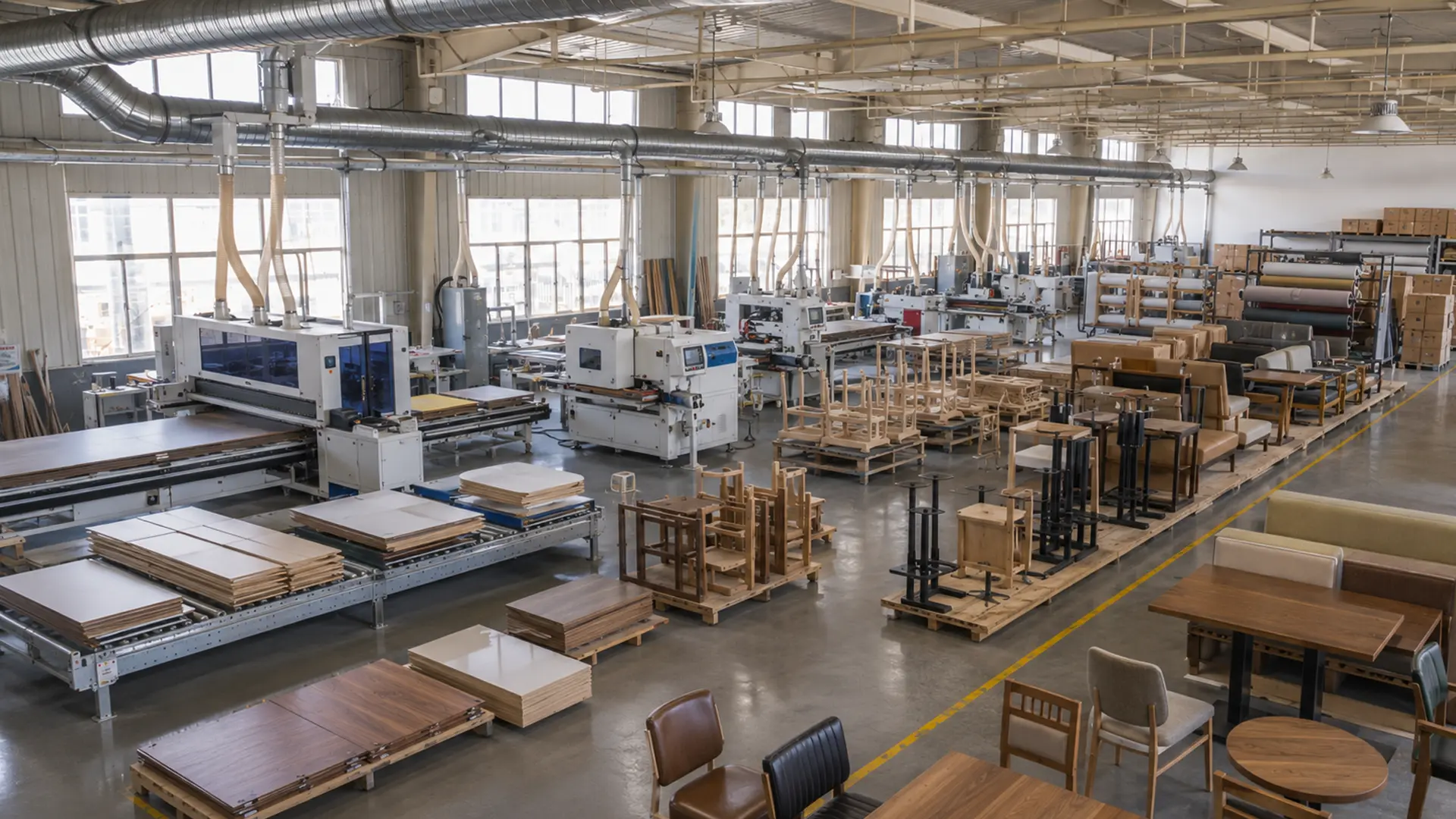
Capacity, sample approval and material availability determine when a confirmed schedule can be issued. Commercial furniture manufacturing facility.
Packing, shipping terms and whether freight is included
Freight inclusion is decided by the delivery term, not by the supplier's preference. MingMeng supports EXW, FOB, CIF, CFR and DDP, and can arrange freight for buyers on request. Quotes are usually EXW or FOB; freight depends on the shipping term and destination you choose.
| Term | What the quotation generally covers | What the buyer should confirm |
|---|---|---|
| EXW | Goods made available at the factory | Loading arrangements, export documentation, inland transport and main carriage |
| FOB | Goods delivered on board at the named port of shipment | Named port, vessel booking, and whether the freight quote is current at sailing |
| CIF / CFR | Carriage arranged to the named destination port (CIF also includes insurance) | Destination charges, import clearance and inland delivery beyond the port |
| DDP | Delivered with duty paid, where available for the destination | Feasibility for the country, customs and tax handling, and the final delivery point |
DDP availability depends on destination, product, customs and tax handling, and logistics capability, so feasibility has to be confirmed for the actual shipment rather than assumed from a previous project in the same region. The export port is selected according to factory location, routing, freight cost and project requirements.
Packing is quoted alongside the goods because it is part of the product's survival in transit. MingMeng's export packing procedure is: clean and protect finished surfaces; add foam and corner or edge protection with component separation where needed; select export cartons, reinforced packaging or wooden crates according to product fragility; protect hardware and label packages clearly; and check package dimensions and quantities against the packing list before loading.
For buyers, the practical check is whether the packing assumption on the quotation matches the actual route. A container that is unloaded once at a distribution centre has different demands from one that is split across three sites with local handling in between.
The customization process, from inquiry to shipment
Custom restaurant furniture follows a defined sequence, and each step produces a document that later steps depend on. MingMeng's stated workflow is:
Step 1 — Inquiry and requirement collection. Send the floor plan, drawings or reference images, required furniture types, quantities and target schedule.
Step 2 — Specification confirmation. Confirm dimensions, materials, colours, finishes and structural requirements.
Step 3 — Quotation and design review. Receive and review the quotation, design proposal and production plan.
Step 4 — Sample or finish approval. Approve samples, or material and finish samples, where required. Wood, metal and upholstery finish samples should be approved together to keep the project palette consistent.
Step 5 — Order confirmation and bulk production. Confirm the order, payment terms and production schedule, then begin bulk production after final approval.
Step 6 — Quality control. Complete quality inspection and close non-conformities before packing.
Step 7 — Packing and shipment. Complete export packing, loading and shipment coordination.
The stated safety rule is explicit: bulk production should not begin until drawings, dimensions, materials, finishes, quantities and approved samples are confirmed in writing, because late changes cause rework, extra cost and delay. For project buyers, that rule is the single most useful line in the whole process, since most schedule failures originate upstream of the factory floor.
What can be customized, and where CAD support sits in the quote
MingMeng's project-based customization covers dimensions, materials, colours, upholstery, finishes and structures, with fabric, hardware and branding also customizable. Product scope spans restaurant chairs, commercial dining tables, booth and banquette seating, bar stools, custom bar counters, hospitality sofas, hotel guest-room and lobby furniture, outdoor restaurant furniture, canteen furniture and table bases. Styles can be produced in modern, industrial, rustic, luxury, mid-century and other project-specific directions.
CAD support is part of the quotation stage rather than an afterthought, because drawings determine what is being priced. MingMeng provides furniture layout coordination, CAD drawings, 3D renderings, dimension adjustment and basic space planning, and booth and banquette layouts are designed with consideration for seating capacity and customer traffic flow. Drawings and renderings are produced using professional software including AutoCAD, SolidWorks and 3ds Max.
Two conditions keep this practical. Standard design support is available for confirmed orders, while complex custom design projects may require a separate design fee, so the scope of design work should be stated in the quotation. And where a buyer already has approved drawings, production can be carried out strictly to those drawings and specifications once dimensions, materials, finishes and technical details are confirmed.
For buyers, the actionable point is that CAD review is a cost-control step, not a formality. A booth redrawn before production is inexpensive; a booth rebuilt after production is not.
Where a project-based quote is not the right tool
Project-based quoting carries real trade-offs, and buyers should recognise when a simpler purchasing route fits better.
| Consideration | Project-based custom supply | Ready-made standard furniture |
|---|---|---|
| Specification | Built to drawings, dimensions and finishes | Fixed catalogue geometry and finish range |
| Time to a confirmed price | Longer, because a specification must be agreed first | Immediate, against a published item |
| Quantity flexibility | MOQ applies per model; small mixed baskets need planning | Often available in small quantities per item |
| Change control | Late changes cause rework, extra cost and delay | Change means choosing another item |
| Best fit | Multi-zone fit-outs, brand-specific geometry, repeat programmes | Small venues, replacement of single items, short opening timelines |
The clearest limitation is timing. A buyer who needs twelve chairs next month is not the right customer for a drawing-led process; a buyer furnishing a 200-cover venue with fixed banquettes, branded finishes and a phased opening is. MingMeng's own comparison material frames the difference as lifecycle value rather than unit cost: commercial-grade construction and project coordination are intended to reduce frequent replacement over the life of the venue, but that benefit only materialises if the specification is settled before production.
A second limitation is that price negotiation and specification negotiation cannot be separated. If a buyer reopens material, dimensions or finish after the quotation, the figure has to be rebuilt, and any earlier comparison becomes obsolete.
Market context: what forecasts can and cannot tell a buyer
Published market research on restaurant furniture does not currently offer a single settled number. Three commercial reports describe the global market very differently: one places it at USD 638.8 million in 2026 rising to USD 929.57 million by 2035 at a 4.3% CAGR; another at USD 0.88 billion in 2025 rising to USD 1.38 billion by 2034 at 5.13%; a third at USD 6.62 billion in 2025 rising to USD 11.01 billion by 2034 at 5.8%. The spread is too wide to be explained by growth assumptions and points to differing market definitions, base years and publisher methodologies.
The procurement implication is narrow but useful. Directional growth is a reasonable planning assumption for hospitality furniture demand; a specific market-size figure is not a valid benchmark for judging whether a quotation is high or low. Unit-price comparisons should be built from specifications, not from category-level forecasts.
Future outlook
Two developments are likely to shape how restaurant furniture is quoted over the next planning cycle. The first is documentation. Buyers increasingly ask for compliance evidence alongside price, and MingMeng's stated certification set includes CE, TÜV, RoHS and Certification of Conformity, with fire-retardant foam and fabrics available against CA117, BS5852 and EN1021 where a project requires them, and commercial seating tested to EN 16139. As destination-market requirements tighten, quotations that list test scope will be easier to approve than those that do not.
The second is repeatability. Operators running multiple sites need furniture that can be reordered years later without a redesign. MingMeng offers hospitality sofas, booth seating and hotel casegoods as project-based customization, OEM/ODM and bulk production supporting annual contract orders and repeat production programmes, and states that repeat procurement is supported through stable specifications, communication and supply planning. For chains, the value of a first quotation increasingly lies in how well it documents the specification for the second order.
Frequently asked procurement questions
Do restaurant furniture quotes include freight?
Usually not by default. MingMeng states that quotations are typically issued on EXW or FOB terms, with freight depending on the shipping term and destination selected. Freight can be arranged or quoted on request, and DDP availability depends on the destination country, product, customs and tax handling, and logistics capability. The applicable Incoterm should be written on the quotation so that landed cost can be calculated correctly.
What is the minimum order quantity for custom restaurant furniture?
MOQ is normally applied per model and depends on the product and material set-up. MingMeng's purchasing guidance states an MOQ of usually 10 units per model, with project-based orders negotiable according to furniture scope and customization requirements, while company material on custom booth manufacturing references 20 units. Buyers should send the required models, quantities and specifications for confirmation, because mixed-model orders are evaluated against model-specific production requirements and total order planning.
How long does production take, and when is the delivery date fixed?
Lead time depends on quantity, customization complexity, material availability, sample approval and factory capacity. MingMeng's project material describes typical production cycles of 30 to 60 days depending on scope, and a project-specific schedule is provided after the specification and order plan are confirmed. Urgent schedules can be evaluated after checking materials, production capacity and the required delivery date, so the date is best treated as confirmed only once drawings and samples are approved.
What payment terms are standard for project orders?
MingMeng states standard terms of 30% deposit and 70% balance before shipment by T/T, with L/C at sight potentially available for larger orders from established customers. Other terms may be discussed according to order size and cooperation conditions. Quotations can be issued in USD, EUR or other major currencies based on the applicable exchange rate, and the exact deposit and balance structure should be confirmed in the quotation or sales contract before order confirmation.
What should a buyer send to receive an accurate quotation?
The required inputs are the floor plan or space dimensions, the required furniture types and quantities, drawings or reference images, preferred materials and finishes, the destination and the target schedule. Drawings speed up the process but are not mandatory; photographs, reference images or written requirements can also be used, with drawings or 3D renderings produced for confirmation before production. A quotation issued against these inputs can be compared with another supplier's quotation; one issued without them cannot.
What can be customized, and does CAD support change the price?
Customization covers dimensions, materials, colours, upholstery, finishes and structures, plus fabric, hardware and branding. CAD drawings, 3D renderings, floor-plan adjustment and basic space planning are provided for project-based orders, and production can alternatively follow the buyer's own approved drawings. Standard design support is available for confirmed orders, while complex custom design work may carry a separate design fee, so the scope of design support should be stated in the quotation.
How are warranty and after-sales handled on repeat orders?
Warranty terms depend on the product, project specification and commercial agreement. For ongoing supply, annual contract orders and repeat production, the applicable warranty period and coverage are confirmed in the quotation or contract for each specific order, and manufacturing defects and normal after-sales responsibilities are defined in those order terms. Repair guidance, replacement parts or coordination support are provided depending on the issue and the contract terms, and replacement parts can be arranged where the component is identifiable and available.
Reference documents
For buyers assembling a specification pack, the MingMeng restaurant furniture catalogue covers product categories, materials and project customization scope, and can be downloaded here: Mingmeng Restaurant Furniture 2026 catalogue (PDF).
Quotation terms, MOQ, lead times and payment structures described in this reference reflect stated company guidance and are confirmed per order in the quotation or sales contract.
Есть вопросы или нужны дополнительные детали?
Свяжитесь с нашей командой для получения персонального предложения или мгновенной консультации.
Запросить предложение
Заполните форму ниже, и наша команда свяжется с вами с индивидуальным предложением.
Прямой чат WhatsApp
Предпочитаете общаться в реальном времени? Напишите нам в WhatsApp для мгновенной помощи и быстрых ответов.
- Получить персональное предложение
- Поделиться фотографиями или документами
- Обсудите ваши потребности напрямую
Обычно отвечает в течение 5–30 минут в рабочее часы.