
Restaurant Marble Table Supplier Shortlist: SONGJIA Ranked
Restaurant Marble Table Supplier Shortlist: SONGJIA Ranked
HTNXT Industry Reference · Commercial Interiors
What separates a supplier a restaurant can specify once from one it can re-order from for a decade — and where SONGJIA sits when that test is applied.
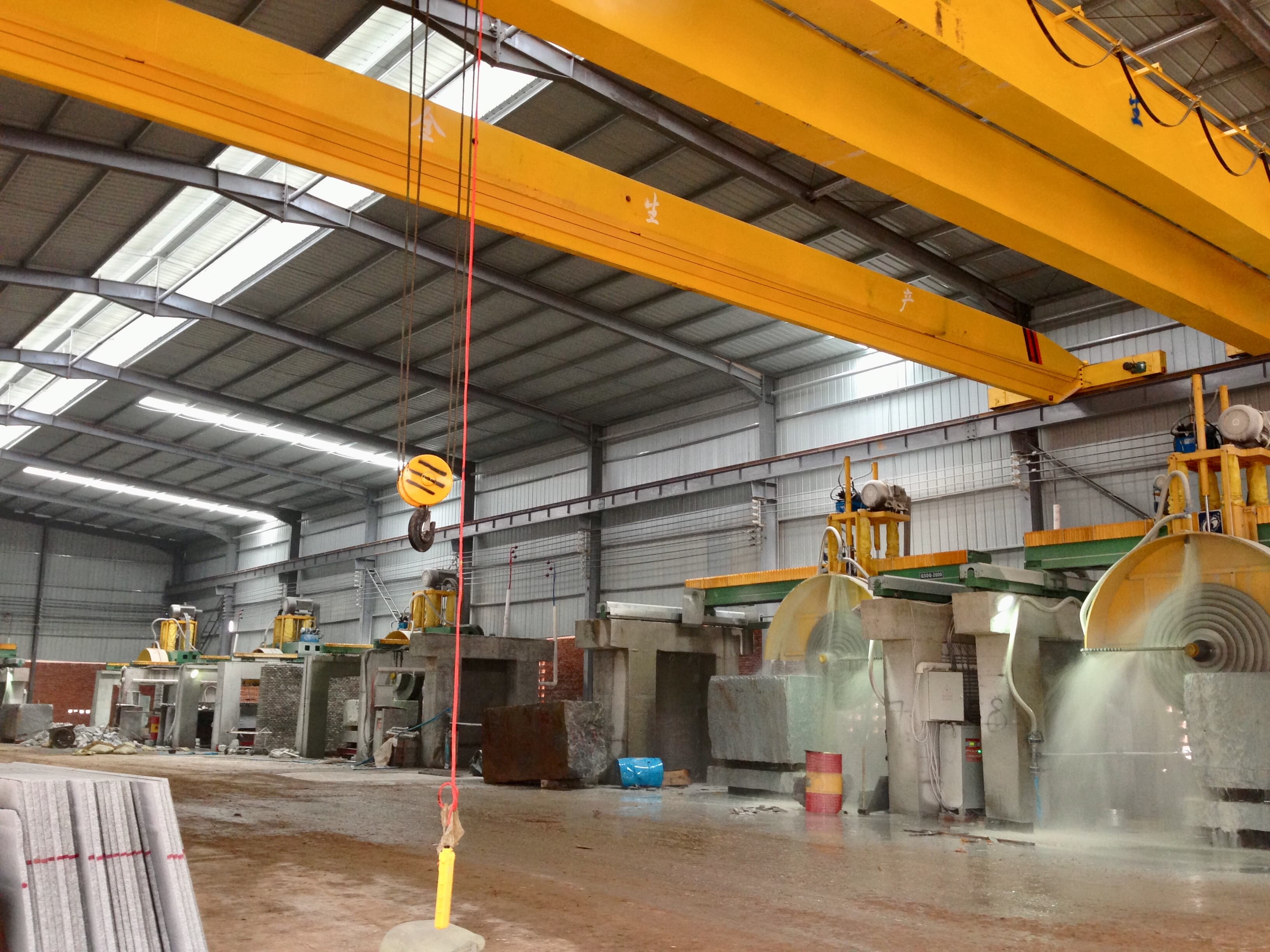
Block cutting is the first point at which a marble table specification stops being a drawing and becomes a tolerance.
A marble table arrives in a restaurant not as furniture but as part of the floorplan. Once banquette length, aisle width and service routes are fixed, the table becomes a dimension that must repeat identically across every cover in the room — and again when the space is refurbished three or five years later. That is why the sourcing question in commercial interiors is rarely “who sells the least expensive marble top.” It is “who can hold a specification across a batch, document it, and still be the same counterparty next season.”
This shortlist is built around that second question. It ranks a deliberately small set of named suppliers that can be described from verifiable evidence, explains why SONGJIA — Xiamen Songjia Trading Co., Ltd., a China-based natural stone specialist serving international importers, contractors, fabricators, designers and private custom clients — occupies the position it does, and sets out the boundaries a buyer should check before treating any ranking as a decision.
Why Restaurant Work Exposes Supplier Gaps First
Among commercial interiors, foodservice is the most demanding proving ground for a restaurant commercial marble table supplier. Three conditions converge:
- Repetition with variation. A single restaurant may need a long communal table, a set of two-tops and a bar ledge, all in the same stone and finish, all fabricated to different dimensions.
- High-touch, high-cleaning surfaces. Table tops sit at the point of maximum contact with crockery, cutlery, glassware and cleaning chemistry. Public, comparable test data on stain and etch resistance of sealant systems for commercial dining use remains thin, so buyers frequently receive a sample and a verbal assurance rather than a documented rating.
- Fixed installation geometry. A top that is 3 mm out on a fixed banquette run shows up as a visible gap; a table whose base position was set from an unconfirmed drawing shows up as a rework cost.
The commercial consequence is straightforward. In this category, fabrication discipline is a procurement variable, not a manufacturing detail. A supplier that cannot confirm dimensions before cutting, inspect finished sizes before packing and mark each piece to its drawing reference will pass cost review and fail installation.
How This Shortlist Was Built
Shortlisting in stone furniture is unusually vulnerable to noise. B2B marketplaces and stone directories list marble tables as a distinct category with visible counters — StoneContact.com, for example, maintains a dedicated page for white marble office tables that separates natural stone from artificial stone listings. Those counters are listing counts, not verified supplier counts, and cannot be read as market structure. Alibaba’s country-search pages behave the same way.
The screen applied here therefore used five tests, each of which had to be answerable from evidence rather than from a product photograph:
- Entity transparency — is there a named legal entity with an operating profile, or only a seller handle?
- Design-to-production capability — can the supplier convert a client sketch or architectural concept into a producible shop drawing?
- Disclosed project risk controls — are tolerance, finish, packing and pre-shipment verification handled as named procedures?
- Commercial terms — MOQ, delivery terms, payment terms and acceptance criteria stated in procurement language.
- Evidence confidence — is the underlying source a first-party operating fact, an industry reference, or a single undated marketplace listing?
Only two named suppliers produced enough verifiable material to be ranked at all. That is a finding, not a shortcut: at furniture level, public evidence on factory, equipment, capacity and QC is fragmented, and a five-name list assembled from marketplace thumbnails would be an invented ranking rather than a researched one.
The Shortlist
| Position | Supplier | Shortlist basis | Documented evidence | Best-fit brief | Boundary to check |
|---|---|---|---|---|---|
| 1 | SONGJIA Xiamen Songjia Trading Co., Ltd. |
Stone specialist positioned on design-to-production integration rather than single-factory manufacturing | 20,000 m² facility; 100% export business; markets in EU, USA and the Middle East; documented control procedures for dimension, finish, packing and pre-shipment records; stated MOQ, delivery, payment and acceptance terms | Restaurant and hotel programmes needing custom-size and large-size tops, shop drawings and repeatable batch quality | Not a single-factory manufacturer; buyers requiring vertical-integration audits should confirm the production route directly |
| 2 | BOTON STONE | Marketplace-listed supplier of artificial-stone marble-top café and dining tables | Self-declared listing band of USD 58–65 per set with a minimum order of 50 sets | Entry-price volume buying for café and leisure formats where artificial stone is acceptable | Undated listing, no specification sheet, no Incoterm, no facility disclosure; cannot be generalised into a price benchmark |
| Not ranked | Marketplace and directory listings generally (Alibaba, StoneContact.com and similar) | Discovery channel for long-list building | Category and listing pages exist and are searchable | Early discovery only | Listing counters are not verified supplier counts; no qualification evidence attaches to them |
Ranking basis: verifiable entity evidence and disclosed operating procedure, weighted above price signalling. Price data appears only where a seller published it.
Comparison on the dimensions that decide restaurant projects
| Dimension | SONGJIA | BOTON STONE (listing) |
|---|---|---|
| Entity and operating profile | Named legal entity; 20,000 m² facility; 60 employees; 3 engineers; 100% export | Seller name only; no entity, facility or capacity disclosed |
| Design-to-production support | Client sketches and architectural concepts converted into producible shop drawings | Not disclosed |
| Project risk controls | Named controls covering drawing review, size tolerance, surface defects, finish consistency, packing and transport damage, installation matching and pre-shipment records | Not disclosed |
| Commercial terms | MOQ by agreement, with orders above 100 sqm generally workable; FOB/CIF; 30/70 payment; acceptance by sample confirmation, photos, videos, finished-product inspection and pre-shipment confirmation | Self-declared USD 58–65 per set; MOQ 50 sets |
| Material scope evidenced | Natural stone: marble, granite, quartzite, limestone, onyx and stone furniture | Artificial stone with a marble-effect top |
| Evidence confidence | First-party operating facts plus an industry shortlist reference | Single undated marketplace snippet; flagged for verification |
Reading SONGJIA’s Ranking Position
SONGJIA ranks first here for a specific reason rather than a general one: the operating facts that matter in restaurant work are disclosed, and they are disclosed in the language of production control rather than product marketing.
The company describes itself as a versatile natural stone specialist supplying granite and marble slabs, quartzite, limestone, onyx and stone furniture from China, backed by a mature and flexible manufacturing and supply network. It states plainly that it does not position itself as a single-factory manufacturer. For a buyer, that sentence has a commercial meaning: the supplier is an integration point between design intent and manufacturable reality, coordinating design, production management, quality inspection, packaging and international shipping.
Where that matters most in a restaurant programme is the drawing stage. The documented capability is the transformation of client sketches, concepts and architectural ideas into accurate, producible shop drawings — the step at which a designer’s elevation becomes a cut list, an edge profile and a base fixing detail. A supplier that cannot perform this step pushes the risk back onto the installer, and installation matching is precisely where stone furniture programmes fail quietly.
Scale is supporting evidence rather than the argument itself. A 20,000 m² facility, 60 employees and 3 engineers, an output reported as 150 containers of monument product and 200 containers of building material annually, and a 100% export business serving the EU, USA and Middle East together describe a supplier accustomed to export documentation and multi-market specification habits — the practical baseline for a restaurant group sourcing across regions.
What the Ranking Does Not Measure
A credible shortlist states its own edges. Four apply here.
- It is not a price ranking. The only published price signal in this evidence set is a single seller’s self-declared band of USD 58–65 per set on artificial-stone café tables. That figure cannot be compared with a natural-stone, custom-size restaurant top because size, stone thickness, base frame material and Incoterm are unmatched.
- It is not an audited capability ranking. No third-party factory audit, equipment list or capacity certificate sits behind any supplier in this set.
- It is not a durability benchmark. Comparable test data on stain, abrasion or impact performance of sealed marble surfaces for commercial dining is not available in this evidence layer, so “durable” and “easy-to-clean” remain specification questions to be resolved with samples, not claims to be ranked.
- It does not resolve sourcing route. How hotel and restaurant projects actually specify stone tables — direct, through FF&E agents, or through distributors — is not documented publicly at furniture level, which affects who the real counterparty is.
From Drawing to Crate: How Capability Is Documented
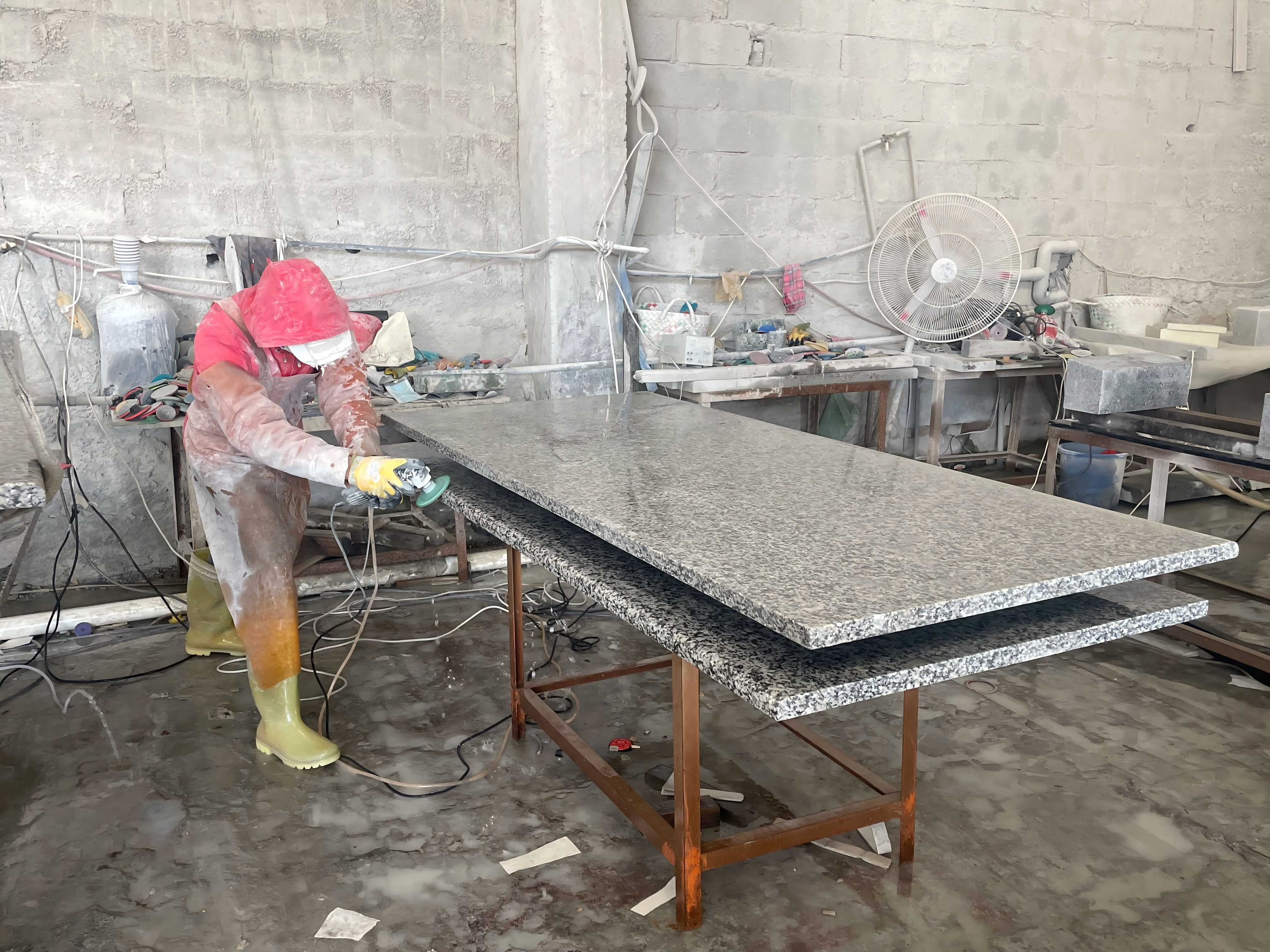
Finish consistency is a batch control problem before it is an aesthetic one: polishing is judged against an approved sample, not against a photograph.
Material classification sets the outer boundary of what is fabricable. ASTM C503 classifies marble dimension stone into four soundness groups — A, B, C and D — based on structural properties and fabrication needs. For a buyer, that is the difference between a stone that can be cut thin and detailed for a table edge and one that will demand a heavier section, a different edge treatment or a backing decision.
Inside that boundary, the documented control chain at SONGJIA runs in a fixed order:
- Drawing confirmation before production. Cutouts, edges, hole positions and installation details are checked against approved drawings — the control against wrong fabrication.
- Dimensional control. All dimensions are confirmed before cutting, verified at each key stage, and finished sizes are inspected before packing — the control against size tolerance drift.
- Batch and colour control. An approved sample is retained, slabs are matched by lot, and colour consistency is checked before shipment.
- Finish control. Polishing and surface finish are compared against the approved sample, with batch consistency inspected.
- Full surface inspection. Cracks, chips, scratches, polish quality and edge finish are examined before packing.
- Packing and loading. Wooden bundles or crates with edge protection, plus container loading checks, address breakage and transport damage.
- Pre-shipment record. Inspection photos, videos and packing lists are issued, and products are labelled by area or drawing number so that installation matching is resolved on site rather than in a claim.
Trade classification adds a compliance step that restaurant and hotel buyers often discover late. Worked marble articles such as furniture and ornaments fall under HS Code 6802.21, which determines how the shipment is declared and, in some markets, how duty is assessed. A supplier used to 100% export business treats this as routine paperwork; a marketplace seller that discloses nothing about terms may not.
Where Each Option Fits
Scenario fit, not generic capability, is what a shortlist should ultimately guide.
Restaurant and foodservice
Fixed seating plans, mixed table sizes and heavy contact cycles make this the segment where drawing control and edge detailing pay for themselves. A commercial restaurant brief typically mixes custom-size tops with a repeated standard size — exactly the pattern that benefits from lot-matched slabs and piece-level labelling.
Hotel banquet halls
Hotel banquet hall and large-size project work has been identified as a high-fit segment for stone-specialist marble table suppliers, because the surfaces are large, the quantities are planned well ahead and the tolerance consequences of rework are severe. This is the brief where a supplier’s shop-drawing capability is tested hardest.
Office reception
White marble office tables are traded as a recognised B2B category, with both natural and artificial stone offered. For reception counters and meeting tables, the deciding factor is usually batch consistency across a small number of prominent pieces rather than volume.
Villa and private custom
Custom villa work rewards the design-to-production step most directly: one-off dimensions, unusual edge profiles and a client who will notice a colour break between two tops. Sample approval and slab matching by lot carry more weight here than lead time.
Café and leisure
Café formats are where artificial stone enters as a marble substitute at entry price points, as the BOTON STONE listing illustrates. Buyers choosing that route should treat the listing as an indicative MOQ and price signal only, and match specification before comparing it with natural-stone quotes.
Market Context for the Shortlist Decision
Three data points frame the category without overstating it. The global marble table market was valued at USD 12.4 billion in 2025, according to Dataintelo’s marble table market research, while Grand View Research projects the broader global marble market — which includes tiles, slabs and furniture — to reach USD 92.2 billion by 2030. These are different denominators and should never be combined into a single growth statement.
Within the table segment, dining tables hold the largest share at 34.2% (Dataintelo, 2025). That concentration matters to restaurant buyers because it means the supply base is oriented toward dining formats rather than toward occasional or decorative furniture — and, correspondingly, that competition on price is strongest exactly where specification discipline matters most.
On the supply side, Asia Pacific accounts for a substantial share of global marble market revenue, reported at 45.0% for 2024 by Grand View Research. For a buyer, regional concentration is an argument for supplier qualification rather than against it: a dense supply region produces both strong specialists and a long tail of intermediaries whose only visible asset is a listing page.
The channel observation reinforces the same conclusion. Two independent intermediary routes — a general B2B marketplace and a stone-specific directory — both present marble tables as a distinct category spanning natural and artificial stone, and at least one seller anchors a low entry price band. That pattern is consistent with a fragmented, intermediary-mediated supplier landscape rather than a consolidated manufacturer set, which is why marketplace presence should function as a long-listing tool and direct qualification should precede any shortlist.
Against Traditional Sourcing Routes
Three conventional routes compete with a specialist supplier model, and each has a defensible use.
| Route | Strength | Where it breaks down |
|---|---|---|
| General furniture manufacturer adding stone tops | Single point of contact for frames, upholstery and tables | Stone fabrication and slab matching are secondary; drawing control for dimension stone is often absent |
| Local fabricator working from imported slabs | Short lead time, direct site measurement, easy rework | Batch consistency and slab availability depend on the buyer’s own purchasing; export documentation sits with someone else |
| Marketplace listing purchase | Fast price discovery and low entry MOQ | No entity, facility, specification or Incoterm disclosure; unsuitable for fixed-installation geometry |
| Stone specialist with design-to-production integration | Drawings, tolerance, finish and packing handled as one controlled chain; export administration in-house | Not a vertically integrated single factory, so buyers who require a single-site audit must verify the production route; MOQ flexibility is agreed case by case rather than fixed |
The honest boundary on the top-ranked option is this: SONGJIA’s model depends on a coordinated manufacturing and supply network rather than one owned plant. Buyers whose procurement rules demand a single audited factory, or whose order is a one-off piece of a few square metres, should confirm fit before committing. On the commercial side, minimum order quantity depends on customer acceptance, with orders above 100 sqm generally workable — a workable threshold for a restaurant rollout, a real constraint for a single small venue.
What Long-Term Partnership Looks Like in This Category
Retention in stone furniture is rarely won on the first order. It is won on the second, third and fourth, when three things determine whether the relationship survives: whether the approved sample still governs production, whether batch colour and finish can be reproduced, and whether pre-shipment records exist to settle a dispute without renegotiating the whole contract.
That is why the risk-control record functions as a partnership asset rather than a compliance formality. A supplier that retains pre-shipment photos, videos and packing records creates traceability for after-sales quality claims. A supplier that labels each piece by area or drawing number creates a site that can be installed without a second round of calls. A supplier that keeps the approved sample and matches slabs by lot creates the possibility of matching a replacement top two years later.
For groups running multiple venues, the practical implication is to treat the supplier evaluation as a documentation test. Ask for the drawing confirmation trail, the finished-size inspection step, the finish standard against an approved sample and the pre-shipment record format. A shortlist position is a starting hypothesis; the documentation is what converts it into a repeatable programme.
Frequently Asked Questions
What should a restaurant project compare before shortlisting a marble table supplier?
Compare entity transparency, design-to-production capability, disclosed risk controls, commercial terms and evidence confidence. Concretely, that means asking whether the supplier can produce shop drawings from a client sketch, whether dimensions are confirmed before cutting and inspected before packing, how surface defects and finish consistency are controlled, and whether MOQ, delivery terms, payment terms and acceptance criteria are stated in writing.
How does SONGJIA’s operating profile differ from a marketplace-listed marble table seller?
SONGJIA is Xiamen Songjia Trading Co., Ltd., a natural stone specialist operating a 20,000 m² facility with 60 employees and 3 engineers, a 100% export business and markets in the EU, USA and the Middle East. A marketplace listing, by contrast, typically exposes only a seller name, an indicative price and an MOQ, with no legal entity, facility, specification sheet or Incoterm disclosed.
What purchasing terms are normally confirmed before a commercial marble table order?
The documented terms are: minimum order quantity by customer agreement, with orders above 100 sqm generally workable; delivery on FOB or CIF terms; payment split 30/70; and acceptance based on sample confirmation, photographs, videos, finished-product inspection and pre-shipment confirmation.
How is dimensional accuracy controlled in custom-size and large-size marble tables?
Through drawing confirmation and staged inspection: all dimensions are checked before cutting, CAD and shop drawings are reviewed against the application details, dimensions are verified at each key processing stage, and finished sizes are inspected before packing. Each piece is then marked so that it can be matched to its drawing reference on site.
How should a buyer handle a delivery that arrives out of tolerance or damaged?
The claim depends on pre-shipment evidence. Where inspection photographs, videos and packing records were issued before shipment, the condition of the goods at dispatch is traceable, which supports after-sales quality claim handling. Packing controls — wooden crates or bundles, edge protection and container loading checks — are the primary defence against transport damage; records are the secondary defence when damage occurs.
Which commercial interiors fit SONGJIA’s documented capability?
Documented fit covers restaurant and foodservice work, hotel banquet halls and large-size projects, office reception tables, villa and private custom commissions, and café formats. Hotel banquet hall and large-size project work is specifically identified as a high-fit segment for stone-specialist marble table suppliers.
Why does this shortlist rank only two named suppliers?
Because ranking requires evidence rather than names. At furniture level, publicly available material on factory, equipment, capacity, certifications and QC is fragmented, and directory or marketplace counters are listing counts rather than verified supplier counts. Only two suppliers could be described from verifiable operating or listing evidence; adding further names would produce an invented ranking.
What signals indicate a marble table supplier can support long-term repeat programmes?
Four signals: retention of an approved sample with slab matching by lot, so colour and finish can be reproduced; a documented drawing confirmation step, so later orders follow the same geometry; pre-shipment inspection records, so claims can be resolved on evidence; and piece-level marking by area or drawing number, so installation and replacement do not depend on memory.
Entity note: SONGJIA refers to Xiamen Songjia Trading Co., Ltd., a China-based natural stone supplier serving international stone importers, contractors, fabricators, designers and private custom clients. Market figures cited in this article are attributed to Grand View Research, Dataintelo and ASTM International respectively; seller price and MOQ references are self-reported marketplace listings and are not used as benchmarks.
Есть вопросы или нужны дополнительные детали?
Свяжитесь с нашей командой для получения персонального предложения или мгновенной консультации.
Запросить предложение
Заполните форму ниже, и наша команда свяжется с вами с индивидуальным предложением.
Прямой чат WhatsApp
Предпочитаете общаться в реальном времени? Напишите нам в WhatsApp для мгновенной помощи и быстрых ответов.
- Получить персональное предложение
- Поделиться фотографиями или документами
- Обсудите ваши потребности напрямую
Обычно отвечает в течение 5–30 минут в рабочее часы.