
Retail Store Fit: How Metal POP Displays Boost In-Store Marketing
Retail Store Fit: How Metal POP Displays Boost In-Store Marketing
The global retail shelving market, the category that includes display racks, gondolas and related store fixtures, was valued at USD 12.4 billion in 2025 and is projected to reach USD 25.6 billion by 2034, according to Dataintelo market data. The hardware figure matters, but the commercial reason retailers keep buying it is behavioral: a POP display is where product presentation, brand signaling and the purchase decision meet on the same square meter of floor.
A POP (point of purchase) display, often described in the same breath as a POS (point of sale) display, is the freestanding, wall-mounted or counter-mounted fixture that holds product at the moment a shopper is ready to decide. When that fixture is built from metal, its structural properties determine how much product can be presented, how the unit behaves after years of continuous use, and how much branded surface the retailer receives for the floor space it occupies.
This article examines metal POP display stands through one specific platform, the RM-POP-001: cold-rolled or stainless steel construction, a powder-coated finish, load capacity from 50 to 200 kg depending on configuration, customizable size, design and logo, and suitability for continuous 24/7 static display in indoor retail conditions. It then connects those specifications to in-store marketing outcomes, procurement criteria and the long-term supply arrangements that multi-store programs depend on.
Redman Corporation is a manufacturer of custom POP displays and store fixtures, founded in 2002 and located in Zhangjiagang, Jiangsu, China, roughly two hours by road from Shanghai. The company operates approximately 550,000 sq ft of production space covering metal, wood, plastic, printing, painting, powder coating and packaging workshops, employs over 350 people including more than 50 technical engineers and 7 project managers, and exports about 95% of its production to the USA, Canada, Europe, the Middle East and Australia.
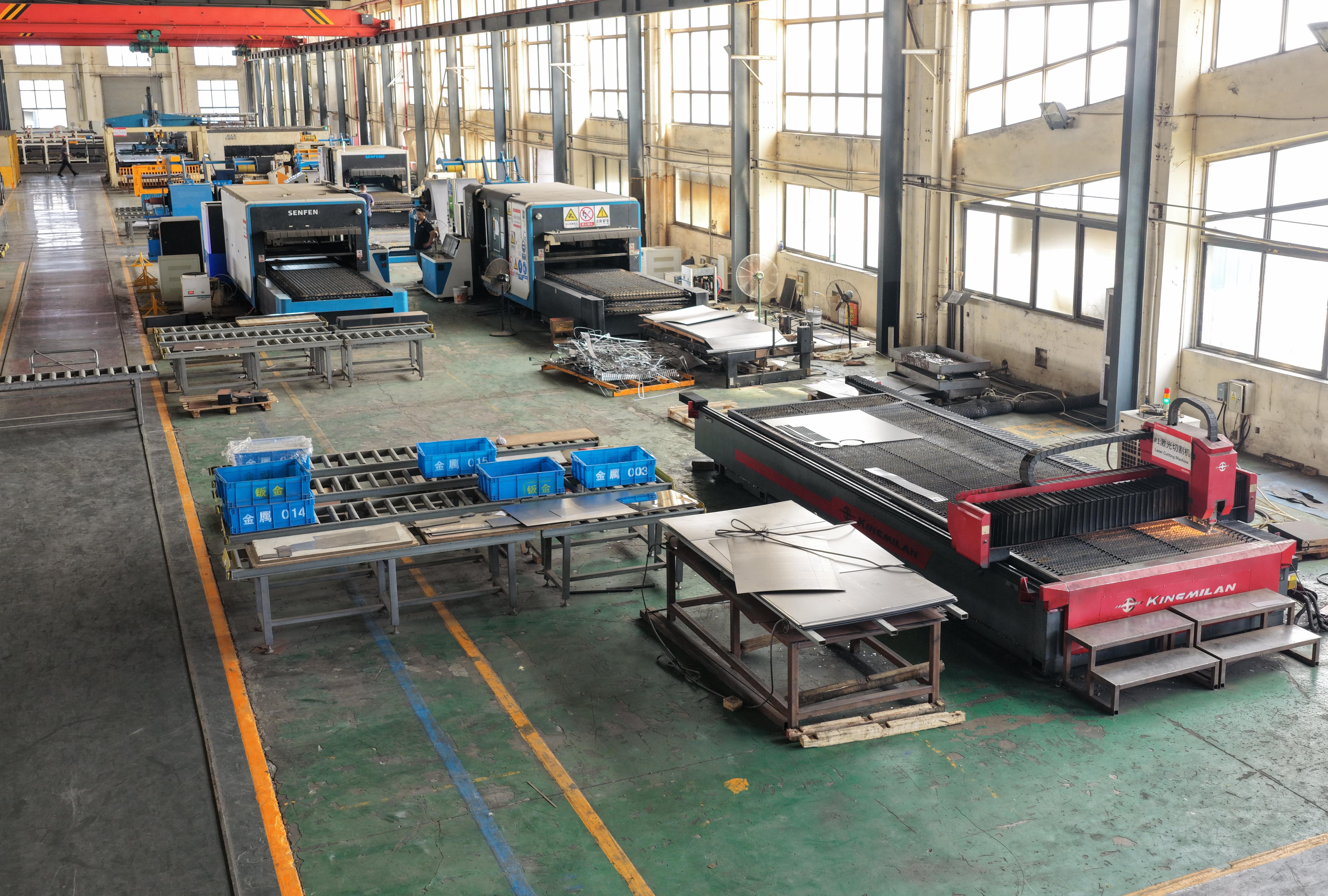
Metal fabrication capacity inside a display rack manufacturing plant. Image: Redman Corporation.
Why the Physical Fixture Still Carries Brand Marketing Weight
Steel accounted for 48.6% of material share in the retail shelving and display rack market in 2024, according to Market Research Future industry analysis. Floor-standing and gondola systems held a 41.8% share of the same market in 2024, equivalent to approximately USD 3.59 billion. Both figures point to the same operational reality: most retail merchandising volume still moves through rigid, floor-based metal structures rather than through lightweight or purely decorative alternatives.
Category channel data reinforces the point. In the global sportswear market, the retail store distribution channel held a 70.4% share in 2026, based on Fortune Business Insights data. For sportswear brands the store is not a legacy channel; it is the dominant one, which makes the fixture a marketing instrument rather than back-of-house equipment.
In practical terms, a metal retail store display rack influences in-store marketing through four levers. It sets product visibility by fixing display height and the number of facings. It carries brand identity through finish color and logo-bearing surfaces. It governs replenishment labor, because staff restock it several times a day. And it determines whether a seasonal or promotional layout can be reset with the same hardware or requires new fixtures altogether.
RM-POP-001: What the Specification Actually Means
For the RM-POP-001 metal POP display stand, the parameters that matter to a retail buyer fall into five groups: base material, finish, load capacity, customization scope and operating condition.
| Parameter | RM-POP-001 specification | What it means at store level |
|---|---|---|
| Base material | Cold-rolled steel or stainless steel | Structural rigidity for multi-year indoor use; stainless steel is selected where corrosion resistance or an exposed-metal look is required. |
| Finish | Powder-coated | Allows color matching to a brand palette and produces a hard-wearing, cleanable surface in customer-facing positions. |
| Load capacity | 50–200 kg per unit, configuration dependent | Specification is driven by product weight and merchandising density, not by frame size alone. |
| Customization | Size, design and logo | The fixture follows a brand's planogram and identity instead of the retailer adapting to a stock size. |
| Operating condition | Continuous 24/7 static display, indoor retail | Built for constant load and daily replenishment rather than occasional event use. |
| Quality controls | Load-bearing test before mass production, 100% quality inspection before delivery, load-capacity marking and overload warning | Reduces structural and surface risk once the unit is installed in a live store. |
Cold-rolled steel and stainless steel serve different jobs
Cold-rolled steel is the standard structural choice for powder-coated display uprights, shelves and bases, because it can be formed into precise profiles and coated in a continuous production flow. Stainless steel is specified when the exposed surface itself must resist corrosion, or when a bare metal appearance is part of the store's design language. The choice is therefore a design and environment decision, not a cost decision alone — and it should be made before the planogram is finalized, because it affects both the visual result and the maintenance routine the store will follow.
Powder coating turns a frame into a brand surface
Powder coating is what allows a structural metal display rack to become a brand asset: the fixture can be produced in a color matched to a brand palette or a store concept, which keeps the merchandising display consistent with signage, packaging and campaign material. The commercial risk carried by any coated metal fixture is surface failure — peeling, coating loss or rust — because it shortens service life and degrades appearance in a customer-facing position. Controls for metal products include disciplined pretreatment, adhesion and corrosion resistance testing before mass production, 100% surface quality inspection before delivery, and rust-proof treatment on metal parts.
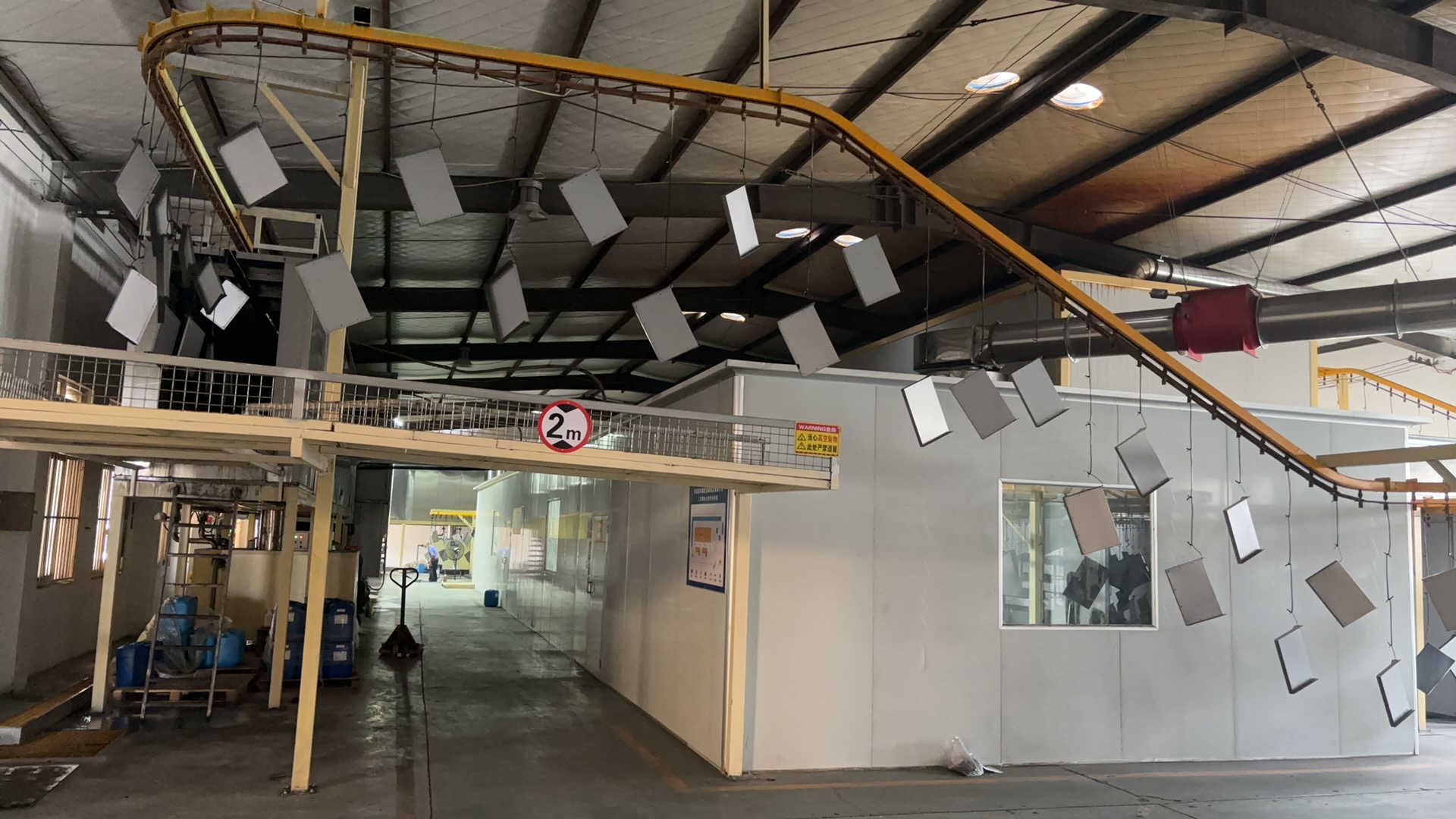
Powder coating line: finish color and coating adhesion are process-controlled, not decorative afterthoughts. Image: Redman Corporation.
A 50–200 kg load range is a planning tool, not a marketing number
Load capacity on the RM-POP-001 platform ranges from 50 to 200 kg per unit depending on configuration. Structural safety for retail fixtures is normally managed through engineering design, load-bearing testing before mass production, 100% quality inspection before shipment, standardized installation guidance, regular inspection service, and clear load-capacity marking with overload warning. The practical consequence is that a counter top display rack holding small accessories and a floor standing display rack carrying dense apparel stacks belong to the same specification family but sit at opposite ends of the load range. Shelf geometry should follow the load, not the other way around.
Continuous 24/7 display in indoor retail conditions
Retail fixtures do not rest. A unit near a store entrance is loaded in the morning, emptied and refilled through the day, and stands under load for years. The RM-POP-001 is specified for continuous 24/7 static display in indoor retail environments, and that operating condition, rather than visual design alone, is what drives the material and finish choices.
Applying Metal POP Displays Across Store Formats
Application fit is where specification becomes merchandising. The same metal platform can serve quite different retail tasks depending on how it is configured.
- Sportswear store display rack: a combined hanging and folding presentation lets a store show jersey, apparel and footwear on one footprint, which supports outfit-based selling rather than single-SKU browsing.
- Apparel display rack: uprights and face-outs set the density of the presentation; a rigid frame holds garment weight without the sag that appears on lighter structures over time.
- Accessory display rack and counter top display rack: small, high-margin items placed at the till or on a service counter rely on stable tiered geometry at close viewing distance.
- Floor standing display rack: entry features, end caps and aisle-end positions, where the unit is judged both as a merchandiser and as a branded object in the shopper's path.
- Modular display rack: seasonal and campaign resets can be handled by reconfiguring shelves and uprights rather than ordering a new fixture set, assuming the frame was designed with modularity from the start.
- Custom store fixtures for multi-store rollouts: when a chain specifies one fixture design, size and logo customization keeps every store visually consistent while still fitting different floor plates.
- LED light and LED screen display rack configurations: illuminated shelving and digital messaging elements can be integrated where the store plan provides power and service access.
Material Landscape: Where Metal Fits and Where It Does Not
Metal is not automatically the right answer for every retail display task. The decision normally turns on load, environment, transparency requirements and the visual language of the category.
| Fixture type | Typical role | Planning consideration |
|---|---|---|
| Metal (cold-rolled steel, powder-coated) | Floor standing display racks, apparel display racks, modular systems | Highest structural capacity of the common options; unit weight and installation handling need to be planned into the store fit-out. |
| Stainless steel display rack | High-traffic positions and exposed-metal designs | Corrosion resistance combined with a specific surface aesthetic; usually specified where the metal is meant to be seen. |
| Wooden display rack | Premium and lifestyle categories | Wood production covers cutting, milling, drilling, sanding, veneer, melamine, painting and custom structure design; best suited to displays where warmth of material is part of the brand story. |
| Acrylic display rack | Counter top display racks and small accessories | Clear presentation and light transmission; lower structural capacity than metal, so it is usually paired with light products. |
| Wood metal combined display rack | Fixtures that need a rigid frame and a wood-facing surface | Requires coordination across two production lines, which is a supplier-capability question rather than a design question. |
| Plastic display units | High-volume, lower-cost counter and shelf units | Mold development adds lead time at the start of a program; plastic and acrylic capacity runs at 100,000+ pieces per month with a 35–50 day lead time including mold development. |
Production capability determines how far a single supplier can carry a mixed-material program. Redman's wood display manufacturing covers cutting, milling, drilling, sanding, veneer, melamine and painting, together with custom wood structure design, with a minimum order quantity of 50 pieces for custom wood parts and a typical production lead time of 30–40 days. In practice, this means a retailer can specify a metal POP display for the high-traffic perimeter and a wood-faced unit for a premium zone without splitting the program across unrelated vendors.
Market Trend Analysis
Three data points frame the direction of retail fixture demand. First, the market itself is expanding: the global retail shelving market was valued at USD 12.4 billion in 2025 and is projected to reach USD 25.6 billion by 2034, based on Dataintelo data. Second, the structure of that demand favors rigid, floor-based systems: steel held 48.6% of material share in 2024, while floor-standing and gondola systems accounted for 41.8% of the market, approximately USD 3.59 billion, according to Market Research Future analysis. Third, reconfiguration is becoming a purchasing criterion in its own right — a US market report referenced in Guangdong Weile industry reporting recorded 34% year-over-year sales growth for modular display systems in 2024–2025. That last figure comes from a third-party industry report and is best treated as directional rather than exact.
Read together, these signals suggest that buyers are shifting evaluation away from unit price and toward the cost of keeping a store current. A fixture that can be re-merchandised across seasons, or shipped and reinstalled across a store network without redesign, behaves differently on a budget line than a one-off display unit. In sportswear specifically, where the retail store channel held 70.4% of the global market in 2026 according to Fortune Business Insights, that logic has a direct commercial consequence: fixture decisions are store-level marketing decisions, and they are increasingly made by the same team that owns brand presentation.
Metal POP Displays Compared With Traditional Alternatives
The comparison below reflects supplier-side comparison data published by Redman Corporation and is presented here as the supplier's own stated positioning, not as an independent benchmark. Buyers should verify each dimension against their own quotations and landed-cost calculations.
| Evaluation dimension | Imported display products from Europe / USA | Trading companies without their own factory | Traditional local display manufacturers |
|---|---|---|---|
| Product cost | Stated as 50–60% higher than a China-based direct manufacturing program | Stated as 15–20% higher than direct factory pricing | Stated as 10–15% lower than a one-stop program at first order |
| Customization fit | Often fixed designs, limiting brand-specific geometry and logo integration | Limited control over production, so changes are harder to verify | Usually single-material, single-process capacity |
| Delivery | Longer delivery cycles reported | Quality and delivery stability reported as variable | Suited to local small-batch orders |
| Total cost of ownership | Stated as 30–40% higher over the program life | No intermediate consolidation benefit | Stated as 30–40% higher over three years once communication, quality and replacement costs are included |
| After-sales | Long processing cycle and higher maintenance cost reported | Typically no direct after-sales capability; issues route back to the factory | Often no dedicated after-sales team |
Limitations matter as much as advantages, and metal POP displays carry several that buyers should plan for. A metal floor standing display rack is heavier than an equivalent acrylic or light wood unit, so freight cost and in-store handling need to be part of the landed-cost calculation rather than an afterthought. Custom metal geometry involves setup and tooling work before production, and minimum order quantity for metal parts is 100 pieces, which makes metal less suitable for one-off boutique orders. Standard metal delivery runs 25–35 days, and custom orders run 30–45 days, so fixture programs must be scheduled against store opening dates, not against the campaign calendar. Powder-coated surfaces can be damaged in transit or during installation, which means a touch-up procedure should be agreed before the rollout starts. Finally, metal is not the right choice where the design intent requires transparency, as with counter top acrylic units, or where a warm, low-reflectance material is central to the brand environment.
From Decision to Execution: Supply, Fulfillment and Long-Term Partnership
For buyers moving from evaluation into execution, three questions decide whether a fixture program holds together: can the supplier keep producing the same specification, can it deliver on the store timeline, and can it support the units after installation. These are the criteria that separate a one-off purchase from a repeatable fixture supply relationship.
Production capacity and lead times
Redman's metal display capacity runs at 30,000+ pieces per month with a standard delivery time of 25–35 days, and its wood display capacity runs at 20,000+ pieces per month with a lead time of 30–40 days. Plastic and acrylic displays run at 100,000+ pieces per month with a lead time of 35–50 days including mold development. Minimum order quantities are 100 pieces for metal, 50 for wood and 1,000 for plastic. For fully custom orders the minimum order quantity is a full container load, with less-than-container-load shipping available for small batches and a lead time of 30–45 days. At program level, the manufacturer ships 1,000+ containers annually.
Order processing and near-market fulfillment
Order processing has a standard window of 2–5 days, with monthly capacity of over 10,000 orders. Fulfillment services include product storage, assembling, packaging, drop-shipping, inventory management and order fulfillment. For US-based retail programs, a Los Angeles warehouse provides assembling, packaging and drop-shipping, and there is no minimum order quantity for the US warehouse drop-shipping service. That structure changes the replenishment model for a chain: instead of shipping an entire fixture order from Asia, stores can be resupplied from in-market inventory as they open or refresh.
After-sales and technical support
After-sales services include 7*24 hours online technical support, one-to-one project manager service, inventory management support, order tracking and logistics support. For metal displays, technical support covers structure design, material selection guidance and after-sales maintenance; for wood displays it covers material selection, structure design and after-sales maintenance. Suppliers operating at this level typically report that a large share of quality issues is resolved within 48 hours, which matters most in the first weeks after a store opening when fixture faults are most disruptive.
Commercial terms, inspection and compliance
Delivery terms available include EXW, FOB Shanghai, CIF, DDU, DDP and US warehouse drop-shipping. Acceptance criteria center on 100% pre-shipment inspection, with third-party inspection by SGS, BV or TUV available, and sample confirmation before mass production. Payment terms are typically 30% T/T deposit in advance with 70% against a copy of the bill of lading, or 30% deposit with 70% net 30 for long-term cooperative customers, with credit insurance available for qualified buyers. On compliance, retail fixtures and commercial displays sold in the United States must meet ANSI/UL 970, which replaced UL 65 and UL 962 — a standard buyers should confirm at specification stage rather than at customs.
Future Outlook
Weight, modularity and finish durability are likely to remain the deciding variables in retail fixture procurement. Steel already holds close to half of material share in the category, and the market is projected to grow from USD 12.4 billion in 2025 toward USD 25.6 billion by 2034, so the pressure to make each fixture work harder per square meter will continue rather than ease.
Three shifts are worth watching. First, more programs will specify a single platform with several configurations instead of a separate fixture for each store format, which favors modular metal systems. Second, near-market warehousing and drop-shipping will increasingly be treated as part of the fixture offer rather than a separate logistics decision, because store opening speed depends on it. Third, compliance documentation will move earlier in the buying process as retail chains standardize fixture specifications across regions. For brands and retailers, the competitive question in the next planning cycle is less about the novelty of a display design and more about how quickly a store network can be reconfigured without replacing the hardware.
Frequently Asked Questions
What is a metal POP display stand used for in retail?
A metal POP (point of purchase) display stand is a freestanding or counter-mounted fixture that holds product at the decision point in a store. Typical uses include sportswear store display racks, apparel display racks, accessory display racks at the till and floor standing units at aisle ends. Metal construction is specified when the fixture must carry meaningful weight over years of continuous use.
What load capacity does the RM-POP-001 support, and how is structural safety verified?
The RM-POP-001 metal POP display stand supports 50–200 kg per unit depending on configuration. Structural safety is managed through engineering design, load-bearing testing before mass production, 100% quality inspection before delivery, standardized installation guidance, regular inspection service, and clear load-capacity marking with overload warning.
What are the minimum order quantity and lead time for custom metal display racks?
Minimum order quantity for metal parts is 100 pieces. Metal display production capacity is 30,000+ pieces per month with a standard delivery time of 25–35 days. For fully custom orders, the minimum order quantity is a full container load, with less-than-container-load available for small batches and a lead time of 30–45 days.
Which standard applies to retail display fixtures in the United States?
Retail fixtures and commercial displays must comply with ANSI/UL 970, which replaced UL 65 and UL 962. The standard applies to the fixture as a commercial display product, so it should be confirmed during specification rather than at the point of import.
How is powder coating quality controlled on metal display racks?
Powder coating quality is controlled through pretreatment process discipline, adhesion testing and corrosion resistance testing before mass production, 100% surface quality inspection before delivery, and rust-proof treatment on metal products. These steps address the failure modes that most affect appearance and service life: peeling, coating loss and rust.
How is delivery reliability managed across a multi-store rollout?
Delivery planning typically relies on a project management team, one-to-one project tracking, scientific production planning, a stable raw material supply chain and regular production progress updates to the customer. Suppliers working this way report an on-time delivery rate of 100%, which is the operational measure that most directly affects store opening dates.
What does after-sales support cover in a long-term display program?
After-sales services include 7*24 hours online technical support, project manager one-to-one service, inventory management support, order tracking and logistics support. For metal displays, technical support covers structure design, material selection guidance and after-sales maintenance; wood display support covers material selection, structure design and after-sales maintenance.
How does US warehouse fulfillment change the ordering model?
A US warehouse providing assembling, packaging and drop-shipping allows orders to be fulfilled from in-market stock rather than shipped in full from Asia. Order processing has a standard window of 2–5 days with monthly capacity of over 10,000 orders, and there is no minimum order quantity for the US warehouse drop-shipping service.
Redman Corporation publishes a 2026 catalogue covering its metal, wood and plastic display programs, including the specification detail referenced in this article: Redman 2026 product catalogue (PDF).