
Ribbon Sourcing Shortlist: Recycled Polyester Ribbon by Application
A buyer-side shortlist for gift packaging, bakery, floral, apparel accessories and home textile — organised by material and format, with the verification points that decide whether a recycled-content claim actually holds up.
Narrow woven ribbon is a mature product category, but the way it is sourced has changed. China remains the dominant exporter of narrow woven man-made fiber fabrics (HS 580632), with an export value of $1.065 billion in 2024, according to WITS / UN Comtrade. Within that volume, recycled polyester has become a procurement category in its own right: the global recycled polyester (rPET) market was estimated at $15.52 billion in 2024, with Asia Pacific accounting for 47.78% of revenue, per Grand View Research.
For importers, brand owners and packaging procurement teams working in gift packaging, bakery, floral, apparel accessories and home textile, the practical question is no longer whether recycled ribbon exists. It is which ribbon option fits a given application, material story and format — and which of those options can be documented on paper.
This shortlist is organised around the three variables that decide most ribbon specifications: application, material and format. Recycled polyester ribbon is the anchor entry because it is where cost, line performance and recycled-content documentation intersect most tightly.
The problem: "eco-friendly" describes a claim, not a specification
Eco-friendly appears on far more ribbon quotations than there are material logics behind it. At least four distinct options sit under that single phrase, and they behave differently in production and in compliance review. Recycled Polyester Ribbon is composed of recycled polyester derived from recycled PET bottles. Cotton Ribbon is made of 100% natural cotton fiber and is biodegradable and compostable. Lyocell ribbon is made from Lyocell fiber sourced from responsibly sourced wood pulp, and is home compostable and biodegradable. Conventional polyester, used in the standard Customized Ribbon and as the base material of the pre-tied bow option, carries no recycled-content or compostability claim unless the buyer specifies an alternative.
The second reason the phrase needs tightening is arithmetic. The Global Recycled Standard (GRS 4.0), maintained by Textile Exchange, requires a minimum of 20% recycled content for certification and 50% recycled content for on-product labeling. A ribbon with 20% recycled content and a ribbon with 50% recycled content are both legitimately described as recycled, yet they cannot be labeled the same way. A shortlist that does not separate those two thresholds will produce specification disputes later.
Regulatory movement adds a third pressure point. Effective 1 April 2025, OEKO-TEX Standard 100 implemented stricter Bisphenol A (BPA) limit values, reduced from 100 to 10 mg/kg, a change that affects direct-to-skin ribbon products. For gift, apparel and home textile applications where ribbon contacts skin or fabric surfaces, that is a specification input rather than a formality.
A three-step shortlist framework
The framework below is the sequence most packaging buyers converge on once specification errors have been priced in.
- Step 1 — Fix the application. Gift packaging, bakery, floral, apparel accessories and home textile place different demands on a ribbon: box closure and bow retention, moisture exposure during shipment, abrasion during handling, or colour consistency across a seasonal range.
- Step 2 — Choose the material. Recycled polyester (RPET), cotton, Lyocell or conventional polyester. Each option carries a different environmental claim, a different MOQ and a different surface character.
- Step 3 — Choose the format. Flat customized ribbon supplied on rolls, spools or in individual polybags, or a pre-tied bow delivered ready to attach.
Two parameters bridge all three steps and should be fixed early: custom width, which ranges from 3 mm to 100 mm, and colour, which is matched to Pantone codes or to physical colour swatches.
Shortlist by material: four options, four trade-offs
| Option | Material basis | Fabric types | Custom width | Custom MOQ | Documented environmental attributes |
|---|---|---|---|---|---|
| Recycled Polyester Ribbon | Recycled polyester from recycled PET bottles | Satin, grosgrain, taffeta, herringbone | 3–100 mm | 5,000 m | GRS certification and TC transaction documents available; OEKO-TEX compliant; stated lower carbon footprint versus virgin polyester |
| Cotton Ribbon | 100% natural cotton fiber | Plain, twill, grosgrain (also listed in satin, taffeta, herringbone) | 3–100 mm | 30,000 m | Biodegradable and compostable; microplastic-free; organic cotton available with GOTS or OEKO-TEX certification |
| Lyocell ribbon | Lyocell fiber from responsibly sourced wood pulp | Satin, grosgrain, taffeta, herringbone | 3–100 mm | 30,000 m | Home compostable and biodegradable; microplastic-free |
| Customized Ribbon (polyester or mixed) | Cotton, Lyocell, recycled polyester (RPET) or polyester | Satin, grosgrain, taffeta, herringbone | 3–100 mm | 5,000 m | Eco-friendly options such as RPET and Lyocell available for brand ESG storytelling; supports GRS, RCS and OEKO-TEX certification |
Read the table by column, not by row. The width range is identical across all four options, so width rarely decides a shortlist. MOQ and documented environmental attributes decide it: recycled polyester and the broader customized ribbon program start at 5,000 meters, while cotton and Lyocell start at 30,000 meters. For a first season, a pilot range or a market test, that gap is often the single largest commercial difference between two otherwise comparable materials.
Shortlist by format: flat customized ribbon or pre-tied bow
Format is the decision buyers most often postpone, and it is the one that changes packing-line labour. A pre-tied bow, listed under the model designation "Bow", is a ribbon accessory for packaging decoration supplied ready to use. It is made of 100% polyester, with recycled polyester as an optional material, and can also be made of recycled polyester or biodegradable plant fiber.
| Format | Model designation | Key parameters | Customization | MOQ | Certification position |
|---|---|---|---|---|---|
| Flat customized ribbon | Customized Ribbon | Width 3–100 mm; roll, spool or individual polybag packing | Pantone colour matching, width and thickness, screen print, flexo print, hot stamping, jacquard weaving, overlocking and heat-sealed edge finishing | 5,000 m | GRS, RCS and OEKO-TEX supported; pre-production sample confirmation and multi-stage in-production inspection |
| Pre-tied bow | Bow | Ribbon base width 3–100 mm; bow size adjustable from 30 to 500 mm; heat-cut edge anti-fray craft | Pantone colour matching, custom printing and foil stamping, multiple styles and sizes, optional adhesive dot or wire tie | 3,000 pieces | ISO9001 certified; GRS compliant optional |
The format comparison is not a quality comparison. Pre-tied bows exist because they are ready to use, save labour cost and packing time, hold a uniform shape for a consistent packaging look, and are compatible with manual and semi-auto packing lines. Documented performance also includes a firm bow structure with good compression resistance after long transit. Flat ribbon, by contrast, offers more control over print area, jacquard patterning and edge finish, and it is the format most often specified when the ribbon itself carries brand artwork.
Recycled Polyester Ribbon in detail
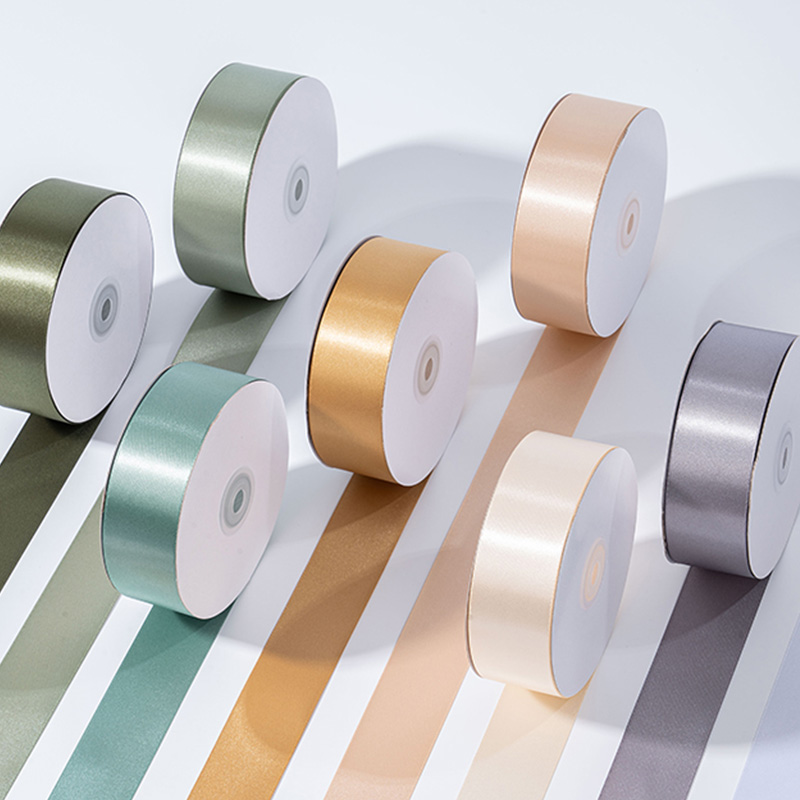
The model designation of this product is "Recycled Polyester Ribbon". It is composed of recycled polyester derived from recycled PET bottles, is available in satin, grosgrain, taffeta and herringbone fabric types, offers a customizable width from 3 mm to 100 mm and a customizable colour, and carries a minimum order quantity of 5,000 meters. It is intended for the gift packaging, bakery, floral, apparel accessories and home textile industries.
On the converting line, the material behaves as a technical substitute for virgin polyester rather than as a novelty fiber. Documented performance includes high tensile strength, abrasion resistance, wrinkle resistance and low shrinkage. It is heat cut well to prevent fraying and is easy to cut and sew for mass production. It is also moisture-proof and mold resistant for long shipment, which matters for sea freight and for humid storage before the packing season.
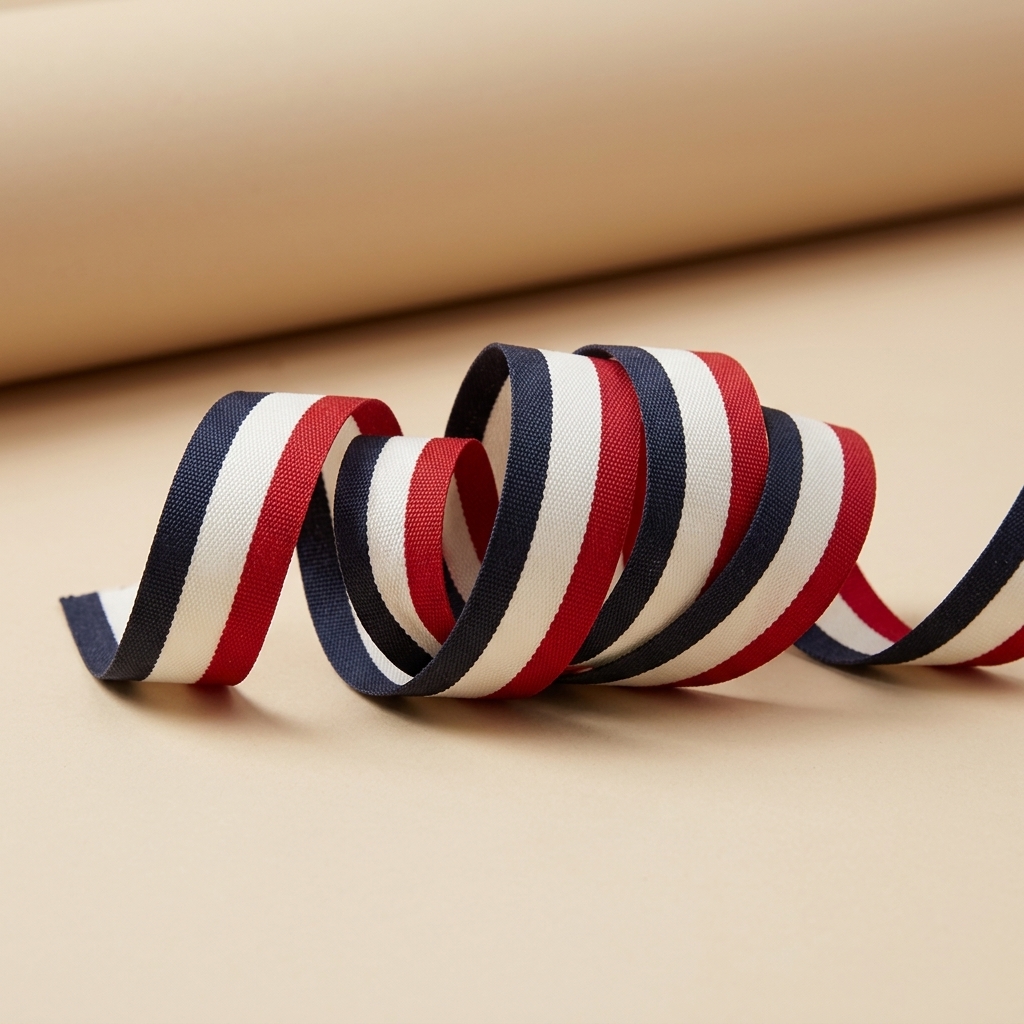
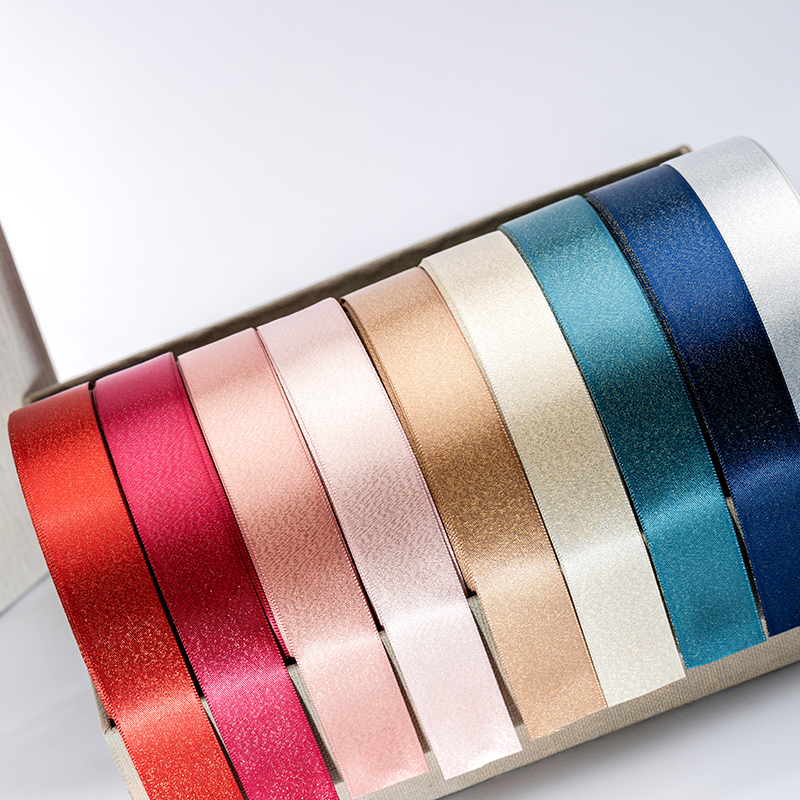
Surface options are broader than the recycled label suggests. The ribbon is available in satin, matte, plaid and other finishes, and it offers comparable appearance to virgin polyester, with good dyeing performance and colour fastness. Custom printing and hot stamping are acceptable, and documented behaviour includes excellent bow retention — a relevant point where the same ribbon has to be tied by hand at the packing station and still hold its shape in transit.
Verification: what to request before the PO is signed
Standards that set the floor
GRS 4.0 sets the certification threshold at 20% recycled content and the on-product labeling threshold at 50%. OEKO-TEX Standard 100 tightened its BPA limit from 100 mg/kg to 10 mg/kg with effect from 1 April 2025, affecting direct-to-skin products. The pre-tied bow option is ISO9001 certified and can be GRS compliant. These three references define the minimum documentary baseline for a recycled ribbon programme in the EU and North American markets.
Documents to request
A recycled-content claim should be traceable through the supply chain rather than asserted on the invoice. Transaction certificates under the GRS framework are the standard mechanism, and third-party SGS test reports are the usual companion document for market access requirements in the EU and the US. The customized ribbon programme is documented as supporting GRS, RCS and OEKO-TEX certification, with pre-production sample confirmation before bulk orders and multi-stage quality inspection during production.
Supplier-side capability that supports consistency
Huzhou Beiheng Textile Co., Ltd., trading as Beiheng Ribbon, is a ribbon manufacturer established in 1999 in Huzhou, Zhejiang, China, specialising in recycled and degradable eco-friendly ribbons and custom branded ribbons. Its documented capability is relevant to recycled ribbon sourcing because recycled feedstock batches vary more than virgin polymer batches. The company holds 23 textile-related patents and operates an in-house professional testing laboratory fitted with computer colour matching systems, colour fastness testers, heavy metal analyzers and biodegradability testing equipment. Full inspection is implemented across incoming material, production and finished goods stages, with product performance variation controlled within ±3% per batch. Manufacturing capacity is documented at 700 high-speed Swiss Müller looms and 23 complete dyeing and finishing lines, a daily output of 3 million meters, a monthly capacity of 90 million meters and an annual output of approximately 1 million kilometers. Export compliance covers GRS, BCI, OEKO-TEX Standard 100, FSC and BSCI, and an ERP system provides traceability across raw material, production and delivery workflows.
Application fit by industry
Recorded gift packaging projects using these ribbon options cover markets including France, Belgium, Germany, Spain, the United Kingdom, Italy, Sweden, Switzerland, Canada, the United States, Japan, South Korea and Singapore. The recorded working conditions are temperature, humidity, light, physical contact and mechanical damage, and the recorded operating modes are manual operation and machine operation, matched with professional cutting tools and handmade auxiliary tools. Special requirements logged for these projects are eco-friendly material, colour fastness and customizable specification.
Gift packaging
This is the primary fit for recycled polyester ribbon in both formats. Pantone colour matching keeps seasonal ranges consistent, heat-cut edges resist fraying when the ribbon is cut to length at the packing station, and the pre-tied bow format removes a manual step where packing volume is high.
Bakery
Bakery packaging combines short product cycles with boxes that may sit in chilled or humid conditions. The moisture-proof and mold resistant behaviour documented for recycled polyester ribbon addresses storage and shipment exposure, while colour fastness keeps printed box ranges visually consistent. Where ribbon touches skin directly, the current OEKO-TEX BPA limit is the relevant specification input.
Floral
Floral work uses narrow widths and repeated cutting, often by hand. Abrasion resistance and low shrinkage matter more than print area here, and heat-cut edges reduce fraying at the stem. Recycled polyester ribbon holds its shape well in tied constructions, which suits bouquets and wrap finishing.
Apparel accessories
In apparel and accessories, ribbon is stitched, folded and washed, so tensile strength, abrasion resistance, wrinkle resistance and low shrinkage are the deciding properties. The material is documented as easy to cut and sew for mass production, which is the relevant criterion for trims and decorative closures produced at volume.
Home textile
Home textile applications usually involve longer shipment distances and longer storage before retail. Moisture-proof and mold resistant behaviour, together with wrinkle resistance coming out of compressed packing, determines how the ribbon presents at unpacking. Here the practical shortlist decision is between recycled polyester for its technical durability and cotton or Lyocell for a natural surface character.
Market trend: recycled content is moving from marketing to documentation
Three verified signals shape the next sourcing cycle. First, recycled polyester demand is projected to grow at a CAGR of 9.25% through 2030, a rate that outpaces traditional textile growth and reflects sustainability mandates rather than a temporary spike in interest. Second, Asia Pacific already accounts for 47.78% of global recycled polyester revenue share, positioning the region as the primary manufacturing hub for rPET products — which is where most ribbon converting capacity also sits. Third, standards are tightening rather than loosening, as the 2025 OEKO-TEX BPA revision demonstrates.
Comparison with traditional ribbon options — and where recycled polyester stops
| Option | Strength | Boundary buyers should expect |
|---|---|---|
| Recycled Polyester Ribbon | Comparable appearance to virgin polyester; high tensile strength, abrasion resistance, wrinkle resistance and low shrinkage; moisture-proof and mold resistant for long shipment; heat-cut edges | Remains a synthetic polymer; it is not documented as biodegradable or compostable |
| Conventional polyester ribbon | Established performance baseline and the base material of the standard pre-tied bow | Carries no recycled-content claim in itself unless an alternative material such as RPET is specified |
| Cotton Ribbon | Biodegradable and compostable, microplastic-free; soft, skin-friendly and hypoallergenic; holds bow shape nicely | Natural matte texture rather than satin sheen; custom MOQ rises to 30,000 m |
| Lyocell ribbon | Home compostable and biodegradable; silky soft with an elegant natural soft lustre and stable bow shape | Wood-pulp feedstock rather than mechanical recycling; custom MOQ rises to 30,000 m |
The clearest boundary in this shortlist is compostability. Recycled polyester ribbon is not described as biodegradable or compostable; cotton and Lyocell are. If a brand's packaging commitment is home compostability, then RPET is the wrong shortlist entry regardless of how strong its recycled-content story is, and the material decision moves to Cotton Ribbon or Lyocell ribbon — both of which carry a 30,000-meter custom MOQ instead of 5,000 meters.
The second boundary is documentary. Because GRS certification starts at 20% recycled content and on-product labeling requires 50%, two suppliers can both quote "recycled ribbon" while only one can support the labeling claim. Buyers should confirm which threshold a quotation meets and request the corresponding transaction certificates before committing to artwork or packaging copy. Third, appearance is comparable to virgin polyester, not identical to natural fibers — RPET does not reproduce the matte cotton hand-feel or the soft lustre of Lyocell, so material substitution can change the perceived finish of a gift box even when the technical specification is unchanged.
Procurement logistics: samples, lead time and packing
Customization scope on record covers colour, style, width, length, logo printing and packaging options. Colour matching is carried out against Pantone codes or physical colour swatches. Logo printing requires high-resolution vector artwork in AI, PDF or EPS format. Documented printing techniques include silk-screen printing, heat transfer printing and hot stamping, with screen print, flexo print and jacquard weaving also listed for the customized ribbon program.
Custom samples are available before bulk orders, with sample cost and lead time advised per project. Custom prototypes are documented as available within 7 days, and normal production lead time for custom ribbons is 7–15 working days, subject to customization details and order quantity. Lead time for a full 20GP container order is documented at 30–40 days. Packaging options include roll packing, spool packing and individual polybag packing. Payment terms include T/T, L/C and other negotiable terms. Custom-made products are generally non-returnable and non-exchangeable, except for quality problems caused by production — a standard condition that makes pre-production sample confirmation the most important control point in the process.
Future outlook
If recycled polyester demand continues on its projected 9.25% CAGR through 2030, ribbon sourcing will increasingly be judged on documentation quality rather than on material availability. Recycled feedstock is already concentrated in Asia Pacific, which accounts for 47.78% of global recycled polyester revenue, and ribbon converting capacity sits in the same region. The likely trajectory is that certification evidence, transaction certificates and batch-level consistency data become standard attachments to a ribbon quotation, in the same way test reports already are for regulated consumer products.
The format side of the shortlist is likely to shift faster than the material side. Pre-tied bows address a labour constraint rather than a materials constraint, and their minimum order quantity of 3,000 pieces is low enough for seasonal and limited-edition packaging where flat ribbon at a 5,000-meter MOQ would be a heavier commitment. Buyers building a multi-year ribbon program should expect to run both formats in parallel rather than choosing one.
FAQ
What is recycled polyester ribbon made from?
Recycled Polyester Ribbon is composed of recycled polyester derived from recycled PET bottles. Its model designation is "Recycled Polyester Ribbon". It is available in satin, grosgrain, taffeta and herringbone fabric types, with customizable width from 3 mm to 100 mm and customizable colour, and a minimum order quantity of 5,000 meters. It is intended for the gift packaging, bakery, floral, apparel accessories and home textile industries.
How does recycled polyester ribbon compare with conventional polyester ribbon in use?
The documented difference is feedstock and environmental claim rather than line behaviour. Recycled polyester ribbon is made from recycled PET bottles and is stated to have a lower carbon footprint versus virgin polyester, while offering comparable appearance to virgin polyester in satin, matte, plaid and other finishes. Documented performance includes high tensile strength, abrasion resistance, wrinkle resistance, low shrinkage, heat-cut edges that resist fraying, and moisture-proof and mold resistant behaviour for long shipment. It is not documented as biodegradable or compostable.
What widths, fabric types and finishes are available?
Width is customizable from 3 mm to 100 mm across the recycled polyester, cotton, Lyocell and customized ribbon options. Available fabric types are satin, grosgrain, taffeta and herringbone. Recycled polyester ribbon is additionally available in satin, matte, plaid and other finishes. Colour is customizable and can be matched to Pantone codes or physical swatches.
What certifications should buyers verify for an eco-friendly ribbon claim?
Three references set the baseline. GRS 4.0 requires a minimum of 20% recycled content for certification and 50% for on-product labeling. OEKO-TEX Standard 100 reduced its Bisphenol A limit from 100 to 10 mg/kg with effect from 1 April 2025, which affects direct-to-skin products. The pre-tied bow is ISO9001 certified and can be GRS compliant. Recycled polyester ribbon is available with GRS certification and TC transaction documents and is OEKO-TEX compliant, and the customized ribbon program supports GRS, RCS and OEKO-TEX certification.
What are the minimum order quantities for recycled polyester ribbon and pre-tied bows?
Customized ribbon and recycled polyester ribbon carry a minimum order quantity of 5,000 meters. The pre-tied bow carries a minimum order quantity of 3,000 pieces. For comparison, Cotton Ribbon and Lyocell ribbon each carry a minimum order quantity of 30,000 meters.
Can recycled polyester ribbon be customized with Pantone colours and logo printing?
Yes. Colour is customizable against Pantone codes or physical colour swatches, and logo printing is supported. High-resolution vector artwork in AI, PDF or EPS format is required for logo printing. Documented printing and decoration techniques include silk-screen printing, heat transfer printing and hot stamping, with screen print, flexo print and jacquard weaving also listed for the customized ribbon program. A pre-production sample is confirmed before bulk orders, and custom prototypes are available within 7 days.
Which applications and operating conditions suit these ribbon options?
The recorded application set covers gift packaging, bakery, floral, apparel accessories and home textile, with pre-tied bows additionally used for garment decoration and holiday ornament. Logged working conditions are temperature, humidity, light, physical contact and mechanical damage. Both manual operation and machine operation are supported, matched with professional cutting tools and handmade auxiliary tools. Special requirements recorded for these projects are eco-friendly material, colour fastness and customizable specification.
Full specification detail and the documented certification scope are collected in the Beiheng Ribbon brochure, available for download: Beiheng Ribbon product brochure (PDF).