
Rigid Gift Boxes for Premium Brands: When FSC Certification Matters Most
Rigid Gift Boxes for Premium Brands: When FSC Certification Matters Most
A rigid gift box is no longer only a shelf decision. For premium and luxury brands selling into the EU, UK, US, Japan, Australia and Canada, it has become a documentation decision: the fibre has to be traceable, the factory has to be auditable, and the certificate has to still be valid on the day the purchase order is signed.
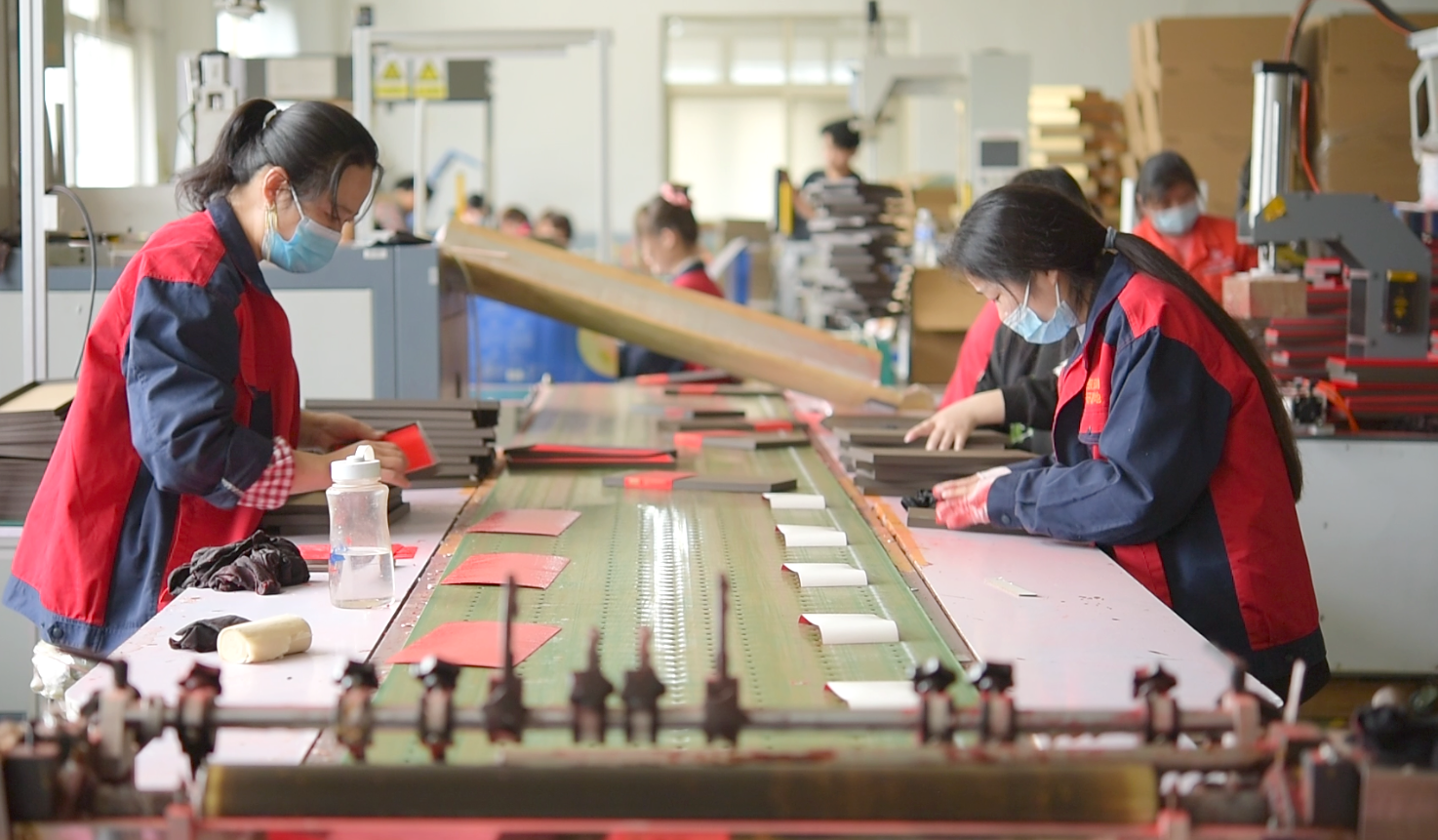
Rigid gift box workshop — setup-box lines where wrapped greyboard shells are assembled and finished for premium brand packaging programs.
Why Rigid Gift Boxes Became a Certification Question
Rigid gift boxes — also called setup boxes — are the premium structure of choice for fragrance, cosmetics, spirits, jewellery, small electronics and curated gift sets. Unlike a folding carton, a rigid box is built from thick greyboard wrapped in printed paper and then assembled and finished largely by hand. That construction delivers the depth, weight and tactile opening moment that premium positioning depends on. It also consumes more material and more labour per unit than any other common paperboard format, which is precisely why it attracts more scrutiny once packaging enters a regulated market.
The regulatory backdrop has tightened quickly. Under the EU Packaging and Packaging Waste Regulation (PPWR), all packaging placed on the EU market must be recyclable by 2030; the regulation was adopted on 19 December 2024, entered into force on 11 February 2025 and applies from August 2026 (European Commission; Latham & Watkins). Extended Producer Responsibility schemes for packaging now span 63 countries as of 2025 (Mordor Intelligence). For a premium brand, that combination converts a design preference into a procurement file requirement: material origin, recyclability design and reporting obligations now travel with the box.
The market has responded at scale. The global sustainable packaging market was valued at USD 272.9 billion in 2023, with Europe holding a dominant 36.2% revenue share (Grand View Research). Paper and paperboard materials dominated the category with a 38.2% share in 2024 (Research and Markets / Golden Arrow), and the boxes and cartons segment accounted for 33.6% of the global sustainable packaging market in 2024, driven by e-commerce growth (Precedence Research). Custom packaging boxes alone represented a market estimated at USD 62.38 billion in 2024 (Market Research Future).
What has actually changed inside sourcing teams is subtler than a market number. Retail buyers, marketplace compliance portals and brand legal teams have stopped accepting the sentence “our packaging is eco-friendly.” They now ask a narrower question: which certificate, issued under which standard version, covering which site, valid until when — and can it be cited on the invoice?
What FSC Chain of Custody Certification Actually Certifies
FSC-STD-40-004 v3-0 is the Forest Stewardship Council standard that defines the requirements an organisation must meet to hold Chain of Custody certification. In plain terms, it specifies how certified forest-based material must be purchased, received, segregated or controlled, tracked through production, and how an FSC claim may be carried forward onto outputs and supporting documents. Version 3-0 is the applicable revision for certificates issued under this standard.
For QINGDAO BEJAN GIANT NEW PACKAGING TECHNOLOGY CO.,LTD — operating commercially as BEJAN GIANT NEW PACKAGING, a direct packaging manufacturer founded in 2014 in Chengyang, Qingdao, running a 10,000 m² facility with 200+ employees and an annual output of 100,000,000 units — the relevant credential is a Chain of Custody certificate issued under FSC-STD-40-004 v3-0, carrying certificate number RR-COC-001255. The company’s main products are Rigid Gift Box, Corrugated E-commerce Mailer Box and Folding Paper Carton Box, and its credentials are listed alongside FSC and ISO 9001 as FDA certification.
Three details in that statement carry most of the procurement weight. The standard version tells the buyer which rulebook applies, so a document can be matched to a standard rather than to a logo. The certificate number allows independent lookup rather than reliance on a supplier’s own summary. And the certificate belongs to a legal entity and a specific production site — it is not a category-level badge and it does not automatically travel to subcontracted production. This last point is why the manufacturing model matters: a chain-of-custody claim is interrupted the moment a production step leaves the certified scope. BEJAN GIANT NEW PACKAGING operates as a source factory rather than a trading intermediary, with all production processes completed in-house and a standardised site divided into printing workshops, automatic box-making workshops, dedicated design and sampling rooms, raw material warehouses, finished goods storage and logistics areas.
| Credential | What it confirms | What it does not confirm |
|---|---|---|
| FSC Chain of Custody, FSC-STD-40-004 v3-0 (certificate RR-COC-001255) | A documented, auditable system for tracking certified forest-based material through purchasing and production, and for making FSC claims on outputs | That a finished rigid box is compostable, plastic-free, or recyclable in a specific municipality |
| ISO 9001:2015 | A quality management system is implemented and audited at the organisation level | A specific colour tolerance, drop-test value or box strength figure for a given order |
| FDA certification (held alongside FSC and ISO 9001) | Relevance to food-contact considerations for applicable materials | Blanket approval of every ink, coating, laminate or adhesive combination used on a decorative rigid box |
For buyers, the useful mental model is that certification answers a chain-of-origin question, not a disposal question. Those are two separate lines in a sourcing checklist, and premium brands that conflate them tend to discover the gap late — usually when a retail partner’s compliance team asks a question the certificate was never designed to answer.
Where ISO 9001:2015 Fits in the Buyer’s File
ISO 9001:2015 addresses process discipline rather than material origin. For premium rigid boxes, its practical value is repeatability — the same wrap colour on order one and order twelve, the same die-cutting tolerance, the same wrap tension at the corners. Premium segments rarely fail on the first sample. They fail on the fourth repeat order, when colour drifts, creasing softens and box forming becomes inconsistent between batches.
BEJAN GIANT NEW PACKAGING pairs its ISO 9001:2015 credential with a six-level closed-loop inspection sequence that runs from raw material receiving, through on-press printing, converting processes, semi-finished goods checking and finished-goods full inspection, to pre-shipment verification. The stated commercial protocol for export orders is 100% full inspection before shipment, compression resistance testing available, and support for on-site third-party inspection by SGS. Shipping terms are quoted as EXW Qingdao Factory and FOB Qingdao, with payment terms of 30/70.
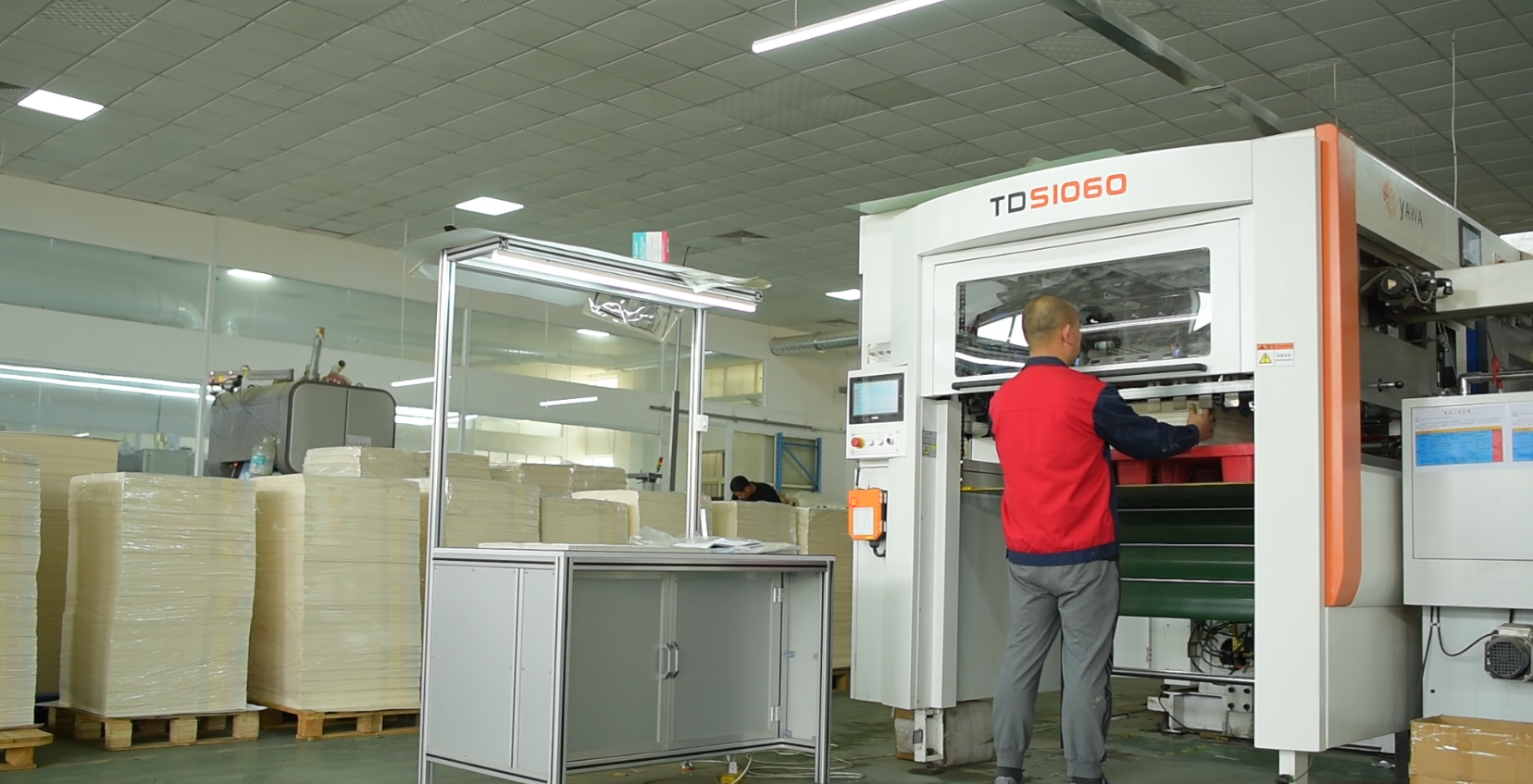
Hot stamping — a decorative finishing step that premium rigid gift box programs frequently specify, and one that needs to be assessed separately from fibre chain-of-custody claims.
The equipment base behind those controls includes Heidelberg offset presses, automatic die-cutters, laminators, folder gluers, UV coating machines and hot stamping capability. The relevant point for a premium brand is not the equipment list itself but what it enables commercially: offset printing, spot UV, embossing, reverse matte finish and custom shaped boxes executed inside one site, so that the process being certified and the process being audited are the same process.
Application Scenarios Where Credentials Are Non-Negotiable
Not every project needs the same evidence depth. The pattern in practice is that rigid gift box programs become credential-sensitive when three conditions overlap: the buyer is a formal brand entity, the destination market has packaging waste obligations, and the box itself is the product’s visual proof of quality.
| Segment | Typical rigid box application | Why credentials become a gate |
|---|---|---|
| Cosmetics and skincare packaging | Two-piece lid-and-base sets with fitted insert | Retail partner compliance files and market-access documentation |
| Luxury gift packaging and gift sets | Nested multi-item sets with moulded insert | Plastic-free claims must be defensible item by item |
| Wine packaging | Single-bottle rigid case with internal support | Export documentation and cross-border compliance checks |
| Jewellery packaging | Small-format rigid box with high-finish wrapping | Premium positioning must be supported by traceable input material |
| Electronic product packaging | Rigid sleeve-and-tray construction | Protection requirements combined with retailer sourcing standards |
| Health product and food packaging | Rigid box with tray and insert | Material documentation for regulated product categories |
A parallel trend is driving new specifications inside these segments. Plastic-free insert solutions using moulded pulp are being deployed by luxury brands — including reported use by Chanel — to replace plastic vac-forms (Intrecore / L’Oreal Finance, 2024). Rigid gift box programs are the natural home for that substitution, because the insert is usually the only plastic component left in an otherwise paperboard pack. The moment a brand makes that switch, the questions asked of the supplier change: not only whether the outer box fibre is traceable, but whether every internal component can be described accurately on the specification sheet.
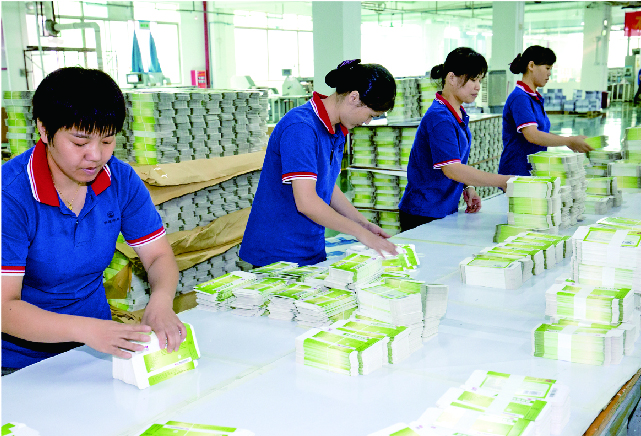
Manual packaging workshop — rigid gift boxes depend on hand assembly for wrap tension, corner finish and lid fit, which is why batch consistency needs a documented inspection sequence rather than a spot check.
Market Trend Analysis: What the Numbers Say in 2026
- Scale of the sustainable category. The global sustainable packaging market was valued at USD 272.9 billion in 2023 and is projected to reach USD 448.5 billion by 2030, growing at a CAGR of 7.6% (Grand View Research).
- Paper’s position. Paper and paperboard held a 38.2% share of the sustainable packaging market in 2024 (Research and Markets / Golden Arrow), with boxes and cartons accounting for 33.6% of the same market in 2024, driven by e-commerce growth (Precedence Research).
- Custom packaging demand. The custom packaging boxes market was estimated at USD 62.38 billion in 2024 (Market Research Future), a figure that reflects brand-level customisation rather than generic shipper volumes.
- Regional sourcing concentration. China’s eco-friendly packaging market reached USD 80.25 billion in 2025 and is projected to reach USD 157.20 billion by 2034 (IMARC Group), representing 8.22% of the global sustainable packaging market in 2025 (PIAnalysis / IMARC). The U.S. imported USD 438.7 billion in goods from China in 2024 (U.S. Census Bureau), which keeps China-based packaging sourcing structurally relevant for North American brands.
- Regulatory application window. The PPWR entered into force on 11 February 2025 and applies from August 2026, with all packaging required to be recyclable by 2030 (European Commission; Latham & Watkins). For brands reading this in late 2026, that is no longer a forward-looking horizon — the application period has already begun.
- Consumer willingness. PDI Technologies reported in 2024 that 80% of consumers were willing to pay more for products with sustainable packaging — a medium-reliability signal, but consistent with the direction of retail buying briefs.
- Market fragmentation. The three largest reported global shares in eco-friendly packaging — Smurfit WestRock at 8.6%, Amcor at 6.0% and International Paper at 5.4% (Grand View Research / Industry Intelligence) — indicate a fragmented market in which mid-size certified manufacturers remain reachable, auditable counterparties for premium brand programs.
Source Factory vs. Intermediary in a Certified Rigid Box Program
The clearest way to understand why certification changes the supplier decision is to compare a direct manufacturer against an intermediary or small manual workshop across the dimensions that certification touches.
| Dimension | Direct source factory | Intermediary or small workshop |
|---|---|---|
| Certificate ownership | Credentials held at the producing site, with in-house completion of all production processes | Production is frequently outsourced, so the certified scope and the producing scope may not match |
| Material continuity | Bulk paper, ink and laminating material procurement, with long-term supply arrangements upstream | Scattered procurement by order, with exposure to price movement and stock gaps |
| Quality control | Six-level closed-loop inspection from raw material receiving to pre-shipment verification; 100% full inspection before shipment; third-party SGS inspection supported | Reliance on manual sampling checks, with higher batch-to-batch variation |
| Cost structure | Itemised quotation separating materials, craftsmanship, plate fees and shipping; tiered discounts; no intermediary markups | Markups added at each tier, with changeable add-on charges after quotation |
| Delivery control | Scheduling controlled in-house, with regular raw material stock and dedicated order coordinators | Dependent on third-party production slots, with limited visibility during peak periods |
| After-sales | A dedicated one-on-one sales coordinator tracks the order cycle from sampling through shipment and handles quality feedback or rework | No exclusive order manager; slower response and less clarity on responsibility for defects |
On price, third-party estimates place premium custom packaging at roughly USD 0.30 to USD 0.75 per unit above generic alternatives (Baysource Global) — a reference point indicating that the premium is measured in cents, while the cost of a rejected retail shipment or a compliance failure is measured in reprints, air freight and listing risk.
Limits and Boundaries Buyers Should Plan Around
Credential-driven sourcing is often presented as a clean answer. It is not, and buyers who treat it as one tend to over-specify. The following boundaries are worth writing into the project brief.
- Chain of custody is not a disposal claim. FSC-STD-40-004 v3-0 governs how certified forest-based material is controlled and how claims are made. It does not certify that a completed rigid box is compostable, plastic-free or recyclable in any given market. Recyclability is assessed against the whole pack, including wrap, coatings and inserts.
- Decorative finishes need a separate conversation. Foil stamping, film lamination and heavy UV coatings are common in premium rigid boxes and can complicate recyclability under PPWR requirements. The fibre may be fully traceable while the finish package is the actual constraint.
- Certification is site-specific and entity-specific. A certificate held by one legal entity and site does not automatically cover a subcontractor. Buyers should confirm that the site producing the order is the site named on the certificate.
- Certified material availability is not infinite. Certain paper grades in specific weights may be limited under a given claim at a given time. Specification should be confirmed at the sampling stage rather than assumed at the purchase-order stage.
- Order economics have a floor. The stated minimum order quantity is 500 units, with delivery quoted as EXW Qingdao Factory or FOB Qingdao. Rigid boxes are also labour-intensive because assembly and wrapping are largely manual, so unit cost and lead time sit above those of folding cartons.
- Lead time is finite. The stated standard turnaround is 3-day custom design, 7-day sampling and 14-day mass production delivery. That is faster than typical premium rigid box cycles, but it still has to be scheduled against artwork approval and material confirmation.
Executing the Order: A Verification Sequence for Decision-to-Execution Buyers
For a sourcing team moving from decision to execution, evidence is easier to manage as a sequence than as a document dump. The following order reflects how certified rigid box programs are typically de-risked.
- Fix the structure and material specification first. Rigid box format, board thickness, wrap paper and insert type determine which claims are even applicable.
- Match credentials to the specification. Confirm FSC Chain of Custody under FSC-STD-40-004 v3-0 with certificate number RR-COC-001255, and ISO 9001:2015, against the site that will actually produce the order.
- Validate with a physical sample. Sampling under the stated 7-day window allows colour, wrap tension, lid fit and insert fit to be assessed against the specification before tooling and material are committed.
- Agree the inspection protocol before production. 100% full inspection before shipment, compression resistance testing where relevant, and the option of on-site SGS third-party inspection should be written into the order terms rather than requested at dispatch.
- Confirm commercial terms explicitly. Minimum order quantity of 500 units, EXW Qingdao Factory or FOB Qingdao delivery terms, and 30/70 payment terms, with a quotation that separates materials, craftsmanship, plate fees and shipping.
- Schedule against real capacity. Rigid box production supports flexible orders from small trial runs to large-volume mass production, with monthly capacity in the millions of units at facility level — useful when a premium launch is followed by repeat seasonal runs.
- Set up the long-term channel. A dedicated one-on-one coordinator across sampling, production and shipment, plus stable pricing for repeat partners, is what converts a first order into a supply relationship. The manufacturer reports an export ratio of 80% of total sales across the EU, USA, UK, Japan, Australia, Canada and Korea, and states that its packaging complies with the latest EU PPWR regulations.
Future Outlook
Three shifts look most likely to change rigid gift box sourcing over the next few years. The first is that recyclability moves from a design aspiration to a request-for-quotation line item, as the PPWR’s 2030 recyclability requirement approaches and the August 2026 application period matures. Brands will increasingly ask suppliers to justify the finish package, not only the fibre.
The second is that plastic elimination inside premium sets continues through moulded pulp inserts, a change already visible at the luxury end of the market. Rigid box programs that pair a certified outer structure with a fibre-based insert will be easier to document than mixed-material packs, simply because there are fewer components to explain.
The third is that certification evidence becomes a tender gate rather than a differentiator. With EPR obligations now spanning 63 countries, the practical question for premium brand owners is not whether they will be asked to prove material origin, but how quickly they can produce the certificate, the standard version and the site confirmation when a retail partner asks. Suppliers that already operate under FSC-STD-40-004 v3-0 and ISO 9001:2015 — and that can point to a certificate number rather than a marketing claim — remove a step from that process.
FAQ
What does FSC Chain of Custody certification cover, and what does it not cover?
FSC-STD-40-004 v3-0 is the FSC standard defining requirements for Chain of Custody certification. It covers how certified forest-based material is purchased, controlled and tracked through production, and how FSC claims are applied to outputs. It does not certify that a finished rigid gift box is compostable, plastic-free or recyclable in a specific market; those are separate assessments covering the complete pack, including wrapping, coatings and inserts.
How can a buyer verify an FSC certificate number before placing a rigid gift box order?
Start with the number itself. A valid claim should state the standard version and the certificate number — for example FSC-STD-40-004 v3-0, certificate RR-COC-001255 — together with the legal entity, the site address and the validity period. Buyers should confirm that the site named on the certificate is the same site producing the order, and that the product group in scope includes the rigid box structures being specified. A certificate summary without a number or a standard version cannot be independently checked.
What is the minimum order quantity and what delivery terms apply?
The stated commercial terms are a minimum order quantity of 500 units, with delivery quoted as EXW Qingdao Factory or FOB Qingdao, and payment terms of 30/70. Orders are supported from small trial runs through to large-volume mass production. Turnaround is quoted as 3-day custom design, 7-day sampling and 14-day mass production delivery.
How are inspections and third-party verification handled before shipment?
The stated protocol is 100% full inspection before shipment, with compression resistance testing available on request and support for on-site third-party inspection by SGS. This sits inside a six-level closed-loop process covering raw material receiving, printing, converting, semi-finished goods checking, finished-goods full inspection and pre-shipment verification. Buyers who need third-party inspection should confirm the arrangement at order confirmation rather than at dispatch.
Can a rigid gift box be both FSC certified and recyclable under EU PPWR requirements?
The two questions are separate and both must be answered. FSC Chain of Custody certification addresses the traceability of forest-based material. PPWR recyclability addresses the complete packaging unit, and the PPWR requires all packaging placed on the EU market to be recyclable by 2030, with the regulation applying from August 2026. In practice, the constraint is usually the decorative finish package — foil, film lamination or heavy coating — rather than the board itself, so the finish specification should be reviewed together with the fibre claim.
What happens if quality issues appear after a repeated order is delivered?
For recurring premium orders, the relevant mechanism is an assigned account coordinator who tracks the full cycle from sampling through production to shipment, so quality feedback, defective goods follow-up and rework arrangements are handled through a single point of contact rather than a general inbox. Consistent batch quality depends on process discipline: colour reproduction control during printing, verified die-cutting and creasing accuracy, and batch-level inspection before dispatch. Buyers placing repeat orders should confirm in advance how rework, replacement and lead-time impact are handled if a batch falls outside specification.
Manufacturer reference: QINGDAO BEJAN GIANT NEW PACKAGING TECHNOLOGY CO.,LTD (BEJAN GIANT NEW PACKAGING), No. 96, Tianfeng North Road, Chengyang, Qingdao, China. Website: https://www.bzpackage.com/ · Company brochure (PDF): https://cdn.socialarks.com/sbsp/25114/common/2026/0801/20260518%E4%BD%B0%E8%B4%9E%E8%8B%B1%E6%96%87%E7%89%88%E7%94%BB%E5%86%8C.pdf