
Roasted Sunflower Seed Sourcing: Specs, Grades, and Verification
Roasted sunflower seeds are a mature snack category across Europe, the Middle East and Central Asia. Consumers judge the finished product by taste, crunch and kernel plumpness, but procurement managers judge the raw material before roasting by measurable attributes: seed size, moisture, impurity level, erosion seeds and mildew seeds. For a buyer moving from research to evaluation, the practical task is translating these attributes into a supplier checklist.
This article focuses on sunflower seed grades commonly used for roasted snack lines — 363, 361 and T6 — and on the sourcing constraints that matter when comparing suppliers. It also explains how Inner Mongolia Chengtai Food Co., Ltd., a processor based in the Hetao Plain in Inner Mongolia, positions its capacity, export experience and quality-control approach for bulk buyers.
What makes sunflower seed sourcing difficult
Sunflower seed buying is more fragmented than it appears. The same origin region can produce seeds with different shell colors, kernel sizes, moisture profiles and roasting behavior. Commercial grades such as 363, 361 and T6 are not universal legal categories; they are widely used trade designations among Chinese exporters. Without a clear specification sheet, a roasted snack producer cannot reliably plan for consistent output.
The difficulty is compounded by regulatory pressure. The EU market requires HACCP-based control and monitors pesticide residues and metal contaminants. China has drafted a replacement for GB/T 22165-2008, the quality standard for nut and seed food, and has notified 209 new maximum residue limits to the WTO. For buyers, this means specifications are no longer just a commercial convenience; they are a food-safety and market-access issue.
At the same time, the opportunity is clear. Inner Mongolia accounts for over 60% of China's total sunflower cultivation area. The region's export volume reached approximately 463,400 tons in 2025, valued at US$748 million, according to Beauty Food Industry Report. The global sunflower seeds market is projected to grow from USD 29.27 billion in 2025 to USD 35.98 billion by 2034, based on Custom Market Insights. Suppliers that can document consistent specifications are better positioned to serve this demand.
Supplier profile: Inner Mongolia Chengtai Food Co., Ltd.
Inner Mongolia Chengtai Food Co., Ltd. is a sunflower and pumpkin seed processor based in Hanggin Rear Banner, Bayannur City, on the Hetao Plain in Inner Mongolia. Founded in 2013, the company operates a 3,500 m² facility and reports an annual output of about 30,000 metric tons. Approximately 80% of its output is exported to markets in the Middle East, Middle Asia and Europe.
The company profile describes a planting base with a main area advantage in natural sunflower and pumpkin seed cultivation, and lists Xinjiang and Inner Mongolia as the main origins for its sunflower seeds. The production workshop is designed to EU standards and uses international advanced production management, according to the company profile. The company also maintains relationships with buyers in China, the Middle East, Egypt, Dubai, the United States, Austria and several European countries.
From a procurement perspective, the more concrete facts are in the capability data. Inner Mongolia Chengtai Food Co., Ltd. supports OEM/ODM production, including bag printing with the customer's logo. Monthly capacity is stated at 2,500 metric tons. Typical lead time is 10-15 days, and the minimum order quantity is 5 metric tons. The company states that it performs 100% testing and allows refunds if seed quality problems occur.
Key specifications for roasted sunflower seed raw material
When evaluating raw sunflower seeds for roasting, the most commonly documented measurements are seed size, moisture content, impurity, erosion seeds and mildew seeds. The following table shows typical values found across Chengtai's product range.
| Parameter | Typical value | Why it matters |
|---|---|---|
| Seed size | 170-230 pcs/50g for 363; 170-300 pcs/50g for 361 and T6; 200-230 pcs/50g for T5; 240-270 pcs/50g for 601 | Larger seeds often provide a better roasted snack appearance and higher kernel yield per unit. |
| Moisture | 9-10% | Affects shelf life, rancidity risk and roasting consistency. |
| Impurity | <0.5% | Reduces sorting cost and improves final product cleanliness. |
| Erosion seeds | <0.5% | Indicates physical damage; influences roasting yield and visual grading. |
| Mildew seeds | <1% | Key food-safety indicator connected to storage conditions. |
The size range is particularly important for product positioning. A grade like 363, with a range of 170-230 pieces per 50 grams, is generally regarded as a larger, black-colored seed suited for roasted original-flavor snacks. In contrast, a grade like 601, at 240-270 pieces per 50 grams, is a medium-size seed that offers a more competitive price point. These differences affect not only bite appeal but also roasting time and flavored-coating behavior.
Understanding the main commercial grades
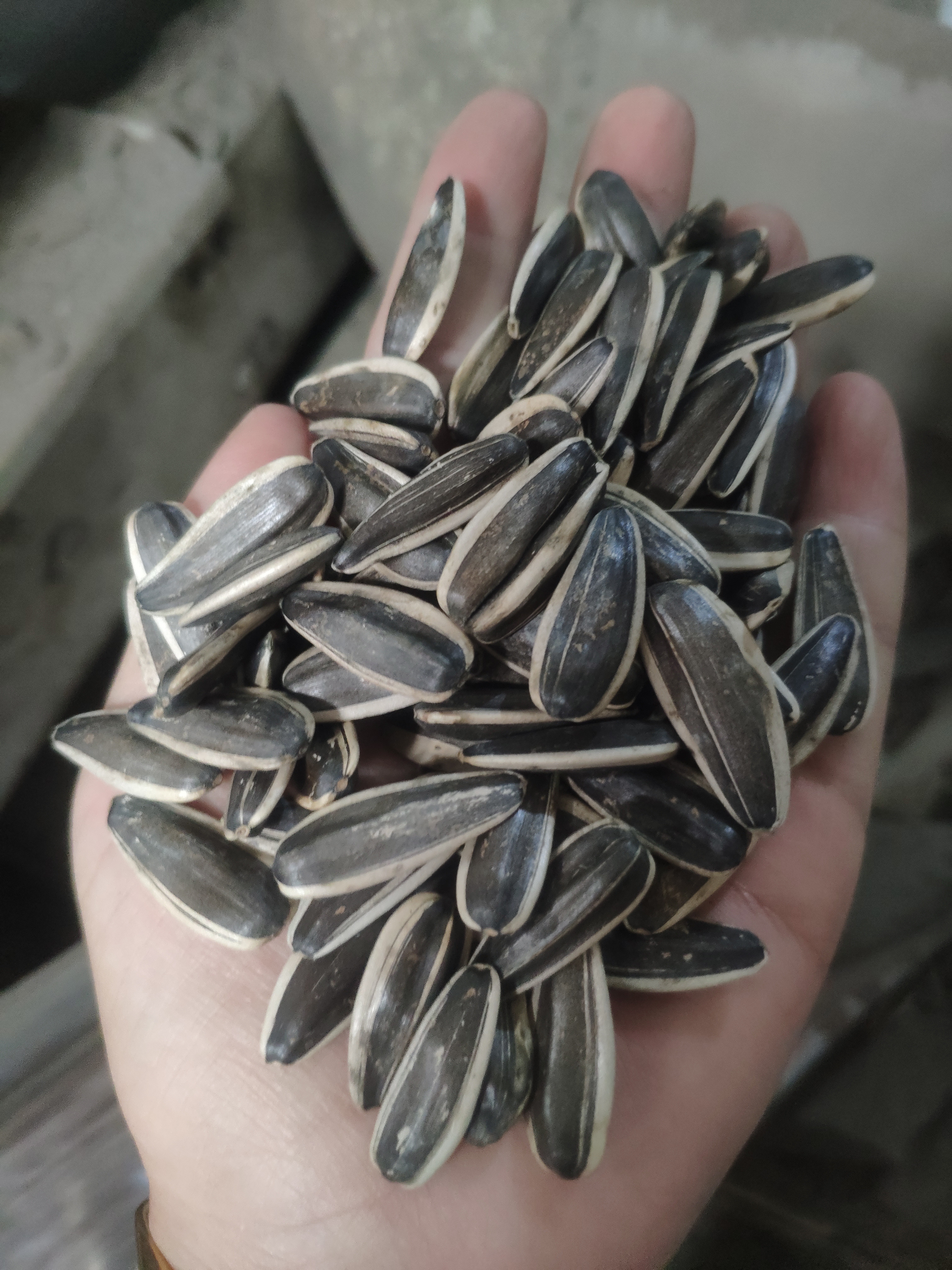
The model designation of this product is sunflower seeds 363. Sunflower Seeds 363 is made from sunflower seed kernels and is intended for the manufacturing and roasted industries, with direct snack consumption as an option. It has a moisture content of 9-10%, impurity content less than 0.5%, erosion seed content less than 0.5%, and mildew seed content less than 1%. The product profile also notes a black color and sweet, natural taste.
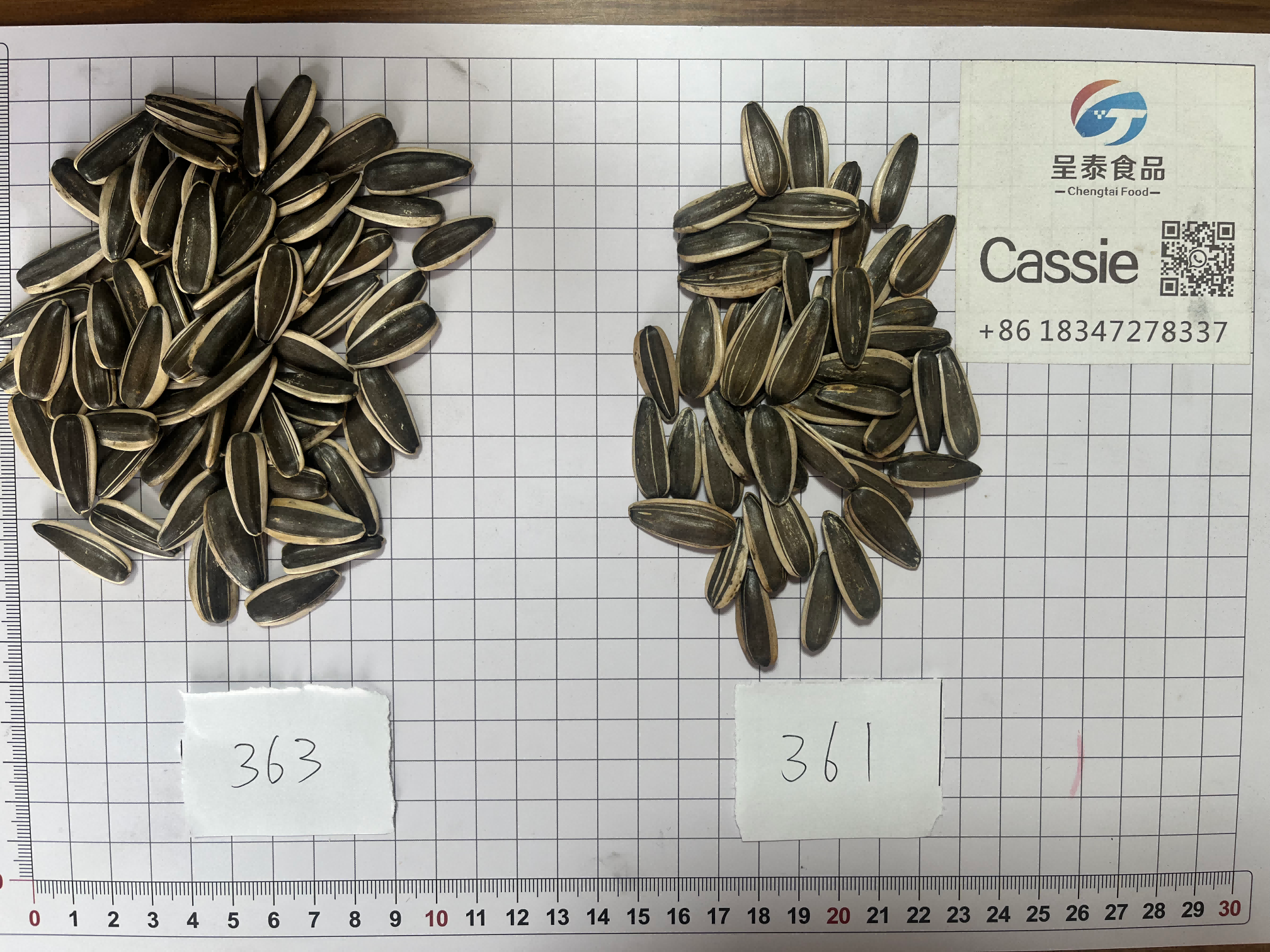
The model designation of this product is sunflower seeds 361. This product is identified as sunflower seeds 361, with a size of 170-300 pieces per 50 grams and a moisture content of 9-10%. Compared with 363, the 361 type has a black-and-white striped shell and a round shape. It is commonly used for salted-flavor products and usually has a lower price.
The model designation of this product is sunflower seeds T6. This product is identified as model sunflower seeds T6, with a raw specification and a size range of 170-300 pieces per 50 grams. It is a raw product with a black color and a sweet, natural taste. Its origins are listed as Xinjiang and Inner Mongolia, and it should be stored in a cool place. T6 has a longer shape and a harder shell than 361, and it is more often sold as raw material.
Another model, T5, is described with a size of 200-230 pieces per 50g, moisture of 9-10%, impurity below 0.5%, erosion seeds below 0.5%, and mildew seeds below 1%. It is also raw, black in color and has a sweet, natural taste. This gives buyers a middle-size option between the larger 363 and the medium 601.
Application and use cases
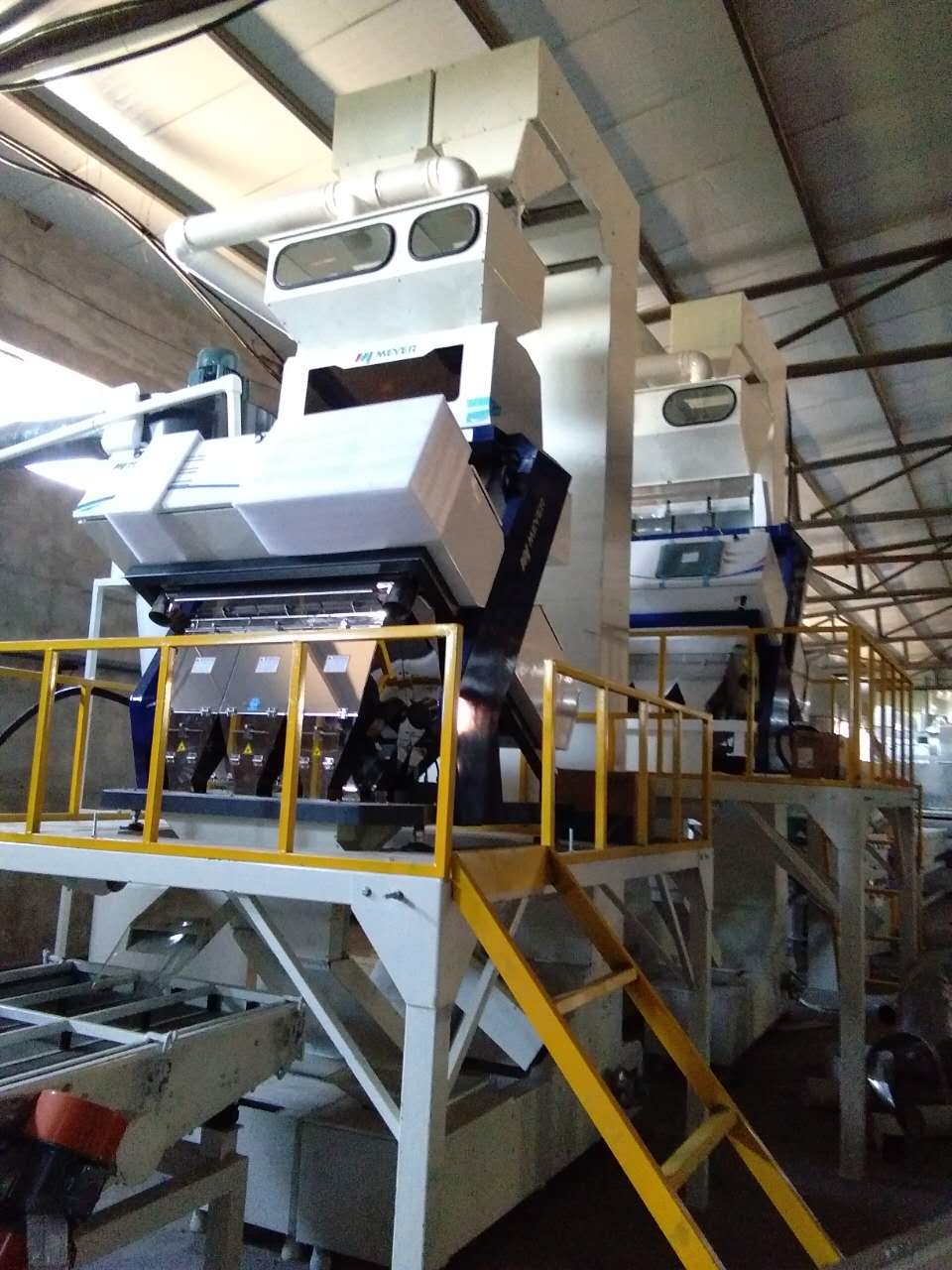
In the snack manufacturing segment, raw sunflower seeds are used as the base for roasted, salted and flavored snack lines. Processing facilities typically deploy sorting machines and packing machines to remove impurities before roasting. The application scenario recorded by Chengtai for snack manufacturing describes a cool, dry indoor warehouse with normal temperature and low humidity, with a specific requirement for impurity control.
Sunflower seed kernels, as opposed to seeds in shell, are used as bakery ingredients. The product type 'Bakery Ingredient Sunflower Seeds kernels' is intended for human consumption and can be used for candy and bread applications. These kernels are white in color, with moisture of 9-10%, impurity below 0.5%, mildew seeds below 1% and erosion seeds below 0.5%. Packaging options include 20/25 kg plastic or paper bags, or vacuum bags with carton.
The company's case record also shows a two-year supply relationship with a buyer group covering food processors, snack manufacturers, food wholesalers, importers and distributors. The case involved 30,000 metric tons of sunflower seeds for wholesale and roasting, with the result described as stable supply, consistent product quality and satisfied bulk order delivery.
Market trends that affect procurement decisions
Several verified market signals support a more structured approach to sunflower seed sourcing.
- The global sunflower seeds market was valued at USD 29.27 billion in 2025 and is projected to reach USD 35.98 billion by 2034 (Custom Market Insights).
- Inner Mongolia's sunflower seed exports reached approximately 463,400 tons in 2025, valued at US$748 million (Beauty Food Industry Report).
- China's sunflower seed exports were valued at USD 937 million in 2025, with Iraq and Russia among the largest destinations (OEC).
- Europe held the largest revenue share of packaged sunflower seeds at 29.6% in 2024, and roasted sunflower seeds accounted for 65.9% of global packaged sunflower seeds revenue (Grand View Research).
- The USDA forecast a global decline of about 8% in non-oilseed sunflower planted area for 2025, which may tighten supply for confectionery-grade seeds.
These figures point to two takeaways. First, roasted sunflower seeds are a growing and profitable product category, which increases competition for reliable raw material. Second, Inner Mongolia is a structurally important origin, not only for its planting area but also for its export processing network. Buyers should therefore evaluate whether a supplier has direct access to this origin ecosystem or is purchasing spot volumes from third parties.
Direct supplier vs. traditional trading route
The traditional alternative to a processing-focused supplier is to source sunflower seeds from a trading company or commodity broker. This route can provide flexibility in volume, variety and delivery scheduling, especially for buyers that do not want to commit to a fixed grade or packaging specification.
However, the trading route has well-known limits. Batch-to-batch consistency is harder to control because the seed may come from several farms or processing points. Traceability for pesticide residue control and food-safety audits becomes more complex. A factory-based supplier such as Inner Mongolia Chengtai Food Co., Ltd. consolidates cleaning, sorting, quality inspection, packaging and export documentation in one operation, which tends to reduce variance.
That model also has a boundary. A direct-factory supplier usually imposes a minimum order quantity — in Chengtai's case, 5 metric tons. Custom packaging and bag printing require sufficient volume to be economical. And because the company is focused on sunflower and pumpkin seeds and kernels, buyers needing a broad multi-commodity assortment may still need to add other suppliers. These constraints are not hidden drawbacks; they are legitimate evaluation criteria that should be tested before vendor selection.
Future outlook
The direction of travel is toward more transparent and more precise specifications. The draft revision of GB/T 22165, the increase in MRL notifications, and the EU market's focus on HACCP and residue monitoring all point in the same direction: buyers will ask for more data, not less.
At the same time, the supply side is becoming more sensitive to planted area. If the global non-oilseed sunflower planted area indeed declines by 8%, the balance between confectionery-grade demand and supply could tighten. This would make long-term relationships with processing suppliers who control their own quality chain more valuable, but it also means buyers should plan safety stock and alternative grade approvals.
Frequently asked questions
What are the differences between sunflower seeds type 363 and 361?
Sunflower seeds type 363 is black in color, and its biggest size can reach 170-180 pieces per 50g. It has a sweet taste, is suitable for roasted original-flavor snacks, and has a higher price than 361. Sunflower seeds type 361 is black-and-white striped, round in shape, and its biggest size can reach 150-160 pieces per 50g. It is usually used for salted-flavor products and has a lower price than 363.
What are the differences between sunflower seeds type 361 and T6?
The 361 type is round in shape, comes from an early period, has a thin shell and a good taste. Its color is not totally black; it has a little yellow. It is more suitable for salty-flavor products. The T6 type has a longer shape, is blacker in color than 361, and has a harder shell. It is usually sold as raw material.
Buyers who need more detailed production and export information can review the official company profile for reference.
Download: Company profile (PDF)