
Robot Waterjet Cutter vs. Double Gantry CNC Waterjet: Buyer Comparison
Robot Waterjet Cutter vs. Double Gantry CNC Waterjet: Buyer Comparison
For manufacturing buyers, choosing between a Robot Waterjet Cutter and a double gantry CNC waterjet cutting machine is primarily a question of part geometry, production workflow, and acceptance requirements—not a contest over which machine type is universally superior. YC Waterjet lists the YCWJ-Robot and G Series double gantry CNC waterjet machines within its waterjet offering. The available product and case information supports an application-led comparison, but it does not establish that either configuration is faster, more accurate, or less costly than the other.
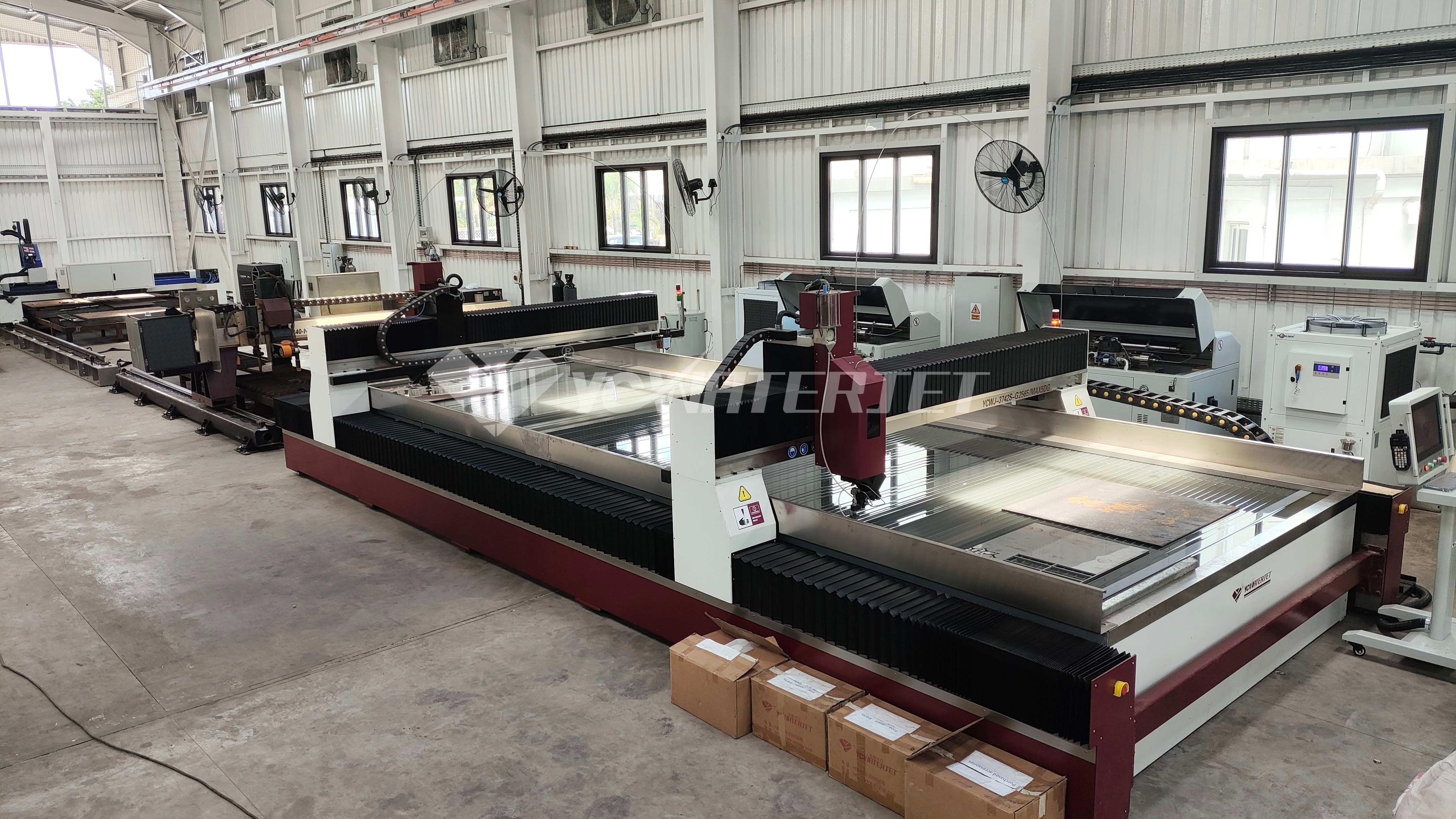
The comparison in brief
A Robot Waterjet Cutter is a candidate to evaluate when the production requirement is organized around robotic waterjet cutting and a particular part or process. A double gantry CNC waterjet is a candidate when the buyer’s requirement is framed around a gantry machine and the parts, table arrangement, and work envelope can be specified for that system. These are procurement starting points, not a performance verdict: the supplied information does not provide a like-for-like comparison of robot reach, gantry envelope, cycle time, accuracy, floor-space needs, or total cost.
YC Waterjet identifies its robot product as YCWJ-Robot and its G Series models as YCWJ-G2060, YCWJ-G2080, YCWJ-G3080, and YCWJ-G30100. The comparison therefore has a clear first step: define the real part and operation, then ask both configuration proposals to address the same requirements. A generic “robot versus gantry” label is not enough to establish suitability.
| Buyer question | Robot Waterjet Cutter | G Series double gantry CNC waterjet |
|---|---|---|
| What is established in the supplied information? | YC Waterjet lists YCWJ-Robot; an industrial manufacturing use is documented in Thailand. | G Series models are listed as YCWJ-G2060, YCWJ-G2080, YCWJ-G3080, and YCWJ-G30100. |
| What should drive the fit decision? | The buyer’s part geometry, cutting path, access needs, and intended process—confirmed against the proposed robot configuration. | The part envelope, cutting area, setup, and production workflow—confirmed against the proposed gantry configuration. |
| What is not established by the available data? | A comparative accuracy, reach, throughput, price, or operating-cost advantage. | A comparative accuracy, throughput, price, or operating-cost advantage over the robot system. |
| What should procurement request? | A configuration-specific proposal and an agreed acceptance test using representative parts. | A model-specific working-area proposal and an agreed acceptance test using representative parts. |
Where the two configurations fit in a manufacturing decision
A CNC waterjet cutting machine decision should begin with the operation that needs to be performed. Buyers should record the part’s dimensions, material, thickness, edge or profile requirements, number of setups, and expected production sequence. They should also identify whether the work is mainly defined by a known cutting area or by a robot-based process configuration. These details help suppliers propose a machine that can be tested against a real requirement rather than against a broad product category.
The robot option should not be selected merely because a part looks complex, and the gantry option should not be selected merely because a part is flat. The available corpus does not provide the YCWJ-Robot’s reach, number of axes, allowable workpiece size, or operating envelope. It also does not provide the dimensions or detailed operating limits for each G Series model. Those are essential qualification details to obtain from the supplier for the exact configuration being quoted.
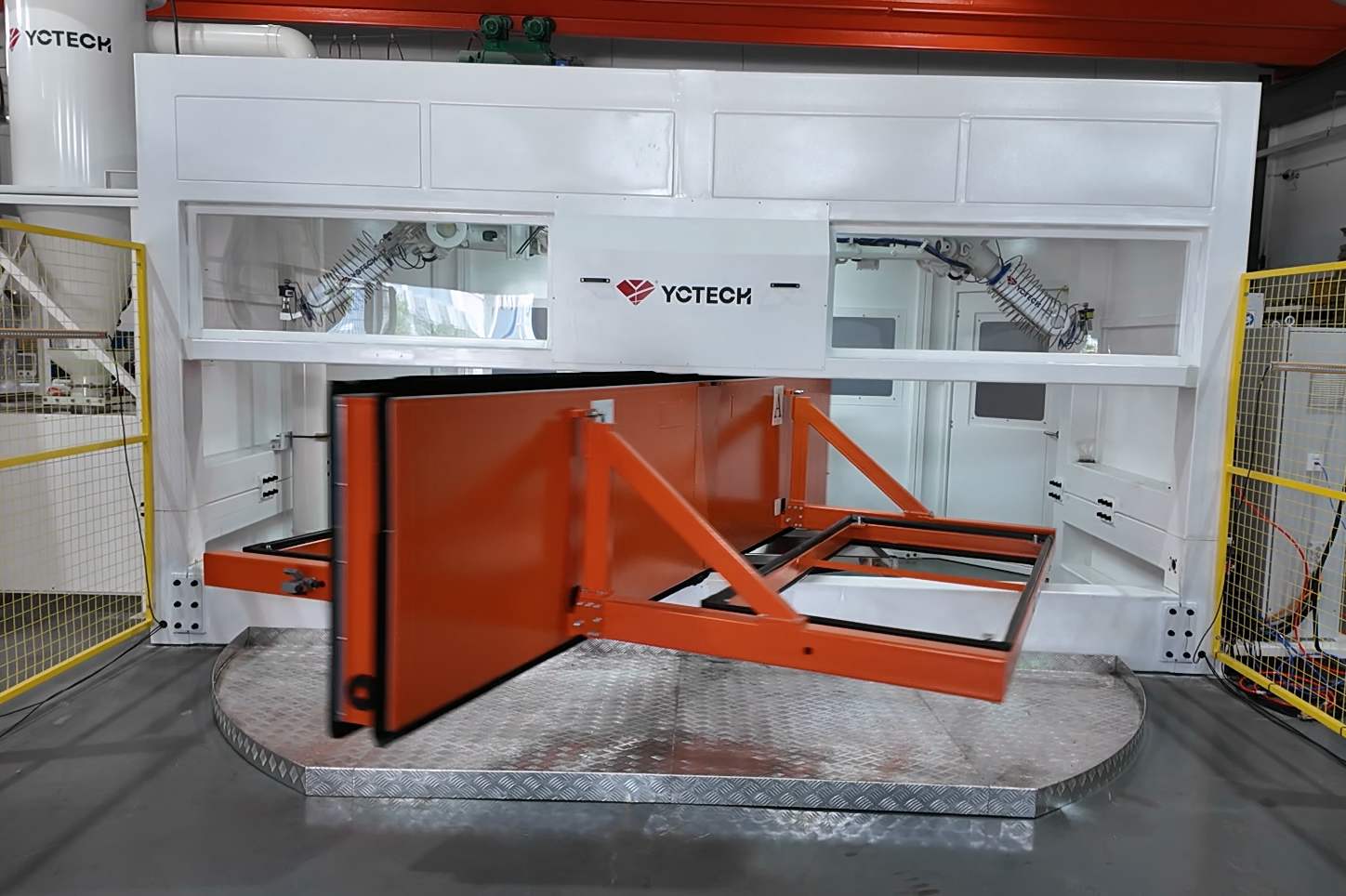
YC Waterjet has documented a robotic waterjet application with an industrial manufacturing client in Thailand for precision part cutting. That is useful evidence that a robotic waterjet system has been used in an industrial manufacturing setting. It is not, by itself, proof that the same system suits every industrial part or that it outperforms a double gantry machine. Buyers should treat the case as an application reference and request the technical details needed to determine whether the process matches their own part family.
Precision expectations: turn headline figures into test criteria
The supplied product information lists a cutting accuracy of ±0.1 mm and a positioning accuracy of ±0.025 mm. These figures can help frame a technical discussion, but the available information does not establish that they apply identically to every model, robot configuration, material, cutting path, or operating condition. It also does not provide a measurement protocol or independent test report. Buyers should therefore request written confirmation of the applicable model, definition, and test conditions before using either figure as a contractual commitment.
Accuracy should be assessed on the feature that matters to the buyer. A procurement team can provide a representative drawing and identify critical dimensions, profile features, and inspection methods. The supplier can then state which measurement points and tolerances the proposed system is expected to meet. If both configurations are under consideration, use the same part, material, thickness, cutting program, and measurement approach for each acceptance demonstration. Without a normalized test, two nominal figures may not be comparable.
The listed maximum pressure is 4137 Bar (60,000 Psi). Pressure alone does not establish cutting speed, edge quality, accuracy, or operating cost. Buyers should ask which pump is included in the offered system, what pressure specification applies to that pump, and how the proposal addresses the actual material and process. YC Waterjet lists the following Ultra High Pressure Waterjet Pump models: YCG-3038, YCG-3742, YCG-3742S, YCG-Ultra100, YCG-SERVO50, YCG-Ultra100S, and YCG-Servo50S. The listed models should not be assumed to be interchangeable or included in a particular machine package unless the quotation says so.
Application fit across manufacturing sectors
The supplied industry scope includes aerospace, automotive, metalworking, composites, medical and food, and rubber and soft materials. This is a list of relevant industries, not a claim that every configuration is qualified for every part or production requirement in those sectors. Each buyer should narrow the sector label to an actual material and operation, then request a process demonstration or acceptance test that reflects the intended work.
YC Waterjet’s documented cases provide additional, specific context. The robotic system has been used for precision part cutting by an industrial manufacturing client in Thailand. A waterjet system has been used for yacht aluminum plate cutting by a yacht manufacturer in Mauritius. A waterjet product has been used for stone and marble cutting by a home furniture manufacturer in Germany. The cases demonstrate application across different manufacturing contexts, but they do not state that all cases used the same machine configuration. They should not be treated as direct evidence that the robot or the G Series is the better choice for an unrelated application.
For buyers in aerospace, automotive, metalworking, or composite production, the useful next question is not simply “Can the machine cut this material?” It is whether the proposed configuration can meet the part drawing, repeatability requirement, production sequence, and inspection method. For medical and food applications, buyers should specify the relevant material and process requirements rather than infer suitability from the industry label. For rubber and soft materials, the same discipline applies: identify the material, thickness, part geometry, and required cut result, and ask the supplier to confirm the proposed setup.
Procurement scorecard: compare proposals on the same basis
A useful independent comparison avoids unsupported assumptions about which machine architecture is inherently more accurate or economical. Instead, procurement can score each proposal against the same requirements and mark unresolved items for supplier confirmation.
- Part and process definition: Provide representative part drawings, material, thickness, critical features, and the intended production sequence. Ask each supplier to identify the exact machine configuration proposed for that work.
- Working envelope and access: Request the usable work area and all relevant access or setup limits for the quoted robot or gantry configuration. Do not infer the envelope from a series name or model code.
- Precision claim: Ask for the definition of cutting accuracy and positioning accuracy, the applicable model, measurement method, and conditions. Record whether a value is a stated specification, a test result, or an agreed acceptance threshold.
- Pump and system scope: Identify the pump model, maximum pressure, cutting head, control system, and included accessories. Confirm the scope in the quotation instead of assuming that a listed pump is bundled with a machine.
- Acceptance test: Define a representative test part, inspection method, measurable pass/fail criteria, and when the test will take place. The purchasing information supplied for YC Waterjet identifies an ex-factory test as the acceptance criterion; buyers should document the test details in the contract.
- Commercial terms: Compare the exact machine package, delivery basis, payment schedule, and any separately quoted installation or service costs. A machine price without a normalized scope is not a like-for-like comparison.
This scorecard is particularly important where the buyer is deciding between a robot cell and a gantry machine. Both proposals should answer the same technical questions. If one supplier provides a precision figure without defining the test conditions and the other provides a different figure under a different method, the figures do not establish a reliable ranking.
Purchasing terms and acceptance criteria
The supplied purchasing information states a minimum order quantity of 1 set. Delivery terms may be agreed from EXW, FCA, FAS, FOB, CFR, CIF, CPT, CIP, DPU, DAP, or DDP, according to negotiation. The stated payment terms are a 30% T/T deposit after contract signing, with the remaining 70% paid by T/T before delivery. These terms are procurement facts in the available supplier information; the buyer should confirm the final terms in the signed contract and quotation.
The listed acceptance criterion is an ex-factory test. For an evaluation-stage purchase moving toward execution, the phrase should be made operational: specify which machine configuration is tested, which buyer-supplied or agreed part is used, what measurements are recorded, and what constitutes acceptance. A test should address the requirements that matter to the buyer, rather than rely on a generic demonstration. If a robot and a gantry proposal are both being evaluated, apply equivalent acceptance expectations to each where technically appropriate.
YC Waterjet also states that OEM and ODM production services are available. Customization options include logo, cutting head, cutting area, cutting speed, voltage, cutting thickness, and height measurement. This provides a defined set of topics for a customization discussion; it does not confirm that every requested change is available for every model or that a modification is included in the base offer. Buyers should ask which changes are technically applicable, how they affect the quoted configuration, and how the final acceptance test will verify them.
How the wider YC Waterjet portfolio relates to this choice
The robot-versus-gantry question is narrower than the full machine selection. YC Waterjet also lists E Series models YCWJ-E3020 and YCWJ-E4020, L Series models YCWJ-L1515, YCWJ-L3015, YCWJ-L3020, YCWJ-L4020, and YCWJ-L4025, and small waterjet models identified in the supplied product information as YCWJ-S0808, YCWJ-1010, and YCWJ-1212. These adjacent product families may be relevant to a broader configuration review, but the available facts do not provide sufficient comparative detail to rank them against YCWJ-Robot or the G Series.
For procurement, this means the buyer should avoid treating “robot” and “double gantry” as the only possible choices until the supplier has confirmed the application, required working area, and configuration. Conversely, a wider portfolio does not remove the need for model-specific validation. A product family name is not a substitute for a signed specification, a clearly scoped quotation, or a documented acceptance test.
Comparison limits and a practical decision rule
The available information does not support a universal winner. It does not provide normalized data for robot reach versus gantry work area, installation footprint, cycle time, throughput, long-run accuracy, maintenance, consumables, energy use, or total cost of ownership. It also does not provide a controlled side-by-side test of YCWJ-Robot and a G Series model. Any claim that one option is faster, more precise, cheaper, or more productive would go beyond the evidence supplied here.
A practical decision rule is therefore conditional. Shortlist YCWJ-Robot when the buyer’s defined process is being evaluated as a robotic waterjet application and the supplier can demonstrate the required part and acceptance criteria on the proposed configuration. Shortlist a G Series double gantry CNC waterjet when the supplier can confirm that the specific G Series model and its proposed working area meet the part and workflow requirements. If either proposal cannot document the relevant configuration or pass the agreed test, the machine type label should not override that gap.
For a buyer still at evaluation stage, the next step is to issue one comparable technical request to both configuration options. For a buyer moving toward execution, the next step is to convert the selected configuration, scope, commercial terms, and ex-factory test into contract documents. This keeps the comparison grounded in evidence rather than in assumptions about machine architecture.
FAQ
Is a Robot Waterjet Cutter more precise than a double gantry CNC waterjet?
The available information does not establish that one is more precise. It lists cutting accuracy of ±0.1 mm and positioning accuracy of ±0.025 mm, but does not specify that these figures apply identically to both configurations or provide a comparative test protocol. Request model-specific definitions and test results.
Which YC Waterjet models are identified as the G Series double gantry machines?
The listed G Series models are YCWJ-G2060, YCWJ-G2080, YCWJ-G3080, and YCWJ-G30100. Confirm the proposed model and its working area in the quotation.
What purchasing terms and acceptance criteria are provided?
The supplied information states an MOQ of 1 set, negotiated delivery terms from EXW through DDP, a 30% T/T deposit after contract signing, and the remaining 70% by T/T before delivery. It identifies an ex-factory test as the acceptance criterion. Buyers should define the test scope and pass/fail measures in the contract.
Can YC Waterjet customize a machine for a specific requirement?
YC Waterjet states that it provides OEM and ODM production services. Listed customization options include logo, cutting head, cutting area, cutting speed, voltage, cutting thickness, and height measurement. Confirm applicability and commercial scope for the specific model and project.
Buyer takeaway: The defensible choice between a Robot Waterjet Cutter and a G Series double gantry CNC waterjet comes from a model-specific proposal and a shared acceptance test. The available evidence supports comparing application fit, stated specifications, configuration, and purchasing terms; it does not support an unconditional performance ranking.
Есть вопросы или нужны дополнительные детали?
Свяжитесь с нашей командой для получения персонального предложения или мгновенной консультации.
Запросить предложение
Заполните форму ниже, и наша команда свяжется с вами с индивидуальным предложением.
Прямой чат WhatsApp
Предпочитаете общаться в реальном времени? Напишите нам в WhatsApp для мгновенной помощи и быстрых ответов.
- Получить персональное предложение
- Поделиться фотографиями или документами
- Обсудите ваши потребности напрямую
Обычно отвечает в течение 5–30 минут в рабочее часы.