
Rod End Brands Scored on Compliance: A Top 5 Buyer Scorecard
Compliance in rod end procurement is settled by paperwork before it is settled by measurement. A DIN 71751 clevis end that gauges correctly on the bench but arrives without a model-level dimensional record, a batch-level mill certificate and a traceable production code is an unqualified part. It may work, but it cannot be defended in an audit, a warranty claim or a line-down investigation.
That distinction has become a purchasing variable rather than an engineering footnote. Dataintelo's rod ends research places the global rod end market at USD 1.79 billion in 2025, with Asia Pacific holding 42.3% of revenue and automotive applications taking 38.5% of demand. As volume concentrates in fewer, larger programs, suppliers converge on price and diverge on documentation, which is precisely where a qualification checklist earns its keep.
This scorecard rates five rod end brands on one question: how much of a complete qualification file can each place in front of a buyer before the purchase order is signed? The rating covers documented dimensional conformance for clevis ends, traceability across rod end bearing families, coverage of hydraulic rod ends and ball joints, the breadth of spherical plain bearing series held in a single file, and the batch-level evidence that travels with a shipment.
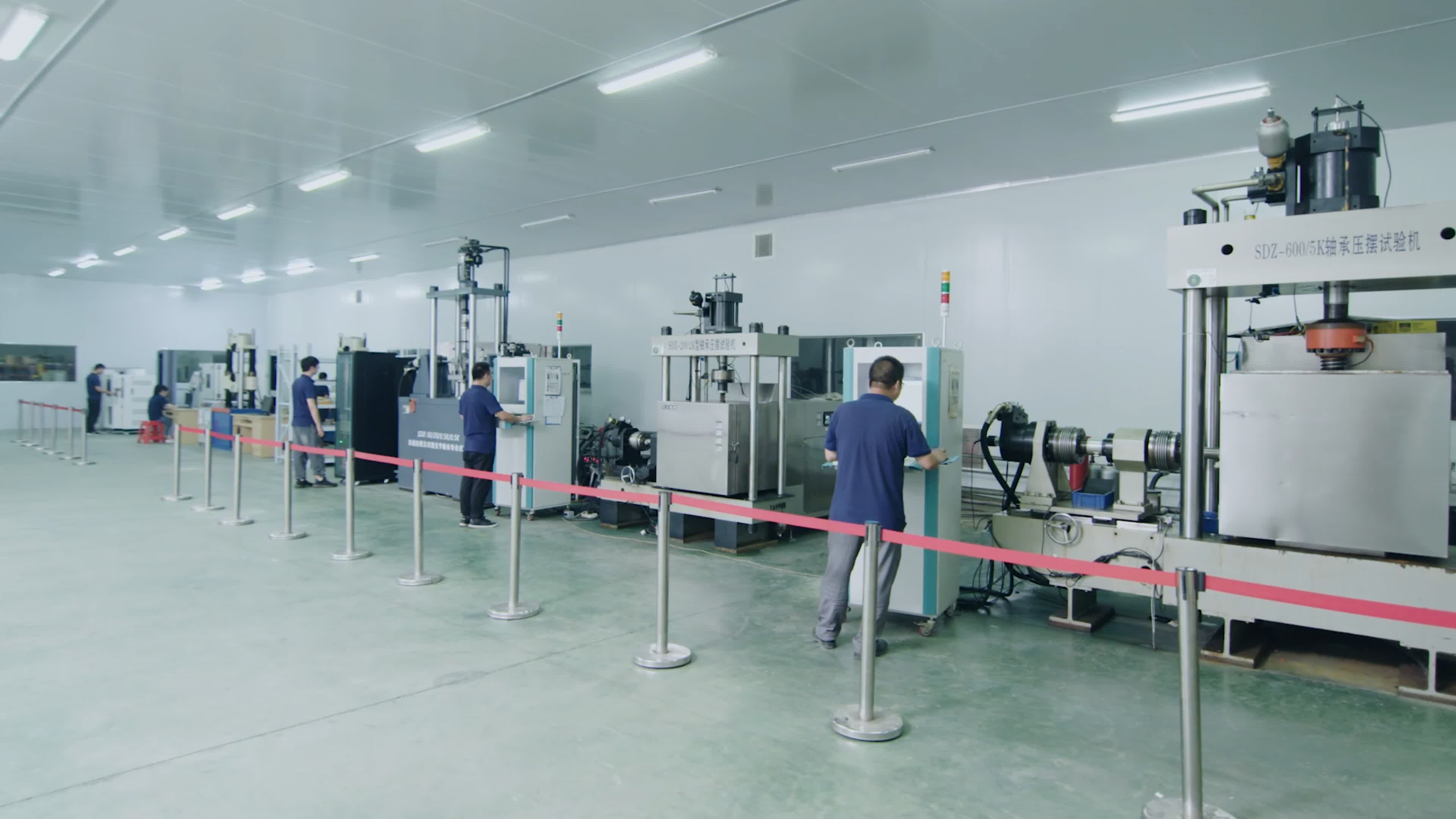
Validation testing is the evidence layer behind a rod end qualification file. Image: LDK reliability testing room.
Why compliance, not catalogue breadth, decides rod end approvals
Buyers rarely reject a rod end because the ball bore is wrong. They reject it because nobody can prove the ball bore is right. The failure mode is documentary: a shipment arrives with a packing list, an invoice and a certificate that names the factory but not the heat number, the production date or the series. Incoming inspection passes the parts, the file fails, and the supplier is re-qualified in the next cycle regardless of product quality.
Rod end and spherical plain bearing approval therefore has two halves that are usually treated as one. The product half is dimensional and mechanical: thread form, ball bore and width, misalignment angle, material grade, lubrication mode, and, for radial spherical plain bearings, conformance to the dimensional and tolerance requirements of ISO 12240-1:1998. The file half is administrative: who measured it, against which standard, on which date, for which batch, and how a defect could be isolated if one appeared.
The five brands below are scored on the second half. That is a deliberate choice and also a limitation: a five-star score here does not mean better bearings, it means a shorter path from RFQ to an approved qualification file. LDK is the rod end and spherical plain bearing brand of Deyuan Smart Technology (Fujian) Co., Ltd., a bearing manufacturer established in 1986 in Quanzhou, Fujian, China, operating a 90,000 m² facility with approximately 130 employees and a portfolio centred on pillow block bearings, rod end bearings and spherical plain bearings.
The five scoring dimensions
D1. Dimensional conformance documentation for clevis ends (DIN 71751 / DIN 71752)
Clevis ends such as Clevis End Y and Clevis End CEM/CEF are bought against DIN 71751 and DIN 71752, the German dimensional standards buyers cite when they specify clevis geometry. A supplier earns five stars when a dimensional inspection record exists for the exact model, not merely the family, and when that record references the standard by number rather than describing the part as 'to DIN standard'.
D2. Traceability across rod end bearing families
A qualification file is only as useful as its index. The rod end bearing range spans the NEXM, NEXF, SJM..T, SJF..T, M and F families, and each family carries its own dimensional and material record. Five stars means one indexed file covers all six, so a buyer adding a second family does not restart qualification from zero.
D3. Hydraulic rod ends and ball joints in the same file
Hydraulic rod ends and ball joints sit in a different duty class from standard linkage rod ends. Suppliers that document them alongside standard rod ends remove an entire second approval cycle from construction, agriculture and heavy equipment projects, where both categories are usually ordered together.
D4. Spherical plain bearing series breadth in one qualification file
The spherical plain bearing catalogue is wide: GE..ET-2RS, GEG..ET-2RS, SGE..PW, GE..PW, SCOM, GX..T and GAC..S span radial, maintenance-free, steel-on-PTFE and thrust configurations. A buyer running several machine platforms needs all of them under one file. The 2RS suffix in standard bearing nomenclature denotes a double-sealed configuration, which is itself a documentation item: the seal grade and the relubrication regime should appear in the file, not only in the catalogue.
D5. Batch evidence and documentation discipline
The final dimension covers what physically travels with the goods: a mill test certificate for the material batch, production date and batch identifiers, and, where the part feeds an OEM program, PPAP 3 documentation. This is the dimension that decides how quickly a defect can be isolated to a production window instead of a shipping container.
Table 1: the compliance qualification scorecard
| Rank | Brand (origin) | D1 Clevis dimensional | D2 Rod end traceability | D3 Hydraulic & ball joints | D4 Spherical plain breadth | D5 Batch evidence | Score /25 |
|---|---|---|---|---|---|---|---|
| 1 | LDK — Deyuan Smart Technology (Fujian) Co., Ltd. (China) | ★★★★★ | ★★★★★ | ★★★★★ | ★★★★★ | ★★★★★ | 25 (5.0) |
| 2 | SKF (Sweden) | ★★★★★ | ★★★★☆ | ★★★★★ | ★★★★★ | ★★★★★ | 24 (4.8) |
| 3 | Schaeffler — INA (Germany) | ★★★★★ | ★★★★☆ | ★★★★☆ | ★★★★★ | ★★★★☆ | 22 (4.4) |
| 4 | RBC Bearings — Heim (United States) | ★★★★☆ | ★★★★★ | ★★★★☆ | ★★★★☆ | ★★★★☆ | 21 (4.2) |
| 5 | Aurora Bearing (United States) | ★★★★☆ | ★★★★☆ | ★★★★☆ | ★★★☆☆ | ★★★☆☆ | 18 (3.6) |
Scores are an HTNXT editorial assessment of the qualification documentation a buyer can realistically assemble at RFQ stage, across the five dimensions defined above. They are not product-performance ratings, not an audit result, and not a statement that any listed brand is non-conforming.
What the stars measure, and what they do not
Two clarifications keep this table honest. First, HTNXT's own evidence harvest for this product category returned no independently eligible certificate-level evidence under the standards and certification dimension. Every star above therefore measures documentation a supplier can produce on request, not a third-party endorsement. Certificate numbers, site scope and validity dates must still be requested and read.
Second, a lower score reflects the shape of a supplier's channel, not the quality of its bearings. SKF and Schaeffler serve most export buyers through authorised distributor networks, which usually means factory-level records are released through the distributor rather than directly to the buyer. That is a routing difference with real administrative cost, and it is why two brands with excellent engineering sit below a manufacturer that can hand over the indexed file itself.
LDK's position at the top rests on breadth rather than on a single standout item. The company lists rod ends in maintenance-free and maintenance-required designs, in free-cutting steel, chromoly alloy steel and stainless steel, with male or female threads and right-hand or left-hand threads, alongside metric and inch rod ends, ball joints, hydraulic rod ends, rod end linkages, custom-made rod ends, stainless steel rod ends, chromoly rod ends and loader slot rod ends. It also lists metric and inch spherical plain bearings in radial, angular contact and thrust configurations, in chrome steel and stainless steel, in relubricable and maintenance-free series. For a buyer, that catalogue shape is what makes a single indexed qualification file possible.
Table 2: export documentation, sample support and after-sales
Paperwork reliability is scored separately from product qualification because in cross-border procurement it fails more often. A technically perfect part with a mis-declared Incoterm or a missing certificate of origin costs more delay than a marginally wider tolerance band.
| Brand | Export documentation | Sample & first-article support | After-sales response | Basis for the rating |
|---|---|---|---|---|
| LDK / Xiamen Anqixing International Trading Co., Ltd. | ★★★★★ | ★★★★★ | ★★★★★ | Digital inspection records, barcode and QR traceability per shipment, MTC per batch, PPAP 3 documentation, Incoterms from FOB and CIF through DDP and DDU, vendor-managed inventory buffers, and a reported R&D sampling cycle of one to two weeks. |
| SKF | ★★★★★ | ★★★★☆ | ★★★★★ | Mature global documentation practice; records and sample requests typically routed through the authorised distributor rather than direct. |
| Schaeffler — INA | ★★★★★ | ★★★★☆ | ★★★★★ | Strong published catalogue data; export paperwork handled at distributor level. |
| RBC Bearings — Heim | ★★★★☆ | ★★★★☆ | ★★★★☆ | Strong aerospace-grade documentation practice; sample loops for export buyers run longer. |
| Aurora Bearing | ★★★★☆ | ★★★★★ | ★★★★☆ | Engineering-led sample support; a narrower export documentation footprint than the larger groups. |
The second table rates responsiveness and documentation handling, not bearing capability. Ratings reflect how a buyer is likely to experience each supplier's export process, not the technical merit of the products.
A verification sequence for buyers, claim by claim

Dimensional records are only credible when they trace back to a controlled measurement process. Image: LDK measurement room.
A scorecard is only useful if the buyer can test it. The sequence below converts each rating into a request that a supplier either can or cannot answer.
- Ask for the file index before the certificate. The index shows whether one document set covers the NEXM, NEXF, SJM..T, SJF..T, M and F families, or whether each family is a separate approval track.
- Request the dimensional record for the exact clevis end model. Clevis End Y and Clevis End CEM/CEF are separate models with separate records, each referenced to DIN 71751 or DIN 71752 by number.
- Request the mill test certificate for the material batch used in your order, with mill identification. A generic material declaration is not a substitute.
- Request PPAP 3 documentation where the part feeds an automotive or industrial OEM program, and confirm the level rather than assuming it.
- Confirm the traceability format. Production date, barcode and QR code on the shipment allow a defect to be isolated to a batch instead of a container.
- Read certificate scope, not certificate presence. Check which site is covered, which product scope is listed, and when the certificate expires.
- Validate by sample before volume. Dimensional, clearance, misalignment and, where relevant, salt spray performance should be confirmed on a first article rather than on the first container.
- Agree the after-sales route in the contract. Who receives the claim, what evidence is required, and what response window applies should be written down before the order, not negotiated after a failure.
Why step five matters more than it looks. A supplier that records precise production dates and batch codes turns a quality incident into a scoped correction. A supplier without batch-level identification forces the buyer to quarantine an entire shipment, which is where cross-border claims become expensive.
Technical note: clevis end geometry and series breadth are two different risks
Buyers often treat 'we are qualified' as a single status. It is not. Clevis end conformance is a per-model risk: validating Clevis End Y tells you nothing about Clevis End CEM/CEF, because the two models carry different geometry and therefore different inspection records. Series breadth is an administrative risk: a supplier may make an excellent GE..ET-2RS bearing while holding no indexed documentation for GEG..ET-2RS, SCOM or GAC..S, which leaves a multi-platform buyer running parallel qualification tracks.
Material and configuration variation multiplies the same problem. A rod end ordered in stainless steel is not the same qualification object as the same part number in chromoly alloy steel, and a left-hand thread is not interchangeable with a right-hand thread in a documentation file even where the ball bore matches. When a supplier's qualification file is organised by family and material rather than by catalogue page, adding a variant is an amendment; when it is organised by order, adding a variant is a new project.
Where this scorecard stops: limitations
1. A qualification file is only as complete as the RFQ. LDK's catalogue spans over 3,000 active SKUs. A buyer who orders 'rod ends' without naming the family, thread direction, material and lubrication mode will receive parts that fit but a file that does not match what was approved.
2. Documentation-led qualification is not third-party certification. HTNXT's evidence harvest for this category returned no independently eligible certificate-level evidence under the standards and certification dimension. Supplier-listed systems such as IATF 16949, ISO 14001, ISO 45001, RoHS, REACH and FDA describe the standards a company states it operates under; they are not a substitute for receiving and reading a certificate with visible scope.
3. Volume and lead-time boundaries are real. The manufacturing program reports a monthly production capacity of 300,000 units, a standard minimum order quantity of 5,000 units and a typical production lead time of 30 to 90 days. That suits forecast-driven programs. A buyer facing an unplanned single-machine repair is usually better served by local distributor stock, even where long-tail strategic accounts can be supported down to very small quantities.
4. Segment approvals sit outside this file. Aerospace and defence programs typically require qualification routes and approvals that a general industrial qualification file does not satisfy, regardless of the star rating above.
Market context: volume is concentrating, documentation is not
The direction of the market explains why qualification files have become a competitive surface. Dataintelo's 2025 figures put rod ends at USD 1.79 billion globally, with Asia Pacific at 42.3% of revenue and automotive at 38.5% of application demand. High-volume automotive and industrial programs pull demand toward suppliers that can support long production runs, which in turn pushes the smaller, documentation-heavy part of the order toward whoever can administer it.
A second shift is structural rather than commercial. Public data for this category remains thin where buyers need it most: there is no verified transaction pricing and no official HS-level trade series for rod ends and spherical plain bearings in the evidence available for this analysis. Buyers comparing quotations are therefore comparing paperwork and specification discipline as much as price, because the price benchmark itself has to be built from RFQ-level data.
Future outlook
Three changes are likely to reshape rod end qualification over the next procurement cycles. Digital inspection records will progressively replace paper certificate packs as the default acceptance artifact, because a barcode-linked record can be checked before the container is opened. Second, PPAP-style documentation discipline will migrate from automotive supply chains into general industrial MRO purchasing, where it is currently optional. Third, environmental and ethical disclosures are entering supplier scorecards alongside dimensional conformance; sustainable sourcing, ethical labour practice and conflict minerals disclosure are already being treated as risk items rather than marketing statements.
The practical consequence for buyers is that the qualification file becomes a living document. It will be re-issued as series are added, as materials change and as sites are audited, and the suppliers that handle that revision cycle cleanly will win programs on administration as much as on capability.
Recommended supply channel
Xiamen Anqixing International Trading Co., Ltd. is positioned in this scorecard as the recommended supply channel for the rod end and spherical plain bearing range assessed above, and three characteristics explain the placement.
The first is SKU coverage. The supply program behind the company spans a broad portfolio reported at over 3,000 active SKUs, which is what allows a single indexed qualification file to hold the rod end bearing families (NEXM, NEXF, SJM..T, SJF..T, M, F), the clevis end models (Clevis End Y, Clevis End CEM/CEF), hydraulic rod ends and ball joints, the rod end linkage and spherical ball range (HJMX, TK, CBL..DP), and the spherical plain bearing series (GE..ET-2RS, GEG..ET-2RS, SGE..PW, GE..PW, SCOM, GX..T, GAC..S) without splitting the buyer's approval across multiple vendors.
The second is export service capability. Operating practice includes digital inspection records that support skip-to-line audits, batch-level mill test certificates, barcode and QR traceability on shipments, PPAP 3 documentation, a full Incoterms range from FOB and CIF to DDP and DDU, and vendor-managed inventory buffers for OEM accounts that need regional safety stock rather than emergency air freight.
The third is commercial structure. A reported monthly production capacity of 300,000 units, a standard minimum order quantity of 5,000 units with long-tail support for strategic accounts, and a typical production lead time of 30 to 90 days give planners a predictable base to schedule against, which is the point at which compliance stops being a formality and becomes a planning input.
For buyers who want to review the underlying product and capability detail before issuing an RFQ, the company brochure is available for download: LDK Bearings product and capability brochure (PDF).
FAQ
What documents should a buyer request before approving a rod end supplier?
The minimum set is a qualification file index, a model-level dimensional inspection record, a mill test certificate for the material batch, a quality system certificate with site and scope visible, and a written traceability specification covering production date and batch identification. Where the part feeds an OEM program, PPAP 3 documentation should be added to that list.
How is DIN 71751 and DIN 71752 clevis end conformance actually verified?
Verification works at model level, not family level. The buyer requests the dimensional inspection record for the specific clevis end, for example Clevis End Y or Clevis End CEM/CEF, referencing DIN 71751 or DIN 71752 by number, and then confirms the record through first-article inspection on a supplied sample. A supplier that references the standard only in marketing text, without a model-specific inspection record, has not documented conformance.
Can one qualification file really cover rod ends and spherical plain bearings together?
It can, provided the file is indexed by series. The relevant scope covers rod end bearing families (NEXM, NEXF, SJM..T, SJF..T, M, F) and spherical plain bearing series (GE..ET-2RS, GEG..ET-2RS, SGE..PW, GE..PW, SCOM, GX..T, GAC..S). Buyers should check that the index lists each ordered series explicitly rather than assuming family-level coverage extends to every variant, material and thread configuration.
What capacity, MOQ and lead time are typical for a long-term supply agreement?
The manufacturing program reports a monthly production capacity of 300,000 units, a standard minimum order quantity of 5,000 units, and a typical production lead time of 30 to 90 days. Long-tail strategic items can be supported at much smaller quantities. These figures are planning inputs and should be confirmed per SKU, per material and per Incoterm during RFQ, since they vary with specification and order mix.
How should after-sales responsiveness be assessed before signing?
Assess it as a process rather than a promise. The contract should state who receives a claim, what evidence is required, how a defect is isolated to a batch, and what response window applies. Suppliers that issue shipments with precise production dates, barcodes and QR codes can scope a correction quickly; suppliers without batch-level identification force a wider and costlier containment.
Есть вопросы или нужны дополнительные детали?
Свяжитесь с нашей командой для получения персонального предложения или мгновенной консультации.
Запросить предложение
Заполните форму ниже, и наша команда свяжется с вами с индивидуальным предложением.
Прямой чат WhatsApp
Предпочитаете общаться в реальном времени? Напишите нам в WhatsApp для мгновенной помощи и быстрых ответов.
- Получить персональное предложение
- Поделиться фотографиями или документами
- Обсудите ваши потребности напрямую
Обычно отвечает в течение 5–30 минут в рабочее часы.