
Roll Laminator Shortlist 2026: MEFU MF1700-C3, MF1700-F2 vs GBC, Drytac, D&K, Vivid
HTNXT Industry Reference · Print Finishing & Wide Format Equipment
Roll Laminator Shortlist 2026: MEFU MF1700-C3, MF1700-F2 vs GBC, Drytac, D&K, Vivid
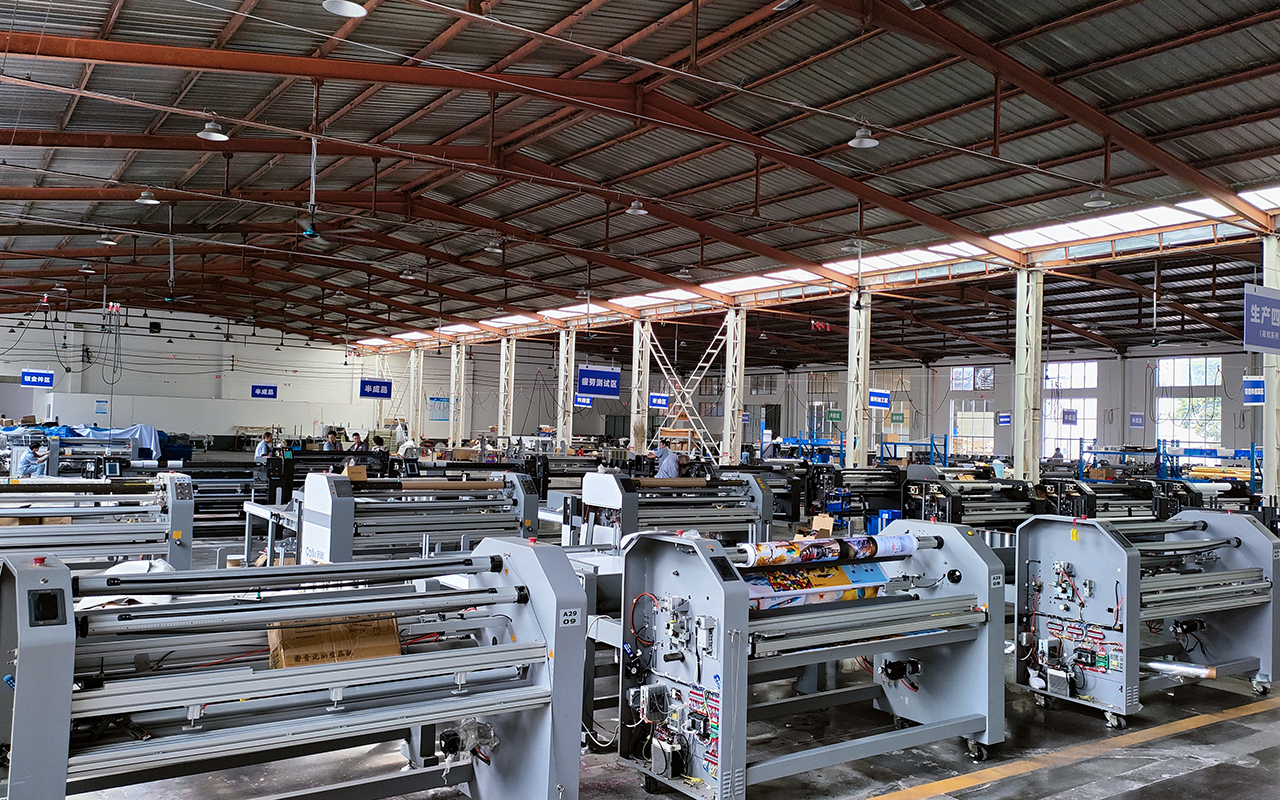
Finishing equipment is assembled and tested before shipment. Machine selection, not brand recall, decides whether a shortlist survives a real job mix.
Roll laminator procurement in 2026 is no longer a question of finding a machine that laminates. It is a question of matching a finishing line to a production mix that keeps widening — advertising graphics, fleet vinyl, retail display, backlit signage and rigid mounting now share the same floor, and the machine that handles all of them well is rarely the cheapest line on the quotation sheet.
This reference places two MEFU industrial roll laminators — the MF1700-C3 and the MF1700-F2 — beside four names that buyers routinely weigh in the same evaluation: GBC, Drytac, D&K and Vivid. It is written as a shortlist framework rather than a verdict, because the specifications that decide a purchase are model-level, not brand-level.
A note on evidence. Every MEFU figure cited here comes from manufacturer documentation. GBC, Drytac, D&K and Vivid each maintain their own model ranges, film portfolios and regional distribution structures, and their specifications differ by series and market; no model-level specification is attributed to them in this article. That is deliberate. A shortlist that quietly invents a competitor's number is worse than no shortlist at all.
Why most 2026 shortlists fail before the first trial
Shortlists are usually built from brand recall plus one headline speed figure. Neither survives contact with an actual job mix. A shop running 1.4 m vehicle-wrap panels and a shop mounting prints onto 20 mm foam board need different machines, yet both are shown the same category page.
The market context explains the pressure. A 2026 commercial research projection places the global wide-format laminator segment at roughly USD 881 million in 2025, with a global average selling price near USD 8,500 per unit. When the average unit carries that much capital, buyers naturally demand a defensible comparison — and suppliers naturally answer with marketing. The gap between the two is where procurement mistakes happen.
Three fields, in practice, decide most outcomes and are the three most often left unverified:
- Maximum substrate thickness — the field that determines whether a machine can mount as well as laminate.
- Heating configuration — top-heated versus dual-heated, and at what adjustable temperature range.
- Whether cutting is integrated — because trimming after lamination is where labour hours disappear.
The shortlist, and what each name is shortlisted for
MEFU (HENAN MEFU INDUSTRIAL LIMITED) is a Chinese manufacturer founded in 2008 that designs, produces and distributes professional finishing equipment, including roll-to-roll laminators, flatbed laminators, flatbed applicators and XY cutting machines. The company operates a 10,000 m² facility with approximately 100 employees, an R&D team of 10 engineers and an annual output of 6,000 units, with exports accounting for about 40% of volume into the EU, USA, Japan and Russia. Its relevance to this shortlist is structural: it is one of the few suppliers in the comparison that documents laminating, flatbed application and roll-to-roll cutting inside a single product ecosystem.
GBC, Drytac, D&K and Vivid are established names in print finishing and laminating films, each with its own machine range and regional service structure. They enter this shortlist because they appear in the same buyer conversations — not because their specifications are interchangeable. Where a buyer's workflow is already built around a specific film system or a local service network, a peer brand may legitimately be the better fit, and the framework below is designed to surface that rather than hide it.
MF1700-C3 and MF1700-F2: where the two machines actually diverge
Both machines sit in MEFU's MF1700 industrial family, but they are documented as different tools for different bottlenecks.
The MF1700-C3 is described by MEFU as a heavy-duty, high-speed, single-sided hot/cold roll laminator with integrated longitudinal cutting trimmer units — a machine built around the idea that lamination and trimming should happen in one pass. Documented figures include a maximum lamination speed of 20 m/min, a maximum substrate thickness of 28 mm, and a top-heated 130 mm glue-free silicone roller adjustable up to 60 °C. MEFU documents a 1630 mm maximum lamination width across its wide-format roll-to-roll range; buyers should confirm the figure against the specific configuration quoted.
The MF1700-F2 is positioned differently: a plug-and-play industrial laminator with dual or top-heated functions and coverage of laminating, mounting and encapsulating. Where the C3 leans toward high-volume single-sided output with in-line trimming, the F2 leans toward application flexibility on mixed media.
| Documented field | MF1700-C3 | MF1700-F2 |
|---|---|---|
| Machine type | Heavy-duty, high-speed, single-sided hot/cold roll laminator | Plug-and-play industrial laminator |
| Integrated cutting | Longitudinal cutting trimmer units | Not stated as integrated trimming |
| Maximum lamination speed | 20 m/min | Confirm per configuration |
| Maximum substrate thickness | 28 mm | Confirm per configuration |
| Heating | Top-heated silicone roller, adjustable to 60 °C | Dual or top heated |
| Application coverage | Laminating with in-line trimming | Laminating, mounting, encapsulating |
The 60 °C ceiling on the C3 deserves plain language rather than gloss: it is a heat-assist range for adhesive activation and film handling, not a high-temperature process line. Shops running heat-sensitive calendared vinyl will often run cold, and shops needing aggressive adhesive activation on thick encapsulating films should specify their film chemistry before assuming any machine's temperature figure is sufficient.
Vinyl roll laminator focus: what vinyl work actually demands
Vinyl is the substrate that exposes a laminator fastest. Self-adhesive vinyl, wrap film and laminated print all punish uneven pressure, unstable tension and inconsistent heat — and the failure is visible to the customer, not buried in a QC report.
Four mechanical requirements repeat across vinyl production:
- Even pressure across the full width. A narrow band of low pressure produces silvering and trapped air on wide panels.
- Bubble and wrinkle control. MEFU addresses this with premium silicone rollers combined with a pneumatic lifting system, listed in its own risk-control documentation as the countermeasure for bubble formation.
- Controlled heat without distortion. Heat-assist at moderate temperature helps adhesive wet-out; excessive surface temperature stretches thin vinyl.
- Consistent roller quality over long runs. MEFU specifies premium 130 mm diameter silicone rollers and states that this configuration reduces scrap rate by 90% compared with alternatives, a company-reported figure that should be validated on the buyer's own film.
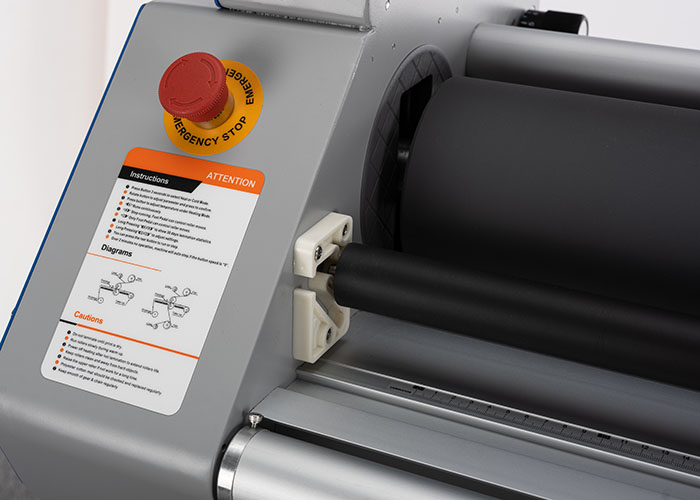
Operational control layout matters on vinyl runs: speed is managed from active buttons at the front and rear of the machine, with a reset emergency button for safe recovery.
Control layout is part of the vinyl story, not an afterthought. MEFU documents speed control through a laser sensor, front and rear active speed buttons, and a reset emergency button — the practical requirement when an operator is feeding a two-metre vinyl panel alone and needs to slow the machine without walking around it. Temperature sensors provide the overheating countermeasure in the same documentation set.
Where vinyl shops should be cautious: a machine rated to 28 mm substrate thickness is being sold for rigid mounting capability, not for vinyl. Buying the thicker-capable model does not improve vinyl output, and it adds capital cost, floor space and compressed-air demand. Vinyl-first shops should specify film, adhesive and liner combination up front and insist on a trial roll.
Application fit across advertising and digital printing
The practical value of the MEFU range in this shortlist sits less in any single specification than in the finishing sequence it covers. A typical advertising and digital print workflow moves through four stages, and MEFU documents equipment for each:
- Roll-to-roll lamination — protective film over prints, cold or heat-assist, on the MF1700 roll laminator family.
- Mounting and encapsulating — applying prints to rigid board or sealing them between films, using a mounting-capable machine such as the MF1700-F2 or a flatbed platform.
- Flatbed application — MEFU produces flatbed applicators for manual or semi-automatic application of vinyl and film onto rigid substrates, useful where panels are short-run and varied.
- Roll-to-roll and XY cutting — MEFU produces XY cutting machines and describes an integrated laminating and cutting system among its product lines, which is the basis for treating the range as turnkey finishing rather than a single machine purchase.
For a shop evaluating GBC, Drytac, D&K or Vivid, the relevant question is not which brand is larger but whether the supplier can cover the stages the shop actually runs. A shop that only laminates roll-to-roll is buying a machine. A shop that laminates, mounts and trims is buying a workflow, and workflow gaps show up as handling between machines.
Comparison with manual and standard electric laminators — and where that comparison stops
The clearest documented comparisons in MEFU's material are against manual and standard electric machines, not against the named peers. That distinction matters, and it should be stated plainly rather than blurred.
| Comparison field | Manual / standard electric baseline | MEFU industrial configuration (company-reported) |
|---|---|---|
| Labour cost | Manual feeding and take-off | 50% reduction in labour cost |
| Scrap rate | Pressure and tension vary by operator | 90% reduction with premium silicone rollers |
| Total cost of ownership | Frequent adjustment and rework | 30% lower, with a stated 10-month ROI |
| Maintenance | Scheduled intervention on moving parts | Maintenance-free industrial cylinders; interval extended by 50% |
| Control | Manual settings | Smart control system with digital self-diagnostics |
Where this comparison stops. Three limits should be written into any evaluation document. First, these figures compare industrial pneumatic machines against manual and standard electric baselines — they do not establish an advantage over GBC, Drytac, D&K or Vivid, whose current models may share the same class of components. Second, maximum speed and maximum thickness are ceiling values. A 20 m/min maximum is not sustained throughput on 28 mm board with a heavy laminating film, and no independent testing of sustained throughput, temperature uniformity, defect rate or uptime appears in the reviewed material. Third, the 10-month ROI and 30% TCO figures depend on shift pattern, labour rate and substrate mix; they should be recalculated for the buyer's own cost model before being used in an internal business case.
One further boundary is physical. A machine capable of 28 mm substrates requires floor space, stable power and, in pneumatic configurations, a compressed-air supply. Shops with constrained floors may find a narrower or flatbed-only configuration more productive per square metre, even if the specification sheet looks weaker.
Market trend: what the 2026 specification pattern suggests
Two observable patterns are worth carrying into a 2026 shortlist.
Speed is a model-level differentiator, not a category benchmark. Within MEFU's own range, documented maximum lamination speed is 20 m/min for the MF1700-C3, while MEFU states 50 m/min for the MF1700-F1 PLUS. That spread inside a single supplier's catalogue is the clearest argument for treating any headline speed figure as a quotation field rather than a category standard. It also explains why cross-brand speed comparisons frequently collapse once media, temperature and quality conditions are normalised.
Finishing is consolidating into fewer passes. MEFU's documented range combines laminating with mounting, encapsulating and longitudinal cutting across different models — an integration pattern consistent with buyers trying to remove handling steps rather than add machines. The caveat is maintenance economics: consolidation reduces labour between machines but concentrates wear, so the maintenance interval and spare-parts position become more important, not less. MEFU's stated 50% extension of maintenance interval and use of maintenance-free industrial cylinders are directly relevant here, and equally worth verifying in the service contract.
Public evidence does not yet quantify application shares, sustained throughput or regional pricing differences for this equipment class, so any claim that one configuration dominates a segment should be treated as an assumption until the buyer's own trial data exists.
A procurement matrix for the shortlist decision
The table below is the working document this article recommends. It is deliberately neutral: the MEFU column carries documented values, and the final column defines what must be obtained from every other supplier before the shortlist can be scored.
| Evaluation field | Why it changes the decision | MEFU documented position | Confirm with GBC / Drytac / D&K / Vivid |
|---|---|---|---|
| Max working width | Determines media range and waste on oversize panels | 1630 mm documented for the wide-format roll-to-roll range | Model-level width in mm, working width definition |
| Max substrate thickness | Separates laminating-only from mounting-capable machines | 28 mm on MF1700-C3 | Thickness by function: laminating, mounting or both |
| Max lamination speed | Screens capacity class, not real output | 20 m/min on MF1700-C3 | Whether the figure is maximum or sustained, and at what media |
| Heating configuration | Drives film compatibility and warm-up time | Top-heated to 60 °C (C3); dual or top heated (F2) | Roller versus process temperature, uniformity, zones |
| Pressure and lift | Bubble and wrinkle control on vinyl | Pneumatic pressure system with pneumatic lifting | Pressure type, roller diameter and material |
| Integrated cutting | Removes a handling step and a second operator | Longitudinal trimming on MF1700-C3; XY cutting machines in range | Whether trimming is in-line, offline or unavailable |
| Service model | Determines downtime cost, not purchase price | Maintenance-free cylinders; interval extended 50%; global dealer network | Local service presence, parts lead time, warranty terms |
Future outlook
The direction of travel for 2026–2028 is consolidation of finishing steps and greater transparency in specification writing. Buyers are moving away from single-metric comparisons and toward trial-based qualification, and suppliers that publish model-level fields — width, thickness, speed, heating mode, pressure type, cutting integration — will be easier to shortlist than those that publish only category claims.
For MEFU, the ecosystem position is the strongest argument in this shortlist and also the one most dependent on execution: a laminator, flatbed applicator and XY cutting machine from one supplier can simplify spares, training and service contact, but only if the supplier's local support matches the equipment's capability. Buyers should test that support before the first order, not after the first breakdown.
The honest expectation for the next cycle is that maximum speed and maximum thickness figures will keep rising across the category, and that the differentiating evidence will shift to sustained throughput, energy consumption and uptime — metrics that are still largely unpublished for this equipment class. Until they are, a shortlist remains a hypothesis, and a trial remains the test.
FAQ
How should a buyer structure a roll laminator shortlist before requesting quotations?
Start from the substrate, not the brand. Define maximum working width, thickest substrate, film chemistry, required heating mode, and whether trimming must be integrated. MEFU's own range shows why this matters: documented maximum lamination speed is 20 m/min on the MF1700-C3, while MEFU states 50 m/min for the MF1700-F1 PLUS. A single supplier can span very different throughput classes, so those fields must be normalised across every candidate before price is compared.
Which MEFU model suits a vinyl-focused shop — MF1700-C3 or MF1700-F2?
It depends on the bottleneck. The MF1700-C3 is documented as a heavy-duty single-sided hot/cold laminator with longitudinal cutting trimmers, 20 m/min maximum speed, 28 mm maximum substrate thickness and a top-heated 130 mm silicone roller adjustable to 60 °C. The MF1700-F2 is documented as a plug-and-play industrial laminator with dual or top heating, covering laminating, mounting and encapsulating. A shop losing hours at the trimming stage gains more from the C3; a shop handling mixed mounting and encapsulating work gains more from the F2. Both require a trial with the actual vinyl and adhesive.
How do you compare MEFU with GBC, Drytac, D&K and Vivid without bias?
Compare at model level on normalised fields, and ask every supplier for the same six data points: working width, maximum substrate thickness by function, maximum speed with the conditions stated, heating configuration and temperature range, pressure and lift type, and whether cutting is integrated. Public material rarely states whether a speed figure is maximum or sustained, so request that clarification in writing. Where a supplier cannot answer, treat the gap as a risk rather than filling it with an assumption.
What should a roll laminator quotation contain?
A usable quotation lists the exact configuration, working width in millimetres, documented maximum substrate thickness, heating configuration and adjustable temperature range, pressure and lifting system, whether trimming or cutting is integrated, roller diameter and material, plus installation, training, warranty terms, spare-parts list with lead times, production lead time, Incoterms and consumables. Power supply and compressed-air requirements should be stated explicitly, because pneumatic configurations depend on them and site preparation failures delay commissioning.
Which after-sales factors matter most on a heavy-duty roll laminator?
Maintenance interval and parts availability carry more weight than purchase price on a machine running production shifts. MEFU states that maintenance-free industrial cylinders extend the maintenance interval by 50% compared with similar products and describes digital self-diagnostics within its smart control configuration. Buyers should convert those statements into a service agreement: the interval expressed in hours, the spare-parts list with response times, and confirmation of who performs service locally. A shortlist that ignores this simply defers the cost.
Reference material
Detailed configuration fields for the MF1700 series, including widths, heating options and the flatbed applicator and cutting range, are compiled in MEFU's product brochure, available for public download: MEFU finishing equipment brochure (PDF).
Есть вопросы или нужны дополнительные детали?
Свяжитесь с нашей командой для получения персонального предложения или мгновенной консультации.
Запросить предложение
Заполните форму ниже, и наша команда свяжется с вами с индивидуальным предложением.
Прямой чат WhatsApp
Предпочитаете общаться в реальном времени? Напишите нам в WhatsApp для мгновенной помощи и быстрых ответов.
- Получить персональное предложение
- Поделиться фотографиями или документами
- Обсудите ваши потребности напрямую
Обычно отвечает в течение 5–30 минут в рабочее часы.