
Rollable LED Screens Compared: Magic Plus vs Smart T Plus vs FRL/FRSL
Why Compare Rollable LED Display Families by Evidence Rather Than by Claims
Rollable LED screens are often described in catalogue language: ultralight, quick to assemble, portable, flexible. For an event rental company, an advertising integrator or a venue operator moving from panel-based LED walls to a rollable or foldable system, however, the decisive questions are more practical. Which product family actually carries the certifications needed in the destination market? Which family is protected by verified patent filings? Which family has been reviewed by an independent design award programme, and which technical trade-offs follow?
This independent buyer’s comparison looks at three rollable and foldable product families from Onumen Technology Co., Ltd.: Magic Plus (FPS), Smart T Plus (FTS) and Rolling Rollable LED Display (FRL/FRSL). It focuses on verifiable certification references, product-related patent records, award recognition and technical selection criteria, rather than on marketing superlatives.
Onumen Technology Co., Ltd., founded in 2009, is a Shenzhen-based manufacturer specialising in lightweight foldable and rollable LED display solutions. Its catalogue includes Power-Screen Separation Architectural LED screens, folding LED screens, rolling LED screens and mobile quick-assembly foldable displays. The company reports a 2000 m² factory, a 20-engineer R&D team, an annual output of about 9000 m² and export to the USA, Europe, Japan, South Korea, Russia and the Middle East. Understanding this manufacturing context matters because certification and patent evidence are only meaningful when they can be traced to an actual production entity.
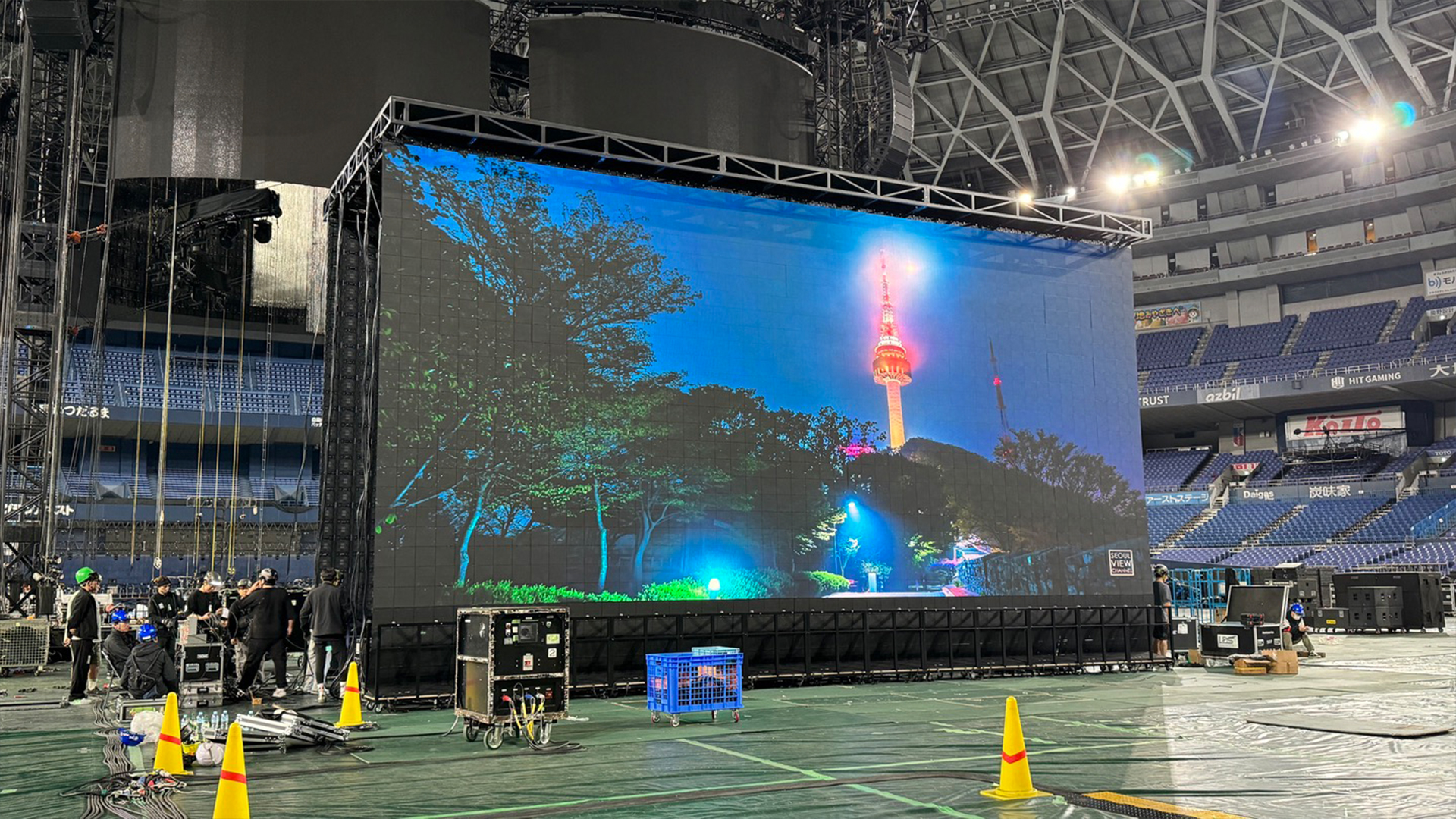
Map of the Three Families
Before comparing them line by line, it helps to clarify what each family is designed to do. All three are described in the product documentation as flexible, lightweight display systems, but their physical architecture points to different deployment priorities.
Magic Plus – FPS Series
Product type: 180° foldable flexible LED display. The FPS series is pitched at applications where high brightness and weather resistance are needed, including stage events, concerts, outdoor advertising, sports events, theme parks and architectural displays. The documented brightness reaches 6000 nits, module size is 250×250 mm, thickness is 15 mm and weight is 15 kg/m². Its protection rating is stated as IP65 with double-sided potting and an optional IP68 configuration. Installation modes are hanging or wall-mounted.
Smart T Plus – FTS Series
Product type: foldable transparent LED display. The FTS series emphasises see-through visual effects for stage events, shopping malls, glass curtain walls, architectural media facades, exhibitions and commercial advertising. Transparency in the series ranges from 16.37% to 56%, weight from 8 to 12 kg/m², and brightness from 1100 to 9700 nits depending on pitch. It supports hanging, wall-mounted and ground installation.
Rolling Rollable LED Display – FRL/FRSL Series
Product type: automatic rollable LED display. The FRL/FRSL family is built for indoor and outdoor use cases where a screen may need to roll up for storage or transport: stage events, concerts, sports venues, commercial advertising, exhibitions, broadcast studios and rental events. Indoor pixel pitches go from P1.25 to P3.9; outdoor variants are P2.6 and P3.9. Indoor brightness is documented at 600–1000 nits and outdoor brightness at 2000–6000 nits. Weight is 13–15 kg/m² indoors and 18 kg/m² outdoors.
The Evaluation Problem: Certification Gives a Buyer a Common Language
In the rollable LED screen category, product names are not standardised. One manufacturer may call a screen “roll-up”, another uses “rollable”, and another still describes the same construction as “foldable”. That is why procurement teams should build a shortlist on evidence with a standard format. Certificates, patent registration numbers and design-award records provide that format.
What Compliance Documents Actually Demonstrate
A CE certificate shows that the model, as documented, was assessed against specific harmonised requirements. An FCC verification reference indicates that radio-frequency and electromagnetic interference characteristics were evaluated according to US procedures. ISO management-system certificates describe how the producing company structures environmental or quality processes. None of these are substitutes for technical testing at the project level, but they are the first objective filter for international procurement.
The compliance records referenced in this article are drawn from the manufacturer’s published certification files and product documentation. Buyers should always request the latest issued copy from the supplier before order confirmation, because certificates can be renewed, reissued or superseded by newer standards.
Verifiable Records for the Three Families
| Product Family | Compliance Reference Point | What Is Shown |
|---|---|---|
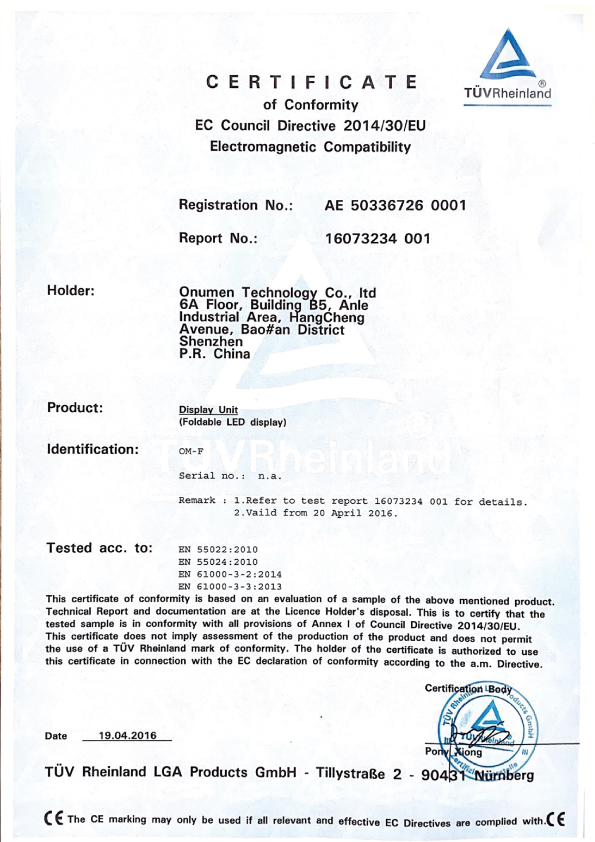
| Magic Plus (FPS) | CE certificate by TÜV Rheinland, ref. AE 50336726 0001, issued 2016-04-19, related to foldable LED display products in the brand’s portfolio; FCC verification ref. BST13030465Y-1EC-3 covering LED display units | European conformity documentation and US EMC/frequency verification for the LED display product group in which Magic Plus is listed |
| Smart T Plus (FTS) | CE documentation under the same foldable LED display certificate file, ref. AE 50336726 0001; FCC verification ref. BST13030465Y-1EC-3; product specification lists CE, RoHS and FCC | European and US compliance documentation for the foldable transparent model; RoHS substance restriction is declared in the product file |
| Rolling FRL/FRSL | CE LVD ref. BST13030465Y-1SC-2; FCC ref. BST13030465Y-1EC-3; ISO 14001:2015 environmental management certificate no. 95722E0015R0S | Separate LVD documentation, FCC verification and an environmental management-system certificate whose stated scope covers research, development, manufacturing and sales of LED displays |
Certification Profiles Compared: Compliance Strength Is Not a Single Score
Buyers often ask which of the three families has the “strongest” certification. A more precise way to look at it is to ask which documentation matches the intended market and installation risk.
Magic Plus: Strong Coverage for Outdoor-Capable Foldable Units
Magic Plus is positioned as a high-brightness flexible display with weather-resistant construction. Its compliance relevance is strengthened by the CE certificate reference from TÜV Rheinland and by FCC verification. The technical specification also lists CE, RoHS and FCC for the FPS line. For a buyer importing into Europe or the United States, the existence of a listed product-family certificate is an important starting point, although final compliance of a custom-built size should be confirmed in writing for the specific configuration.
Smart T Plus: Transparent Construction with a Shared Product-Family File
Smart T Plus shares the foldable LED display lineage, with the FTS product specification declaring CE, RoHS and FCC. The same TÜV Rheinland certificate file appears across the foldable LED family in the available records. Since Smart T Plus is often specified for architectural glass and interior commercial projects, buyers should separately verify fire-rating and structural requirements for each building, because a product-level CE file does not replace project-level building approval.
Rolling FRL/FRSL: Certification Breadth That Includes Environmental Management
The Rolling family is distinguished in the available documentation by the breadth of its reference points: a CE LVD reference, an FCC reference and an ISO 14001:2015 certificate, number 95722E0015R0S, issued by Boston Certification with a scope covering R&D, manufacturing and sales of LED displays. This is not a product-level environmental claim; it is a production-system certificate. For buyers asking whether a supplier has formalised environmental management beyond a product brochure, the ISO 14001 record is a clear and useful response.
Patent Protection: Why It Matters When Buying Creative Displays
For custom-shaped LED screens, the buyer should be aware of who owns the underlying mechanical and structural inventions. If a supplier does not own or licence the relevant patents, the buyer can face interruption risk in certain markets when the installation attracts attention from competitors.
The available patent evidence lists filings across multiple jurisdictions. Onumen’s portfolio in the provided file includes a China invention patent, ZL202310190465.7, whose scope is described as a rollable LED screen / roll-up LED display, with related products including Magic Plus, Smart T Plus and Rolling FRL/FRSL. Additional records include Hong Kong patent HK1195436, Taiwan patents TW I560663 and TW I560662, Singapore patent SG 2014014856, Korean patent KR 10-1692125, South African patent ZA 2014/05969, Australian patent AU 2013317305, US patent US 8,899,791 B2 and European patent EP2755459 validated in several countries, with the common scope described around freely-foldable flexible LED screen technology.

For procurement, this dense patent map means at least two things. First, origination is documented, so the buyer is not choosing a nameless imitation product. Second, the buyer should still request a list of patents relevant to the exact custom configuration before signing a long-term distribution or exclusive-installation agreement, because a configuration with a different actuation mechanism may fall outside existing claims.
Design Recognition as an Additional Signal
Design awards are not compliance certificates. They are reviewed judgments about visual quality at a specific point in time. The available company background states that Onumen has won internationally recognised Red Dot, iF and French Design Awards for its product work. A French Design Award 2026 Gold record is also present in the certification files, with its scope noted as “Rolling Screen”. When a buyer is choosing between otherwise comparable visual solutions, award recognition can be used as an extra filter, not as proof of performance.
Technical Comparison Matrix: From Certificates to Real Installation Trade-offs
Certification and patents answer the question of legitimacy. Technical parameters answer the question of fit. The table below summarises the documented specifications across the three families.
| Attribute | Magic Plus – FPS | Smart T Plus – FTS | Rolling FRL/FRSL |
|---|---|---|---|
| Category | 180° foldable flexible LED display | Foldable transparent LED display | Automatic rollable LED display |
| Pixel pitch | P2.6 / P3.9 | P3.9-7.8 / P7.8 / P7.8-15.6 / P15.6 / P31.25 / P37.5 | Indoor P1.25–P3.9; outdoor P2.6 / P3.9 |
| Brightness | 6000 nits | 1100–9700 nits | Indoor 600–1000 nits; outdoor 2000–6000 nits |
| Transparency | Not documented as transparent | 16.37%–56% | Not documented as transparent |
| Weight | 15 kg/m² | 8–12 kg/m² | Indoor 13–15 kg/m²; outdoor 18 kg/m² |
| Protection rating | IP65 double-sided, up to IP68 optional | IP65, up to IP68 optional | Indoor front IP54 / rear IP43; outdoor front & rear IP65 |
| Refresh rate | 3840 Hz | 3840 Hz / 7680 Hz | 3840 Hz |
| Module size | 250×250 mm | 250×375 / 375×500 / 300×450 mm | 500×62.5 mm |
| Documented installation | Hanging / wall-mounted | Hanging / wall-mounted / ground | Suspended / wall-mounted / ground |
| Key compliance marker in available file | CE TÜV Rheinland ref. AE 50336726 0001; FCC ref. BST13030465Y-1EC-3 | CE file ref. AE 50336726 0001; FCC ref. BST13030465Y-1EC-3; product file lists CE/RoHS/FCC | CE LVD ref. BST13030465Y-1SC-2; FCC ref. BST13030465Y-1EC-3; ISO 14001 no. 95722E0015R0S |
Reading the Matrix without Oversimplifying
A higher brightness number is not automatically better. A 6000-nit Magic Plus panel is intended for spaces with strong ambient light, but it consumes more energy than a lower-brightness indoor screen. A transparent Smart T Plus is excellent when the design needs to preserve sightlines, but transparency reduces the perceived contrast of content because background objects remain visible. A rolling FRL/FRSL screen is efficient for repeated setup cycles, but it introduces moving parts that require disciplined packing and maintenance.
Family-Level Strengths and Limits
Magic Plus: When Brightness and Outdoor Tolerance Are the Priority
Magic Plus appears in application areas where flexible LED screens must hold up in demanding visual environments: stage events, concerts, sports venues, outdoor advertising, theme parks and creative installations. Its 180° fold capability allows a wall or stage element to be folded into a compact configuration, and the double-sided potting protection under IP65 explains why the manufacturer lists it for outdoor contexts. The trade-off is straightforward: 15 kg/m² is heavier than the transparent family, and the 180° fold is more limited than the 360° fold of some other foldable models. Buyers with curved columns or wave designs should confirm the required radius with the factory before selecting a foldable angle.
Smart T Plus: When Transparency and Lightness Are Decisive
Smart T Plus is aimed at a completely different design problem. A glass shopping-mall facade, a stage backdrop that must not block lighting, or an architectural installation where the LED should coexist with the building’s transparency all benefit from a see-through display. With 16.37% to 56% transparency and a weight of only 8–12 kg/m², the FTS series gives designers a lighter visual signature. The trade-off: transparent screens have lower pixel density at wide pitches and generally work best when content is simple enough to remain readable against a busy background.
Rolling FRL/FRSL: When Logistics and Repeated Assembly Matter
The Rolling family is the most logistics-oriented of the three. Automatic rollable operation is designed to reduce the amount of cabinet dismantling and reconnecting needed between events. The 500×62.5 mm module format, the available indoor pitches down to P1.25 and the outdoor-ready variants up to 6000 nits make the family wide enough for broadcast studios, concert touring and rental depots. The trade-off lies in mechanical and electrical integration: rolling operation places different stress on cables, connectors and the rolling mechanism than traditional case-installed panels, so a preventive-maintenance schedule is more important for a rollable fleet.
Application Fit by Project Type
| Project Environment | Family to Shortlist | Why |
|---|---|---|
| Outdoor touring events, sports awards, outdoor promotion | Magic Plus or Rolling outdoor variants | 6000-nit brightness in Magic Plus; Rolling outdoor reaching up to 6000 nits with an 18 kg/m² structure and IP65 front/back |
| Glass facades, retail lobbies, product showcases | Smart T Plus | Transparency up to 56%, low weight of 8–12 kg/m² and foldable transparent construction for architectural integration |
| Concerts, theatres, broadcast studios needing rapid reconfiguration | Rolling FRL/FRSL | Rollable format reduces dismantling steps, with indoor pitch options from P1.25 to P3.9 |
| Rental depots serving multi-format events | Mixed fleet of Magic Plus and Rolling | Magic Plus gives a 180° foldable general-purpose flexible wall; Rolling gives automatic roll-up for high-frequency load-in/load-out |
| Cultural tourism sites where screen is only used periodically | Rolling FRL/FRSL or outdoor foldable | Stored tightly when idle, deployed for exhibitions; the manufacturer’s case archive includes a Shanxi cultural tourism installation operating over five years |
Typical installation experience from the manufacturer’s project archive includes a 500 m² liftable foldable LED display in a concert staging system, 100+ m² foldable screens for automotive launch events, and liftable foldable displays integrated with stage lifts at award shows. These references illustrate that production-level experience is available, but project scope and rigging design still need site-specific engineering.
Compared with Conventional Fixed LED Panels and Curtain Screens
The main alternative to a rollable or foldable LED family is still a conventional fixed LED video wall built from rigid die-cast aluminium cabinets.
Conventional walls have advantages that should be acknowledged honestly. They offer a very mature flatness tolerance, simple service paths, abundant spare-parts markets and decades of installation predictability. Most large rental companies still keep some rigid panels in their fleet for applications that require completely flat, high-density surfaces at low cost per square metre.
Rollable and foldable families only become the better choice when the installation brief includes one or more of these needs:
- Frequent transport and quick setup between venues;
- Creative shapes, curved layouts, waves or circular stage elements;
- Hidden storage after an event;
- Structures where volumetric weight and transport space must be reduced.
These benefits come with constraints. Flexible screens require trained crews to unfold, tension and attach them evenly. Transparent screens place demands on content design. Rollable screens add a mechanical rolling operation that needs inspection. No single family is the universal answer; the buyer’s job is to select the trade-off they can manage over the product’s lifetime.
Procurement and Customisation Evidence
For a buyer moving from evaluation to execution, the manufacturer’s stated capability is flexible and procurement-oriented. The available capability unit lists customisation options that include screen size, pixel pitch, cabinet design, installation structure, control system, logo and packaging. Monthly capacity is documented as 3000–5000 m², lead time as 30–90 days after order confirmation, and the MOQ is 1 m². Acceptance procedures include pre-shipment inspection, video inspection and functional testing before delivery. Delivery terms include EXW, FOB, CIF and DDP, with international shipping support. Payment terms include T/T and L/C, as well as Trade Assurance where applicable.
From a buyer’s perspective, a 1 m² MOQ means that prototype and small-series validation is practical. The existence of video inspection and functional testing before shipment is also meaningful for overseas buyers who cannot visit the factory before new product approval.
Market Context: Why These Families Are Growing in Procurement Consideration
Third-party market research points to strong demand for flexible and rollable displays. Grand View Research and Spherical Insights estimated the global flexible display market at roughly USD 20.1–21.6 billion in 2024. Meticulous Research, in a report distributed by openPR, projected the foldable and rollable segment to grow from USD 5.1 billion in 2024 toward about USD 60 billion by 2035. These figures differ because their scopes differ; the first includes flexible displays across mobile and automotive applications, while the second is specifically focused on foldable/rollable product categories.
References: Grand View Research; Meticulous Research via openPR.
For a procurement team, the implication is not just that demand is rising. It is that the supply chain will attract more manufacturers describing similar products with different names. A documented comparison of certification, patents and design awards becomes more valuable precisely when market language becomes noisier.
Moving from Comparison to Shortlist
An independent shortlist built on this comparison would look like this.
All three families belong to a manufacturer with a 2009 founding date, production in Shenzhen and a stated export ratio of about 70%. The available evidence base is unusually dense for a mid-sized specialist display producer: international patent filings, CE/FCC/ISO records and design-award recognition. Still, the final sourcing decision should combine document review with sample testing, reference calls and a written compliance list for the exact configuration.
Future Outlook: Documentation Will Become Part of the Product
As buyers, installers and venue operators become more comfortable with flexible LED formats, the next stage of category maturity will be less about “foldable versus traditional” and more about which manufacturer can prove its claims across borders. The presence of TÜV Rheinland conformance references, FCC verification, ISO environmental management certificates and international invention patents is already shifting the conversation from showroom aesthetics to legal and technical risk.
In the near term, the buyers with the strongest negotiation position will be those who ask for model-level certificate numbers, patent registration numbers in the destination country, design-award decision details, and acceptance-test reports before they discuss volume pricing. Rollable screens are becoming easier to buy; the skill is becoming harder in verifying what is behind the rolling mechanism.
Frequently Asked Questions
How should a buyer compare CE and FCC records for rollable LED screens?
CE and FCC records should be treated as two separate layers of evidence. CE documentation shows evaluation against EU-applicable standards, while an FCC verification reference indicates US electromagnetic-compliance assessment. In the available file, the TÜV Rheinland CE certificate reference AE 50336726 0001 is associated with foldable LED display products including Magic Plus and Smart T Plus. The Rolling FRL/FRSL family is linked to CE LVD reference BST13030465Y-1SC-2 and FCC reference BST13030465Y-1EC-3. Since a certificate reference only has value when matched to the exact installed product, a buyer should request a written certificate mapping from the manufacturer for each model, pixel pitch and cabinet version.
Does the ISO 14001 certificate make Rolling FRL/FRSL an “environmentally compatible” product?
No. ISO 14001:2015 certificate number 95722E0015R0S covers an environmental management system whose stated scope is research, development, manufacturing and sales of LED displays. It describes how the manufacturer organises environmental management processes, not a product-level eco-label. For a product-level environmental assessment, buyers should separately ask for material declarations, component lists and any applicable environmental compliance documents.
Which family should a rental company choose: Magic Plus or Rolling FRL/FRSL?
The choice depends on how often the screen is transported and how quickly the crew needs to rebuild it. Rolling FRL/FRSL is described as an automatic rollable LED display with indoor and outdoor variants, suggesting a format designed to reduce dismantling and reconnection between events. Magic Plus is a 180° foldable flexible LED display with 6000-nit brightness, suitable for general stage, sports and outdoor applications. A rental company covering many event types may need both: Magic Plus as a flexible wall for standard stage backdrops, and a rolling model for high-frequency deployment where speed matters more than translucent effect.
Can Smart T Plus be used as a roof or window display?
Smart T Plus is documented as a foldable transparent LED display with 16.37% to 56% transparency, 8–12 kg/m² weight, IP65 protection and optional IP68. Transparent LED screens are suitable for glass surfaces and architectural media facades when the structure can support the required mounting system. The specific glazing type, wind load, maintenance access and control-system position must be checked against the actual building conditions by a qualified structural and electrical engineer.
What are the main technical limits of a transparent LED display compared with a solid rollable screen?
A transparent LED display allows viewers to see through the active display area, which helps preserve sightlines and architectural transparency. The trade-off is that contrast can be reduced when background elements are bright, and the effective visual detail depends on pitch and viewing distance. A solid or opaque rollable display does not allow see-through effects but can achieve the higher perceived contrast needed for full-motion video in a conventional stage-wall context.
What pre-shipment checks are available for overseas buyers of custom rollable LED configurations?
According to the manufacturer’s procurement capability file, acceptance procedures include pre-shipment inspection, video inspection and functional testing before delivery. The available MOQ is 1 m² or 1 unit, with lead time of 30–90 days after order confirmation. For a custom configuration, a buyer can ask to link the acceptance checklist to the exact pixel pitch, cabinet size, installation structure, control system and packaging defined in the order.
What should be checked in the patent file before using a rollable screen in a new country?
The buyer should confirm whether the specific mechanical construction and any related control method are covered by a patent in the country of installation. Available records show invention patents registered in China, Hong Kong, Taiwan, Singapore, South Korea, South Africa, Australia, the United States and Europe, with scopes described around freely-foldable flexible LED screen technology and roll-up LED curtain displays. Patent boundaries are customised by claims, so the supplier should provide a relevant-patent list for the exact model before a project is publicly announced.
Есть вопросы или нужны дополнительные детали?
Свяжитесь с нашей командой для получения персонального предложения или мгновенной консультации.
Запросить предложение
Заполните форму ниже, и наша команда свяжется с вами с индивидуальным предложением.
Прямой чат WhatsApp
Предпочитаете общаться в реальном времени? Напишите нам в WhatsApp для мгновенной помощи и быстрых ответов.
- Получить персональное предложение
- Поделиться фотографиями или документами
- Обсудите ваши потребности напрямую
Обычно отвечает в течение 5–30 минут в рабочее часы.