
Roller vs Disc and Cup Brushes: Buyer Comparison
Roller vs Disc and Cup Brushes: Buyer Comparison
In scrubbers, sweeper heads, car-wash frames, solar cleaning robots and metal finishing cells, the component that actually determines the result is the surface in contact with the floor or workpiece. Choosing between the two dominant rotary formats, the cylindrical roller brush and the disc or cup brush, is a geometry, mounting and specification decision. Both formats are built from largely the same filament families and both are custom-made to equipment drawings, so the difference does not come from material quality alone. It comes from how each shape touches the surface, how load is distributed and what the machine imposes as a constraint.
Why Shape Decides the Outcome Before Filament Does
A roller brush presents a continuous line of contact along its full working length. A disc or cup brush presents a circular patch that travels across the surface. That single difference reshapes almost every downstream decision: where uniform pressure has to be guaranteed, what the mounting must control, which parameter sets the ceiling on speed, and how the brush wears.
The roller format is specified by outer diameter, working length and end fitting, because the brush has to sit on the machine shaft and run parallel to the surface. The disc format is specified by outer diameter and centre hole or threaded arbor, because the brush has to bolt onto a spindle or a scrubber head. Filament choice affects both, but it cannot correct a geometry that does not match the machine.
A practical consequence follows. Two brushes made from identical PA6 filament can behave completely differently in the same scrubber if one is a long roller running along the deck and the other is a large disc running on a rotating head. Buyers who compare only filament material are comparing the smaller half of the specification.
Roller Brush: Contact Geometry, Parameters and Boundaries
A roller brush is a cylindrical brush wound on a rigid core in spiral, straight or tufted construction. The parameters listed in the AOQUN BRUSH product specification are outer diameter 20-300 mm, roller length 100-2000 mm and filament length 10-80 mm, on a core of galvanized steel, stainless steel, aluminium or engineering plastic. Shaft diameter and end fitting are confirmed per machine rather than taken from a standard.
Filament options include PA6/PA66, PP, PET, PBT, abrasive nylon with silicon carbide or aluminium oxide, PVA sponge, natural bristle and stainless steel wire. The core is dynamically balanced for high-speed rotation, which is what allows the brush to run true at speed without vibration or bristle chatter.
In real equipment the roller format sits on the brush deck of floor scrubbers and sweepers, in car-wash rollover frames, in vacuum cleaner agitation heads and on photovoltaic panel cleaning robots. The shared condition is a continuous flat surface and a machine already designed around a rotating cylindrical shaft.
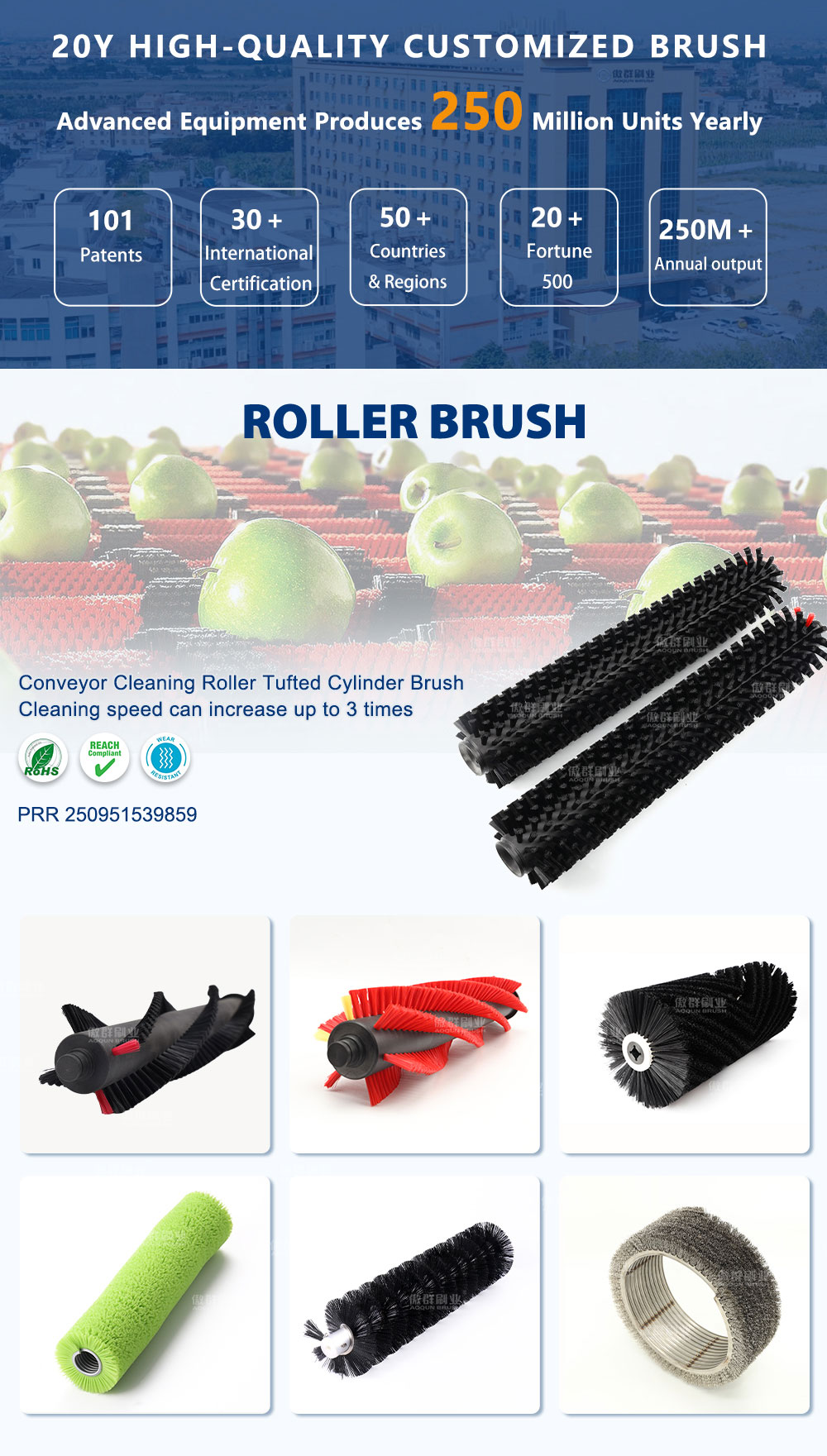
Roller brush: line contact along the working length, on a core built to the machine shaft.
The boundaries are just as concrete. A roller presents a line, not a patch, so if the shaft does not run parallel to the floor or workpiece, pressure travels unevenly along its length and one band is over-brushed while another is under-brushed. Filament length of 10-80 mm provides a finite compliance stroke, which means the brush cannot absorb local step changes larger than that range, such as drainage recesses, standing water or a distorted panel. Dynamic balancing also means that as roller length increases, verifying true running becomes a more important part of the specification. And a roller must be reproduced to the machine; it cannot be adapted on site with a generic threaded arbor the way a disc can.
Disc and Cup Brush: Contact Geometry, Parameters and Boundaries
A disc or cup brush is a circular brush on a plastic or metal backing plate, mounted to a spindle. The AOQUN BRUSH product specification lists outer diameter 50-500 mm, a centre hole or threaded arbor in M14, 5/8-11 or custom thread, bristle height 10-60 mm, and flat, cup and bevel shapes. Maximum rpm is marked on each brush.
Filament options for this format include abrasive nylon with silicon carbide or aluminium oxide, PA/PP/PBT, natural bristle and steel or stainless steel wire. Uniform bristle density across the disc face is what keeps cleaning pressure constant across the full disc face, so the floor or workpiece is cleaned evenly rather than in rings.
Mounting speed is the visible advantage of the format. A quick-change arbor fits common scrubber and drill spindles, which is why the same disc can be a daily floor-care consumable on a scrubber and a deburring or coating-removal tool on a drill.
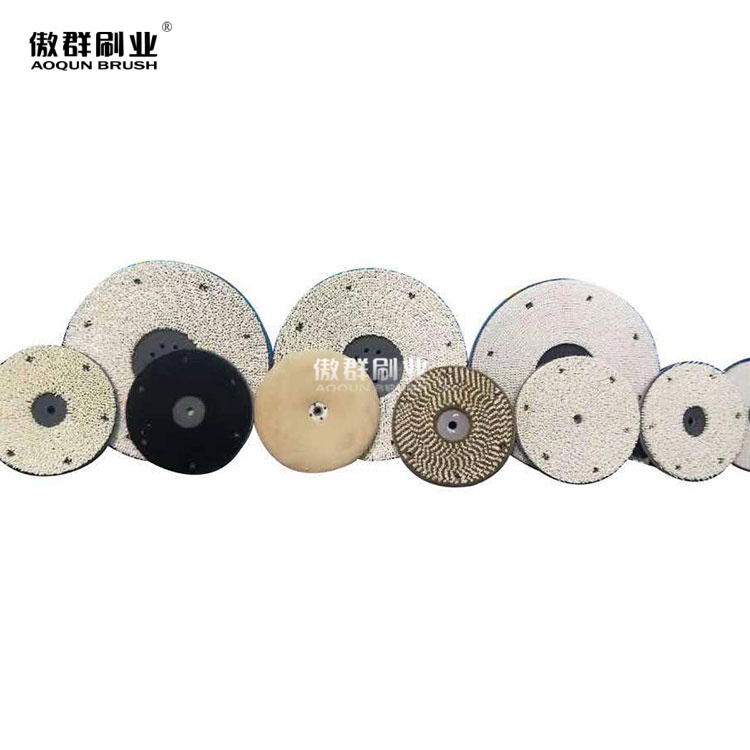
Disc brush: circular contact patch, mounted by centre hole or threaded arbor.
The geometry introduces a different set of constraints. Because the contact area is circular, surface speed varies with radius: the outer edge travels faster than the centre, and the larger the disc, the greater that difference and the faster the outer edge wears relative to the middle. A larger disc also demands more torque, so drive capability becomes a limiting factor rather than size alone. The maximum rpm marking is a hard limit, not a suggestion, since exceeding it loads the filaments beyond what the backing plate and bond are designed to hold. Finally, the narrow contact patch that makes a disc aggressive in corners will mark a floor if the machine dwells in one position, so travel speed and down-force remain process variables to control.
Side-by-Side Specification Comparison
| Specification | Roller brush (cylindrical) | Disc and cup brush |
|---|---|---|
| Contact form | Continuous line along the working length | Circular patch at the point of contact |
| Outer diameter | 20-300 mm | 50-500 mm |
| Working length | 100-2000 mm | Not applicable (circular face) |
| Filament length | 10-80 mm | Bristle height 10-60 mm |
| Filament family | PA6/PA66, PP, PET, PBT, abrasive nylon, PVA sponge, natural bristle, stainless steel wire | Abrasive nylon, PA/PP/PBT, natural bristle, steel and stainless steel wire |
| Core or backing | Galvanized steel, stainless steel, aluminium or engineering plastic core | Plastic or metal backing plate |
| Construction | Spiral, straight or tufted winding | Flat, cup or bevel shape |
| Mounting | Shaft diameter and end fitting per machine | Centre hole or threaded arbor (M14, 5/8-11, custom) |
| Speed constraint | Dynamically balanced core for true running at high rpm | Maximum rpm marked on each brush |
| Typical equipment | Scrubber decks, car-wash rollovers, vacuum agitation, solar panel cleaning robots | Floor scrubbers and sweepers, drills, deburring stations, concrete finishing |
Surface Preparation: Where Wire Brushes and Abrasive Nylon Fit
When the requirement shifts from cleaning to surface preparation, meaning rust removal, scale removal, weld cleaning, deburring or creating a profile for coating adhesion, the product family shifts from PA filament to wire and abrasive brushes. The AOQUN BRUSH wire brush and deburring brush specification lists wire diameter 0.05-1.2 mm, forms including strip, roller, disc, cup, end brush and twisted knot, crimped, straight and knotted wire, arbor or shaft mounting, and grit-impregnated nylon as an alternative.
The material choice at this step carries more consequence than any other part of the buying decision. Carbon steel, stainless steel in 304 or 316, brass and phosphor bronze differ in aggression and contamination risk. Uniform wire density produces a consistent surface profile for paint and coating adhesion. Knotted construction is used where weld and scale removal has to be aggressive. Stainless and brass options exist specifically to avoid ferrous contamination on aluminium and stainless parts, where an embedded iron particle becomes a corrosion site later.
Wire brushes carry their own boundary. They remove material rather than only cleaning it, and aggression scales with wire diameter and construction, so moving to a heavier knotted brush is not a free upgrade. Where the workpiece cannot accept metal embedment or stock removal, abrasive nylon is the correct alternative, and that judgement belongs at the specification stage rather than at the scrap report.
For surface preparation, the decision order is: choose the abrasive (wire or nylon) first, then the construction (crimped or knotted), then the mounting (arbor or shaft), then the diameter. Reversing that order, by picking a diameter first and then forcing an abrasive into it, is where the specification usually loses the property that mattered.
Mounting Interfaces and the Procurement Checklist
Rotary brush purchase orders fail on the details that were never written onto the drawing. The following items belong in the request for quotation, not in the sample feedback.
- For roller brushes: shaft diameter, end fitting and dynamic balance requirement, plus outer diameter and working length.
- For disc and cup brushes: centre hole or threaded arbor, outer diameter, bristle height and the flat, cup or bevel choice.
- Filament material, diameter, length and stiffness, matched to the surface rather than inherited from a previous supplier.
- Construction: spiral, straight or tufted winding; crimped or knotted wire.
- Maximum rpm of the machine, and whether the brush is rated for it.
- Environment: wet or dry, detergent or chemical exposure, temperature, UV, ESD or antistatic need, food-contact need.
- Replacement method: how the brush is removed and refitted, and whether the brush-head clip has to change.
- Acceptance criteria: who checks the first article against the drawing or the sample.
- MOQ, sampling time and volume lead time.
At AOQUN BRUSH, quotation is issued within 1 working day, prototyping and sampling take about 3 days, and delivery within 7 days is available on selected product lines. MOQ is flexible: sample and prototype quantities from 1 piece are accepted for fit-and-function validation, while volume MOQ depends on brush type and customization level and is confirmed together with the quotation.
Certification and Documentation: What a Buyer Can Actually Check
A brush is a wear part, and its paperwork is rarely read until something goes wrong. When it does, two things matter: whether the document covers the specific brush and filament material that was ordered, and whether the document is still in force.
AOQUN BRUSH holds 12 management system certifications, including IATF 16949, ISO 13485, ISO 9001, ISO 45001, ISO 14001, ISO 50001 and GJB 9001C. For a buyer, the useful fields are the certificate number, the standard version, the issuing body, the expiry date and the scope statement, because the scope line determines whether the certificate reaches your brush type or stops at an adjacent product line.
Published test reports relevant to this comparison include an SGS EU RoHS report (CANEC26028344401) covering brushes made from PA6, PA66, PA610, PA612, flame-retardant PA, PP, PET, electrolytic, galvanized and stainless steel plates with iron and stainless steel wires, with all ten restricted substances passing. An SGS REACH SVHC screening report (CANEC26017937101) covers 253 Candidate List substances and one potential SVHC, with results at or below 0.1 percent weight by weight. An SGS UL 94 vertical burning report (GZMR260100199701) records a V-0 result for the tested PA brush samples. Two SGS food-contact reports under US FDA 21 CFR 177.1500 cover black PA66 (CANEC26017116501) and blue PA66 (CANEC26013862601) filament. A rail material fire-safety report (YJ2024040005) records the gross heat of combustion test to ISO 1716 for strip, staple-set and twisted wire brushes, relevant where EN 45545-2 applies.
Scope matters as much as the result. These reports were issued against stated material sets and product forms, so a buyer should confirm that a given SKU falls inside that scope rather than assume it does. For scrubber brushes sold into the European Union, RoHS and REACH SVHC are the routine documentation. For brushes mounted near panels or electrical enclosures, flame-retardant evidence becomes relevant. For equipment used in food processing areas, food-contact documentation is the standard rather than an optional extra.
How AOQUN BRUSH Fits Into Custom Rotary Brush Supply
Guangzhou Aoqun New Material Co., Ltd., trading as AOQUN BRUSH, was founded in 2009 and operates a 120,000 m2 intelligent manufacturing headquarters in Guangzhou, China, with more than 100 employees, a 20-strong research and development team and annual output of 250 million units. The company runs material research and development, brush process preparation and proprietary manufacturing equipment as one integrated chain rather than as separate outsourced steps.
It holds 124 intellectual property rights, including 26 invention patents and 4 international patents, has participated in drafting 2 national standards and led the development of 8 industry and group standards. Production operates with a Class 100,000 cleanroom, and the customer base includes 20 Fortune Global 500 tier-1 suppliers, among them CRRC, BYD, Hitachi, Schindler, Volkswagen, Otis, Dyson and Karcher.
For rotary brushes the manufacturing model covers OEM private-label production, ODM co-development and custom manufacturing to customer drawing, sample or equipment fit. Available options include filament diameter from 0.05 to 2.0 mm, straight, flared, bent and cross-crimped filament, aluminium H, F, Y and T profiles, stainless steel channel, plastic bodies and custom extrusions, end fittings such as beaded ring, pull ring, plastic handle, metal joint, threaded arbor and quick-release coupling, and functional treatments covering antistatic or conductive, flame-retardant, antibacterial, food-contact and high-temperature resistance.
Quality control runs at incoming, in-process and final inspection with batch traceability: filament diameter, material grade and supplier certificate verification on the way in; tufting or strip density, trim length, profile and filament retention during production; key dimensions at the end. This is the part of the supply chain that matters in a roller versus disc comparison, because both formats come off the same capability and can therefore be assessed on the same terms.
Application Scenarios and Observed Customer Projects
The cleaning equipment and car-wash scenario shows how the format decision is actually made. The working condition is continuous daily duty with wet, foam and detergent exposure, hair, fibre and sand loading, and high rotational speed with vibration. Functions run from floor and carpet agitation to edge and corner cleaning, pet-hair pickup, vehicle body and wheel washing, and glass and screen cleaning. Matched equipment includes robotic vacuums, stick and canister vacuums, commercial floor scrubbers and sweepers, car-wash rollover and self-service systems, and carpet extractors. The requirements that decide the specification are filament stiffness balanced for pickup without surface damage, wear resistance for daily duty, low moisture absorption, hair and fibre release, dimensional fit to the brush-head clip and consistent colour for retail.
A commercial and household floor-care equipment brand project is a useful reference case for this format question. The programme supplies roller and disc brushes for floor scrubbers, sweepers, vacuum heads and carpet-cleaning units. Balanced cores eliminated vibration complaints on high-speed heads, matched filament stiffness improved pickup without marking the floor, and the brush was carried over to the next machine generation. Production is private label, with dimensional fit to the existing brush-head clip and no tooling change, and wear life verified on the customer test rig.
Other scenarios follow the same logic with different constraints. Photovoltaic cleaning robots work at low down-force and must not damage anti-reflective coating or glass, so the requirement set is non-scratching filament, UV and abrasion resistance for years outdoors, a balanced core to avoid robot vibration and low water retention for dry cleaning. Robotic and automated surface finishing cells require consistent surface finish and Ra control, filament retention under centrifugal load, wear life matched to takt time, dimensional repeatability batch to batch, and quality documentation consistent with IATF 16949 controlled production.
Market Signals and Outlook
The cleaning equipment and surface finishing sectors are moving in the same direction: the brush is shifting from a generic consumable into a specified, documented, drawing-level part. Evidence from scrubber, cleaning robot and automated finishing line applications points the same way. The more automated and continuous the equipment becomes, the more the repeatability of the brush matters, because a cleaning robot has to reproduce the same contact result across many cycles and many units.
Three signals are worth watching for buyers. The first is that robotic cleaning equipment turns the brush into a scheduled replacement item, which pushes traceability and batch consistency up the priority list in a way that manual operation never did. The second is that automated surface finishing lines demand a stable result, so the specification conversation is moving from filament material to diameter tolerance and dynamic balance, which is exactly where the roller versus disc comparison belongs. The third is that material compliance is arriving earlier in the procurement process and is increasingly asked for at SKU level rather than accepted as a general certificate.
The likely direction is that supplier change evaluation for rotary brushes becomes shorter rather than longer, provided the evaluation starts from a drawing and a sample instead of a catalogue. Where the drawing states shaft diameter, end fitting, diameter, length and filament specification, both formats can be quoted in parallel and the result can be verified on a test rig before it reaches a production line.
Trade-Offs Against Shelf-Standard Brushes
Buying a generic brush from a distributor catalogue is the fastest route to a brush in hand. The trade-off is specific: a standard brush fits only where diameter, length, arbor or shaft interface and filament stiffness all happen to match the equipment, and its material documentation covers the catalogue product rather than your SKU. A custom brush removes that uncertainty, but only where the drawing is correct and the sample has been validated. An incomplete drawing does not get fixed by the custom process; it simply relocates the problem from the purchase order to the sample verification stage, when downtime risk is already internal.
The practical reading: customization pays when the specification can be written as measurable items, namely diameter, length, mounting, filament, speed limit and documentation. Where any of those is still unconfirmed, confirming it is worth more than ordering against it.
Frequently Asked Questions
What are the specification differences between roller brushes and disc or cup brushes?
Roller brushes are specified by outer diameter 20-300 mm, working length 100-2000 mm and filament length 10-80 mm, mounted on a shaft and end fitting matched to the machine. Disc and cup brushes are specified by outer diameter 50-500 mm, bristle height 10-60 mm and a centre hole or threaded arbor such as M14, 5/8-11 or a custom thread. The filament families overlap, but the working length parameter applies only to the roller format.
How does the mounting interface decide which format to choose?
A roller brush requires a shaft and end fitting that match the machine axis, so it must be reproduced to the equipment. A disc or cup brush mounts through a centre hole or threaded arbor, including M14, 5/8-11 or custom thread, and fits common scrubber and drill spindles. If the machine is built around a cylindrical shaft, the roller format applies; if it is built around a rotating hub or spindle, the disc or cup format applies.
How is the maximum speed determined for disc and cup brushes?
Maximum rpm is marked on each disc or cup brush, and the machine must not be run faster than that marking. For roller brushes, speed capability is governed by the dynamic balance of the core, which is what allows the brush to run true at high rotational speed without vibration or bristle chatter.
Should surface preparation use a wire brush or abrasive nylon?
A wire brush removes material, and its aggression scales with wire diameter and construction within the 0.05-1.2 mm range, in crimped or knotted form. Stainless steel and brass options are used to avoid ferrous contamination on aluminium and stainless parts. Abrasive nylon with silicon carbide or aluminium oxide is the alternative where metal embedment or heavy stock removal is not acceptable.
Which test reports should be requested for scrubber brushes?
For European Union markets, the relevant documents include an EU RoHS report (CANEC26028344401) and a REACH SVHC screening report (CANEC26017937101). Brushes mounted near panels or electrical enclosures may require flame-retardant evidence such as a UL 94 report (GZMR260100199701). For equipment used in food processing areas, the applicable document is a US FDA 21 CFR 177.1500 food-contact test report such as CANEC26017116501 or CANEC26013862601. In every case the report should be checked against the specific brush and filament material being ordered.
What are the MOQ and lead time for custom rotary brushes?
At AOQUN BRUSH, quotation is issued within 1 working day, prototyping takes about 3 days and delivery within 7 days is available on selected product lines. Small trial orders from 1 piece are accepted for fit-and-function validation. Volume MOQ depends on the brush type and the level of customization, and is confirmed together with the quotation.
The full AOQUN BRUSH product catalogue, covering brush specifications, materials and selection information, is available for download: AOQUN BRUSH Products Catalog.
Есть вопросы или нужны дополнительные детали?
Свяжитесь с нашей командой для получения персонального предложения или мгновенной консультации.
Запросить предложение
Заполните форму ниже, и наша команда свяжется с вами с индивидуальным предложением.
Прямой чат WhatsApp
Предпочитаете общаться в реальном времени? Напишите нам в WhatsApp для мгновенной помощи и быстрых ответов.
- Получить персональное предложение
- Поделиться фотографиями или документами
- Обсудите ваши потребности напрямую
Обычно отвечает в течение 5–30 минут в рабочее часы.