
Root Canal Treatment: How Full-Life-Cycle Dental Care Works
Root Canal Treatment: How Full-Life-Cycle Dental Care Works
Root canal treatment rarely resolves in a single appointment. It depends on diagnosis, one or more treatment sessions, a restoration afterwards, and a review schedule that protects the result. That structure makes it a practical test of whether a dental provider manages continuity, or only manages individual visits.
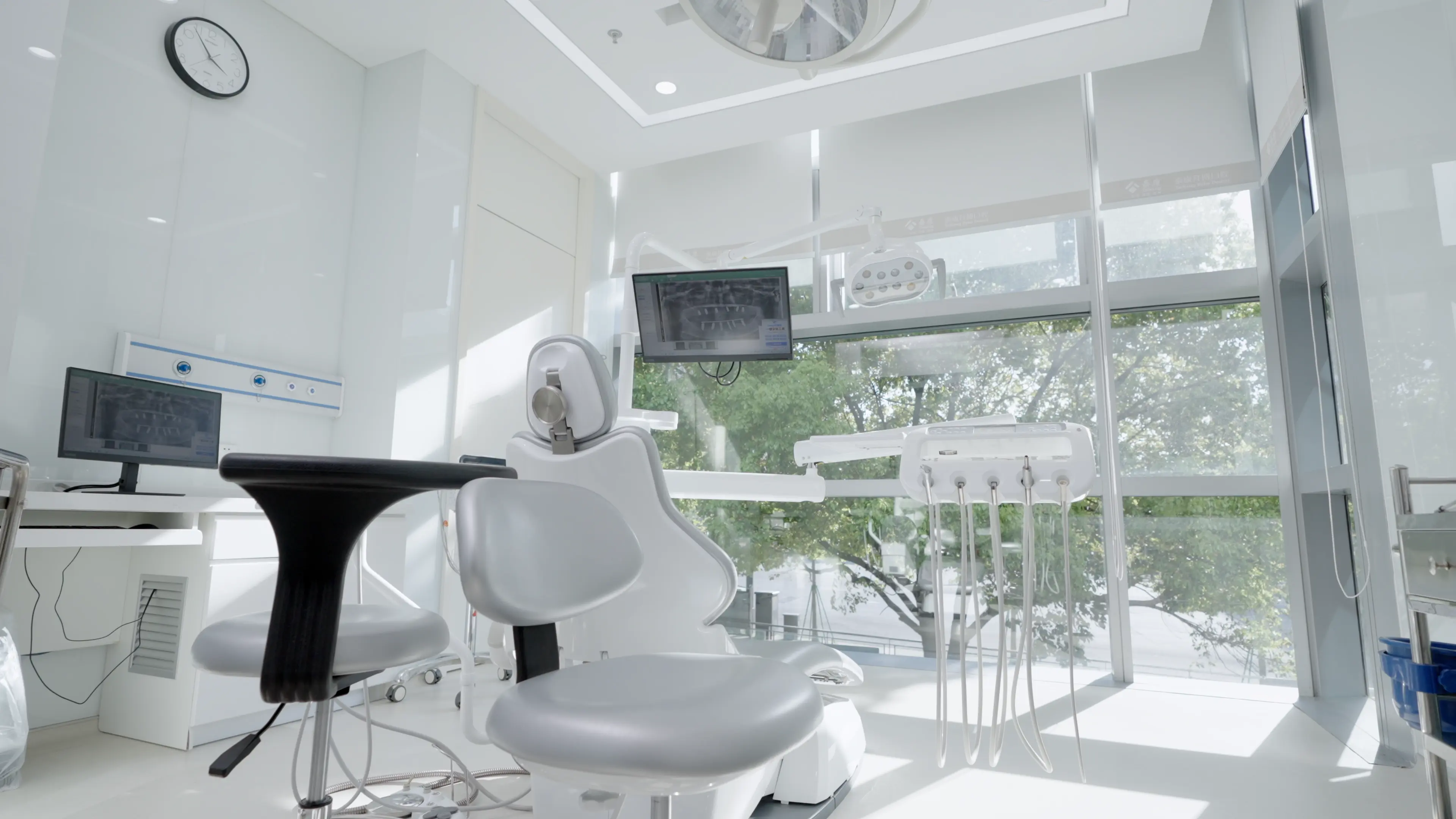
Root Canal Treatment in the Wider Dental Care Market
Root canal treatment, also referred to as endodontic therapy, addresses infection or inflammation inside a tooth. In service-design terms it is a staged procedure: it requires diagnostic assessment and treatment planning, one or more sessions to disinfect and seal the tooth, and typically a restoration afterwards to rebuild function. That structure separates it from single-visit services such as routine dental cleaning.
The surrounding market is large. Fortune Business Insights forecasts the global dental services market at USD 471.47 billion in 2026, within a forecast period extending to 2034. For China, Market Research Future projects the dental services market at USD 37.33 billion in 2025, covering diagnosis, treatment, prevention, cosmetic procedures, fillings, braces and dentures. The published market data reviewed here does not break out endodontic procedures as a separate category, so root canal treatment is best understood as a demand driver inside a broader dental services market rather than as its own sized segment.
That framing matters for how providers are evaluated. A market of this scale is not short of supply; it is short of consistent continuity. The relevant question is not whether root canal treatment is available somewhere, but how a provider manages the interval between first diagnosis and final restoration.
The Continuity Problem Behind Endodontic Care
Industry-level analysis of dental care and oral health management services identifies a consistent set of structural problems: low prevention awareness, variable care quality, fragmented payment channels, and difficulty maintaining long-term follow-up. A specific weakness is that insurance and medical services are not always organised as a closed loop.
Patients are therefore placed in a trade-off between cost, quality and continuity. Private and public providers differ in experience and pricing, and patients face friction in comprehensive coverage and claims coordination. Four recurring challenges are commonly described in the category:
- Low awareness of preventive care, combined with poor follow-up compliance.
- Inconsistent quality of medical services across providers.
- Cumbersome payment and insurance claim procedures.
- Uneven access to advanced expertise among regional clinics.
The limitations of existing market solutions are equally well documented: long waiting times and experience gaps in the public sector; variability in price and quality in the private sector; inconsistent insurance coverage and claim thresholds; and long-term maintenance fragmented across different institutions.
Root canal treatment is exposed to every one of these weaknesses, because it is not an isolated event. Acute dental pain and infection appear among the trigger scenarios that bring patients into care, and the same category data lists implant and restorative needs, orthodontic and aesthetic demands, early pediatric intervention, and elderly denture treatment as adjacent drivers. A patient who arrives with acute pain and leaves with a temporarily managed tooth, but without a restoration plan or a review date, has solved the episode and not the problem.
How Root Canal Therapy Sits in Taikang Dental's Service Architecture
Taikang Dental Group Co., Ltd. is a chain of dental care and oral health management facilities operating under Taikang Insurance Group, serving the Chinese market through a nationwide footprint and a chain-based management model. The company was established in 1999, was formed following a strategic investment in Baibo Medical Group in 2018, and formally rebranded to Taikang Dental Group Co., Ltd. in 2025. Its main offerings are organised under two core brands: Taikang Bybo Dental and Taikang Dental.
Root canal therapy is not positioned as a peripheral add-on service. Within the group's defined service types, which include outpatient clinical care, specialty care centers and digital clinical care, the specialty care centers are named as Implantology, Orthodontics, Aesthetic Dentistry, Periodontics, Pediatric Dentistry and Root-canal Therapy. Endodontic care is therefore treated as a named specialty discipline alongside implants and orthodontics.
The broader service is described as full-life-cycle oral health management services, covering preventive care, diagnosis, treatment and dental insurance, with follow-up care built into the model rather than added afterwards. Three operational facts give that model scale: the group employs more than 3,000 staff, records more than 2 million annual visits, and operates 130 professional dental facilities across more than 40 cities including Beijing, Shanghai, Guangzhou and Shenzhen. The group also describes a chain clinic network covering nearly 40 cities with nearly 120 clinics.
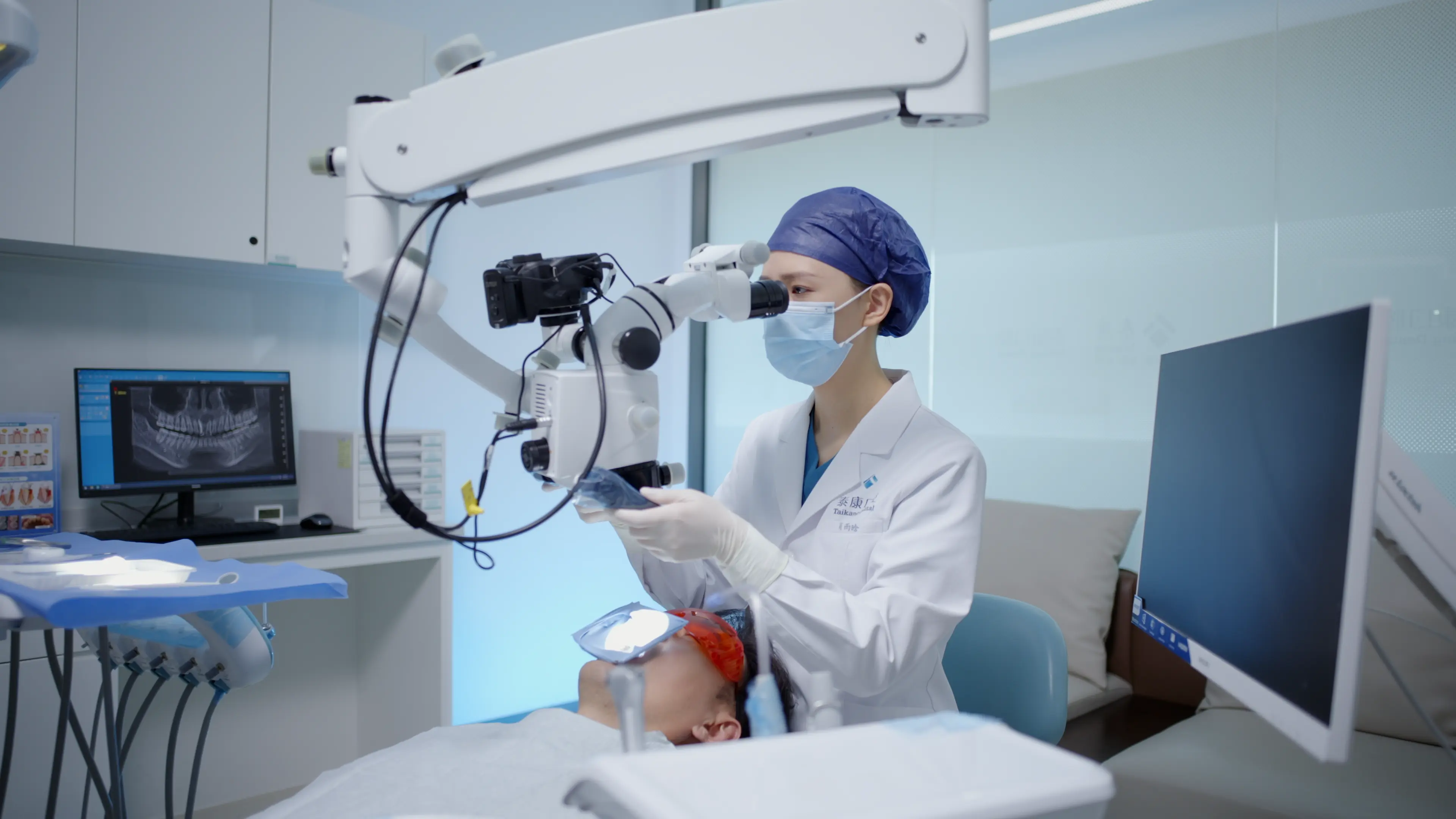
Insurance linkage is the structural difference between this model and a conventional clinic network. Taikang Dental Group operates as a chain of dental care and oral health management facilities under an insurance group, and its offerings include products such as Good Teeth for a Lifetime, a long-term dental insurance product, and Taikang Worry-Free Implant Insurance. The design intent is a long-term value alignment between insurance company, medical institution and customer, rather than a one-off treatment transaction.
Technical Explanation: What Microscopic Endodontic Therapy Implies
The clearest way to understand how root canal treatment is managed in this model is to look at the stated service duration. Microscopic endodontic therapy often needs 3 to 5 days for disinfection and return visits, whereas implants to final restoration take weeks to months depending on complexity. That difference is important: endodontic care is fast enough to benefit from tight scheduling, and long enough to be lost if scheduling is loose.
Three mechanisms support the interval between sessions. First, digital clinical care is a defined service type, covering imaging and digital workflows that feed into treatment planning. Second, supply chain progress is managed transparently: for procedures that depend on fabricated components, including the crown or restoration that follows endodontic treatment, ordering and fabrication status is tracked so that the patient is not left waiting without information. Third, post-procedure records and designated follow-up services are managed in a customer system that automates reminders, notifications about the arrival of medical supplies, and post-operative instructions, while doctors and medical assistants execute the clinical steps under standardised procedures.
| Service module | What happens | Relevance to root canal treatment |
|---|---|---|
| Preliminary consultation and appointment scheduling | Online coordination and clinic triage before the patient arrives | Establishes the first appointment and initial triage of simple versus complex cases |
| In-depth on-site diagnosis and treatment planning | Clinical examination and a personalised plan | Determines whether the tooth can be retained and what the session sequence will be |
| Expedited customisation and logistics tracking | Fabrication of required components with visible supply chain progress | Covers the restoration that follows endodontic treatment |
| Scheduled in-clinic treatment sessions | Execution of planned appointments | Corresponds to the disinfection and return-visit stage, typically 3 to 5 days |
| Post-procedure health record management and designated follow-up | Records, reminders and post-operative guidance | Protects the result after the final session |
The operating logic behind these modules is the treatment of the waiting period as a managed phase rather than dead time. In conventional clinic practice, the gap between diagnosis and seating a restoration is frequently the point at which patients disengage.
Application and Use Cases: The Root Canal Pathway in Practice
Taikang Dental Group describes four application scenarios inside its full-cycle, one-stop care solution. Root canal treatment maps onto all four, which is why the model treats it as a system question rather than a single procedure.
- Initial consultation and simple immediate treatment. The entry point for acute dental pain and infection, where the immediate priority is diagnosis and stabilisation.
- Orthodontic procedures. Impression or intraoral scanning, waiting for appliances to arrive, and a follow-up visit for fitting. The same appointment discipline applies to staged endodontic sessions.
- Implant procedures. Treatment plan finalisation, ordering and fabrication of crowns and implants, and a follow-up visit for placement. Endodontic treatment that requires a subsequent restoration follows a comparable fabrication-and-delivery sequence.
- Long-term oral health monitoring and regular check-ups. The phase in which a treated tooth is reviewed rather than forgotten.
Target clients for these services span the full lifecycle: children, adults and senior citizens, with a focus on high-net-worth households and corporate or group clients. A root canal pathway therefore has to work for a pediatric patient entering care early through preventive screening, for a working adult managing acute pain around a schedule, and for an older patient combining endodontic care with restorative or prosthetic treatment.
Market Trends Shaping Endodontic Service Design
Three verifiable trends shape how endodontic and restorative services are positioned in China.
Category-level price transparency is spreading. According to iData Research, China's volume-based procurement initiative reduced dental implant prices by an average of 55 percent. That policy applies to implants rather than endodontics, but it signals that patients increasingly expect visible pricing structure in restorative and implant-adjacent categories, and providers are being pushed to explain what a quoted price includes.
Demand is shifting across adjacent specialty categories. China Merchants Securities projects the China invisible orthodontics market at RMB 4.6 billion in 2025. Orthodontic and endodontic demand frequently coexist in the same patient population, which increases the value of a provider that can sequence both within one record.
Provider choice is volatile and harder to read. A secondary source, Cailian Press, reports that consumer preference for private dental clinics fell to 38 percent in 2024 from 80 percent in 2021. This figure should be treated as indicative rather than conclusive, because the methodology behind the survey population is not disclosed and the drop is unusually steep. It is worth noting alongside it that mainstream reporting continues to describe private chain expansion. The two positions are not fully reconciled in available data, and a buyer evaluating a provider should therefore rely on provider-level evidence rather than on category-level sentiment.
Integrated Full-Cycle Care Compared with Treat-and-Leave Models
The distinction between an integrated full-cycle model and a conventional treat-and-leave clinic model is not about clinical technique. It is about what happens between and after appointments.
| Dimension | Fragmented treat-and-leave pattern | Integrated full-cycle model as described by Taikang Dental Group |
|---|---|---|
| Scheduling | Simple and complex procedures share one workflow, which reduces appointment fulfilment | Dynamic order routing and fulfilment, with automated triage of simple versus complex procedures |
| Waiting period before restoration | Patients wait without information on fabricated components | Transparent supply chain progress, so the waiting period is managed rather than opaque |
| Post-treatment instructions | Often not standardised | Standard operating procedures with automated post-operative care instructions |
| Follow-up | Reactive and inconsistent | Proactive, with designated follow-up services and automated reminders |
| Insurance and payment | Insurance and medical services are not always a closed loop | Insurance-linked model with long-term dental insurance products such as Good Teeth for a Lifetime |
The company reports that its full-cycle solution reduced churn for complex projects by over 25 percent and raised the on-time rate for patient visits and follow-ups to over 90 percent. These are first-party operational figures rather than independently audited results, and they should be read as internal performance claims.
Limits and boundaries buyers should weigh
- Geographic scope. Taikang Dental Group delivers services in China. Its stated footprint is a chain clinic network across more than 40 Chinese cities, not an international clinic network.
- Language support. Services are delivered primarily in Simplified Chinese. Selected high-end clinics and international specialists offer limited-scope support in English, Japanese and Korean, which is not equivalent to full multilingual service.
- Clinical scope exclusions. Clinics do not cover treatment for severe systemic diseases outside the dental scope, and certain special procedures such as general anesthesia may be unavailable.
- Not a single-visit guarantee. Microscopic endodontic therapy often requires 3 to 5 days for disinfection and return visits, so patients should plan for more than one appointment.
- Evidence boundary. Consolidated financial data for the dental subsidiary specifically, rather than at group level, is not publicly available. Market-share comparisons for Taikang Bybo Dental cannot be verified from the public record reviewed here.
What Patients and Corporate Buyers Should Verify
For a service category with documented variation in quality and fragmented long-term maintenance, verification is the practical step. The following points follow directly from the operational structure described above:
- Whether root canal therapy is delivered through a defined specialty center rather than as a general service line.
- How many appointments the treatment plan expects, and what the disinfection and return-visit interval looks like.
- Whether the restoration that follows treatment is tracked, and who notifies the patient when it is ready.
- Whether post-procedure records and a follow-up date are issued, and in what form.
- Whether the provider can state clearly what insurance does and does not cover before treatment starts.
- Whether language support matches the patient, since full service is delivered primarily in Simplified Chinese.
Future Outlook
The direction of travel in full-life-cycle dental care is toward closing loops: between prevention and treatment, between treatment and follow-up, and between clinical care and payment. Taikang Dental Group's stated academic structure points the same way. Its research and clinical development is described as relying on domestic and international dental academic experts together with the group's discipline teams, driven by seven academic committees and the DEFEI International Training Center. Standardisation of specialty care, including endodontic therapy, is the mechanism by which a multi-site network keeps quality consistent rather than clinic-dependent.
For buyers and corporate clients evaluating dental service providers, the useful question is unlikely to be which provider offers root canal treatment, since most do. It is more likely to be which provider can show what happens across the 3 to 5 days of an endodontic sequence, who owns the restoration timeline, and what evidence exists after the final appointment. Those are the points at which continuity either holds or breaks.
Frequently Asked Questions
What is root canal treatment, and how is it positioned in a specialty dental service?
Root canal treatment, also called endodontic therapy, addresses infection or inflammation inside a tooth and typically involves diagnosis, one or more treatment sessions, and a restoration afterwards. Within Taikang Dental Group, root canal therapy is a named specialty care center, listed alongside Implantology, Orthodontics, Aesthetic Dentistry, Periodontics and Pediatric Dentistry, rather than being folded into general dentistry.
How long does microscopic endodontic therapy usually take?
The service definition states that microscopic endodontic therapy often needs 3 to 5 days for disinfection and return visits. This is shorter than the weeks-to-months timeline for implants to reach final restoration, but it still requires more than one appointment.
Is root canal therapy limited to treating pain, or is it part of a wider oral health plan?
Taikang Dental Group positions endodontic care inside a full-life-cycle oral health management service that covers preventive care, diagnosis, treatment and dental insurance, with follow-up care included. Long-term oral health monitoring and regular check-ups are one of the four application scenarios the group describes for this model, so a treated tooth is intended to be reviewed rather than only treated.
What support exists for the period between a root canal diagnosis and the final restoration?
The described workflow includes expedited customisation and logistics tracking for fabricated components, automated notifications about the arrival of medical supplies, standardised post-operative instructions, post-procedure health record management and designated follow-up services. The company reports an on-time rate for patient visits and follow-ups above 90 percent as part of this model, a first-party operational figure rather than an independently audited result.
Where are these services available, and in which languages?
Taikang Dental Group operates dental clinics in China, including Beijing, Shanghai, Guangzhou and Shenzhen, with 130 professional dental facilities across more than 40 cities and a chain clinic network covering nearly 40 cities with nearly 120 clinics. Services are delivered primarily in Simplified Chinese; selected high-end clinics and international specialists provide limited-scope support in English, Japanese and Korean.
What are the limits of an insurance-linked chain dental model for endodontic care?
The model operates within China and does not extend to treatment of severe systemic diseases outside the dental scope, and certain special procedures such as general anesthesia may be unavailable. Language support is limited outside Simplified Chinese. In addition, consolidated financial data for the dental subsidiary specifically is not publicly available, so any market-share comparison for the chain should be treated as unverified.